By: Dr. Adam Ozimek
As employers increasingly say they will let many workers stay remote, and as many employees continue to insist that they do, the debate around remote work has evolved. It is no longer a discussion of whether significant levels of remote work will be with us permanently, but what the impacts will be. While short-run considerations focus on how practical considerations like how office policy will change and where people will move, a bigger long-run consideration must be made: what will happen to U.S. workers competing in a global remote labor market?
In this paper, I use data from Upwork, the world’s largest global remote labor market, to shed light on how things already look, and how they will look, for U.S. workers. The results are as follows:
- Overall, U.S. workers earn a pay premium in global labor markets
- The premium varies by work type, and whether on average U.S. worker’s particular skills and traits are important for production.
- Marketing, sales activities, and other customer facing activities in general are where U.S. workers earn the highest premium.
- Similar trends are visible when we focus on global businesses, suggesting it is not mere home country bias.
- Similar trends are visible when we look at probability of being hired, suggesting it is not merely selection bias.
- U.S. workers and global workers can be compliments, not just substitutes, as remote work creates the potential for collaboration.
- Overall, global remote labor markets certainly create more competition for U.S. workers but also more opportunity.
The U.S. Worker Pay Premium
Data from Upwork provides the ideal environment to test how U.S. workers fare in a global remote labor market. The marketplace has existed for over twenty years now, and is the largest remote labor market, bringing together clients and freelancers from all over the world. Finally, the granularity of the data is unmatched. Not only do we know the location of the client and the freelancer, but we know how much they bid on the job, who else bid on the job, how much they earned and how many hours they worked, detailed description of the type of work, and also detailed and trusted reviews of all of their past experience.
We begin by asking whether U.S. workers earn a wage premium. To do this, we estimate regressions on millions of hourly priced contracts from 2020 through 2021. We look at the effects of being a U.S. freelancer on the log of hourly wage. We find consistent evidence across a variety of models that U.S. workers earn a significant wage premium. Every model controls for whether the freelancer has experience, whether they are top rated or top rated plus, and which of the 184 categories of work that the contract falls in. In the most basic model (Model 1), we find that U.S. workers earn 80% more than the average worker.
While this number suggests a significant U.S. worker premium, it is useful to know whether U.S. workers are doing higher paying jobs, or being hired by hiring paying clients. To that end, we can include client level fixed effects and limit the analysis to clients who hire multiple workers. What this tells us is that U.S. workers earn 82% more than non-U.S. workers who are working for the same clients (Model 2).
One possible explanation for U.S. workers earning a premium is that most clients on Upwork are in the U.S., and they simply prefer workers from the same country. In other words, it is not a U.S. worker premium, but an own-country premium that all clients have, regardless of location. We can use two more models to test this theory. First, we can see that Canadian workers also earn a significant premium on the platform, albeit somewhat less than U.S. workers (Model 3). In addition, we find that non-U.S. and non-Canadian clients also pay a premium for U.S. workers (Model 4).
Together these results suggest that it is not just own-country bias that creates the U.S. worker premium, as Canadian workers earn a premium as well, and both U.S. and Canadian workers earn a premium while working for clients outside North America as well.
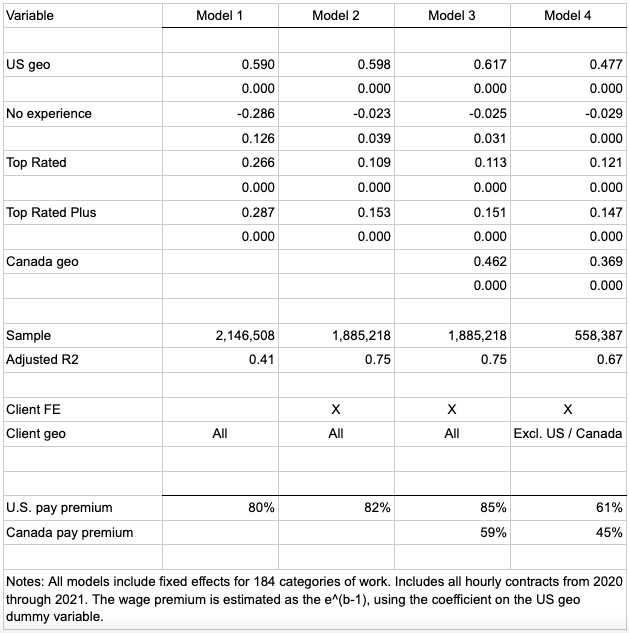
Notes: All models include fixed effects for 184 categories of work. Includes all hourly contracts from 2020 through 2021. The wage premium is estimated as the e^(b-1), using the coefficient on the US geo dummy variable.
Where the advantage lies
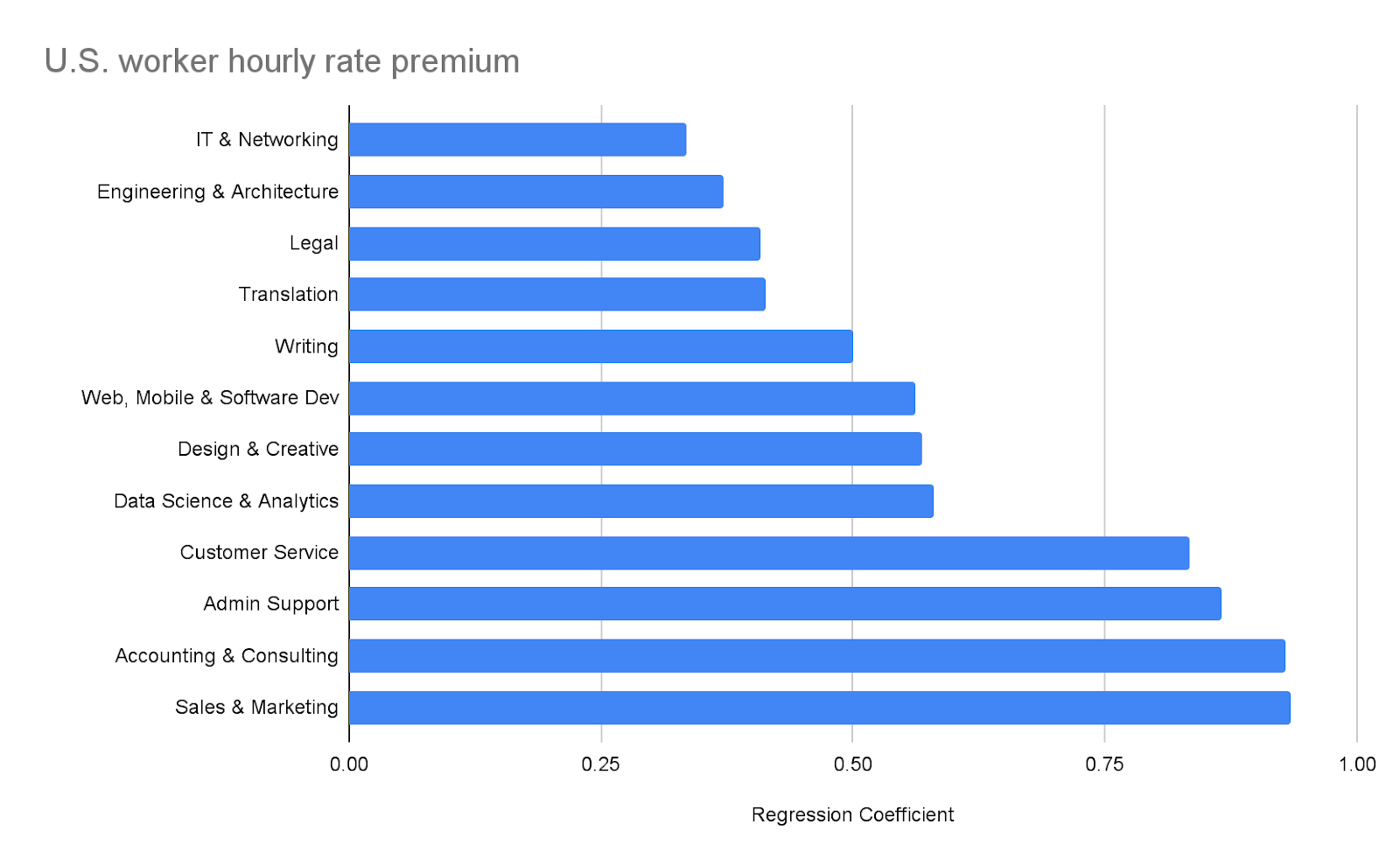
Additional regression models can also help shed light on what kinds of tasks U.S. workers have the biggest competitive advantages. The largest pay premium is found in sales and marketing. The smallest premium is found in IT & networking, and engineering & architecture. In general, the results seem to suggest more technical and less soft-skill focused job categories have a smaller premium.
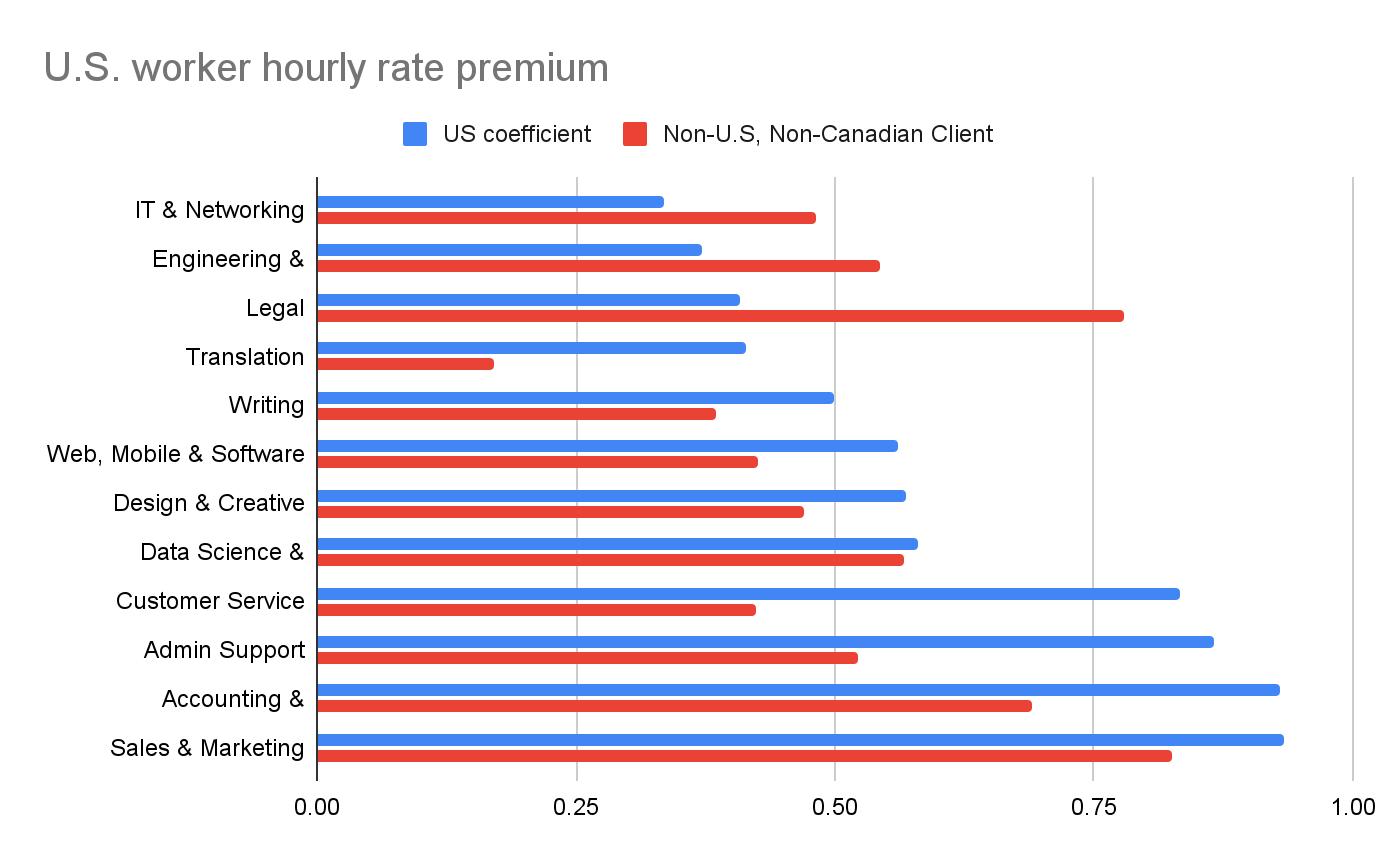
Additional regression results show that U.S. worker pay premiums are fairly consistent in most categories of work for both U.S. and non U.S/non-Canadian clients. Both types of clients place a high value on U.S workers for sales and marketing, and the lowest on translation, engineering, and IT & Networking.
One notable exception is legal, which may owe to foreign firms navigating U.S. legal systems having less access to U.S. legal assistance in their own countries.
Who gets hired
One possible limitation of the hourly pay analysis is that U.S. workers may simply demand high pay, but that they aren’t any more valuable to clients. If this was the case, then U.S. workers would be hired less often. Upwork data provides unique granularity to test this theory. We have data not only on who won a contract, but everyone who bid. As a result, we can estimate similar models as above but examine the probability that a U.S. worker will be hired for a particular job. Regression analysis allows us to control for freelancer experience, job success score, whether they are top rated or top rated plus, and also the hourly rate bid. The results show that when comparing otherwise similar workers, U.S. workers are overall more likely to be hired.
For U.S. clients, U.S. freelancers are 51% more likely to be hired. For non-U.S clients, U.S. freelancers are just slightly more likely to be hired than an otherwise similar worker. These results show that the higher pay that U.S. workers earn is not a result of simply demanding higher rates that make them less likely to be hired. In general, they are more likely to be hired.
Why U.S. worker skills are valuable
That clients in other countries are willing to pay a significant premium to hire U.S. workers in some categories of work. In particular, in marketing and sales, the U.S. workers appear to have a competitive advantage. While this may appear counterintuitive, it is worth reflecting on the value of the U.S. consumer market. The U.S. economy is one of the two largest in the world by overall size, and is home to some of the highest income consumers in the world. We are also a major importer, buying over $3 trillion of goods and services from businesses all over the world. This makes the ability to market and sell to U.S. consumers a globally valuable skill.
However, U.S. workers earn a premium across almost every category. While a global labor market may create the impression that there will be complete convergence in pay for those participating, it is worth remembering that the U.S. economy is among the highest income in the world. One cannot address the question of what will happen to U.S. worker wages in a global remote economy without first answering: why are U.S. worker wages high in the first place? That income reflects high productivity, much of which is embedded in skilled knowledge workers' human capital.
Trade flows
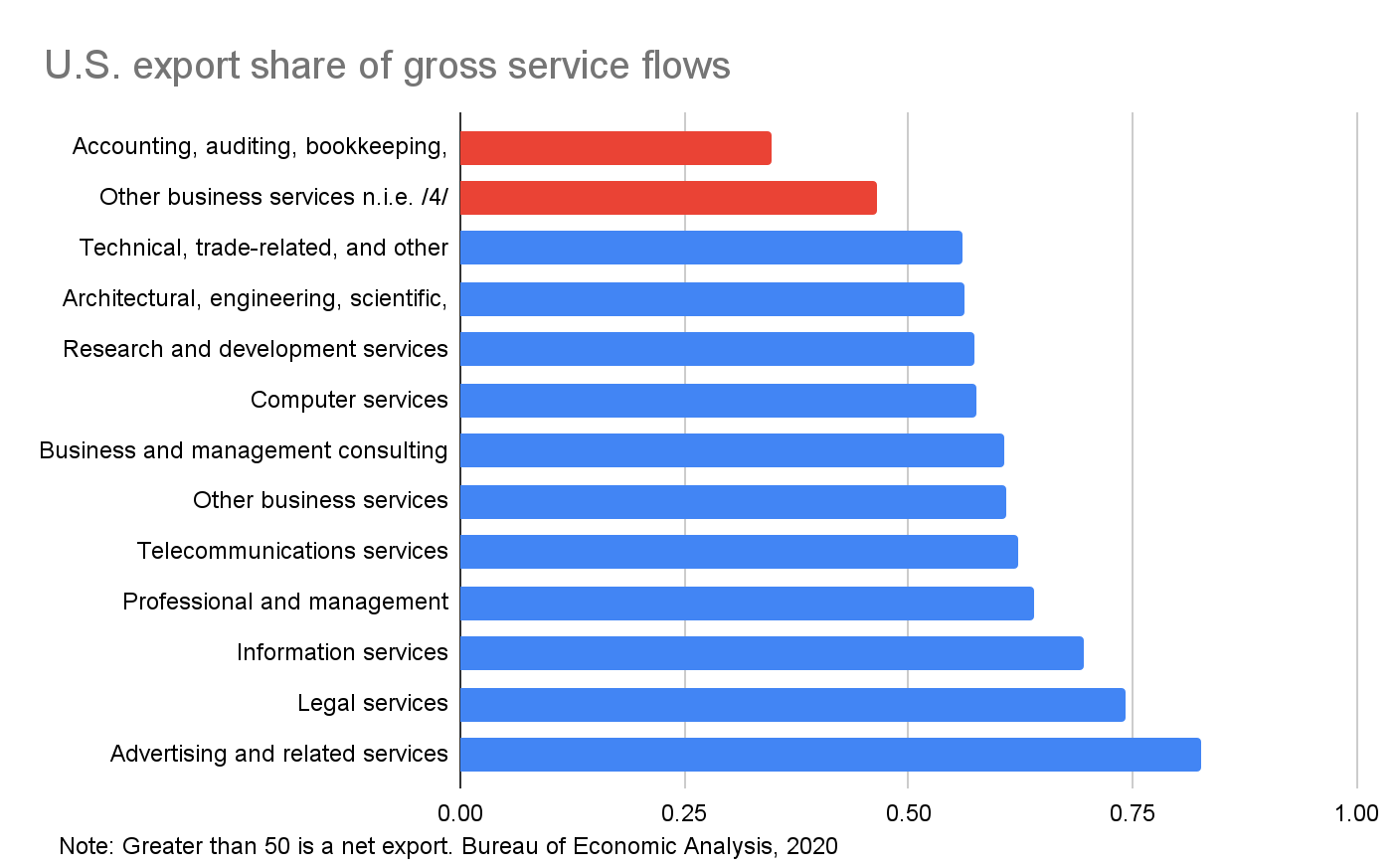
While U.S. workers earn a premium in general, it is entirely possible that on the net the U.S. will import more service than it exports. There are two countervailing data points here. On the one hand, the US imports more services than it exports on Upwork. However, this is likely due to the platform originating in the U.S. and expanding to global clients gradually over time. On the other hand, Bureau of Economic analysis data on overall U.S. trade flows suggest that the U.S. is a net services exporter. In 2020, around 60% of gross service flows were exports, meaning that exports of services exceeded imports of services.
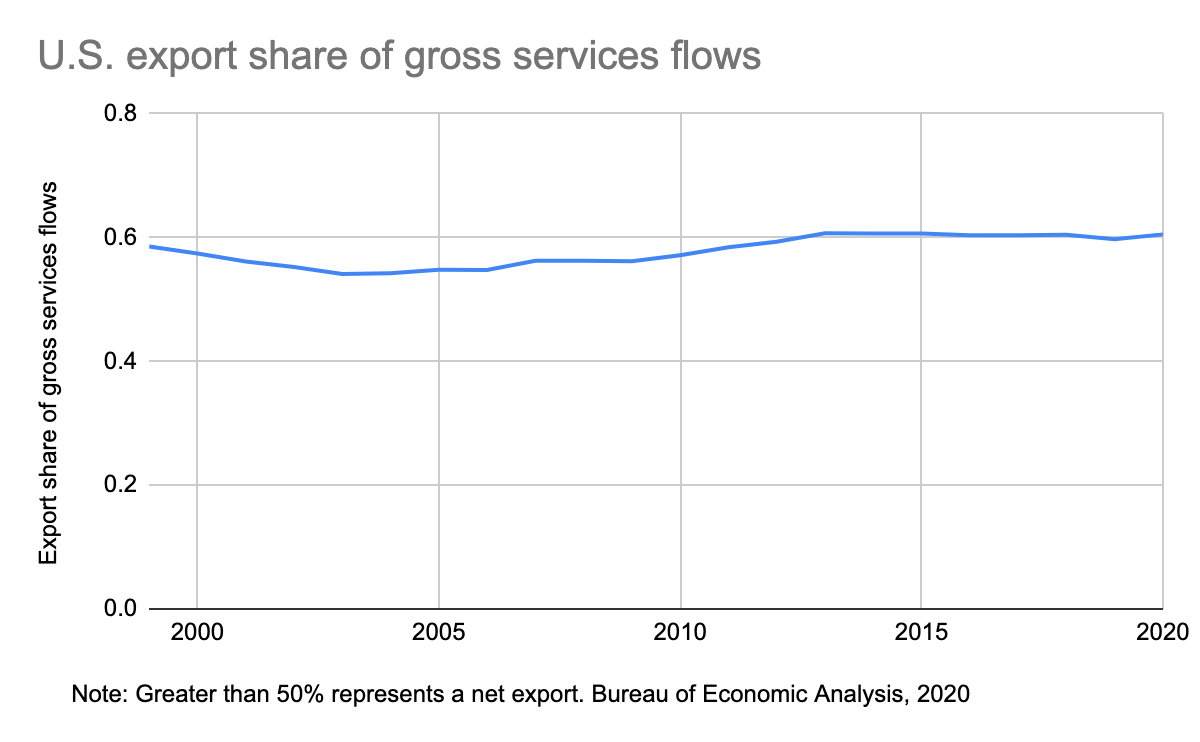
Furthermore, a detailed look at BEA data on industries that broadly correspond to professional services, only in two categories is the U.S. a net importer. Consistent with the Upwork analysis, exports are most significant in advertising and related services. Again, there is a strong suggestion of a U.S. competitive advantage here when it comes to marketing.
Complementarity and collaboration
While U.S. workers earn a premium on Upwork, the benefits of a global remote labor market extend far wider and deeper than this. It’s true that some workers will face heightened competition, especially in areas where language skills and knowledge of U.S. customers are less important, but there are still gains to be had in how workers can complement each other rather than substitute. For example, a U.S. worker who is a web developer may find that she faces more competition from global web developers, however this may create opportunities to manage global teams of web developers. We find strong evidence of complementarity here, with 87% of agencies headed by U.S. freelancers hiring global freelancers. The zero sum view of global digital labor markets is too pessimistic. Global competition also means global cooperation and collaboration. Upwork’s new Teams feature expands capabilities for global collaboration even further.
Conclusion
There is a lot of uncertainty about how the global remote labor market will evolve, however a few facts seem important to remember in considering how U.S. workers will fare. First, in the existing remote global labor market of Upwork, U.S. workers earn a wage premium and are more likely to be hired, even for non-U.S clients. Second, BEA data shows that the U.S. to-date is a net exporter of professional services. Finally, and more broadly, the U.S. is one of the richest countries in the world, if U.S. workers do not have a competitive advantage in skilled services, what is their competitive advantage?


.svg)