By Adam Oziemk
To view the PDF click here and to download a copy click here
EXECUTIVE SUMMARY
Remote work is undoubtedly on the rise, especially as companies adapt to the changing times of COVID-19, but what impact will this have on the broader economy? In this analysis, we examine the potential for remote work to reshape the geography of opportunity in the U.S. Using a variety of data sources, we provide evidence that remote work is already helping to send economic activity from the top 15 most expensive parts of the country to less expensive parts. When this happens, we show that it can be mutually beneficial: higher earnings for independent professionals and lower cost for businesses than in their local labor markets. In addition, both sides will likely benefit from a variety of under-discussed benefits beyond pay.
Key Findings:
- The wage and opportunity gap is large: On average, wages in the top 15 most expensive metros for skilled occupations were $40.54 per hour, compared to $28.36 for the average place, a premium of over 40% for the exact same occupation.
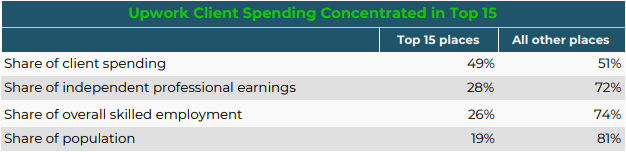
- Remote work is already spreading economic opportunity across the country: Despite having only 19% of the U.S. population, businesses are highly concentrated in the top 15 most expensive places. However, with remote work, 49% of business spend is going from the top 15 most expensive places to lower cost places.
- Independent professionals can make more working remotely: Upwork project data shows when businesses in the top 15 most expensive places engage independent professionals remotely, they will earn, on average, 18.6% more than average wages in the same occupational categories in their local market, and 8-11% more than Upwork clients in their local labor market pay.
- Professionals looking to relocate can benefit in more affordable metros: Despite having higher pay in the top 15 most expensive places, the extremely high cost of living means that a high percent of earnings are eroded by housing costs. The price to income ratio in those top 15 metros is, on average, more than double the rest of the country, to an average of 680% and as high as 1,260%.
- Businesses engaging remote professionals will see benefits that extend well beyond cost savings: While hiring outside of the top 15 most expensive places can help lower costs, it can also provide access to a larger talent pool, and even improvements to productivity.
Introduction
With half of the labor force working remote during the COVID-19 pandemic, it’s evident that the gradual transition to greater remote work is about to accelerate. As major tech companies are announcing a switch to remote-first policies, research shows that hiring managers across the board have doubled their remote plans over the next few years. This trend will have significant economic implications for the wider economy, specifically on the potential to create mutually-beneficial opportunities across the U.S.
The potential for spreading opportunity is a welcome trend, given that over the last half a century the geography of opportunity in the U.S. has become increasingly unequal. Compared to the 1960s, the spread of wages between cities has doubled, meaning two people doing the exact same job in different parts of the country will earn significantly different pay. A major contributing factor to this wage disparity is in the high cost of living in some of the country’s top metros. The politics of NIMBYism and forces of agglomeration have made this a difficult problem to solve, however, remote work presents one of the first structural changes in the economy with the potential to help in quite some time. As the analysis will show, the growth and adoption of remote work could shrink the gap across the U.S. by spreading opportunities and increasing wages to places across the U.S., rather than just concentrating in the top metros.
The analysis will first consider how different the most expensive parts of the country are from the rest. Then it will examine how remote work can benefit professionals currently outside the most expensive places, professionals looking to relocate outside these places, and businesses located in these places.
How The Top 15 Most Expensive Metros Differ From the Rest
An important measure of the economic potential for remote work is the magnitude of the wage gap across the country for the same jobs. When distance becomes irrelevant, the wider the wage gaps are today, the more that can be potentially gained from remote work. In order to quantify the size of the gap, we looked at comparable wages for a sample of skilled service professions that can be done remotely. Specifically, we analyzed data on twelve occupational categories that are both already done on Upwork and can be matched to BLS data on local pay. The twelve occupational categories include: accounting, human resources, management consulting, personal/virtual assistant, customer service, technical support, graphics & design, law, network & systems administration, marketing (market research analysts and marketing specialists), web, mobile, and software development, and engineering.
Using BLS data on the average hourly earnings for those 12 occupational categories, we ranked over 500 geographies to find the metros with the highest average earnings. We then looked at the housing prices and annual income to see how the top 15 metros compare to the rest of the U.S. What we found is that, overall, these top 15 metros are dramatically different from the rest of the country in a variety of ways. On average, hourly earnings in the top 15 for these occupational categories were $40.54 per hour, compared to $28.36 for the average place, a premium of over 40% for the exact same occupation. Additionally, the gap in the cost of living is even higher, as median house values in the top 15 were over half a million dollars, nearly three times that of the average place.
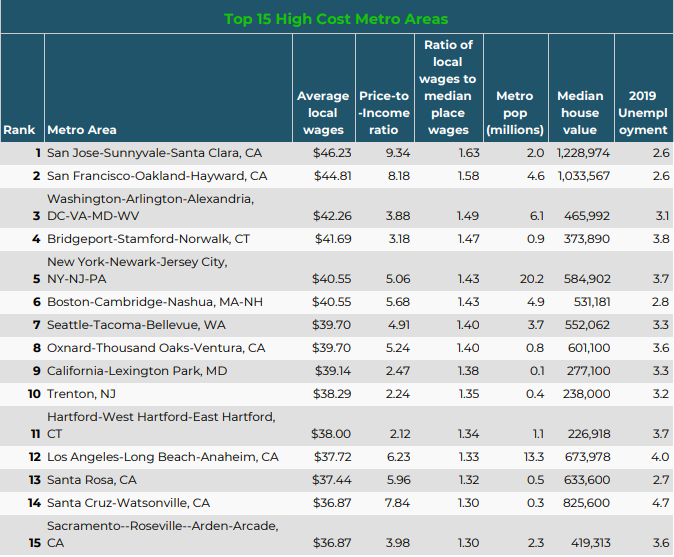
This stark difference between the top 15 metros and the rest of the U.S. shows the potential that remote work could have for professionals in other cities across the U.S., professionals looking to relocate, and businesses looking to hire.
Professionals Outside the Most Expensive Places
As many companies have announced plans to stay remote even after COVID-19, many have asked what happens to earnings. Does the pay match the labor market of the company’s location or the worker’s location?
To help answer this question and analyze some of the benefits that remote work could have for professionals living outside of the top 15 metros, we use Upwork platform data on business spending. By using thousands of remote projects between U.S. companies and freelancers, constituting over 100 million in earnings, we can see how remote work performed by independent professionals is already helping to spread opportunity.
The data shows that, on Upwork, clients are disproportionately located in the most expensive places, while the independent professionals they engage with through the platform are located all over the country. When looking at the top 15 most expensive metros, despite containing only 19% of the U.S. population and 26% of the overall workforce in these skilled occupations, they contain half of the business spending on Upwork. In contrast, 72% of independent professionals work outside the top 15. This means half the spending on Upwork is coming from businesses in the most expensive places, and most of this is going to other parts of the country.
Taking a more granular look, projects posted on Upwork can be matched to BLS data on the local average pay for those occupational categories for both the businesses and the freelancers. On average, Upwork clients are in a labor market where wages are 6.2% higher than they are in the freelancer’s labor market. In other words, client spending flows from higher cost places to lower cost places in general.
Altogether, this data shows that through Upwork, remote work is already helping spread opportunities beyond the most expensive places into the rest of the country.
But what happens to earnings when a client in a high cost of living place engages an independent professional in a lower cost of living place? To answer this question, we look at hourly pay negotiated between clients and freelancers for projects posted on Upwork where the client is located in one of the top 15 most expensive places. Focusing on clients in the top 15 allows us to examine projects where cost savings is likely to be a goal, in contrast to projects where the client is seeking skilled talent that is scarce in their labor market and is willing to pay a premium.
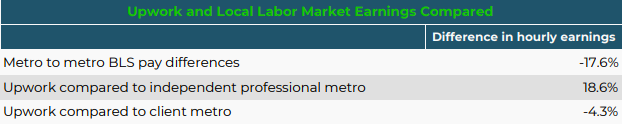
To start, we use BLS data to compare local wages for the labor markets of the businesses to that of independent talent. We find businesses in the top 15 places engaging professionals on Upwork are located in labor markets where wages are 17.6% higher. This illustrates that businesses located in the top 15 are generally spending their money in significantly lower cost places overall.
When looking at the actual project level earnings when businesses hire remote workers, those independent professionals will earn, on average, 18.6% more as compared to average wages in their local market. This means that the remote independent professionals engaged by clients in the most expensive places are earning more than average wages in their market.
However, these comparisons are not perfect. Professionals hired on Upwork are self-employed and not employees, and as such their hourly earnings are not interchangeable with wages. For example, employees may have non-pay benefits included in their compensation, and independent professionals enjoy freedom and flexibility that is valuable as well. For a more apples-to-apples analysis, we can compare freelancers and businesses who are located in the same local labor market. We find that freelancers who contract with businesses in the top 15 earn 8% more per hour the average business on Upwork spends in their own labor market. If we exclude freelancers located in the top 15, this rises to 11%. In other words, Upwork helps independent professionals earn more than local businesses hiring independent professionals pay on average— especially when independent professionals in lower cost places engage with businesses in higher cost places.
We can also go beyond averages and use regression analysis to take a more rigorous look at this question. Specifically, we can control for occupational categories and length of contract and see whether average wages in both client and independent professional labor markets affect earnings. The results show that both have an economically and statistically significant effect. A 1% increase in average occupational category specific pay in the local labor market is associated with a 0.1% increase when it’s the client’s local labor market, and a 0.3% increase when it’s the independent professional’s local labor market. In other words, the pay that remote independent professionals earn is affected by both local labor markets.
In short, independent professionals on Upwork earn 18.6% more than similarly skilled professionals in their local labor markets, and 8% to 11% more than Upwork clients in their local labor markets pay. To put this increase into context, an 18.6% increase to average hourly rate would equate to $11,061 a year. Remote work means access to more opportunities, higher earnings, and the ability to work from where they want.
Professionals Looking to Relocate
Another potential benefit of remote work could be for professionals that are looking to relocate. With companies like Facebook and Twitter announcing the option to go remote, many are asking questions about what that means for wages of existing workers that choose to move away from their company’s current location. While we have no data on earnings for relocating workers, it is important to recognize that even with pay cuts, workers can end up considerably better off thanks to the lower cost of living.
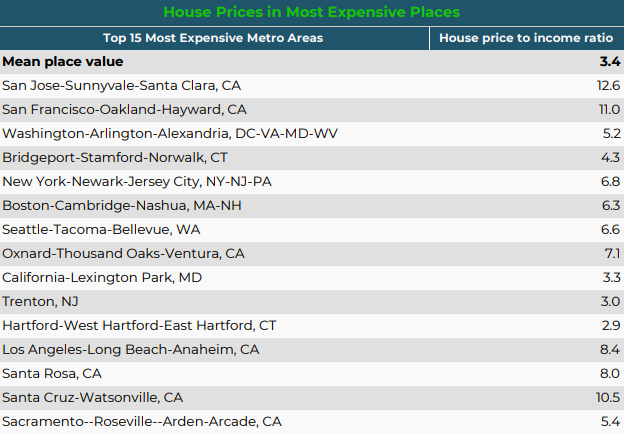
To understand the potential gains, we can compare house price to income ratio for the top 15 to the rest of the country. These ratios reflect how much of ones’ salary goes towards housing costs. The average price to income ratio in the U.S. is 3.4, meaning on average house costs are 340% of the typical salary for the remote-capable occupations in this analysis. The average across the top 15 is double that, at 6.8. In San Francisco, this rises to 11.0, and for San Jose it is an even higher 12.6. This means that house prices in these areas are more than 1,100% the salaries for these occupations.
While some of the differences in pay reflect the value of amenities and quality of life in more expensive cities, these are not valued the same for everyone. For those who are living in these places primarily for access to a job, the high cost of living is more like a tax on work than the price of a preferred lifestyle.
Businesses Looking to Hire
Businesses who are looking to hire or are considering a more remote workforce will also see the benefits of hiring outside of the top 15 metros. By analyzing local labor market supplies, recent survey data, and Upwork platform data it is clear that remote work can provide businesses with access to highly-skilled professionals and help increase economic efficiency.
Access to talent
The first major benefit that remote work will have for businesses is in the ability to provide them with access to a larger, equally-qualified talent pool than their local markets. Although COVID-19 has impacted the labor market across the country, to understand the potential long-term benefits for access to talent we looked at how labor markets in the highest cost metros differed in the relatively healthy labor market of 2019.
Prior to the pandemic, not only were workers more expensive to hire in these metro areas, they were also more difficult to find due to the significantly tighter labor market. The overall unemployment rate in the top 15 during 2019 was 0.6 percentage points below that of the average place. Looking at wider measures of labor market slack, the differences are even more stark: in 2018, the share of people aged 25 to 64 who are employed is 5.1 percentage points higher in the highest cost places. For comparison, during the Great Recession this rate for the U.S. economy overall fell by around 5 percentage points.
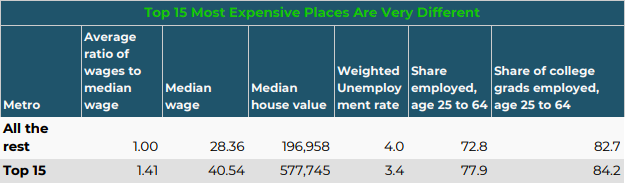
Even for skilled workers there is a big gap between the top 15 places and the rest of the country. In 2018, the employment rate for college grads aged 25 to 64 was a substantial 1.5 percentage points above average in the highest cost places. Businesses looking outside of the top 15 highest cost labor markets will find it easier to hire skilled workers.
The way remote work can affect access to talent goes far beyond tightness of the labor market, however. Consider that one of the most commonly cited economic benefits of large, expensive cities is the ability to have better “matches” between firms and workers thanks to a greater number of both. For example, this means the most productive firms can be matched to the most productive workers. While this is usually thought of as a benefit of cities, it is also an upside of remote work. By expanding the scope of who the most productive firms can hire, and allowing them to reach beyond their local labor markets, remote work and Upwork specifically create the opportunity to improve overall match quality and boost productivity.
In a sense, remote work will allow the creation of a massive online labor market that is subject to many of the same forces of agglomeration that cities experience. For comparison, the San Francisco-Oakland-Hayward, CA metro area has a labor force of just under 2.6 million in 2019. A remote labor market that constituted just 2% of the labor force would be larger than this high agglomeration metro area. In fact a remote labor market that was just over 6% of the labor force would be bigger than any city in the country.
Cost Benefits
The potential savings to a business from going remote can be captured by the differences in labor costs for the same occupations across the U.S. As the preceding analysis showed, thanks to high costs of living in some parts of the country, these differences can be significant. For some occupations, the potential savings are even larger. BLS data shows that for graphics and design, as well as, marketing and law, wages in the most expensive places are at least 50% higher than they are everywhere else.
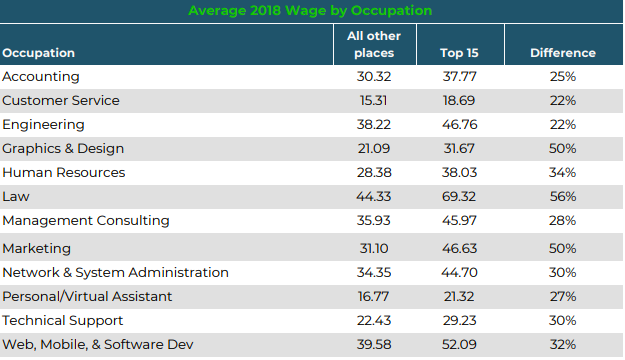
We can also examine the average benefits for firms engaging with remote professionals today by comparing hourly earnings from projects posted on Upwork by clients in the top 15 most expensive places to BLS data on average earnings. We found that while earnings by independent professionals on Upwork are higher than hourly earnings in the freelancer’s local labor market, they are also 4.3% lower than the business’ local labor market. This means that it is cost advantageous for both the business and the professional.
Productivity Gains
Lastly, productivity growth is another benefit that businesses will likely experience as they embrace more remote work. This is important because if differences in pay between high and low cost places just reflect differences in productivity, then this would suggest that gains from remote work are more limited than they first appear. However, there are good reasons to think this is not the case. In fact, there are many ways in which remote work can contribute to productivity growth.
First it is worth recalling that this analysis is focused on differences in wages for relatively narrow and skilled occupation groups. Differences in education, skills, and overall productivity will create less variation in the wages of engineers than they do for the wages of workers overall.
In addition, while productivity is clearly a factor in wage differences across places, the enormous cost of housing in the highest cost metro markets play a significant role as well. A recently released analysis shows that many of the top 15 most expensive places - including San Jose, San Francisco, New York City, Washington, DC, and Seattle - are also among the most highly regulated housing markets in the country. These laws artificially reduce the supply of new housing, which can lead to skyrocketing prices. As a result, at least some of the high pay workers receive is being absorbed by housing costs, and thus landlords and homeowners grab a growing share of the economic pie. This matters from a macroeconomic perspective as well. What good are the productivity gains in major cities if the value is captured by land owners?
Of course productivity surely drives some of the difference in wages between different labor markets, as a long economics literature suggests big dense cities enjoy agglomeration economies that boost worker productivity. This raises the risk that workers going remote instead of moving to big, dense cities, would lower overall U.S. productivity. However, the growth in remote work is in part driven by changes in communication technology that improves the productivity of collaborating with people located far away. Rather than killing agglomeration, through improvements in technology, remote work holds the possibility of spreading the benefits of agglomeration to other parts of the country.
Consider one of the main drivers of agglomeration, the importance of chance encounters and meetings. The theory suggests people are more innovative and productive when they work in close geographic proximity to both colleagues (working in the same office) and also people working on the same problems at other companies (working in the same city). It’s why Alfred Marshall argued in 1890 that in cities, the “mysteries of the trade become no mysteries; but are as it were in the air.” Yet remote work, and digital communication, in general, also contains chance encounters, social networks, and something “in the air.”
With coworkers, the office pop-in is replaced by a message in Slack or an impromptu video chat. For the wider community of experts, a chance encounter in the neighborhood pub is replaced by a chance encounter on social media. Many fields of study, for example, have vibrant online communities. On twitter, economists gather on #EconTwitter, epidemiologists on #EpiTwitter, and even more niche communities like election maps, weather forecasting, ancient ruins, and fried eggs. It is hard to argue that chance encounters on net will go down as these virtual communities grow.
Another productivity advantage of working online is the potential to collect more information about workers and firms, which could also improve match quality. For example, Upwork already provides detailed data on worker experience and skills.
For all of these reasons, it is more likely that remote work will increase rather than decrease productivity — there is some data supporting this as well. A recent survey of hiring managers studying how the increase in remote work during the COVID-19 pandemic was going found that 32.2% saw an increase in productivity versus 22.5% that saw a decrease.
Finally, in order to improve aggregate U.S. productivity not every job that can be done remotely needs to have higher productivity. In the long run, those who find increased productivity working remotely will continue to work this way, and for those who do not, will not. Via this selection process, remote work has the potential to significantly increase U.S. productivity even if only a fraction of those who can do it choose to.
Conclusion
This switch to remote work has great potential for the U.S. economy at large and has benefits for both professionals and businesses. As our research demonstrates, rather than threatening productivity growth, remote work holds the potential to reduce spatial mismatch, lean against the hoarding of opportunity into a handful of cities with expensive housing markets, and help spread productivity across the U.S. by essentially creating the largest labor market in the world.


.svg)