1099 Workers: What Clients and Workers Need To Know
Learn what a 1099 employee is, how independent contractors differ from W-2 workers, and the tax and legal responsibilities of clients and workers.

.png)
.avif)
Businesses hire independent contractors (also known as self-employed workers and sometimes referred to as "1099 workers") for specific projects or specialized skills. While this can lower their payroll costs and reduce administrative work, misclassifying workers can lead to IRS penalties and legal trouble—that's why understanding the differences between independent contractors and employees (or “W-2 employees,” because their earnings are reported on IRS Form W-2) is important for both businesses and freelancers.
This guide covers key aspects of working with independent contractors, including tax responsibilities, classification rules, and financial considerations. Whether you’re a business owner hiring contractors or a freelancer managing self-employment, knowing the legal and financial implications will help you stay compliant and financially secure.
What is a 1099 worker?
A worker whose earnings are reported on IRS Form 1099, also known as a “1099 worker” or independent contractor, is someone who provides services to a business as an independent professional rather than as a traditional employee (whose earnings are reported on IRS Form W-2). Unlike W-2 employees, independent contractors operate as nonemployees or businesses, meaning they handle their own taxes, benefits, and schedules. Businesses hire independent contractors for specific projects or specialized services, often outlined in a written contract.
The working relationship between a business and an independent contractor differs from that of an employer-employee relationship. Contractors use their own tools, set their own rates, and control how they complete their work. This classification is common among gig workers, freelancers, and sole proprietors who provide services in industries such as consulting, design, writing, and skilled trades.
Since independent contractors are not on the company payroll, businesses don’t withhold taxes from their payments. Instead, they report contractor earnings to the IRS using Form 1099-NEC or 1099-MISC. These tax forms are essential for nonemployees who must track their income and fulfill their tax obligations independently.
1099 vs. W-2: Key differences
Below, we outline the primary distinctions between the two types of workers these forms are used for.
Employee classification factors
The IRS evaluates workers’ classifications based on three main concepts:
- Financial control. Independent contractors cover their own business expenses, including equipment, software, and work-related costs. In contrast, employees have these expenses provided or reimbursed by their employer.
- Behavioral control. This factor refers to how much oversight a business has over a worker. Employees follow set schedules and work under the direct supervision of an employer, while independent contractors have flexibility in how and when they complete their tasks. Gig workers and freelancers, for example, have the freedom to manage their own schedules and choose which projects to take on.
- Relationship of the parties. This factor considers how the worker and business perceive their relationship. Independent contractors typically maintain their own business identity separate from clients they serve and work for their clients under written contracts clearly stating that they’re independent from clients’ companies, while W-2 employee professionals are integrated into the hiring company's regular business operations, perform work that’s key to the company’s regular operations, and are subject to the company’s policies related to employment and benefits.
Misclassifying workers can lead to serious consequences for small businesses and business owners. If a business incorrectly classifies a worker as an independent contractor instead of an employee, it may be liable for unpaid Social Security and Medicare contributions and penalties from the IRS, the Department of Labor, and/or other state agencies.
In addition, misclassified workers may miss out on important protections and benefits, such as unemployment insurance and employer-provided health coverage. Proper worker classification is essential for maintaining compliance, avoiding disputes related to the employer-employee relationship, and preventing costly fines.
Tax responsibilities
For employees, businesses withhold payroll taxes, including Social Security and Medicare taxes and report this information on a W-2. Independent contractors, however, receive full payments for their work and must handle their own tax withholding and self-employment taxes. They are usually responsible for making estimated tax payments throughout the tax year to avoid penalties.
Unlike traditional employees who receive a W-2, independent contractors receive IRS form 1099-NEC (for nonemployee compensation) or, in some circumstances, a 1099-MISC, from clients who paid them $600 or more in a given year. Contractors also complete Form W-9, which provides their taxpayer identification number to clients for reporting payments to the IRS.
Self-employed individuals usually must pay federal income tax and self-employment tax, which in part covers things like Social Security and Medicare contributions. Since these taxes are not deducted from paychecks, contractors must estimate their tax liability and typically need to make quarterly estimated tax payments to the IRS.
To reduce taxable income, independent contractors may be able to deduct business expenses such as office supplies, travel costs, and professional services.
Benefits
Employees often receive benefits such as health insurance, retirement plans, and other common employment-related benefits. Independent contractors do not—these self-employed individuals must secure their own coverage.
Pros and cons of being an independent contractor
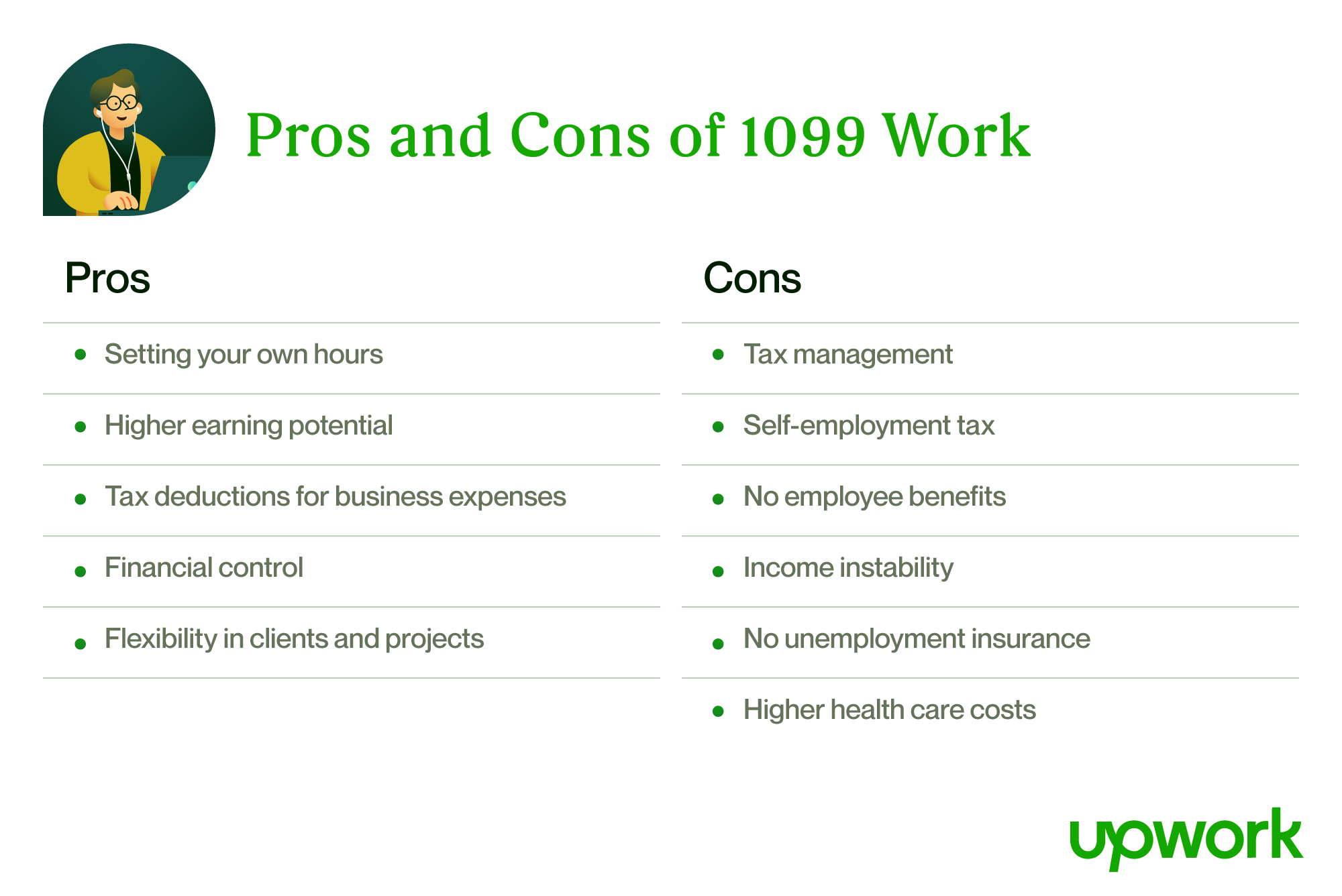
Working as an independent contractor offers both benefits and challenges. While working as an independent contractor provides flexibility and the opportunity for higher earnings, it also comes with financial responsibilities that traditional employees don’t face. Understanding these factors can help individuals determine if independent contracting aligns with their career and financial goals.
Advantages of Independent Contracting
Independent contractors have greater control over their work, income, and business operations. Many professionals choose to work as independent contractors for their flexibility and potential for increased earnings. We break down some of the perks of this arrangement below:
- Setting your own hours. Contractors generally have full control over their schedules, allowing them to work when, where, and how they choose as long as they deliver agreed work.
- Higher earning potential. Since independent contractors negotiate their rates, they can often earn more than salaried employees in the same field.
- Tax deductions for business expenses. Independent contractors may be able to deduct business-related costs, such as office supplies, equipment, and travel expenses, reducing their taxable income.
- Financial control. Unlike employees who receive fixed paychecks, independent contractors can decide how many projects to take on, directly influencing their income.
- Flexibility in clients and projects. Contractors can choose which clients to work with and diversify their income streams.
Challenges of Independent Contracting
In addition to the advantages, independent contracting comes with financial and logistical challenges as well:
- Tax management. Contractors must track their income and, often, make quarterly estimated tax payments to the IRS.
- Self-employment tax. Independent contractors may need to pay both the employee and employer portions of Social Security and Medicare taxes.
- No employee benefits. Unlike employees, independent contractors don’t receive employer-provided health insurance, retirement plans, or paid time off.
- Income instability. Pay can vary from month to month, making financial planning more complex.
- Lack of unemployment insurance. Since independent contractors are not covered by employer-paid unemployment taxes, they aren’t eligible for unemployment benefits.
- Higher health care costs. Self-employed individuals must secure their own health insurance, which can be more expensive without employer contributions.
Tips for working with independent contractors
Hiring and managing independent contractors requires a different approach than working with traditional employees. The top tips to keep in mind are:
- Use a written contract. Clearly define project scope, payment terms, and expectations to avoid disputes.
- Set a clear pay rate and payment schedule. Be transparent in discussing compensation to build trust with contractors.
- Clarify the type of relationship. Reinforce these workers’' independent status and make it clear that they have financial control over their work.
- Avoid misclassification. Incorrectly classifying an employee as an independent contractor can lead to legal and financial consequences.
Legal protections for independent contractors
Unlike traditional employees, independent contractors have fewer legal protections, such as:
- No employer-provided health or other insurance coverage. Contractors must secure their own insurance, as businesses are not required to provide health insurance or other employee benefits.
- No unemployment insurance. Since contractors are self-employed, they don’t qualify for unemployment benefits if a contract ends.
- Not covered by the FLSA. Properly classified independent contractors are not entitled to minimum wage guarantees, overtime pay, or other workplace protections under the Fair Labor Standards Act (FLSA).
However, independent contractors have the right to:
- Negotiate contracts. Contractors can set their rates, work terms, and conditions through written agreements.
- Control their own work schedule. Unlike employees, independent contractors usually determine their own hours and project timelines.
Hire independent contractors or find freelance opportunities on Upwork
Understanding the responsibilities of hiring or serving as an independent contractor is important for both contractors and their clients. Unlike traditional employees, independent contractors handle their own taxes, including estimating and submitting quarterly taxes in lieu of withholding. They’re generally responsible for employee and employer parts of payroll taxes and reconcile this amount when they file their tax return. Business owners must classify workers correctly to avoid legal and financial trouble.
Misclassification can lead to IRS penalties and tax liabilities, as well as other consequences, so both parties need to define their working relationship clearly. While independent contractors have more financial control and flexibility, they also face challenges like securing benefits and handling their own self-employment taxes.
Staying informed about tax rules, worker classification, and legal protections can help businesses and freelancers avoid costly mistakes.
Need flexible talent? Hire freelancers on Upwork to build your project-specific workforce. Looking for independent opportunities? Find freelance jobs on Upwork and connect with clients seeking your specialized skills.
Upwork does not provide tax or legal advice. Each reader and company should take the time needed to adequately analyze the laws that apply to their business endeavor. The information in this article relates to U.S. workers, and international law and taxes will differ.
Each state’s laws are different, so be sure to consult a local attorney so they can explain your state’s rules and regulations to you before making a decision.
This article does not address all tax issues for freelancers, and you should not rely on it for legal advice. We strongly encourage readers to seek tax advice based on their particular circumstances from an independent tax advisor.

.avif)

Author Spotlight

Upwork is the world’s largest human and AI-powered work marketplace that connects businesses with independent talent from across the globe. We serve everyone from one-person startups to large organizations with a powerful, trust-driven platform that enables companies and talent to work together in new ways that unlock their potential.