A Freelancer's Guide to Self-Employment Taxes: What You Need To Know
Self-employment tax covers Social Security and Medicare for independent professionals. Learn how to calculate and file your taxes, and reduce your liability.

.png)
.avif)
Filing taxes as a freelancer isn't as simple as having an employer withhold a portion of your paycheck. Instead, self-employed individuals are responsible for calculating and paying their own taxes—including self-employment tax.
Self-employment tax covers Social Security and Medicare taxes, which employees typically split with their employer. Since independent contractors and small business owners work for themselves, they pay both portions.
If you're new to freelancing or have recently transitioned from traditional employment, these tax obligations can feel overwhelming.
This guide breaks down the essentials of self-employment tax, including how it's calculated and which tax forms you need to file. We’ll also discuss how your business structure affects your tax liability, what deductions can help lower your tax bill, and how you can manage your self-employment tax responsibilities so that you can keep more of your hard-earned income.
Understanding self-employment tax
Self-employment tax is a mandatory tax that covers Social Security and Medicare for self-employed individuals. Unlike traditional employees, who split these contributions with their employer, freelancers, independent contractors, and small business owners must pay the full amount. This tax ensures that self-employed workers receive Social Security benefits and Medicare coverage when they retire.
The total self-employment tax rate consists of two parts: the Social Security tax and the Medicare tax. While employees only pay half of these taxes, self-employed individuals cover both the employee and employer portion. This requirement means their overall tax burden is higher than that of traditional payroll taxes.
However, certain tax deductions (which we also cover in this guide) can help reduce this amount.
Who has to pay self-employment tax?
You must file an income tax return and pay self-employment tax if your net self-employment earnings are $400 or more during a tax year. This rule applies whether you're working as a sole proprietor, running a small business, or taking on freelance projects.
Even if your earnings are below this threshold, you may still be required to file if you meet other IRS filing requirements.
You must also file if:
- You owe additional taxes, such as the alternative minimum tax or household employment taxes
- You received distributions from a health savings account (HSA), Archer MSA (medical savings account), or Medicare Advantage MSA
- You earned $108.28 or more from a church or qualified church-controlled organization that is exempt from Social Security and Medicare taxes
- You received advance payments of the premium tax credit for health insurance purchased through the Marketplace
- You have tax liability under section 965, which applies to certain foreign income
- You purchased a clean vehicle and transferred a tax credit to the dealer
For a full list of requirements, refer to IRS Form 1040 and 1040-SR instructions.
How business structure impacts self-employment tax
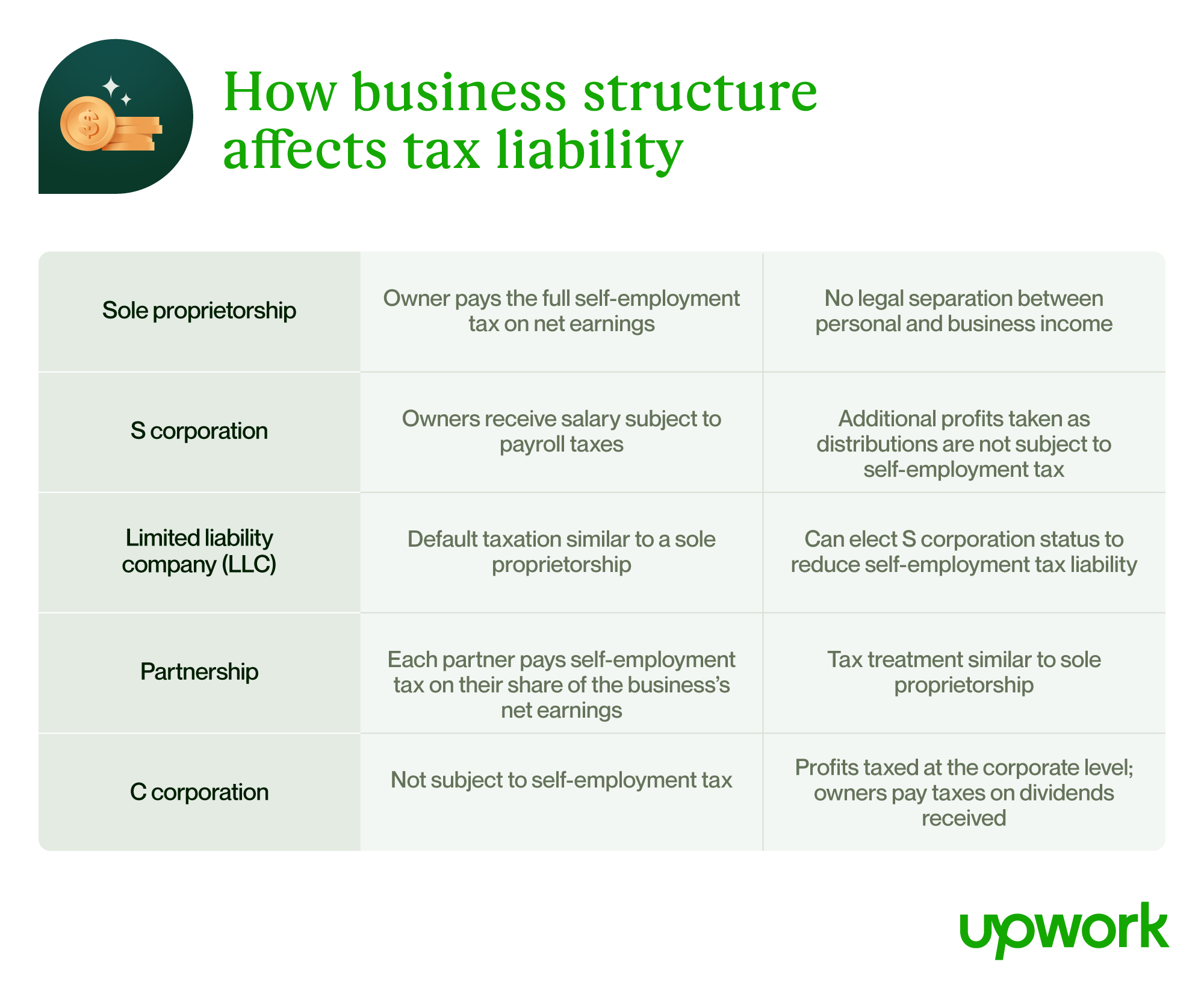
Your business structure determines how your income is taxed and whether you must pay self-employment tax on all earnings. While sole proprietors typically pay the full self-employment tax, other structures may offer strategies to reduce tax liability.
Below, we break down how different business entities can affect taxation:
- Sole proprietorship. The owner is responsible for paying the full self-employment tax on net earnings since there is no legal distinction between personal and business income.
- S corporation. Business owners can take a salary subject to payroll taxes while receiving additional profits as distributions, which are not subject to self-employment tax.
- Limited liability company (LLC). Typically taxed like a sole proprietorship unless elected to be taxed as an S corporation, which can reduce self-employment tax liability.
- Partnership. Each partner pays self-employment tax on their share of the business's net earnings, similar to a sole proprietorship.
- C corporation. This structure is not subject to self-employment tax, but profits are taxed at the corporate level, and owners pay taxes on any dividends received.
Choosing the right structure can significantly impact your tax obligations, so consider your income level, business goals, and potential tax savings.
How self-employment tax is calculated
Freelancers and other self-employed people must pay self-employment tax, which covers Social Security tax and Medicare taxes. Unlike traditional employees, who share these costs with their employer, self-employed individuals are responsible for paying both portions.
The total self-employment tax rate is currently 15.3%, with 12.4% allocated to Social Security and 2.9% to Medicare.
Your net earnings—calculated as business income minus deductible expenses—determine how much self-employment tax you owe. The IRS applies the self-employment tax rate to these net earnings to calculate your tax liability. However, certain deductions, such as the ability to deduct half of your self-employment tax on your income tax return, can help reduce the total amount owed by detracting it from your gross income.
Since self-employment business tax isn't automatically withheld from payments received, estimating your tax liability throughout the year is essential. Proper planning can help you set aside the right amount for quarterly tax payments and avoid unexpected tax bills.
How to calculate your self-employment tax
Upwork's Freelance Tax Calculator can help you determine your tax liability so you can set aside the right amount from your income for tax filing. It estimates how much you owe based on your net income and deductible business expenses.
To better understand your specific obligations, consider working with a tax professional or tax guide.
Which tax forms do freelancers need to file?
Proper tax preparation ensures accurate federal income tax reporting and helps avoid IRS penalties. Freelancers must file specific IRS forms to report their earnings and calculate taxes owed:
- Schedule SE determines self-employment tax based on taxable income and ensures contributions to Social Security and Medicare.
- Form 1040-ES is used to estimate and make quarterly tax payments since self-employed individuals do not have taxes withheld from their income.
- Schedule C reports business income and deductible expenses to determine net profit for the tax return.
Keeping detailed records of income and expenses can simplify the filing process—an experienced bookkeeper can help.
Estimated tax payments and due dates
Since taxes are not automatically withheld from self-employment income, freelancers must make estimated tax payments if they expect to owe at least $1,000 in taxes for the year. These payments help cover self-employment tax and federal income tax and are typically due on a quarterly basis.
The deadlines for each tax year are:
- April 15
- June 15
- September 15
- January 15
Failing to make estimated payments on time can result in tax-due penalties from the IRS. To calculate what you owe, estimate your annual income and divide the total tax obligation into four payments. Setting aside a portion of each payment received can make it easier to cover tax obligations when quarterly deadlines arrive.
Consulting a tax professional can help you calculate your tax accurately and avoid underpayment penalties.
Self-employment tax deductions and credits
Freelancers can reduce their self-employment tax by claiming deductions and credits that lower taxable income. Keeping detailed records of deductible expenses ensures they maximize available tax savings.
Common deductions and credits for freelancers include:
- 20% self-employment deduction. This deduction allows eligible freelancers to deduct up to 20% of their qualified business income, reducing their overall taxable income.
- Business expenses. Freelancers can deduct costs related to their work, such as office supplies, software, internet, and professional services, as long as they are necessary for business operations.
- Health insurance premiums. Self-employed individuals who are not covered under an employer-sponsored plan may deduct the cost of their health insurance premiums for themselves, spouses, and dependents.
- Tax credits. Certain credits, such as those for education expenses, can directly reduce the amount of tax owed, lowering overall tax liability.
Tax FAQ for self-employed individuals
Below are answers to common questions about freelancer taxes.
How much tax do you pay if you are self-employed?
Self-employed individuals must pay self-employment tax, which includes Social Security and Medicare taxes, along with federal income tax. The total self-employment tax rate is 15.3%, divided into two components: 12.4% for Social Security and 2.9% for Medicare.
Why is a 30% tax bracket recommended for self-employed individuals?
A common rule of thumb is to set aside around 30% of self-employment income for taxes. This rule typically covers self-employment tax, federal income tax, and state taxes, helping freelancers set aside enough to cover their tax liability when making quarterly tax payments.
How can I avoid self-employment tax?
You can't avoid self-employment tax entirely, but tax deductions and business expenses can reduce your taxable income. Forming an S corporation may also help lower your self-employment tax liability by allowing some earnings to be taken as distributions rather than salary.
What is the 20% self-employment deduction?
The 20% self-employment deduction allows qualified freelancers to deduct up to 20% of their business income before calculating taxable income. This deduction is part of the Qualified Business Income (QBI) Deduction and can significantly reduce tax liability for self-employed individuals.
Freelancers and business owners operating as pass-through entities may be eligible for the QBI deduction, including:
- Sole proprietorships
- Single-member LLCs
- Partnerships
- S corporations
- Independent contractors
- Freelancers
For tax year 2024, full eligibility for the QBI deduction depends on taxable income. The following are eligible:
- Single filers with taxable income below $191,950
- Married filing jointly with taxable income below $383,900
Certain service-based businesses—such as those in health, law, accounting, finance, brokerage, performing arts, consulting, or athletics—may have additional restrictions on the deduction.
How do I ensure accurate self-employment tax filing?
Freelancers should keep detailed records of business income and expenses, make estimated tax payments, and file the correct IRS forms. Consulting a tax professional can help with tax preparation and ensure compliance with IRS rules.
Why is self-employment tax important?
Self-employment tax funds Social Security benefits and Medicare, ensuring that self-employed filers contribute to these programs. Under the Federal Insurance Contributions Act, these taxes support future retirement and healthcare benefits.
Simplify your self-employment taxes
From knowing which tax forms to file to estimating quarterly payments, freelancers must fulfill their own tax obligations. Taking advantage of deductions, tracking business expenses, and using tax preparation services can help reduce your tax liability and simplify the filing process.
Plan ahead to avoid surprises when tax time arrives. Keep detailed records and consider relying on a bookkeeper or a tax professional to ensure accuracy and compliance with IRS regulations, minimize stress, and focus on growing your freelance business.
Businesses and freelancers seeking tax advice can hire tax professionals on Upwork. Looking for freelance work? Let Upwork connect you with clients looking for your expertise and talent.
This article is intended for educational purposes and should not be viewed as legal or tax advice. Please consult a professional to find the solution that best fits your situation.

.avif)

Author Spotlight

Upwork is the world’s largest human and AI-powered work marketplace that connects businesses with independent talent from across the globe. We serve everyone from one-person startups to large organizations with a powerful, trust-driven platform that enables companies and talent to work together in new ways that unlock their potential.