How AI Is Transforming Accounting
Discover how AI is reshaping accounting practices. Explore its applications, benefits, and impacts in this article.

.png)
.avif)
Accounting plays an integral role in businesses of all sizes, helping stakeholders evaluate performance, manage risk, and make informed decisions. But many traditional accounting processes—like data entry, invoice tracking, or financial reporting—can be time-consuming and prone to errors.
That’s where accounting AI (artificial intelligence) comes in. From automating repetitive tasks to surfacing real-time insights, AI-powered tools are reshaping how finance teams work. These platforms use machine learning algorithms, generative AI, and predictive analytics to streamline workflows, reduce errors, and support better strategic decision-making.
In this article, we’ll explore how AI is transforming modern accounting processes, what tools are driving the shift, and how freelance AI experts can help your accounting team adopt and integrate the right solutions.
The evolution of AI in accounting
Capabilities of and access to AI in accounting have transformed how professionals manage data, forecast trends, and support business decisions. This timeline shows how this technology has progressed over the decades:
- Manual bookkeeping era. For many decades, most accounting work was done manually, relying on detail-oriented individuals to prepare financial statements.
- Spreadsheet introduction (1980s). Tools like VisiCalc, Lotus 1-2-3, and later Microsoft Excel helped automate basic accounting tasks like data entry and expense management. Though not AI-powered, they laid the groundwork.
- OCR technology adoption (1980s). Optical character recognition (OCR) made it easier to extract data from invoices and enter it into computer systems, streamlining workflows.
- Early AI applications (1990s). Artificial neural networks began supporting tasks like fraud detection and financial forecasting, though adoption was limited due to their complexity.
- AI growth phase (2000s). More powerful machine learning algorithms improved forecasting, analysis, and risk assessment, leading to wider AI adoption in accounting.
- Rise of NLP-enhanced tools (2010s and beyond). Natural language processing enabled AI to interpret human language, generate reports, analyze real-time financial data, and support decision-making with predictive insights.
How AI supports modern accounting workflows
AI tools are transforming day-to-day accounting workflows—especially in areas traditionally bogged down by manual tasks and repetitive processes.
- Automating data entry and bookkeeping. AI systems can extract financial data from receipts, invoices, and bank statements, helping reduce manual effort and human error.
- Speeding up financial reporting. Tools powered by generative AI can create balance sheets, cash flow statements, and profit-and-loss reports with real-time data inputs.
- Enhancing audits and fraud detection. AI models can flag anomalies in transactions, helping audit teams focus their reviews and identify risk-prone areas faster.
- Improving customer experience. AI assistants and chatbots can answer common questions, freeing up accounting professionals for higher-value client work.
- Optimizing cash flow and budgeting. With predictive analytics and access to historical data, AI can help businesses forecast spending patterns and manage budgets more effectively.
Benefits of AI in accounting
The growing use of AI in accounting isn’t just about automation—it’s about driving better outcomes across finance teams and the businesses they support.
- Greater effectiveness. By automating routine tasks, accounting professionals spend less time on manual work and more on strategy and planning.
- Improved accuracy. AI models reduce human error and help ensure that financial reports, tax preparation and filings, and data analyses are more reliable.
- Better decision-making. AI tools provide real-time insights and forecasts that support strategic decisions—whether for cash flow management, risk mitigation, or growth planning.
- Cost savings. Fewer errors and less manual labor translate into lower operational costs for firms and finance teams.
- Higher client satisfaction. AI-backed tools help firms deliver faster responses, more accurate data, and customized support at scale.
Where AI stops short (and when to hire an expert)
Even the best AI transcription tools, forecasting models, or invoice automation systems can’t run on autopilot. That’s why companies often need freelance accounting experts, AI consultants, or developers to support tool integration, review outputs, and ensure accuracy.
Here’s when it makes sense to bring in independent talent:
- Integration and customization. Need to connect AI-powered accounting software to your existing ERP or finance stack? Freelance developers can help configure tools, build integrations, and optimize data flows.
- Quality assurance and oversight. Whether you’re automating expense categorization, validating financial statements, or reviewing outputs from chatbots and virtual assistants, human input is essential. Hiring a CPA or finance pro on Upwork can ensure nothing slips through the cracks.
- Training and implementation. Independent professionals can guide your team through AI onboarding—training staff on new workflows, setting up reporting dashboards, or providing templates for filings and forecasting.
If you’re not ready to commit to full-time hires, freelancers can fill skill gaps quickly and help you make the most of your accounting AI investment.
AI's challenges and considerations
While AI can revolutionize the accounting sector, it faces various challenges and ethical implications that affect its implementation. Here are some issues you should watch for when integrating AI into your workflow.
- Bias and fairness. The quality of AI outputs depends on the quality of data used for training. AI tools can inherit unintended biases in this training data. As a result, they could end up generating discriminatory or misleading responses.
- Transparency. AI systems rely on complex algorithms and machine learning models to perform various actions. Tracking and determining how decisions are made from these AI intricacies can be challenging.
- Accuracy. While incredibly powerful, AI tools are not perfect. They can spit out inaccurate outputs from time to time, and if left unchecked, they could affect the quality of your decisions.
- Data privacy concerns. Most AI systems collect user data and use it for further training to improve their capabilities. As a result, many stakeholders have concerns that systems could end up accessing personal data, leading to security breaches and misuse of sensitive information.
Artificial intelligence has the potential to improve numerous accounting activities. However, individuals must have the right technical expertise to effectively harness the power of AI in their workflows. To prepare well for the AI accounting era, users must update their skills to take advantage of the capabilities of various AI tools.
Short AI courses on platforms like Udemy, Coursera, and Udacity can equip you and your team with knowledge and skills in different AI technologies. But if you don’t have enough time to master AI fundamentals and nuances, consider working with generative AI specialists on Upwork to help you ramp up the process of implementing AI in your workflow.
Top AI-powered tools used in accounting today
The emergence of cloud-based accounting systems has reshaped how businesses access and handle their financial data, facilitating numerous benefits.
For starters, the cloud has improved accessibility and flexibility in the accounting sector by enabling businesses to access their data from any location. Cloud platforms also feature multiple security layers, which help businesses protect their core data. Moreover, cloud-based accounting systems support a high level of collaboration.
Below are some of the top AI-powered accounting tools on the market today, plus what they’re best for and how their features can support their implementation.
Truewind
Aimed at early-stage startups, Truewind simplifies accounting processes with AI that reduces manual input and improves accuracy.
- Best for: Automating invoice categorization and expense management in early-stage startups.
- Integration: QuickBooks and Xero; compatible with other ERP systems via API.
- Features: Customize workflows and set up rule-based categorization to align with your chart of accounts.
Booke

Booke helps small and midsize businesses streamline their bookkeeping through AI-driven automation and smart dashboards.
- Best for: AI-assisted bookkeeping and financial statement generation for small to midsize businesses.
- Integration: Directly with QuickBooks, Xero, and Zoho Books.
- Features: API integrations or tailor dashboards to business-specific metrics.
Zeni

Zeni offers a comprehensive solution for startups by combining full-service bookkeeping with AI insights and investor-ready reports.
- Best for: Startups needing full-service bookkeeping and financial reporting with AI-powered oversight.
- Integration: Connects with banking platforms, payroll providers, and financial tools via API.
- Features: Automated transaction categorization and reconciliations, investor-ready financial reports, and AI-powered dashboards that flag inefficiencies.
Vic.ai
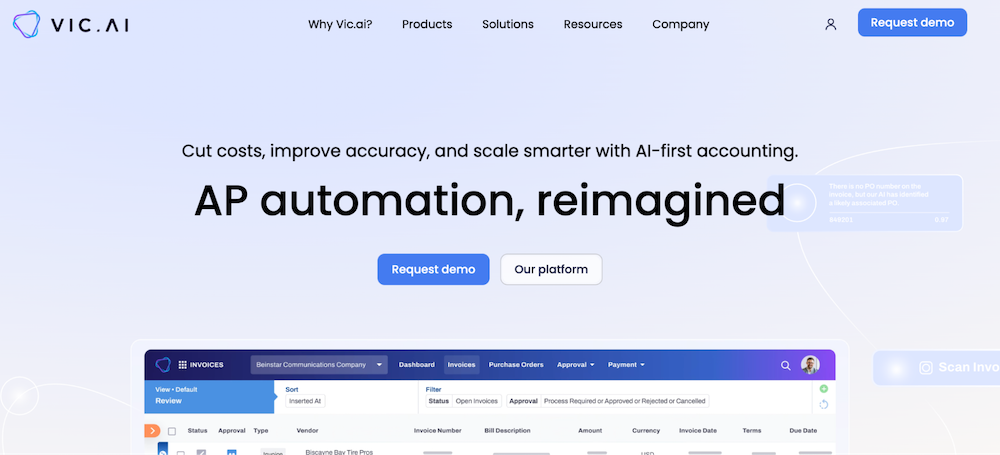
Built for growing organizations, Vic.ai automates high-volume accounts payable workflows with precision and scalability.
- Best for: Mid-size to enterprise businesses automating accounts payable at scale.
- Integration: Works with leading ERP systems like Oracle NetSuite, Sage Intacct, and Microsoft Dynamics.
- Features: AI-driven invoice processing, PO matching, and monthly close automation for audit-ready results.
Blue Dot
Blue Dot helps global companies stay compliant by automating complex tax processes and employee expense reviews.
- Best for: Global companies managing tax compliance and employee expenses.
- Integration: Integrates with major expense management systems like SAP Concur and Coupa.
- Features: AI-powered VAT calculation, employee benefits auditing, and real-time compliance flagging.
Karbon
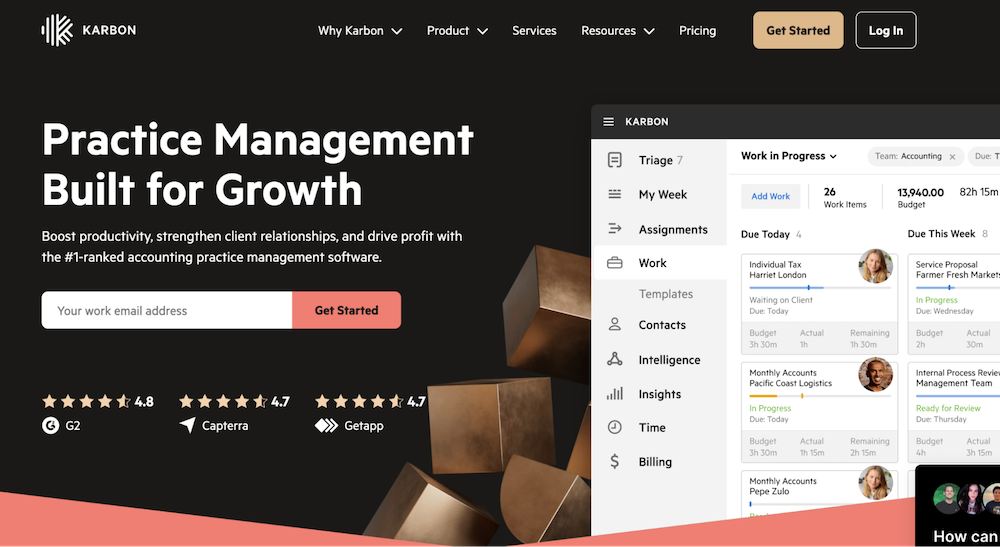
Karbon brings accounting teams together with AI-enhanced tools for managing workflow, communication, and collaboration in one place.
- Best for: Accounting firms and teams looking to centralize workflow, email, and client communication in one platform.
- Integration: Connects with Xero, QuickBooks, Microsoft 365, and other practice management tools.
- Features: Uses AI to summarize emails, prioritize tasks, and streamline client collaboration in a shared dashboard.
ChatGPT

ChatGPT supports accounting workflows by assisting with financial report generation and managing client interactions through conversational AI.
- Best for: Firms seeking an AI assistant to handle FAQ, educate clients, and streamline communication via custom knowledge bases.
- Integration: Can connect to accounting platforms, CRMs, and internal databases using APIs or plug-ins.
- Features: Generates natural language responses, summarizes financial documents, and routes client questions with contextual accuracy.
Microsoft Excel
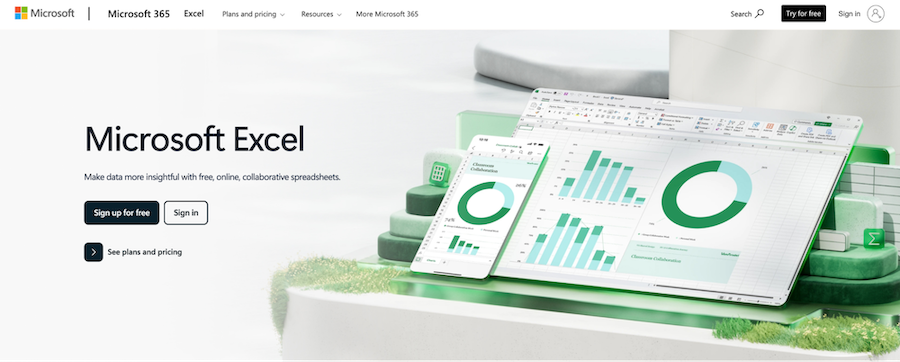
Microsoft Excel enhances traditional spreadsheet tasks with AI tools for data analysis, forecasting, and multilanguage support.
- Best for: Accounting professionals looking to unlock deeper insights from financial data using familiar software.
- Integration: Integrates seamlessly with Microsoft 365, Power BI, and external databases.
- Features: Analyze Data highlights patterns and trends, Forecast predicts outcomes using historical data, and Translator converts text across languages.
Case studies: AI adoption in accounting
Because of the powerful features and immense benefits that AI can offer, many companies and CFOs have adopted it in their financial operations. Enterprise accounting firms like Deloitte, KPMG, and PwC are already putting AI to work. Here’s how these companies are applying AI in real use cases today.
- Deloitte. This company uses AI to improve business models and enhance its clients' operations. Specifically, Deloitte utilizes AI in invoice processing, expense tracking, and financial reporting. It also uses AI to help its clients file taxes and ensure compliance with regulations. Generally, artificial intelligence has helped Deloitte improve the efficiency and accuracy of its accounting systems, delivering better services to clients.
- KPMG. This business uses artificial intelligence for risk assessment and monitoring, enabling its clients to make solid investing decisions. AI tools also allow KPMG to automate manual financial processes, improving productivity by allowing staff members to focus on value-adding activities. Additionally, KPMG uses AI in credit risk assessments for its clients to determine the type of loans or mortgages they can offer.
- PwC. PwC uses AI to extract valuable insights from large datasets for quick decision-making. Internally, the company has used AI to develop products that help its staff to be more productive and efficient in their roles. For clients, the company runs AI-powered predictive analytics to help them plan for the future. PwC also uses AI in tasks like data extraction, tax planning, and compliance.
The future of AI and accounting
Advancements in AI will continue revolutionizing the accounting profession. Here are some upcoming AI trends and innovations likely to shape the accounting industry.
- AI personalization. As AI systems become more advanced, their ability to generate personalized insights, automate financial planning, and improve real-time decision-making will continue to grow.
- AI-driven decision support systems. Artificial intelligence will increasingly play an active role in decision-making, helping stakeholders to make data-driven choices.
- Blockchain integration. Expect to see deeper integration of blockchain for secure auditing, more intuitive generative AI tools that support end-to-end workflows, and AI-driven platforms that can recommend actions based on predictive modeling.
- Freelance AI consultants and accounting professionals. They’ll play a growing role in helping businesses implement, test, and scale these innovations, offering flexible, specialized support when internal resources are stretched.
As AI benefits become more evident, the adoption of artificial intelligence in the accounting sector will also likely increase in the foreseeable future. Advancements in natural language processing will allow AI tools to process inputs with a higher degree of accuracy, generate more coherent responses, and enhance user interactions.
Get work done with Upwork
AI-driven tools have the potential to favorably transform accounting practices by facilitating significant time and cost savings.
By embracing AI technology, accounting firms can quickly analyze complex datasets and extract meaningful insights for decision-making. These platforms can also help with forecasting and predictive analytics, allowing companies to plan better and boost their financial performance.
AI is changing how accounting teams work, but it’s not a plug-and-play solution. The right freelance talent can help you train models and AI-driven tools, integrate platforms, and ensure your outputs are accurate and actionable. Whether you're building smarter workflows or looking for your next freelance opportunity, Upwork connects you to the people and projects that power modern accounting.
Consider working with accountants and AI developers on Upwork to help you integrate AI successfully into your workflow.
And if you’re a professional looking for work, start your job search on Upwork. With accounting and AI-related jobs posted regularly, you can find a role that aligns with your skills and earn extra income. Get started today!

.avif)

Author Spotlight

Upwork is the world’s largest human and AI-powered work marketplace that connects businesses with independent talent from across the globe. We serve everyone from one-person startups to large organizations with a powerful, trust-driven platform that enables companies and talent to work together in new ways that unlock their potential.

Latest articles