Best Data Science Courses for 2026: Top Picks for All Levels
Explore the best data science courses, curated for all skill levels. Whether you're a beginner or an expert, find top-rated online courses for data science.

.png)
.avif)
Data science is a broad discipline that serves as the backbone of skills related to machine learning, generative AI modeling, business analytics, and more. In fact, data science encompasses the most in-demand skills on Upwork right now—and we expect this demand to keep on growing.
Whether you want to become a data scientist or simply want to learn more about how generative AI works, you can choose from a wealth of great courses to take to grow your skills. In this guide, we’ll go over some of the best data science courses available to learners right now—and how to choose the right one for your goals.
What to look for in a data science course
While you’ll want to assess a number of key things when looking for a data science course—including how much time you have and your preferred learning style—we’ve highlighted some of the top considerations for each course on this list.
As you explore the courses, take note of the following information for each one:
- Skill level: We’ve broken this down into beginner, advanced beginner, intermediate, and advanced. If you aren’t sure where you fall, check out each of the linked course descriptions and see how much of the introductory content feels familiar versus confusing.
- Duration and structure: Whether you want to work at your own pace or follow an instructor, you can find courses that last anywhere from a few hours to 12 months.
- Certification: Online courses might offer a certificate of achievement, a certification (which often involves a test), an accredited degree, or nothing. Think about what you need or want for your career and choose a course accordingly.
- Cost: Price is also a factor. If you’re just starting out in data science, it may make sense to take a few free courses, which is sometimes called auditing a course. This way, you can figure out which areas of data science appeal to you most—then pick a more comprehensive paid certification course.
You can also start by exploring data science lessons available in Upwork’s Education Marketplace. These courses can give you a taste of how different online education platforms work and help you find the best fit for your continued learning needs.
9 best data science courses
These nine options are a great place to start your data science journey—or learn new, advanced skills.
1. What is Data Science? (IBM via Coursera)
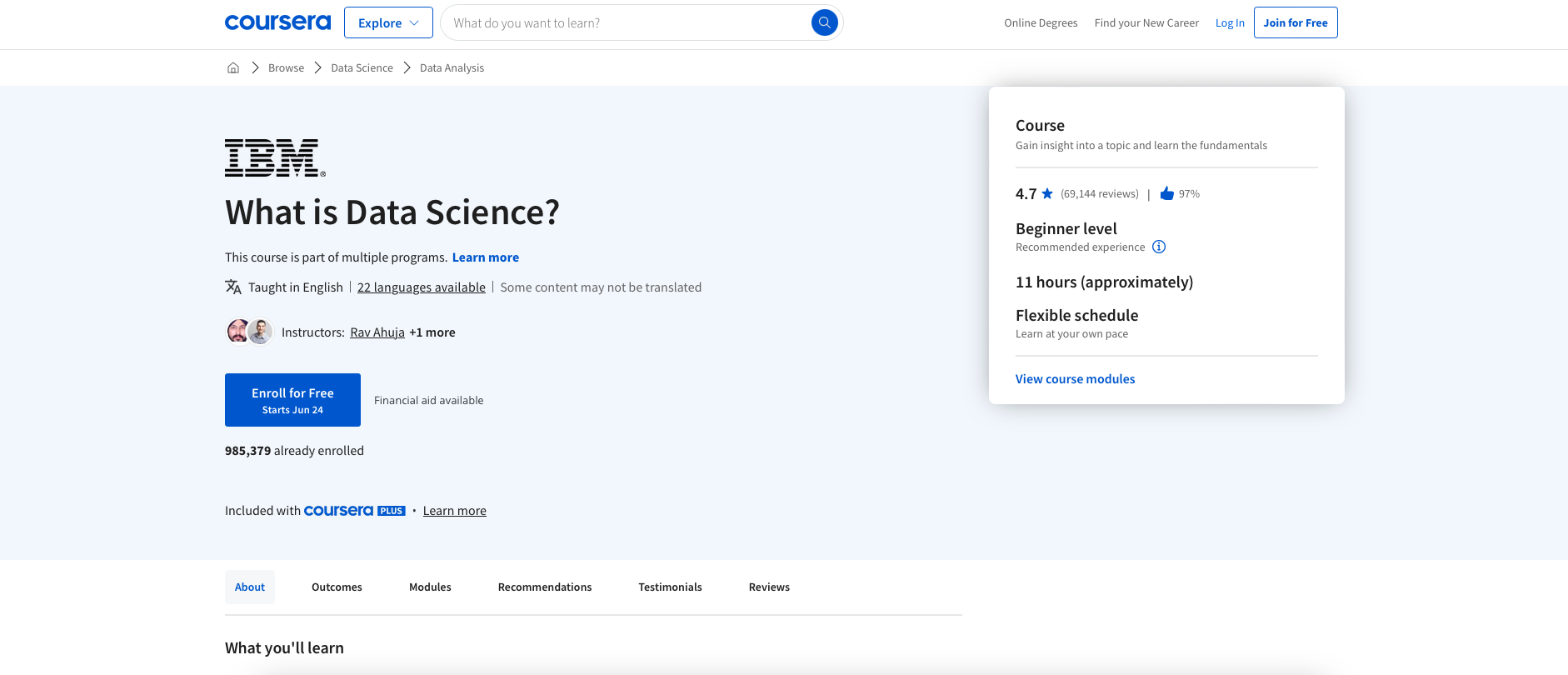
- Skill level: Beginner
- Duration: 11 hours
- Certificate? Optional certificate of completion
- Course structure: Self-paced with prerecorded class modules
- Overview: The “What is Data Science?” intro course is for complete newbies to the world of data science. Taught by experienced data scientists, this class covers the basic fundamentals of data science—and how experience in this area can help you succeed in different careers.
- Notable features: IBM’s course starts at the very beginning; its first module is called “Defining Data Science and What Data Scientists Do.” This makes it great for anyone who’s unfamiliar with big data, Python, and other key concepts in the world of data science.
- Pros & cons: It’s part of Coursera, which means it’s self-paced and easy to access at any time. However, you won’t be able to get one-on-one support from instructors or advisors like you would in a traditional university setting.
- Cost: You can take the course for free, but if you want a data science certificate, you’ll need a Coursera Plus subscription ($59 per month).
2. Data Analytics Certification (Google via Coursera)

- Skilll level: Beginner
- Duration: Six months at 10 hours per week
- Certificate? Yes, acknowledging your certification
- Course structure: Self-paced with prerecorded class modules
- Overview: The Google Data Analytics Certification course is a great introductory course for anyone who has broad familiarity with data science as a discipline, but no hands-on experience. You’ll learn how to work with data using spreadsheets, SQL, Tableau, and more. You’ll also learn about data visualization and how to present your findings to clients.
- Notable features: After completing the course, you’ll get access to additional career resources from Google, including resume review, interview practice, and job opportunities available through the Google Employer Consortium.
- Pros & cons: This course provides more post-certification support thanks to Google’s extra resources, but it’s not a fast-track answer to getting hired by Google. You can take as much time as you need to complete the course, though, and benefit from Google’s additional resources.
- Cost: $49 per month, or free with a Coursera Plus subscription
3. Data Science Foundations (Codecademy)

- Skill level: Advanced beginner
- Duration: 56 hours
- Certificate? Yes, a certificate of completion
- Course structure: Self-paced with prerecorded class modules
- Overview: Codecademy’s Data Science Foundations course uses a blend of self-paced learning and interactive projects that will have you doing Python programming, analyzing data sets, and learning how to communicate your results.
- Notable features: The Codecademy platform includes an AI-powered learning assistant that will help you identify errors in your work—and move toward the right solution. There are also a number of quizzes and projects included to help you validate your understanding as you move through the course.
- Pros & cons: While the course is for beginners, it does assume some basic understanding of Python. Luckily, Codecademy has a resource library that includes information on this and other related topics, so you can brush up on unfamiliar terms as you move through the lessons. You can also jump right in to related courses and learning paths as soon as you finish!
- Cost: You can try out this and other Codecademy courses for free, but you’ll need to subscribe in order to finish the class and get your certificate. Plans start at $14.99 per month (billed annually).
4. Introduction to Natural Language Processing in R (DataCamp)

- Skill level: Intermediate
- Duration: Varies
- Certificate? Yes, a certificate of completion
- Course structure: Self-paced with prerecorded class modules
- Overview: The DataCamp Introduction to Natural Language Processing in R course is a great way to keep growing your data science skills. You’ll build on your existing experience with the R programming language, learn how to work with regular expressions and tokenization, preprocess text, practice bag-of-words (BoW) representations, and more.
- Notable features: Like Google, DataCamp maintains a job board for students. You can create a professional profile and apply to jobs directly from your DataCamp account.
- Pros & cons: DataCamp lets you try the first lesson for free, and you can also click through each module and see what some of the exercises look like. Like many other online courses, though, it doesn’t come with the same level of support you’d get in a university setting.
- Cost: In order to complete the course, you’ll need a DataCamp Premium subscription. This costs $13 per month when billed annually.
5. Data Analysis for Business in Python (Dataquest)

- Skill level: Intermediate
- Duration: Seven hours
- Certificate? No
- Course structure: Self-paced with prerecorded class modules
- Overview: This Data Analysis for Business course is a short introduction to understanding and using data in corporate applications. You’ll learn how to clarify language, use data to measure business performance, and communicate with non-technical audiences. This can help you in your future work as a data scientist or data analyst.
- Notable features: Dataquest’s courses are geared toward understanding and using data in professional applications. In addition to your coursework, you can watch live webinars that break down data science projects and read more about different ways that data can be used for business intelligence.
- Pros & cons: Unlike some of the other courses on this list, Dataquest doesn’t provide certificates of completion for each individual course. You’ll need to finish an entire learning path, which links together multiple courses, in order to get a certificate. If you decide to do that, though, you can choose from paths based on skill sets as well as job titles—great for exploring different disciplines within data science.
- Cost: Dataquest lets you try a course out for free, but you can’t see how much continued access costs until you create an account. Best Colleges reports that Dataquest memberships cost $49 per month or $399 per year, though you’ll want to confirm current pricing after creating your free Dataquest account.
6. Artificial Intelligence: Reinforcement Learning in Python (Udemy)

- Skill level: Intermediate
- Duration: 14.5 hours
- Certificate? Yes, a certificate of completion
- Course structure: Self-paced with prerecorded class modules
- Overview: The Artificial Intelligence: Reinforcement Learning in Python course walks students through the process of training AI agents with reinforcement techniques rooted in both psychology and AI engineering. To get the most out of this course, you’ll need a solid foundation in calculus, probability, Python, Numpy, Matplotlib, linear regression, and object-oriented programming.
- Notable features: The course is created and taught by one data scientist—and in the course description, he says that you can email him if you disagree with any of the code he uses in the lessons. This isn’t the case with many online courses!
- Pros & cons: While there are a few hands-on elements to this course, it’s more focused on lectures than executable assignments. If you prefer to learn by doing, instead of listening, this may not be the course for you. That said, you will use the OpenAI Gym to practice some of the 17 different reinforcement algorithms you learn during the course and you get lifetime access to revisit modules at any time.
- Cost: $74.99
7. Case Studies in Functional Genomics (Harvard via edX)

- Skill level: Advanced
- Duration: Five weeks at two to four hours per week
- Certificate? Optional
- Course structure: Self-paced with prerecorded class modules
- Overview: Harvard’s Case Studies in Functional Genomics course blends data science and biological science together. Throughout this course, you’ll learn how to use R and Bioconductor to analyze DNA and RNA.
- Notable features: This course ties in to a larger professional certification program, so you can try lessons out for free before deciding if you want to invest in a full, paid certification.
- Pros & cons: Harvard says that the statistics and programming parts of this course “ramp up in difficulty relatively quickly,” so it may require more prerequisite work, especially if your prior experience is mostly in the life sciences. Prerequisites are available through edX, though, so you can build an entire educational path for yourself based on your interests and goals.
- Cost: You can audit the class for free; a certificate of completion costs $219.
8. MicroMasters® in Statistics and Data Science (MIT via edX)

- Skill level: Advanced
- Duration: 14 months at 10 to 14 hours per week
- Certificate? Yes, a MicroMasters program certificate
- Course structure: Instructor-led
- Overview: MIT’s Statistics and Data Science course is part of the MicroMasters program, which teaches graduate-level skills on a condensed time frame. You’ll learn how to build machine learning algorithms, deploy probabilistic modeling methodologies, and more.
- Notable features: You can choose between two tracks when starting the course. The general track focuses on common data analysis models and applications and is useful for business purposes. The social sciences track teaches you how to use probability, statistics, and machine learning in societal applications.
- Pros & cons: This course includes proctored exams and assignments with set due dates, so it’s not as flexible as other options on this list. This means that it offers more support than a fully self-paced course, though—and your certificate can be applied as credit toward a full graduate degree at MIT or other participating universities.
- Cost: $1,350
9. Data Science Master’s Degree (Johns Hopkins University)

- Skill level: Varied
- Duration: One year or more
- Certificate? Yes, a master’s degree
- Course structure: Instructor-led, asynchronous online study
- Overview: The Data Science Master’s Degree program at Johns Hopkins offers a more traditional university experience, albeit remotely. The program is tailored to working business professionals who want to grow their data science and leadership skills. You’ll learn how to model different types of data, work with large-scale and complex data sets, and use automation to improve decision-making at your job. You’ll be able to select from a variety of electives that interest you, too, from the foundations of neural networks to statistical analysis.
- Notable features: The university doesn’t require you to take the GRE to enroll, and you can take a proficiency exam to test out of various prerequisite classes.
- Pros & cons: As this is a full master’s degree, costs are much higher than for the other certificates and classes listed above. However, because it is a degree program, you may be able to apply for U.S. federal or state grants and loans. You can also opt to scale down your studies and get a graduate certificate for less—then apply it to your master’s degree studies later on if you so choose.
- Cost: $52,700 and up
How to choose the right course for you
When choosing a data science course, it’s important to be realistic about your current skill level. If you try taking a course that’s too advanced, you might wind up feeling frustrated and lost rather than excited about data science.
If you’re completely new to data science, try exploring some free online courses and tutorials first—this can help you figure out what interests you the most within the data science field. From there, you can pick the right courses and boot camps to help you reach your goals.
And if you’re already experienced in data science, take advantage of any prerequisite lists and assessments that are available to you. You can use this information to figure out which courses cover information you already know. Some of the longer courses also have FAQ sections, chatbots, and even customer service support teams that can help you learn more about the program, as well.
Plus, you can read reviews about many online classes including those on Udemy, Coursera, and platforms like DataCamp. Hearing from other professionals with a similar background can make picking the right course simple.
Find work as a data scientist on Upwork
Whether you’re seeking your first project as a data scientist or you’re a senior-level professional interested in working independently, you can find work here on Upwork. Hundreds of data science jobs are available now, with more landing on our platform every day. Log in or sign up for an Upwork account now to start your new career as a freelance data scientist.
And if you’re a business leader looking for qualified talent to help with your data projects, you can connect with experienced data scientists all around the world—right here on Upwork.
Upwork does not control, operate, or sponsor the tools or services discussed in this article, which are only provided as potential options. Each reader and company should take the time to adequately analyze and determine the tools or services that would best fit their specific needs and situation. Prices are current at the time of writing and may change over time based on each service’s offerings.
If you are communicating with a hiring manager for a job through the Upwork platform, please note that sharing your personal contact information, such as email address, phone number, or LinkedIn profile, is not permitted in cover letters or at any time prior to the start of a contract. Additionally, all pre-contract communication should take place through the Upwork Messages feature. Learn more about using Upwork Messages here, and see more details on sharing information on Upwork here.

.avif)

Author Spotlight

Emily Gertenbach is a B2B writer who creates SEO content for humans, not just algorithms. As a former news correspondent, she loves digging into research and breaking down technical topics. She specializes in helping independent marketing professionals and martech SaaS companies connect with their ideal business clients through organic search.

Latest articles