Debunking Myths About Freelancing: What You Need To Know
Freelancing can be a rewarding, stable, and even lucrative career—if you don't let these seven common myths hold you back from making the leap.

.png)
.avif)
Freelancing is an incredibly flexible work model that allows you to collaborate with all kinds of companies, explore a wide range of projects, and do it all anywhere in the world.
But freelancing isn’t a totally carefree lifestyle. Being a freelancer means you have to meet client deadlines, manage your time well, supply all of your own equipment, and in some countries, pay self-employment taxes.
I've worked as a freelance writer on and off for nearly 20 years, and it's been my full-time job since 2019. Here's what I've learned about some of the most common freelancing myths along the way.
Myth 1: Freelancing is only for creative professions
If you've never freelanced before, you might think that it’s only for writers, graphic designers, web designers, and photographers. It’s a common misconception!
You can actually become a freelancer in all kinds of industries and professions. I know successful freelancers who are:
- Financial consultants
- Fractional CMOs
- Business coaches
- Computer programmers
- Mechanical engineers
- Community managers
And that's just the tip of the iceberg, too. Take a peek around the site and see how many different jobs you can do on a freelance basis!
Myth 2: Freelancers constantly struggle to find work
I've had many conversations over the years with other professionals who were thinking about becoming their own boss. One of their biggest concerns is "Will I be able to find work?"
If you're feeling that way, I get it. Before launching my own business, I felt some uncertainty about freelancing full time even though I'd done projects on the side for years. I didn’t know if I’d be able to find the volume of work I needed ... how I would meet new clients … what to do if my pipeline dried up ... could I stand out as a freelancer?
As it turned out, I had way more freelance opportunities than I ever would have realized if I hadn’t taken the plunge. The idea that all freelancers experience constant job insecurity simply isn't true.
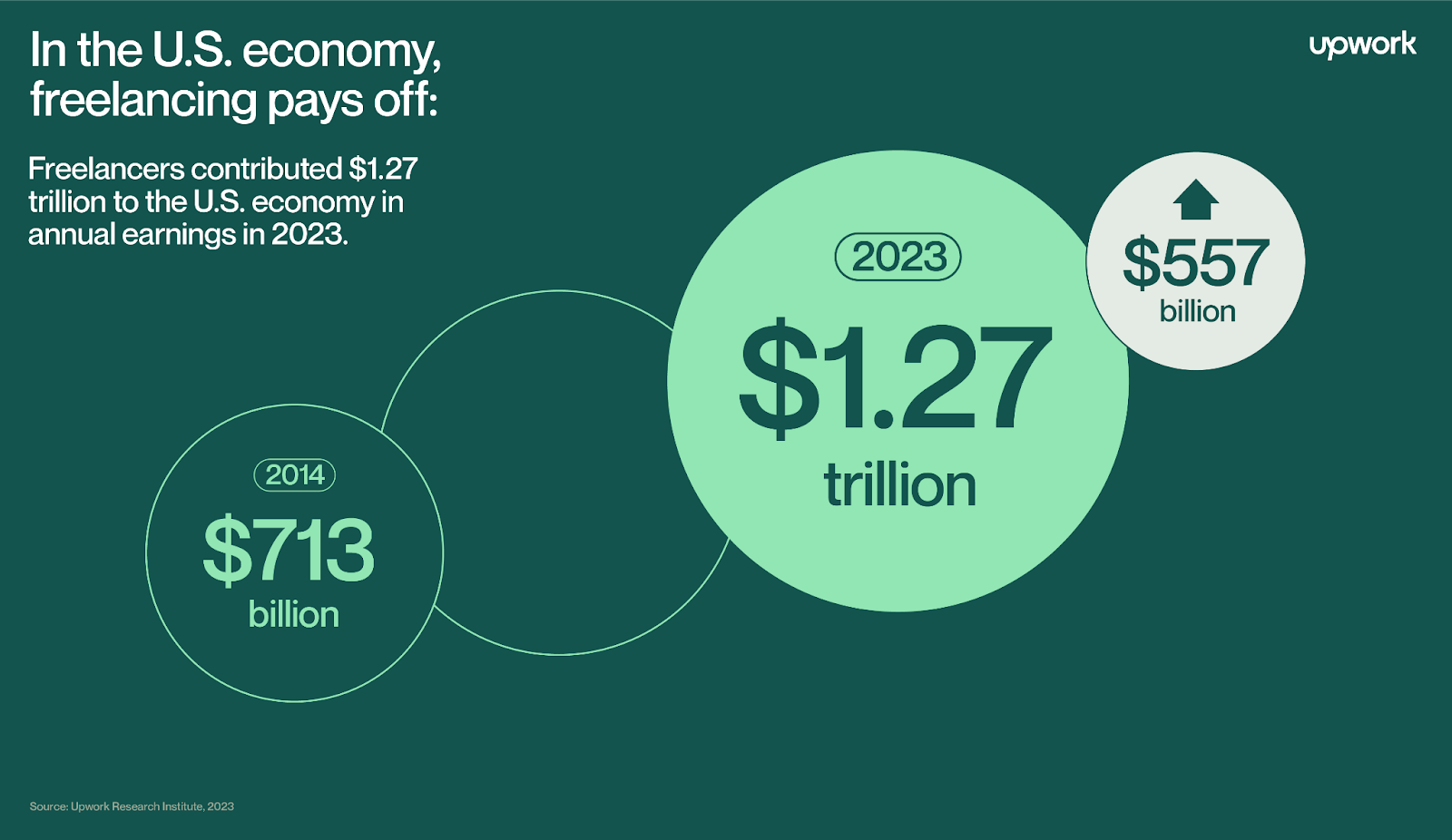
Freelancers contributed $1.27 trillion to the U.S. economy alone in 2023—and this amount is expected to grow.
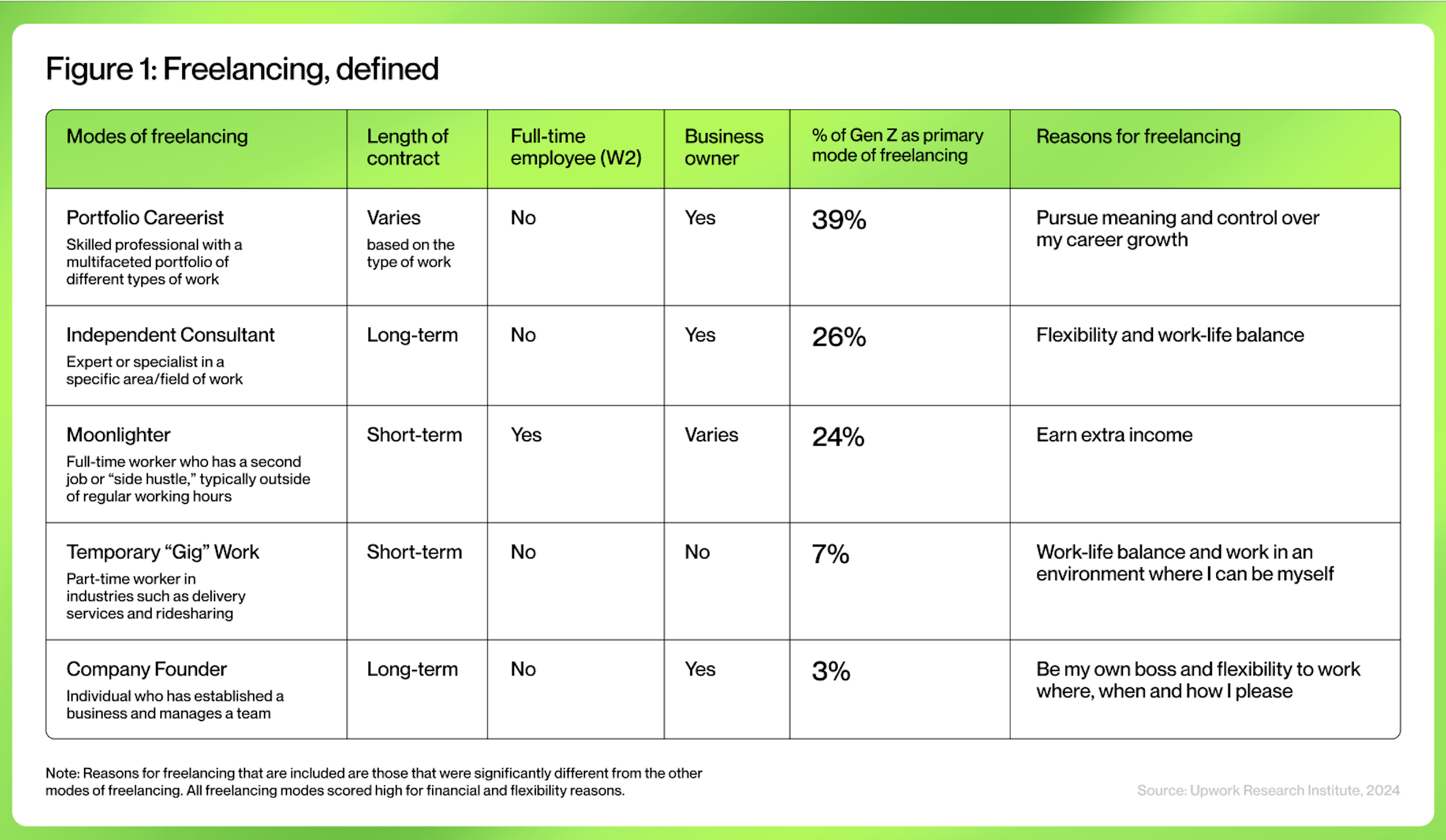
Future growth isn’t surprising, either, considering that most Gen Z freelancers approach their independent work as a full-time job.
That said, many freelancers do have periods in which they may have fewer clients than they'd like. I’ve experienced these periods myself. Because of this, I now:
- Make sure I participate in communities for freelance professionals. This is where I build connections, meet people I can collaborate with, and get (or give) referrals.
- Keep consultations active on my Upwork profile at all times.
- Work with a mix of companies, so that a major global impact to one industry won't strip away all of my work.
- Go to at least one industry conference a year and make sure to introduce myself to other people, even if I feel awkward. This can pay off; I still regularly work with someone I met at a conference years ago.
- Never fully close myself off from new clients. When I'm very busy, I won't actively seek out new work—but I keep a waitlist option open on my website so potential clients can sign up and be notified when I have availability again.
- Regularly monitor my revenue and expenses to make sure I have enough money set aside for slow periods.
While I can’t guarantee that I’ll never struggle to find work again, I’m far more prepared for different outcomes than I was earlier in my freelancing career.
Myth 3: Freelancing doesn't provide a stable income or job security
Concerns about income instability go hand-in-hand with worries about finding work. And it's understandably confusing—without a guaranteed paycheck every two weeks, how can you comfortably and confidently pay your bills? It's not as if most landlords accept "Sorry, couldn't find a client" as a reason for missing a month's rent.
The reality is that to live comfortably as a freelancer, you have to be really good at two things (aside from delivering quality work, of course):
- Setting your rates
- Budgeting
The Freelancers Union suggests that you consider all of the following when calculating rates:
- How much you’d like to make in a year
- Your fixed expenses, like rent
- Your variable expenses, like gas and groceries
- The amount of money you need to set aside for taxes, healthcare, and insurance
- What your cost of doing business is—this can include materials, office space, internet service, and more
- The amount of time you may spend doing non-billable work, like sending proposals or paying business bills
(Upwork’s Freelance Rate Calculator makes figuring this out simple—but you’ll have to come up with a budget on your own!)
Calculating the right rate is only one part of the equation, though. To help keep your cash flow positive, you can also:
- Offer a mix of services at different price points. If there's a period when one of your services becomes less popular, you'll have other offerings to fall back on
- Diversify how you structure your contracts. For example, I work on a mix of one-time flat rate, ongoing hourly, and retainer-based projects.
- Build a cushion into your rates. In my case, I have a consistent stream of work but tend to see a dip in demand during June and July. By accounting for this all year, I don't have to scramble and stress.
- Balance your books every month. Whether you do this yourself or hire a bookkeeper, knowing exactly how much you have coming in and going out of your business is essential for financial planning.
- Work with an accountant. Hiring an accountant, either on an ongoing basis or at tax time, can help you make sure you're maximizing the deductions and credits that are available to you in your country.
Myth 4: Freelancers work in isolation and miss out on professional growth
This is a common myth about freelancing, but it’s rooted in some truth.
When I first started freelancing, I spent a lot of time working alone in my house with only my dog for company. She’s great, but I eventually wanted some more human interaction—and referrals to potential clients.
As freelancers, we have to actively seek out groups to interact with, who can enhance our professional development and who we can also help. I did this, and today I belong to five online communities (as well as a real-world coworking space) that give me the chance to meet other freelancers, learn new skills, find referrals, and more.
Myth 5: Freelancing is easier than a 9-to-5 job
The business of freelancing isn't easy. I'm responsible for far more than I was in my traditional jobs. I have to do things like:
- Stay on top of when I've sent an invoice and when it's due
- Talk through any questions or problems with my customers
- Set and enforce boundaries to protect my free time (such as not taking meetings with clients after 6 pm or on weekends)
- Take full responsibility for all work that I send to clients
- Make sure I'm appropriately protected with the right contracts
- Maintain and review my professional insurance policies
- Figure out a backup plan if my computer needs to go into the shop for repairs
- Grow and nurture a client base
- Keep my email and social media inboxes clear
- Manage my books
If you decide to create an agency, then you may need to also manage projects, coordinate work with other freelancers, and juggle larger business responsibilities.
Plus, turning off at the end of the day and maintaining a true work-life balance can be hard. These are all real difficulties, which may feel easier or harder based on your personal skill sets.
Freelancing has made some aspects of my life easier, though. When my husband received a job offer states away from where we lived, I didn't have to quit my job and search for a new one or ask for permission to work from another state. All of my work came with me—I took a week off to move and picked back up where I left off.
Similarly, many of my colleagues have found that freelancing gave them the scheduling flexibility they needed to take care of their families, get kids to and from school, look after elderly parents, and be present in ways that a traditional office job didn’t allow.
Using Upwork takes away some of the administrative burden, too. It’s nice to know that all of my project details, messages, and files are all in one spot—and that Upwork will collect what a client owes me and deposit it in my bank account automatically.
Myth 6: Freelancers have less career development and advancement
I spent years working in a traditional office job before starting to freelance full time, and in my opinion, embracing a freelance life equals near-boundless opportunities for career development. I find these opportunities to be a huge benefit of freelancing.
The catch is that you have to decide when and how your career is advancing, and doing so can feel weird at first (I promise, it gets more normal and natural over time). There isn't a boss who will tell you when you're getting a new title or promotion based on years of experience.
Margareth Espero, a freelancer on Upwork, is a great example of how anyone working independently can take charge of their career progression. She initially started working in customer support for a variety of companies, taking on smaller contracts at a relatively low hourly rate.
Over time, this work allowed Espero to hone additional skills and gain experience with a wide range of clients. She wound up making a shift from customer support to recruiting customer support teams for her clients—and eventually managing clients’ entire recruiting process.
She then turned the skills she gleaned from those experiences into a new career as a business and project management consultant.
Myth 7: Freelancing is only a temporary solution, not a career
It's absolutely fine to freelance on the side or just for a period of time. I did this myself for years. But freelancing is a valid career choice—and you can make it your primary source of income if you want to.
When I began freelancing full time, I made sure to treat it as just that: my full-time job. This meant that I:
- Came up with a business name
- Formally registered my business with the appropriate government agencies
- Built a website, bought a domain, and hired a graphic designer to make my logo and brand assets
- Set up a LinkedIn page for my freelance business
- Created an email address and phone number for business use
- Opened up separate bank accounts and credit cards for my freelance earnings and expenses
- Drew up contract and invoice templates
- Took out a professional and general liability insurance policy
- Established my working hours and communicated them to new clients
This isn't a list of things you have to do, just an example of what I've done. The appropriate steps for you to take will vary based on where you live and how you want to structure your freelance work. The key, though, is to look at freelancing as your full-time job—if that's what you want it to be.
Freelance with Upwork
Whether you want to go all-in on freelancing full time or would like to dip your toe into the water with a few projects on the side, Upwork is your home for building a successful freelance career. You can send proposals for one-time jobs, take on longer-term hourly contracts, offer consultations, and even build an agency all in one spot. This makes Upwork a fantastic place to figure out how you work best as a freelancer—and then build your ideal career.
All it takes is an Upwork account. Sign up today to start exploring freelance opportunities, connecting with others in our community, and meeting clients who need your skills.

.avif)

Author Spotlight

Emily Gertenbach is a B2B writer who creates SEO content for humans, not just algorithms. As a former news correspondent, she loves digging into research and breaking down technical topics. She specializes in helping independent marketing professionals and martech SaaS companies connect with their ideal business clients through organic search.