Is the Gig Economy Still Booming? Freelance Job Trends To Know
Is gig work here to stay? Explore emerging trends, and learn what the future holds for distributed teams in our comprehensive guide.

.png)
.avif)
Once viewed by many as a temporary fix during the COVID-19 pandemic, remote work has evolved into a foundational part of modern business. While the lockdowns of 2020 forced millions into remote jobs overnight, the shift has proven durable. Today, the average U.S. worker spends around 25 hours per month working from home.
This change is reshaping how both companies and professionals think about the future of remote work. For many workers, the flexibility of remote work improves work-life balance, reduces commute stress, and opens up broader career opportunities. On the business side, organizations are adapting their work models, office space use, and talent strategies to support distributed teams and help them stay productive. The rise of remote work has also driven a surge in freelance professionals, especially among younger generations—53% of Gen Z skilled workers now work independently, according to Upwork’s Future Workforce Index.
In this article, we’ll explore whether the gig economy is still booming, what the current trends reveal about the state of remote work, and how both businesses and professionals can thrive in this evolving landscape.
The economic impact of independent talent

Skilled independent professionals are making a major contribution to the U.S. economy—and reshaping how businesses think about their talent strategies. With more companies embracing remote work and flexible work models, freelance demand has grown significantly, providing a wide range of work options for both businesses and professionals.
According to Upwork’s Future Workforce Index:
- 28% of skilled knowledge workers in the U.S. are freelancers.
- Skilled knowledge freelancers in the U.S. generate $1.5 trillion in income, showcasing their economic value.
- The U.S. is home to over 20 million skilled professionals offering services across IT, design and creative, sales and marketing, and more.
As businesses continue to shift toward remote jobs and project-based hiring, independent professionals remain an essential part of the workforce—especially for companies seeking agility without expanding their full-time headcount.
Income potential and job satisfaction
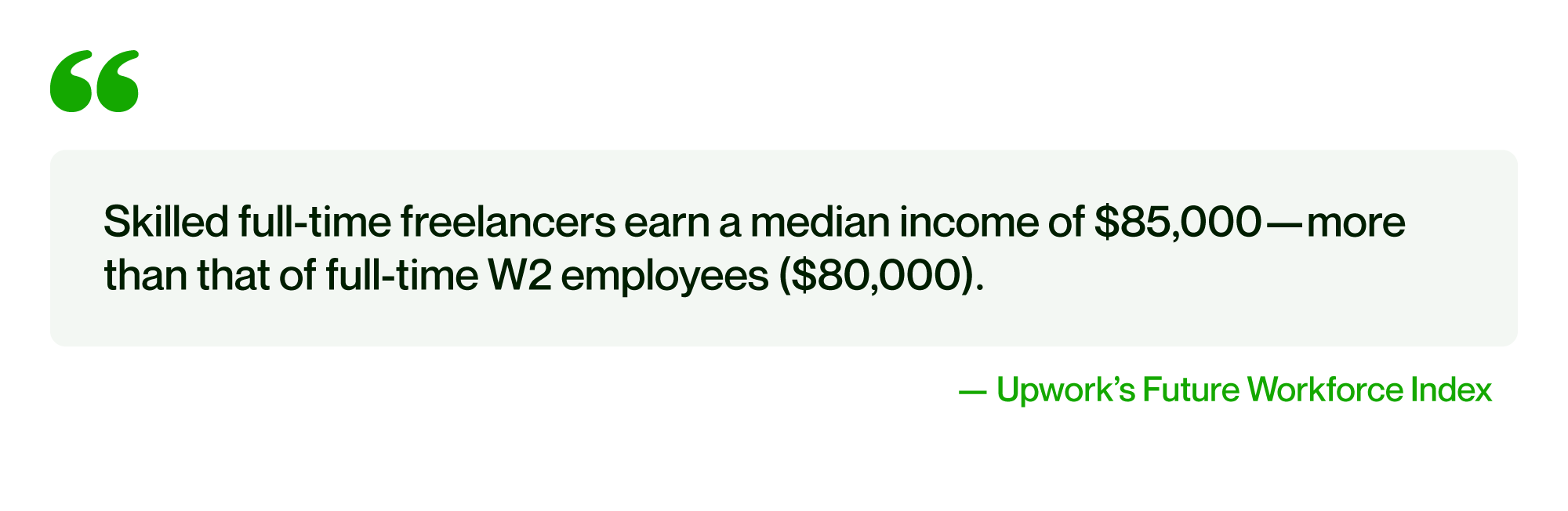
Independent professionals are not just growing in number—they’re also reporting higher incomes and greater satisfaction compared to traditional employees. According to Upwork’s Future Workforce Index, full-time independent professionals earn a median income of $85,000 annually, which outpaces the $80,000 median for full-time traditional employees.
Beyond pay, the benefits of remote work and flexible scheduling contribute to a higher quality of life. About 78% of independent professionals report satisfaction with their income, compared to just 64% of traditional employees. Many remote workers also appreciate the improved work-life balance that comes with telework and flexible work arrangements. In fact, 54% of skilled independent professionals now use online marketplaces to find remote jobs, showcasing the growing popularity of this work style.
The current landscape is full of opportunities for freelancers who prioritize autonomy, income control, and the ability to work from anywhere.
The rise of hybrid work models
The hybrid model has quickly become the go-to work arrangement for many organizations. It offers a balance between in-office work and remote flexibility, giving both employees and employers more control over how and where work gets done. Rather than returning to the traditional office for five days a week, many professionals now split time between home and a designated workspace.
As this work model gains traction, companies are rethinking their workspace needs and in-office expectations. Businesses are increasingly evaluating which roles require on-site presence and which can be managed remotely. This allows them to tap into a broader talent pool, including independent professionals who thrive in remote and hybrid environments.
It's no wonder 36% of skilled traditional employees are now considering a shift to independent work in search of better opportunities, according to Upwork’s Future Workforce Index.
Technology enabling remote collaboration

The success of remote work depends heavily on the tools that make virtual teamwork seamless. Over the past few years, technology has transformed the remote work environment from a temporary adjustment into a long-term solution. Platforms for communication, collaboration, and project management have made it possible for remote teams to operate with cohesion, even without in-person meetings.
Key tools powering remote collaboration include the following:
- Zoom is a go-to platform for virtual meetings, interviews, and team check-ins that supports both real-time collaboration and async updates.
- Slack enables quick communication between team members and departments, helping to replicate the in-office environment online.
- Trello and Asana streamline project management, letting remote teams assign tasks, track progress, and meet deadlines.
- Google Workspace and Microsoft Teams offer integrated tools for document collaboration, video conferencing, and file storage.
Independent professionals are leading the way in adopting these technologies. According to Upwork’s Future Workforce Index, 54% of freelancers have advanced AI skills, compared to just 38% of traditional employees. Additionally, 29% have extensive experience building and training machine learning models, outpacing the 18-20% of their traditionally employed counterparts.
These skills help freelancers stay competitive and deliver strong results while also reducing burnout by creating efficient workflows without constant employee monitoring.
How businesses leverage independent talent
Independent professionals are no longer viewed as a short-term fix—they’re a core part of how successful businesses scale, innovate, and stay agile. Business leaders increasingly recognize the value of tapping into flexible work options, especially as traditional models evolve to meet the demands of a dynamic workforce.
According to Upwork’s Future Workforce Index, 63% of C-level executives have worked independently at some point in their careers, and 42% of CEOs have done freelance or contract work that directly informs their current roles. This first-hand experience helps shape work policies that welcome nontraditional contributors and prioritize outcomes over in-office presence.
The top 25% of fastest-growing companies are embracing alternative talent strategies in big ways:
- 50% partner with managed service providers to scale quickly and efficiently.
- 45% integrate independent professionals across multiple business functions.
- 41% have a mature strategy driven by people and AI that supports scalable workflows.
- 39% collaborate with external agencies to expand their reach and capabilities.
These companies are rethinking their approach to full-time hiring while also reevaluating the use of office space, investing in hybrid work models, and adapting their work style to align with what the future holds.
Future predictions for independent work
As remote work trends continue to evolve, so does the outlook for independent professionals. The demand for flexible work arrangements and agile talent is expected to grow as businesses seek to balance innovation with cost-efficiency.
According to Upwork’s Future Workforce Index, 82% of skilled independent professionals believe they have more work opportunities now in 2025 than they did a year ago. In contrast, only 63% of traditional employees feel the same—highlighting how the future of remote work is especially favorable for freelancers and contractors.
Emerging trends like "work from anywhere" policies and virtual-first team cultures are shaping how organizations operate and how remote workers engage. Job seekers are prioritizing flexibility and personal autonomy, pushing companies to rethink their workspace strategies, team-building efforts, and hybrid model structures.
As new work arrangements become the norm, businesses and freelancers alike will need to stay adaptable, leveraging technology and human insight to navigate whatever the future holds. For remote workers and companies ready to embrace change, the opportunities are only growing.
How to thrive in the remote work landscape
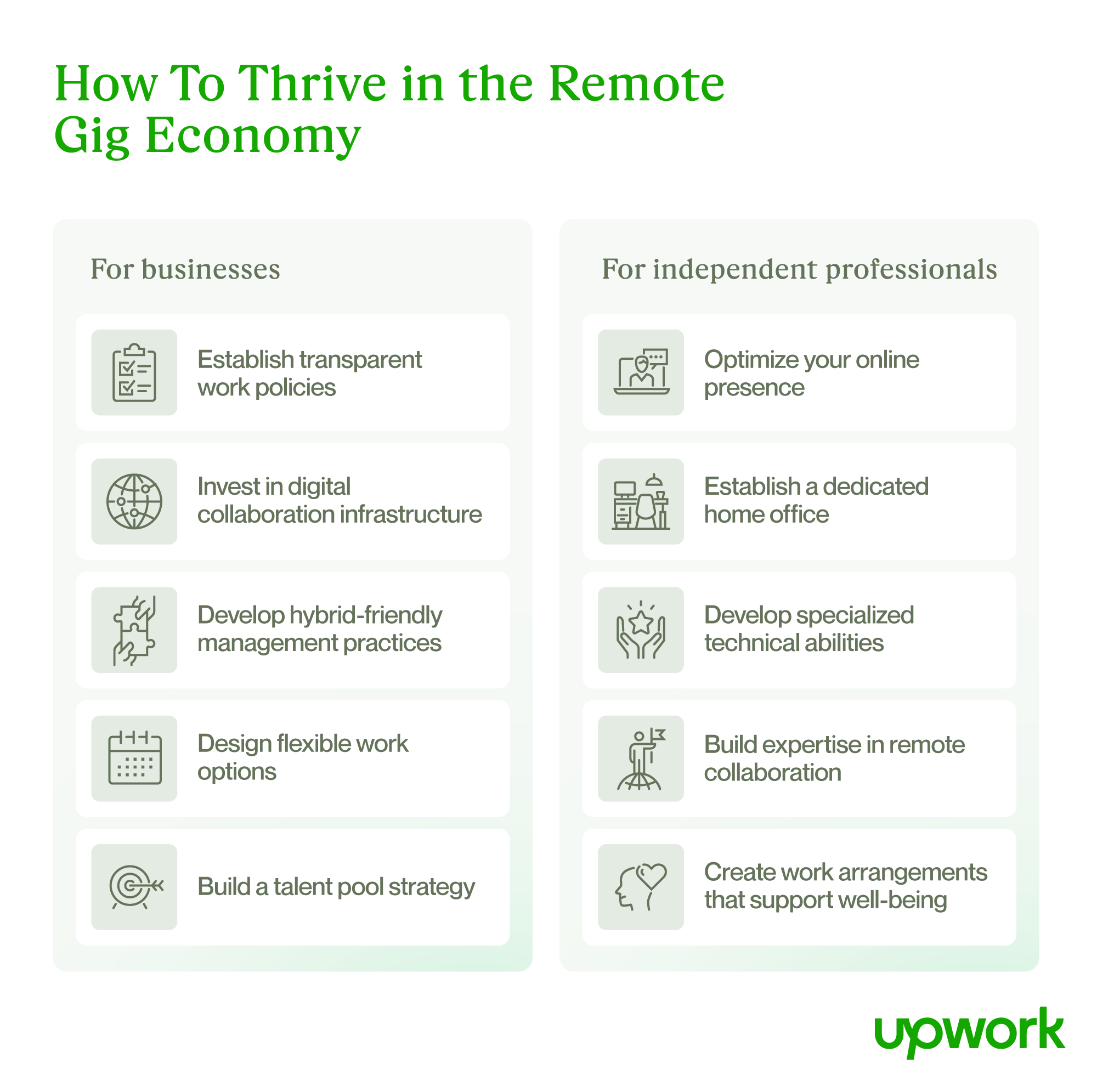
Adapting to the evolution of independent work requires strategic approaches from both businesses and talent. Creating a flexible work environment where both traditional employees and independent professionals can collaborate effectively is essential for sustainable growth.
For businesses looking to integrate independent talent:
- Establish transparent work policies. Create clear guidelines for remote teams, including communication expectations, project timelines, and evaluation metrics that focus on outcomes rather than activity monitoring.
- Invest in digital collaboration infrastructure. Implement secure platforms that enable seamless work across distributed teams, ensuring independent professionals have appropriate access to necessary resources while maintaining data security.
- Develop hybrid-friendly management practices. Train managers to effectively lead teams that combine traditional employees and independent talent, focusing on results rather than location or work schedule.
- Design flexible work options. Create various engagement models that accommodate different talent needs, from project-based contracts to ongoing retainer relationships that provide continuity.
- Build a talent pool strategy. Create a curated network of prevetted independent professionals who understand your business, reducing onboarding time for future projects and maintaining institutional knowledge.
Independent professionals can position themselves for success in this evolving landscape by developing specific strategies that enhance their marketability and work-life balance.
For independent professionals seeking opportunities:
- Optimize your online presence. Create a compelling profile on Upwork, highlighting specialized skills and quantifiable results from previous projects.
- Establish a dedicated home office. Invest in a professional workspace that supports productivity and creates clear boundaries between work and personal life.
- Develop specialized technical abilities. Pursue training in high-demand skills—particularly AI and machine learning, where independent professionals currently lead—to command premium rates and attract quality clients.
- Build expertise in remote collaboration. Master virtual communication tools and remote project management methodologies to demonstrate your effectiveness as a distributed team member.
- Create work arrangements that support well-being. Establish consistent availability hours, communication protocols, and workload management systems that prevent burnout while maintaining client satisfaction.
Reshaping the future of work
Independent professionals are driving change in how the world works. From the surge in remote jobs and flexible work arrangements to the adoption of hybrid work models and advanced tech skills, today’s talent looks vastly different than it did pre-pandemic. Remote employees and freelancers alike are pushing organizations to rethink traditional office structures, work policies, and what well-being means in a professional setting.
As work models evolve, one thing remains constant: Independent talent is here to stay. Whether through full-time freelancing or hybrid teams, businesses are embracing more agile ways of hiring, and professionals are choosing freedom, autonomy, and purposeful work over rigid routines. These shifts reflect a larger movement toward career paths shaped by choice and adaptability—not just job titles.
The future of remote work will continue to unlock new possibilities for how, when, and where we work. If you’re looking to build your team with expert freelancers, you can hire freelancers who bring specialized skills and flexibility. Or, if you're ready to take control of your own schedule and career path, find work that fits your lifestyle.

.avif)

Author Spotlight

Upwork is the world’s largest human and AI-powered work marketplace that connects businesses with independent talent from across the globe. We serve everyone from one-person startups to large organizations with a powerful, trust-driven platform that enables companies and talent to work together in new ways that unlock their potential.