The Freedom Premium: Why Skilled Freelancers Are Ahead of Their Full-Time Peers
Skilled, freelance knowledge workers aren’t just earning more than employees—they’re leading the way on being future-ready.

.png)
.avif)
According to a recent survey from The Upwork Research Institute, many skilled workers began freelancing for the freedom they felt it gave them in their careers. This included the freedom to create a flexible schedule. The freedom to be their own boss. And the freedom to find work they felt was meaningful. On top of that, highly skilled freelancers earn over 6% more than their full-time counterparts, bringing home a median income of $85,000.
And that’s just the beginning. Skilled freelancers are more likely to have hands-on experience with emerging technologies, excel at the uniquely human skills needed to collaborate with AI, and feel energized—not overwhelmed—by the pace of change.
Independent knowledge workers are earning more, are finding their work more fulfilling, and are leading the way on being future-ready.
Who are skilled freelance workers?
Skilled freelance workers are independent knowledge workers who use their highly specialized expertise to solve organizational challenges. To understand why they’re pulling ahead of their full-time employee counterparts, we need to distinguish knowledge workers from the broader freelance economy.
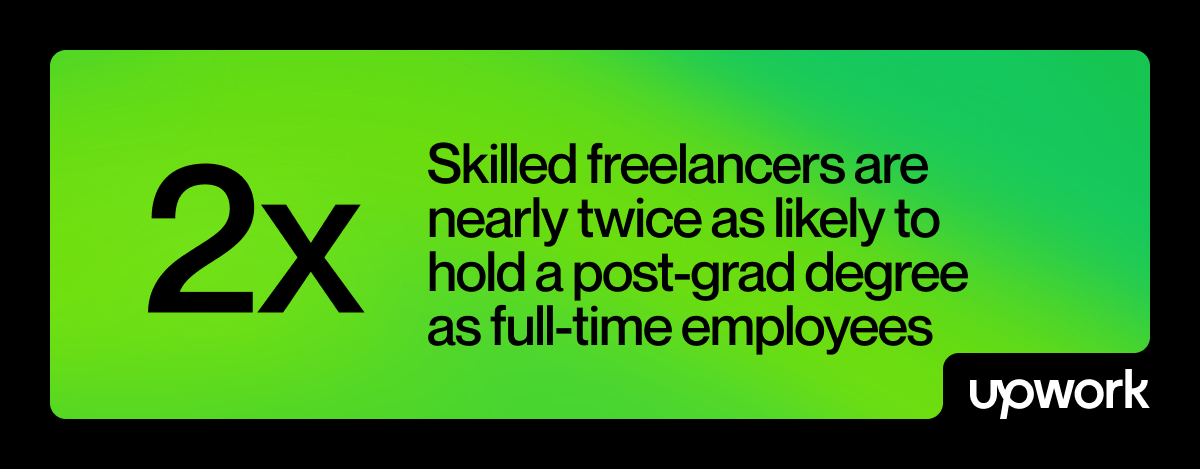
While some freelancers earn extra money through delivery driving, ride shares, and selling goods, skilled freelancers bring deep specialization to the table. Their skills are built over years of education, training, and real-world experience. In fact, our research shows that 37% of skilled freelancers hold post-graduate degrees. That’s nearly double the rate of skilled full-time employees (20%).
They apply their advanced expertise to solve complex business challenges in fields like AI, software engineering, marketing, and strategic consulting.
This isn’t task-based gig work. This is strategic, high-impact knowledge work.
The soft side of being future-ready
As AI becomes embedded across industries, the definition of “skilled” is shifting fast.
Being future-ready is about more than mere technical know-how. It’s also about human skills—how quickly you learn, how well you adapt, and how effectively you collaborate with both people and machines.
These soft skills are becoming critical career differentiators, especially as AI takes over more routine tasks and the value of uniquely human capabilities rises.
So, how prepared are today’s skilled professionals—both full-time employees and freelancers—for what’s next?
To find out, The Upwork Research Institute surveyed 3,000 skilled knowledge workers. Here’s what we learned.
The five traits of future-readiness (and how employees compare)
From our survey, we developed the Future Workforce Index, a framework for measuring how prepared today’s workforce is for what’s next.
The Index shows freelancers are doing more than keeping up—they’re setting the pace.
1. Expertise in fast-growing areas
Tech-forward roles like machine learning specialists and software developers are growing quickly. So are roles tied to the green economy, such as environmental engineers and renewable energy experts.
Compared to full-time employees (FTEs), skilled freelancers are ahead of the curve:
- 31% claim extensive experience in sustainability and renewable energy work (vs. 17% of FTEs)
- 29% have built or trained machine learning models (vs. 18–20% of FTEs)
- 35% have deep experience in software development (vs. 28% of FTEs)
2. Continuous learning and skill application
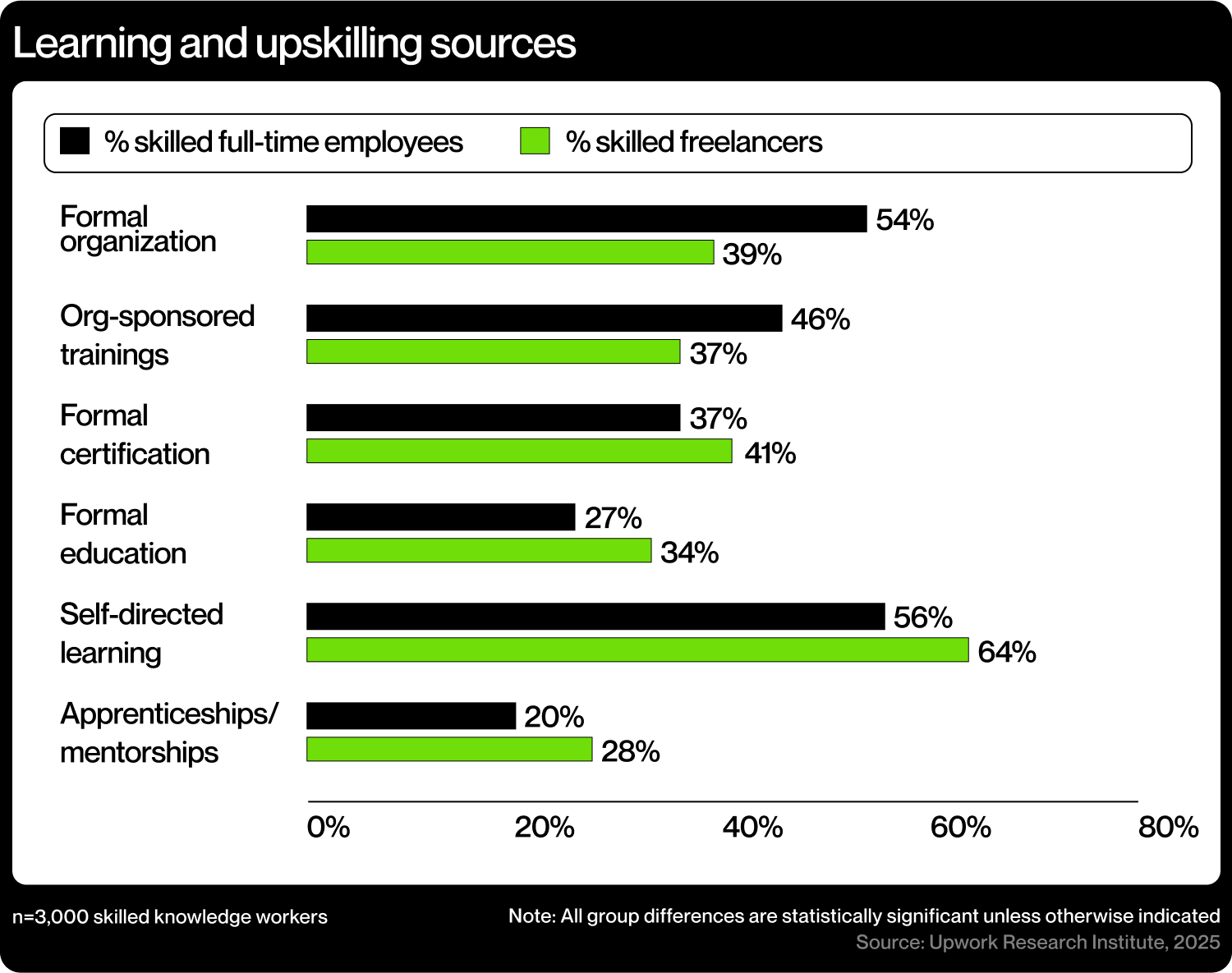
Both freelancers and full-time employees value ongoing learning. In fact most—87% of freelancers and 82% of FTEs—say they’ve picked up a new skill within the past six months.
The difference lies in how they’re learning.
Without access to company-sponsored training programs, freelancers take the lead in their own development. While 54% of full-time employees rely on formal training through their organizations, freelancers draw from a mix of sources.
3. Proficiency in AI
Freelancers’ multi-modal approach to learning really pays off when it comes to using AI tools professionally.
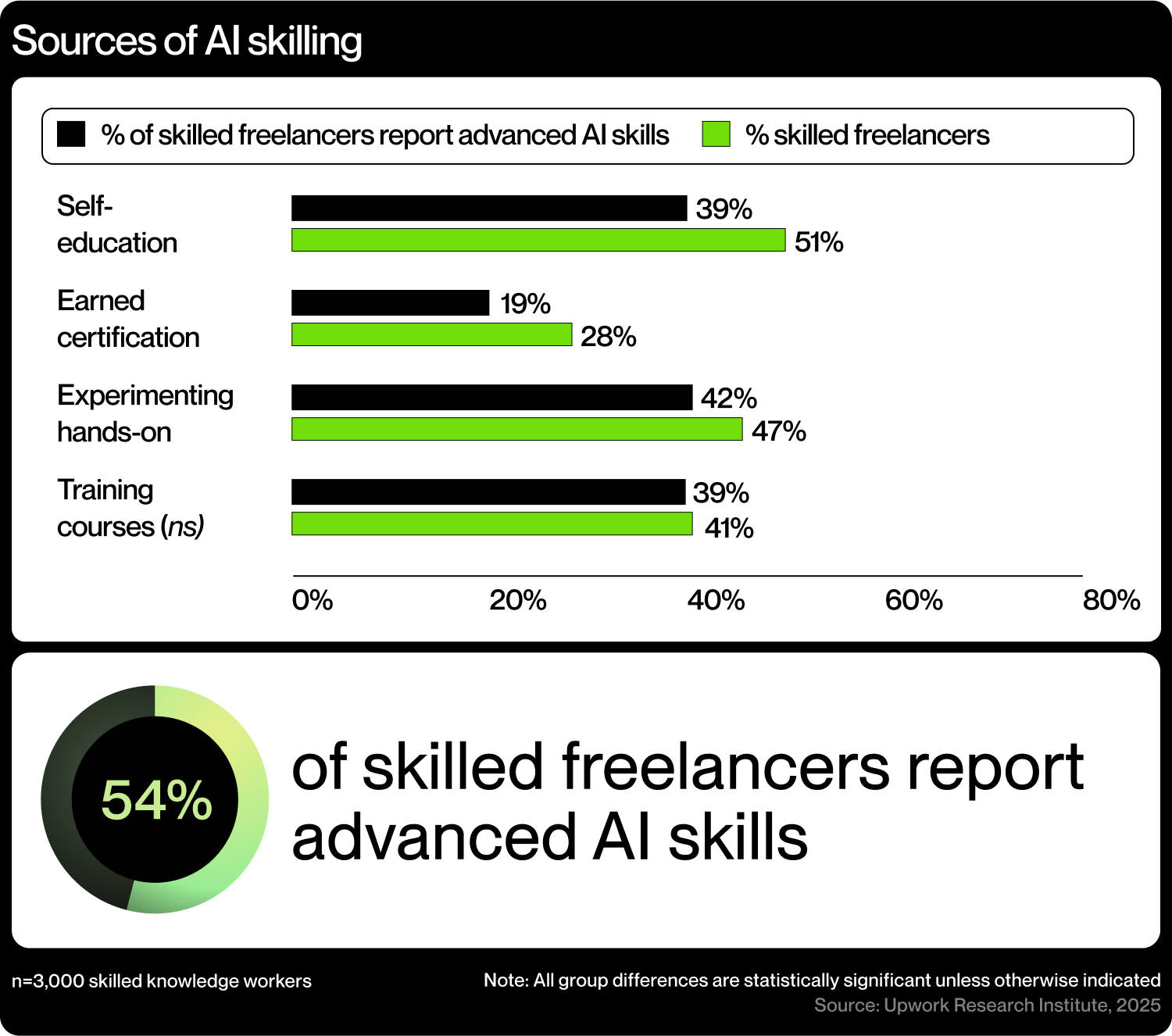
More than half (51%) of skilled freelancers are self-training on AI tools—compared to 39% of FTEs.
While both groups are equally likely to be enrolled in formal courses, freelancers tend to go further. They’re more excited about using AI tools and take a multimodal approach to learning.
The result: 54% of skilled freelancers report having advanced or expert-level AI skills vs. 38% of FTEs.
4. Uniquely human skillsets for an AI agent future
While technical AI skills are on the rise, human strengths are what will define success in an AI-enabled workplace.
As AI agents move from concept to reality, people will need to work alongside these tools—guiding, interpreting, and optimizing their output. To do that well, soft skills like creativity, adaptability, clear communication, and critical thinking become even more essential.
And this is where freelancers stand out again. More skilled freelancers report being experts in these human capabilities than their full-time peers:
- Problem solving (49% of freelancers vs. 44% of FTEs)
- Clear communication (47% vs. 40%)
- Critical thinking (43% vs. 38%)
- Adaptability (41% vs. 37%)
5. Motivation and energy to take on what’s next
Experience and technical skills matter, but motivation and mindset are just as critical for staying resilient in the face of constant change.
Work demands are rising. Most business leaders (81%) say they’re asking more of their teams than they were a year ago. Full-time employees—71% of whom report feeling burned out—are tired of the pressure.
Freelancers, in contrast, are stepping into the future of work with greater energy and optimism. A majority (83%) say their work contributes positively to their physical, mental, and emotional well-being.
Skilled freelancers are reshaping the workforce at scale
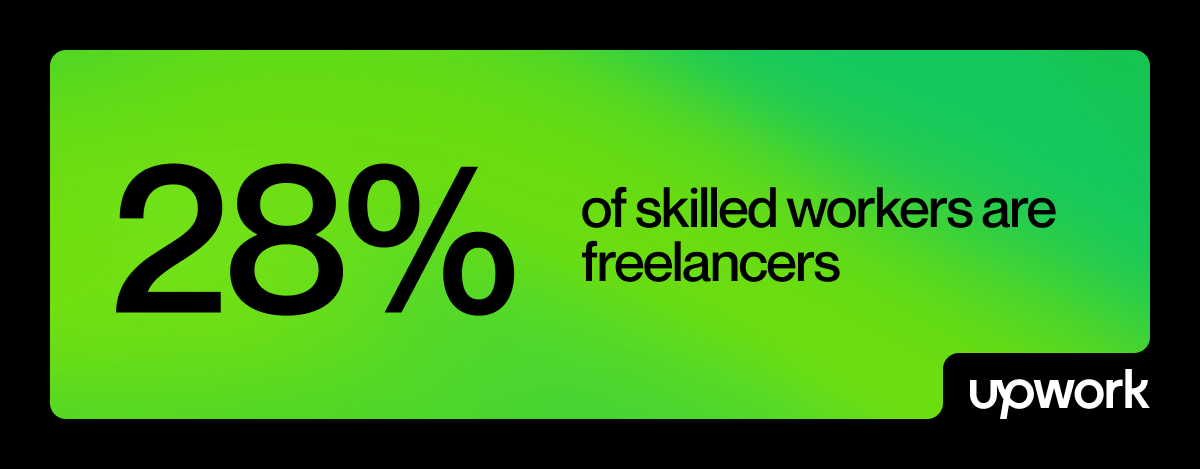
More than 1 in 4 (28%) skilled knowledge workers are freelancers or consultants. They’re driven by a desire for more freedom, financial agency, and control over their career growth, and to find work that is meaningful to them.
This shift is reshaping more than individual careers—it’s impacting the labor market at scale:
- In 2024, freelancers generated $1.5 trillion in earnings, with many out-earning full-time employees
- 36% of current full-time knowledge workers are considering the shift to freelancing
- Gen Z is leading the way, choosing independence from the start
This isn’t a fringe trend. It’s your future leadership—and your future workforce—choosing a different path from traditional work models.
What this means for workers
Choosing to freelance is about more than flexible hours or being your own boss. It’s about what freedom makes possible—faster learning, sharper skills, greater adaptability, and the confidence to navigate constant change.
Skilled professionals who lean into these traits gain what we call the freedom premium—a set of compounding advantages that come from working independently.
These advantages add up. And together, they make skilled freelancers consistently more future-ready than their full-time peers.
Skilled freelancers aren’t just keeping up with change. They’re leading through it.
What this means for businesses
The freedom premium presents a powerful advantage for businesses willing to adapt.
Work is moving faster. What gets done, how it gets done, and how quickly it needs to happen looks very different than it did just a few years ago. Talent is scarce, project-based work is the norm, and the most in-demand skills today may be outdated by next quarter.
This pace of change isn’t just a challenge—it’s an opportunity.
By moving beyond traditional, employee-only models, forward-thinking companies can unlock greater speed, flexibility, and access to specialized expertise. And just as importantly, it allows them to support their full-time teams more sustainably—by reducing burnout, filling skill gaps faster, and ensuring the right people are focused on the right work.
Adjusting how we build teams isn’t only good for business; it’s also good for the people inside it.
A new standard for what comes next
Being future-ready takes more than technical skills. It requires a mindset built for adaptability, relevance, and long-term growth in a world where change is constant.
That’s where skilled freelancers lead, and where businesses have a real opportunity to evolve.
In a landscape where speed, agility, and innovation are essential, companies need a workforce that can keep pace. That means looking beyond traditional, employee-only models and tapping into the growing pool of independent professionals already working at the leading edge.
The companies that will shape what’s next are building teams designed for the future.
Explore more in the full Future Workforce Index.

.avif)

Author Spotlight

Dr. Gabby Burlacu is Senior Research Manager at Upwork, where she studies how organizations are adjusting their cultures and talent practices to access skilled talent in a rapidly evolving world of work. Her research has been featured in a variety of peer-reviewed studies, articles, book chapters, and media outlets, and has informed strategy and technology development across a range of Fortune 500 companies. Gabby holds a Ph. D. in industrial-organizational psychology from Portland State University.