Types of Talent Needed in the Age of GenAI
Succeeding in the age of AI requires a talent infrastructure built on agility, flexibility, and speed. See the types of talent you need and how to get them.

.png)
.avif)
Unlike early days when one or two teams experimented with GenAI, the technology is so accessible now that it’s used in nearly every function to cut costs, offer more personalized and efficient customer service, and solve problems faster.
For example, shipping giant UPS uses the technology to optimize driver routes so packages are delivered faster. Beauty retailer Sephora is using GenAI to provide customers with personalized beauty recommendations based on a selfie. Mastercard uses GenAI to detect fraudulent transactions in real time for greater customer protection. Pharmaceutical company AstraZeneca uses GenAI to identify new drugs and get existing drugs to market faster.
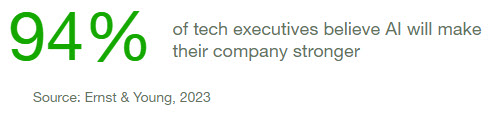
GenAI carries so much potential for innovation that most tech executives (94%) think it will help them come out of the current economic uncertainty stronger than before.
Emerging stronger is a big wish, and completely realistic—but not if you only focus on the technology.
Your talent infrastructure is as important as your technical infrastructure, according to Karim Lakhani, Harvard professor and author of "Competing in the Age of AI: Strategy and Leadership When Algorithms and Networks Run the World."
The thing is, your talent infrastructure is more than the AI specialists you hire.
Start from the top
In addition to accessing the right technical talent, such as data scientists and machine learning experts, business executives and managers must understand their tech stack well enough to know what it can do.
“You must understand what you can do with the technical stack from a digital strategy perspective, from a data-driven marketing perspective, from an operations perspective, from a leadership perspective, and from a people perspective,” Lakhani said in an interview with the Center of Applied Data Science. Only then can you begin to use GenAI strategically.
In fact, he believes that understanding GenAI is a requirement for being an effective leader. He often emphasizes this point by saying, “AI is not going to replace executives and managers. But executives and managers with AI are going to replace executives and managers without AI.”
“AI is not going to replace executives and managers. But executives and managers with AI are going to replace executives and managers without AI.”
— Professor Karim Lakhani
Listen to Work Week: How Will AI and Automation Reshape Our Jobs?
4 types of AI talent
Once you understand how to squeeze every drop of potential out of generative AI, you can concentrate on building a team to make it happen. At a very high level, AI talent can be categorized into four types:
- Talent for inputs. Cleans data, builds, feeds, and trains models. “Neural networks learn tasks based on a specific dataset and can only learn from what’s available,” said Richard Alexander, a deep learning freelancer on Upwork. “The single best step we can take to drive success with deep learning projects is creating a strong dataset from the very beginning.”
- Talent for outputs. Checks quality and accuracy and removes biases. “No product is 100%,” said Jennifer Davis, an MLOps freelancer on Upwork. “That just doesn't happen because it's overtrained or overfit. And when a product is overtrained, it will perform very badly on new data. So, you always need humans to monitor the algorithm.”
- Talent for systems. Builds and maintains applications and systems. “If you’re going to incorporate AI, you want to make sure it’s actually going to benefit you at scale,” said autonomous AI expert Abay Bektursun. “If it does, find someone to do a prototype, then keep iterating on that.”
- Talent for governance. Ensures AI works in alignment with company values, ethically, and without bias. “Organizations must be very mindful of the ethical side of all of this because machines don’t have ethics; humans do. There should always be a human in the loop, no matter which AI you're using,” said Jennifer Davis.
No time to wait and see
Your talent infrastructure must also be designed for fast access to the right skills. When Upwork analyzed GenAI-related searches by companies on its platform quarter over quarter, the data showed businesses are moving from singular generative AI tools to generative AI applications and services.
What this suggests is how businesses use generative AI is maturing. And it’s happening so quickly that the skills you need now may not be the skills you need six months from now.

Ajay Agrawal, author of “Power and Prediction: The Disruptive Economics of Artificial Intelligence” calls this period “The Between Times.” That is the time when people are seeing the technology’s capability and are leveraging its potential through widespread adoption.
The two most common strategies for adopting technology during The Between Times are to:
- Wait and see: Let someone else make the mistakes and be a fast follower
- Lead: Be an early mover, collect data sooner, learn quicker, and improve faster
Leading is riskier and both are usually smart strategies. But Agrawal says, when it comes to AI, it may be wiser to take the risky approach.
That’s because AI learns with use. The more you use it, the more capable it becomes. So people who take the lead have an advantage that makes it harder for people to catch up.
Take autonomous vehicles for example. Let’s say autonomous vehicles are released in your city. Sensors collect data every time people grab the wheel because the car is doing something they don’t like. Every time they grab the wheel, they’re training the AI. Twelve months later, a second autonomous car company enters the market.
The first car company had a year of data to train its AI—would you want to be in a car with the second-best AI? Probably not. That’s what makes the wait-and-see strategy so risky.
How to deliver by yesterday
To meet the need for speed, Agrawal believes companies must rethink the design of their business to extend capacity with the speed and flexibility required. At the very least, companies must decide what percentage of work should be done in-house vs. by freelance or fractional talent.
Professor Lakhani of Harvard agrees. “Technology transformation requires courage. You will have to change the architecture of your company. You will have to change your operating model. You will have to change your business model.”
So where should you start? Lakhani suggests focusing on use cases that will deliver customer value, and then creating a system where you can rapidly prototype and test customer value through AI.
It may be tempting, but you probably won’t be able to muscle your old processes and talent model to work with the agility and flexibility required to compete in the age of GenAI. “Don't wait for AI systems that are going to take nine months or a year to come through,” said Lakhani. “Force your teams to create a prototype in three to four months. The prototype doesn't have to be amazing; it has to show proof of concept. Once you know it works, figure out a way to implement and scale it. Then iterate to make it better.”
Excel in the age of GenAI with Upwork
In the age of GenAI, speed is survival. How well you survive is determined one algorithm at a time. “The time to start is now,” stressed Lakhani. “What matters are the algorithms you develop and the customer value you can create from those algorithms. In order to do that, you need the talent.”
Upwork has been providing top AI talent for years. Get amazing things done faster by leveraging the immense experience that AI experts from Upwork provide. See how you can use the technology to reach your company’s potential by visiting the Upwork AI Services hub.
Upwork does not control, operate, or sponsor the tools or services discussed in this article, which are only provided as potential options. Each reader and company should take the time to adequately analyze and determine the tools or services that would best fit their specific needs and situation.

.avif)

Author Spotlight

Brenda Do is a direct-response copywriter who loves to create content that helps businesses engage their target audience—whether that’s through enticing packaging copy to a painstakingly researched thought leadership piece. Brenda is the author of "It's Okay Not to Know"—a book helping kids grow up confident and compassionate.