
By Dr. Rakesh K. Yadav and Jennifer Brett, Ph.D.
Key Insights
- One of the most interesting trends we’re seeing on the Upwork Marketplace is that jobs for people to improve AI-generated work are growing 70% year over year
- Since 2023, the number of Upwork jobs asking humans to improve AI-generated work has increased more than eightfold in software development
- In the Design & Creative category, these job posts have grown almost 8x in the same time period
AI output is just the first draft
As organizations adopt AI tools, they are also discovering a persistent challenge: getting AI output from a first draft to something accurate, polished and production-ready. When that human refinement is missing, the result is often defined as "AI slop".
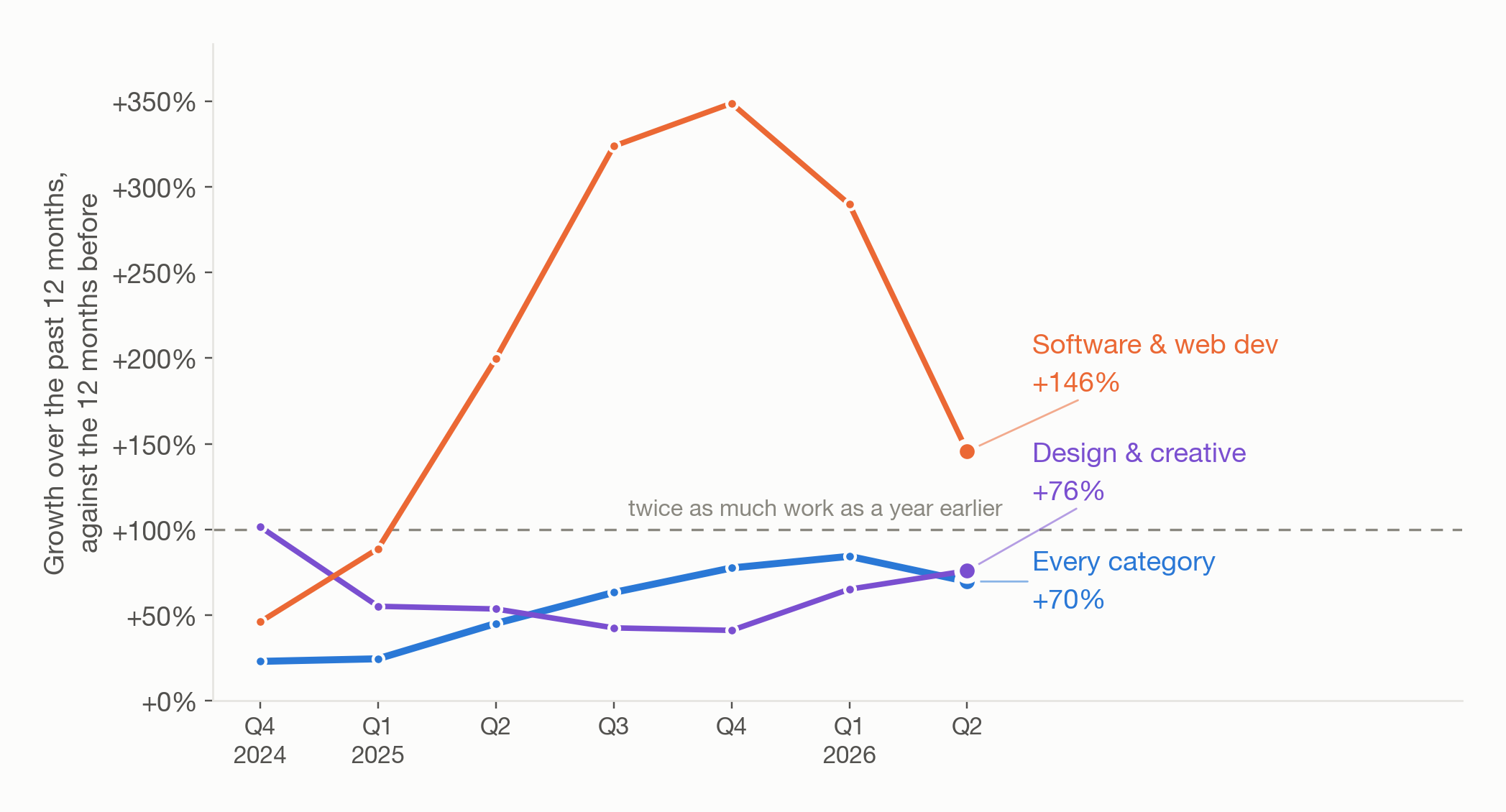
That challenge is showing up in the labor market. Upwork’s Data Science team analyzed job posts on the Upwork Marketplace and found that demand for people to fix, refine, or finish AI-generated work is growing rapidly: these AI-remediation job posts are up 70% year-over-year, based on a trailing 12-month average (see figure 1).
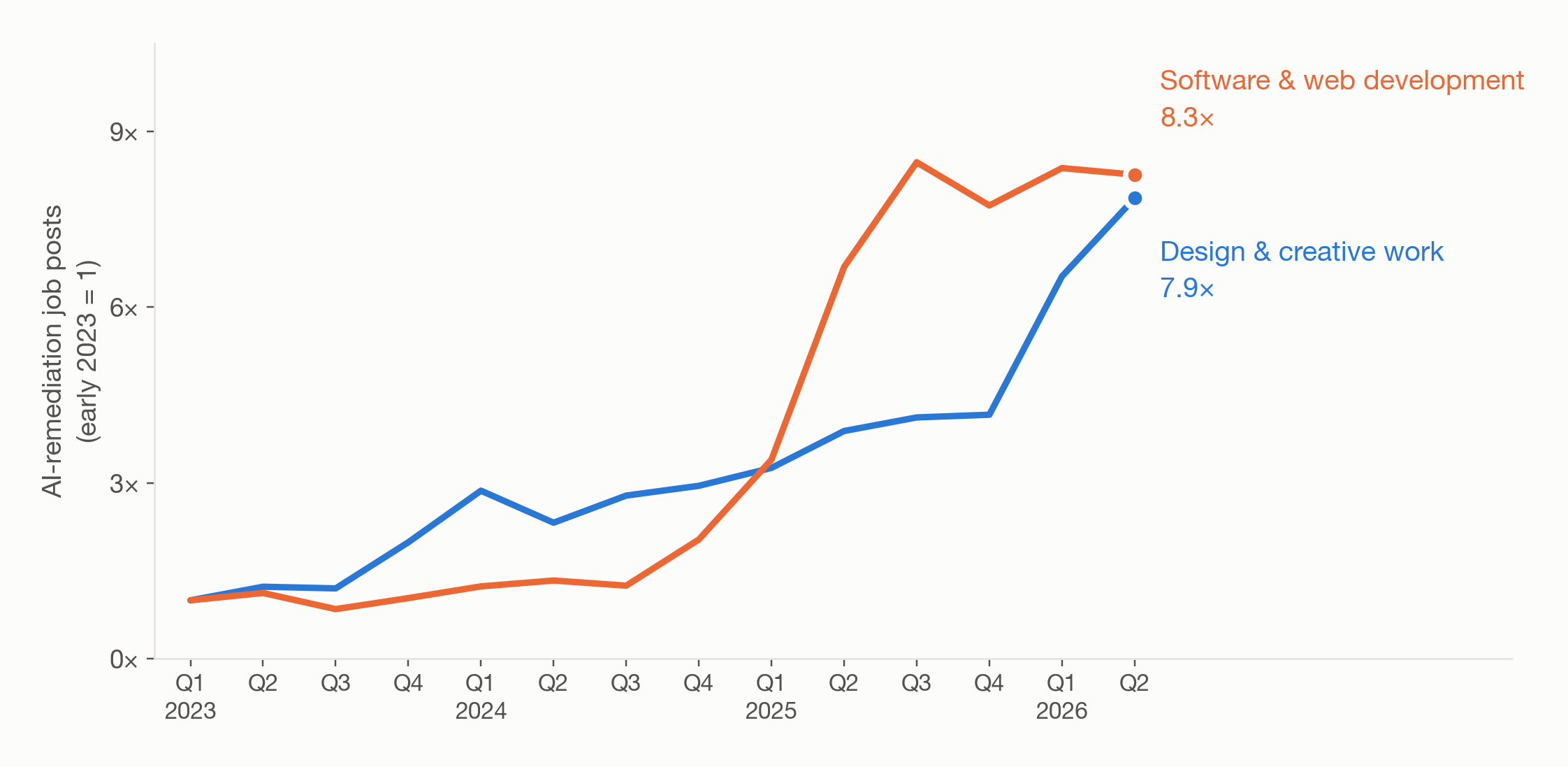
The growth is even more pronounced in software and creative work, where AI-remediation job posts have grown 8.3x and 7.9x, respectively, since 2023.
This trend points to an important way AI is changing work: AI can accelerate production, but organizations still need human expertise, judgment and quality control to turn that output into high-quality work.
Figure 1. 12-month trailing average growth rate of AI-remediation job posts by job category
Source: Upwork Marketplace data, Q4 2024 - Q2 2026
AI remediation is rising in software and creative work
The pattern is particularly pronounced in two categories where quality, judgment and specialized expertise are critical: Figure 2 shows that AI-remediation job posts in Software & Web Development have grown 8.3x and in Design & Creative have grown 7.9x since 2023.
In software development, the growth in demand accelerated from 2025 onward. More recently, growth has moderated, but demand remains strong, with these job posts still growing almost 150% year-over-year (figure 1). This suggests that organizations may be adapting to AI-assisted coding workflows while retaining an important role for human review and oversight.
The same dynamic is playing out in creative work. The acceleration in Design & Creative AI-remediation job posts suggests that clients are continuing to work through the challenges of incorporating AI-generated images and video into production workflows. The growth coincides with the expanding availability of tools for AI image and video generation.
The need is visible in the work clients are posting on the Upwork Marketplace. One software client wrote that an initial design created with an AI tool "feels generic AI generated" and "needs a human touch." In creative work, another client sought a freelancer to "refine AI-generated illustrations and format a children's book for print."
Figure 2. AI-remediation job post volume in SWD and Design & Creative job categories
Source: Upwork Marketplace data, Q1 2023 - Q2 2026
AI is changing the work, not eliminating the need for people
The rise of AI-remediation work points to a broader challenge with AI adoption: avoiding “AI slop” by putting the right human expertise in the loop. AI can produce a first draft, generate code, create an image, or assemble a video much faster than before. But getting that output to a professional, production-ready standard still requires human expertise, judgment and quality control.
In other words, AI is changing who does what rather than simply eliminating the underlying task. Organizations are increasingly using AI to complete parts of a workflow while relying on people to evaluate the output, identify problems, apply domain expertise and finish the work. This finding is reinforced by Upwork's previous work on the Human+Agent Productivity Index (HAPI), which quantifies the impact of humans and AI agents collaborating on real client work, showing that as AI-generated output scales, the demand for skilled human oversight grows in parallel.
Freelancers are particularly well positioned for this shift because organizations can bring in specialized talent for specific AI-related tasks without first creating a new full-time role. They may need someone to review AI-generated code, refine a design, edit a video or take an AI-generated draft through production.
Data from the Upwork Marketplace suggests those tasks are becoming more specific as AI adoption matures. In Design & Creative, for example, clients are increasingly searching for specific production skills such as AI User Generated Content video, AI animation, AI video generation and AI video ads rather than broad AI-content skills.
These findings point to a growing role for the human in the loop. The workers best positioned to benefit may be those who combine AI fluency with the skills AI cannot easily substitute for: domain expertise, judgment, quality control, creativity.
AI is not just automating tasks. It is changing the tasks people perform, and creating new opportunities for specialized talent to work alongside it.
Methodology
Scope. We measure demand caused by AI output — clients hiring a human to fix, finish or clean up something an AI already produced. That is a statement about what caused the work, not about what the work is. In each of the twelve marketplace categories, we took a 50% sample of job posts from January 2023 to June 2026 and read every post.
Method. Every post was independently read by three different AI models, each asked what role AI played in the situation the client describes — did AI make the thing, or is the client merely using AI? — rather than for a yes-no label. A post counts only when all three models independently agree. The three LLMs were chosen because they make different mistakes, so agreement between them is meaningful. Requiring unanimity makes every figure a conservative floor.
Tech: three open-weight LLMs: gemma-4-26B-A4B, gpt-oss-20b, and Qwen3-30B-A3B-Instruct-2507 served on 8 H100 Nvidia GPUs.
About the authors
Dr. Rakesh K. Yadav is a Lead Data Scientist at Upwork, where he focuses on developing data science-driven products and quantitative models to optimize the platform’s two-sided marketplace. Prior to joining Upwork, he served as a Senior Data Scientist at CVS Health, leading the development of large-scale time-series forecasting frameworks, and was a Research Scientist at Harvard University specializing in computational fluid dynamics. He holds a Ph.D. in astrophysics from the Max Planck Institute for Solar System Research, Germany.
Jennifer Brett, Ph.D., is the managing director of The Upwork Research Institute, where she leads research and thought leadership on the future of work, including AI, flexible talent, and evolving workforce models. She is a research and insights leader with more than 15 years of experience translating data, market signals, and human behavior into strategies, narratives, and business impact. Jennifer has held senior insights leadership roles at Attentive and LinkedIn across the U.S. and Europe, and previously served as an industry analyst at Google. She holds a Ph.D. in political science from Trinity College Dublin, with academic training in research design and quantitative and qualitative methods.






Join the world's work marketplace
Find great talent. Find great work. Are you ready to move your business or career forward?
%20(1).png)