The Future Workforce Index 2026: AI, Freelancing, and the New Value of Work

By Jennifer Brett and Teng Liu
Executive summary
Freelancing offers an early signal of where the broader labor market may be headed as AI reshapes the value of work. Upwork’s Future Workforce Index 2026 shows that AI skills already command a premium, but the story is becoming more nuanced: Lower-complexity AI execution work is growing quickly while earnings decline, and more complex AI-augmented professional work is rising in value. The Future Workforce Index is Upwork’s annual research report on the future of work, exploring how AI adoption, workforce models, and changing career preferences are reshaping skilled work. The 2026 Index combines proprietary Upwork marketplace insights with survey data from skilled professionals to identify emerging labor market trends across full-time employees and freelancers.
This divergence points to the emergence of new, higher-value roles for workers who can connect AI tools to real workflows, apply human judgment, and turn AI-enabled execution into business outcomes. At the same time, a sharp rise in full-time employees considering freelancing suggests that workers are reassessing traditional employment as work conditions, career development, and workplace culture remain in flux.
- Freelancers are a leading indicator of how AI may reshape the broader labor market. Because freelancers often adopt new tools quickly, repackage their services, and respond directly to market demand, their work offers an early view into how AI skills are being valued and how new forms of work are emerging.
- AI is creating a divergence in the value of work. Freelancers performing AI work on the Upwork Marketplace earn 34% more per hour than those not incorporating AI, but not all AI work is becoming more valuable. Generative AI and creative production work saw 90% year-over-year growth in contract starts while per-contract earnings declined 13%, suggesting that lower-complexity AI execution may become less lucrative as it scales.
- Complex AI-augmented work is driving higher earnings and new roles. AI-augmented professional services grew 72% year over year and saw earnings rise 22%, while freelancers doing more complex work with AI saw earnings increase 45%. This points to the rise of the “AI orchestrator”: a worker who combines AI fluency with domain expertise, judgment, workflow design, and business impact.
- More full-time employees are considering freelancing as work conditions remain in flux. Skilled freelancing rose from 28% of skilled knowledge workers in 2025 to 38% in 2026, while 58% of full-time employees now say they’re considering freelancing to better access professional opportunities, up from 36% the year before.
Introduction
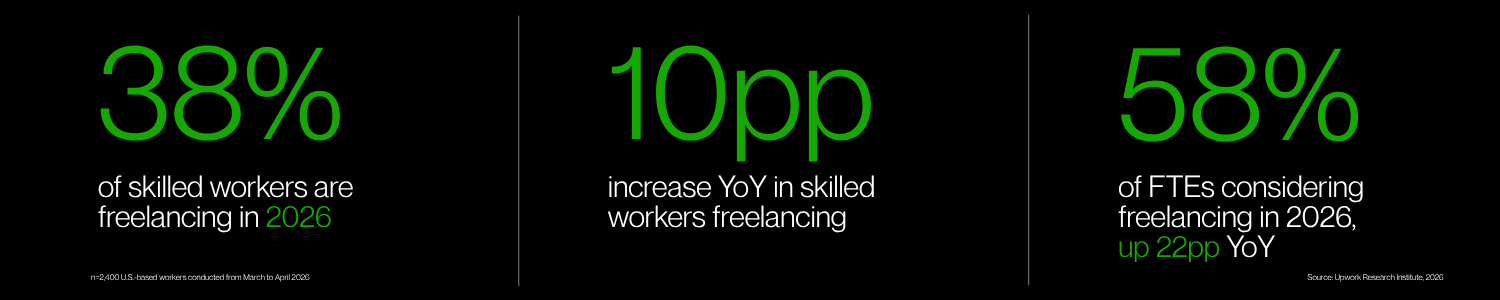
The AI era of work has arrived, changing how work is performed, how skills are valued, and how workers choose to build their careers. Upwork’s Future Workforce Index 2026 shows this shift happening fastest at the edges of the labor market, where freelancers are moving quickly to test new tools, repackage their services, and respond to changing demand. Skilled freelancing itself is accelerating: 38% of skilled workers are freelancing in 2026, up from 28% in 2025. Because freelance work is more directly exposed to market pricing, it offers an early signal of how AI is reshaping the value of emerging skills.
Figure 1.
The rise of the AI orchestrator
The 2026 data shows a clear pattern: AI skills already command a premium, but not all AI work is becoming more valuable. Lower-complexity AI execution tasks are growing quickly as earnings for these tasks decline, while more complex AI-augmented professional work is seeing earnings rise. This points to the emergence of a higher-value role in the labor market: the AI orchestrator.
.png)
At the same time, full-time employees are adopting AI faster than many organizations are prepared to support. Workers are experimenting, learning, and in many cases using AI without formal guidance, creating risks around “shadow AI,” but also a major opportunity. Businesses that can harness worker-led experimentation and pair it with strategic talent models will be better positioned to capture AI’s value.
Freelancers are giving the broader labor market a preview of what comes next. AI is making some work faster and more plentiful, but less lucrative as it scales, while making other work more valuable: the work of connecting tools to strategy, outputs to outcomes, and automation to human judgment. This is where the new value of work is beginning to emerge. Read on for the findings and what they mean if you’re a business leader, a freelancer, or considering moving into freelance work.
“We're an AI company that believes humans still play a vital role. Keeping humans in the loop is central to how we operate.”
Sam Wright, Head of Operations and Partnerships, Huntr
Takeaway 1: Freelancers are a leading indicator of how AI will change the value of work
The freelance market provides an early view into how AI is reshaping the value of work because freelancers often move faster than traditional organizations: adopting new tools, testing new services, and responding directly to shifts in client demand. That signal has been visible for several years: Upwork’s Expanding the Frontier 2024 report found 268% year-over-year growth in AI-related jobs in nontechnical fields such as design and marketing on Upwork Marketplace. Now, PwC’s 2026 Global AI Jobs Barometer shows a similar pattern in the broader labor market, with AI creating a two-track economy of work. These findings suggest that AI expands opportunity when it helps people move into more complex, higher-value work.
Demand Is Growing. Value Is Splitting.
Upwork Marketplace data from 2026 shows that AI skills already command a meaningful premium: Freelancers performing AI work earn 34% more per hour than those not incorporating AI, across every work category (as experienced by this marketing automation freelancer who embraced AI). Freelancers are also ahead of full-time employees in applying AI agents to complex work, with 41% using AI agents for autonomous task execution compared with 34% of full-time employees.
Figure 2.
.png)
But the value of AI work is beginning to diverge. Lower-complexity AI execution tasks, i.e. AI work that generally focuses on producing discrete outputs, such as text, images, or video, are growing quickly, yet becoming less lucrative as they scale: Generative AI and creative production work saw 90% year-over-year growth in contract starts, while per-contract earnings declined 13%. Overall, AI-based execution tasks saw earnings fall 28% year over year.
By contrast, more complex AI-augmented work is gaining value. AI-augmented professional services grew 72% year over year and saw earnings rise 22%, while freelancers doing more complex work with AI saw earnings increase 45% in Q1 2026. The data reveals where value is moving: AI is increasing demand, but the earnings premium is moving toward workers who can apply it to higher-value outcomes.
Figure 3.
.png)
The AI orchestrator: where value is heading
This is where the “AI orchestrator” role begins to take shape: a worker who’s not simply a prompt user or tool operator, but someone who understands business goals, selects and coordinates the right tools, manages AI agents and workflows, evaluates output quality, and applies human judgment where context matters. As AI becomes more embedded in everyday work, the labor market is likely to reward people who can operate at this intersection of technical fluency, commercial awareness, judgment, communication, and accountability.
But this shift also exposes a gap inside traditional organizations: If AI’s value depends on workflow design and business context, companies need more than access to tools. They need structures that help workers experiment safely, build AI fluency, and connect individual adoption to organizational outcomes.
Takeaway 2: Traditional organizations are at risk of falling behind worker-led AI adoption
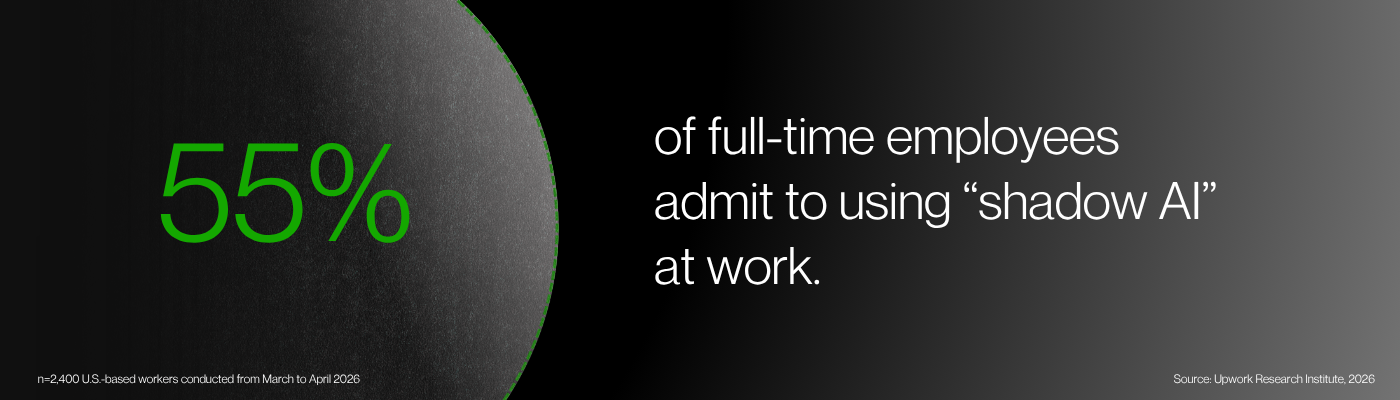
AI adoption is not limited to freelancers. Full-time employees are also closing the AI gap, but many are doing so without sufficient support from their employers. The 2026 survey data shows that 55% of full-time employees admit to using “shadow AI” at work (i.e., employees using AI tools for work without formal approval or guidance from their organization). Meanwhile, 68% want more leadership support to experiment with AI tools, and 78% seek learning opportunities outside their organization when they’re not getting enough through work.
Figure 4.
These findings point to a widening gap between worker behavior and organizational readiness. Employees aren’t waiting for formal AI strategies to be finalized. They’re experimenting with tools, looking for ways to increase productivity, and building skills independently. In many cases, they’re doing so because they believe AI is important to their future employability and professional growth.
For organizations, this creates both risk and opportunity.
The risk: AI adoption happens informally, inconsistently, and without adequate guardrails. Shadow AI can expose companies to issues around data privacy, security, quality control, compliance, and reputational risk. Employees may use tools that aren’t approved, upload sensitive information, or rely on AI-generated outputs without sufficient review.
The opportunity: Worker-led AI adoption shows that employees are motivated to learn and experiment. Businesses don’t need to create demand for AI from scratch; in many cases, the demand already exists inside the workforce. The challenge is to channel that energy into responsible, strategic, and outcome-focused adoption.
Organizations that move too slowly may fall behind in two ways. First, they may fail to capture productivity gains that employees are already trying to unlock. Second, they may lose talent to more flexible work arrangements or employers that provide better opportunities to build AI skills.
The SMB Advantage
This shift is especially important for small and medium-sized businesses. SMBs may not have large transformation teams, AI centers of excellence, or extensive training budgets, but they can often move faster than larger organizations by setting practical guidelines, identifying high-impact use cases, and bringing in specialized freelance talent to support implementation without building every capability internally.
The data also shows that leadership matters: Workers want more than access to tools; they need clear expectations, safe ways to experiment, and training that connects AI skills to real work. Businesses that provide that structure will be better positioned to turn bottom-up experimentation into enterprise value. Those that don’t may see workers look elsewhere to build skills, apply AI, and capture the value of their expertise – one reason skilled freelancing is accelerating as workers reorganize around the new value of work.
Takeaway 3: Freelancing’s acceleration shows how quickly the labor market can reorganize around new value
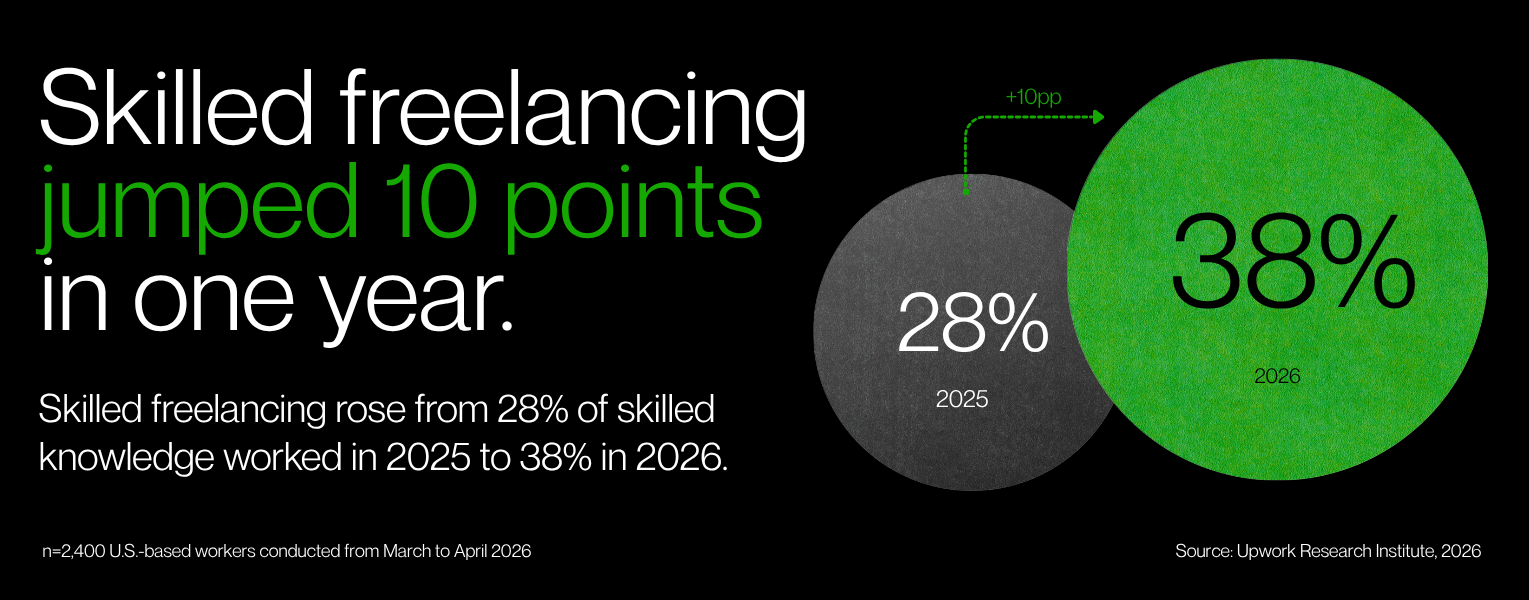
The acceleration of freelancing shows how quickly the labor market can reorganize when workers see new opportunities to learn, earn, and apply their skills. The survey data reveals that skilled freelancing rose from 28% of skilled knowledge workers in 2025 to 38% in 2026. At the same time, 58% of full-time employees now say they’re considering freelancing to better access professional opportunities, up from 36% the year before.
Figure 5.
The changing full-time landscape
This shift reflects more than a preference for flexible work. It suggests that workers are responding to a changing opportunity landscape. As AI reshapes which skills are valuable, many professionals are seeking more control over how they build expertise, choose projects, apply new tools, and monetize their capabilities.
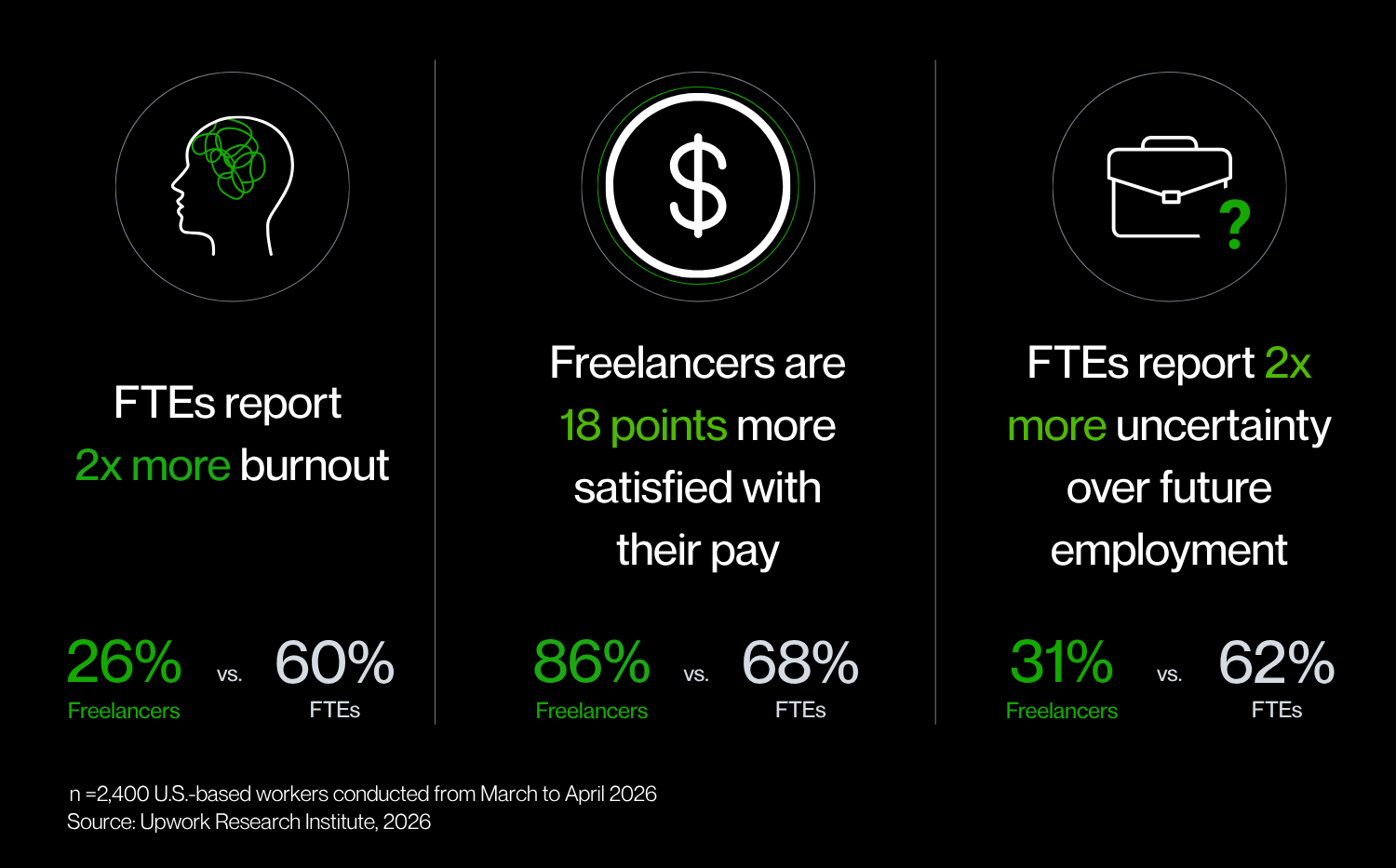
The rise in interest in freelancing may also reflect pressure within traditional employment. Full-time employees are navigating burnout, dissatisfaction with pay, and a lack of certainty over future employment (see Figure 6). When workers don’t feel that their organizations are adequately supporting them, they may look elsewhere for growth, autonomy, and opportunity.
Figure 6. Freelancers vs. FTEs on key sentiments toward work
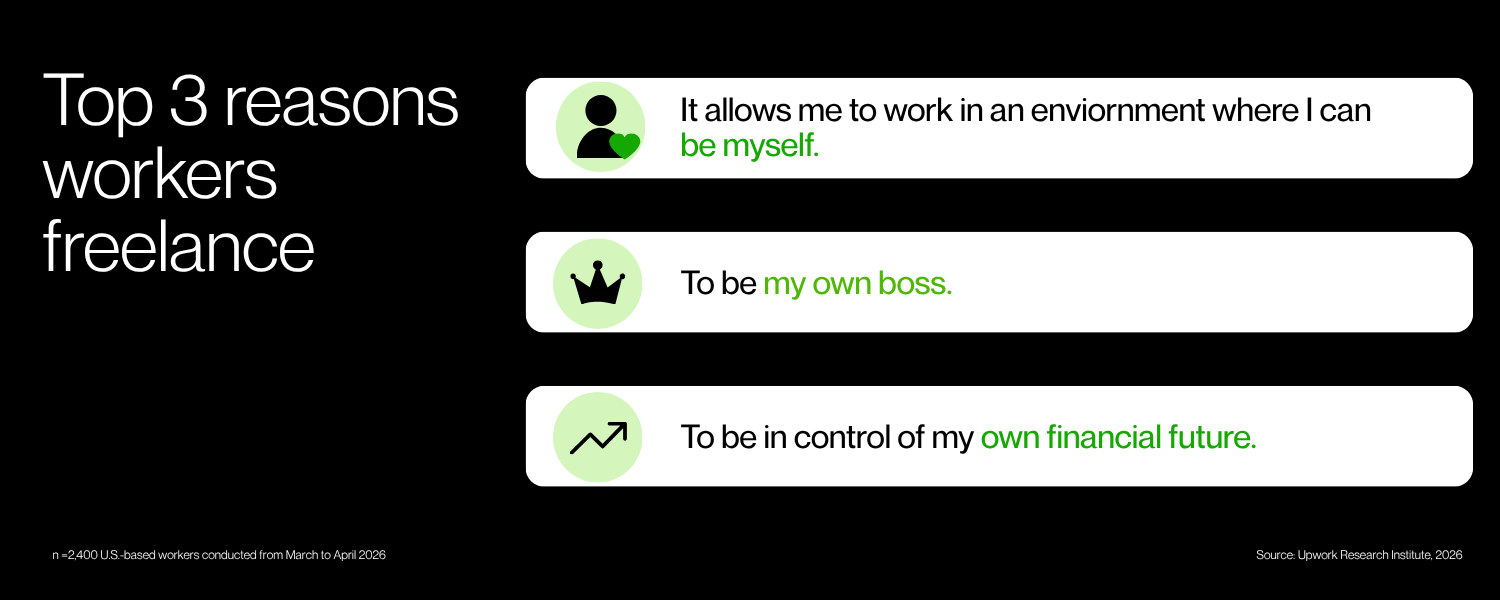
Freelancing can offer a faster path to experimentation and value creation in the AI era. Independent professionals can test new tools, update their services, pursue projects aligned with emerging demand, and more directly capture the market value of advanced AI capabilities. The freelance work model also supports the autonomy and adaptability workers increasingly want as work changes quickly. As Figure 7 shows, the top reasons workers freelance include being their own boss and having more control over their financial future, advantages that can help talent differentiate, maximize earnings, and stay closer to where new opportunities are emerging.
Figure 7. Top 3 reasons workers freelance
The reorganization of work
For the broader labor market, freelancing’s acceleration is a signal that work can reorganize faster than traditional workforce planning cycles often assume. Workers are not only adapting to AI; they’re changing the terms under which they participate in the labor market. They’re looking for arrangements that allow them to learn faster, apply tools more freely, and capture the value of their expertise.
For businesses, this means that talent strategy must evolve. The future workforce won’t be built through full-time hiring alone. It will increasingly depend on flexible access to specialized expertise, especially in areas where skill demand is changing quickly. Freelancers can help organizations close capability gaps, test new use cases, and bring AI-enabled expertise into the business faster than traditional hiring models may allow.
What does this mean for the future of work?
The findings point to a central conclusion: The next phase of AI adoption is not just about deploying more tools. It’s about developing and accessing the human expertise required to make AI useful.
The top implications for business leaders
For business leaders, especially SMB leaders, success in the AI era will depend on moving from experimentation to orchestration. Many companies have introduced AI tools, but tools alone don’t create transformation; businesses need talent who can identify the right use cases, redesign workflows, manage risk, evaluate outputs, and connect AI activity to measurable business goals. For SMBs, this creates an opportunity to compete in new ways by accessing specialized freelance experts for targeted needs such as automating workflows, improving marketing operations, or integrating AI agents into repeatable processes. Flexible talent can help smaller businesses close the gap between AI adoption and AI deployment without having to invest in building a full team.
Thruhike is an example of an SMB using the combination of freelancers and AI to improve internal workflows as it scales. The Boston-based company helps connect small businesses with consumers through shoppable, personalized local experiences. The team deploys AI tools with freelancer expertise across data collection, back-end operations, and content curation, cutting project timelines without taking on the cost of a large full-time team.
Business leaders should also address shadow AI usage directly. The goal shouldn’t be to shut down experimentation, but to make it safer and more useful. That means creating clear AI use policies, defining what data can and cannot be used, offering approved tools, and giving employees structured opportunities to test AI in their work. Leaders should ask where AI is already being used, where employees are seeking external training, and which workflows could benefit most from AI-supported redesign.
The top implications for talent
For talent, the durable advantage in the AI era will come from becoming an AI orchestrator, not simply an AI operator. Technical fluency matters, but higher-value opportunities will increasingly depend on the ability to frame problems, apply domain expertise, communicate clearly, manage projects, and use judgment to turn AI-enabled work into meaningful outcomes. Freelancers can strengthen their positioning by selling business results rather than AI-generated outputs, such as faster research synthesis, smarter customer workflows, more efficient marketing operations, better decision support, or improved business processes. As AI tools become more common, workers should also build evidence of impact through case studies, before-and-after workflow examples, measurable efficiency gains, and clear communication about how their process delivers better results.
Ultimately, the future of work will reward those who can combine human and AI capability in ways that are practical, responsible, and commercially relevant. The premium will go not simply to those who use AI, but to those who can make AI work.
“I believe AI allows us not to build the most amazing solution but rather have the solution firmly come second and focus on the problem. What really determines success versus failure in business is whether or not you have the innate human quality to emotionally and empathetically understand the problem.”
Boris Spiegl - Artificial intelligence (AI) and machine learning (ML) expert
Conclusion
Upwork’s Future Workforce Index 2026 shows that AI is already reshaping the value of work. Freelancers offer an early signal of this shift: AI skills command a premium, but the value is moving away from simple execution and toward more complex, AI-augmented professional work.
The rise of the AI orchestrator captures the direction of this change. As AI tools become more accessible, the scarce skill is not just producing outputs. It’s knowing what to produce, why it matters, how to evaluate it, and how to integrate it into real business workflows.
For organizations, the priority is to turn worker-led AI experimentation into strategic capability. For talent, the opportunity is to build the human skills that make AI valuable. The future workforce will be shaped by those who can bridge technology and judgment, automation and accountability, and efficiency and impact.
Methodology
The Future Workforce Index 2026 is based on a survey of 2,400 U.S.-based workers conducted from March to April 2026.
Skilled workers were determined by first targeting a representative sample of U.S. workers, and then limiting survey participants to those working above the administrative level across skilled organizational functions and earning hourly earnings above a minimum threshold, as determined by analyzing U.S. Bureau of Labor Statistics salary data. The margin of error for these insights is 2% at the 95% confidence level.
Skilled freelancers were determined through self-reports, with the additional criterion of currently working or having worked as a freelancer within the past 12 months. Skilled moonlighters, defined as full-time employees who also perform freelance work on the side, were determined when their freelance work met the same criteria.
The report also draws on Upwork Marketplace platform data, including data on AI-related work categories, contract starts, hourly earnings, and year-over-year earnings trends. We use an LLM-based pipeline to identify AI-related jobs from job post data, including titles and descriptions, and classify them by how AI is being used. We then map those jobs to relevance-weighted task clusters. Because a single job can map to multiple tasks, contract volume and earnings are allocated across tasks using task relevance scores, so tasks that are more central to the job carry more weight.
For the platform data, we compare year-over-year changes (Q1 2026 versus the same period last year) in volume and associated value. Task clusters with rising value are treated as candidates for higher-complexity, human-agency, or “orchestrator” work, while clusters with declining value are treated as candidates for simpler, more execution-oriented work. These placements are then validated through content analysis and checked against LLM-generated task-cluster annotations, including human agency scores, rationales, and confidence notes. While we endeavor to study AI work and tasks with high precision, there is great uncertainty with measuring AI work. The methods and categorization we used in this report may contain measurement errors and are subject to change as AI-related work continues to evolve.
About The Upwork Research Institute
The world of work is not the same as it was just a few years ago, and leaders are facing new challenges as a result. The old work playbook is gone, and in its place are new debates and decisions around workforce location, worker arrangements, flexibility, and the role of AI in how work gets done. Leaders do not need to navigate this new world of work on their own.
The Upwork Research Institute is committed to studying the fundamental shifts in the workforce and providing business leaders with the tools and insights they need to navigate the here and now while preparing their organizations for the future. Using proprietary platform data, global survey research, partnerships, and academic collaborations, the Institute produces evidence-based insights to help create the blueprint for the new way of work.
About the authors
Jennifer Brett
Jennifer Brett is the managing director of The Upwork Research Institute, where she leads research and thought leadership on the future of work, including AI, flexible talent, and evolving workforce models. She is a research and insights leader with more than 15 years of experience translating data, market signals, and human behavior into strategies, narratives, and business impact. Jennifer has held senior insights leadership roles at Attentive and LinkedIn across the U.S. and Europe, and previously served as an industry analyst at Google. She holds a Ph.D. in political science from Trinity College Dublin, with academic training in research design and quantitative and qualitative methods.
Teng Liu
Dr. Teng Liu is an economist at Upwork, where he studies how AI and technological change are transforming the labor market and reshaping skill demand. He holds a Ph.D. in economics from the University of California, Santa Cruz, and specializes in labor market dynamics and quantitative research. His work informs Upwork’s insights on workforce shifts, economic opportunity, and policy.
Acknowledgements
The Upwork Research Institute would like to thank Fei Long, Alex Roberts, Shagun Kala, KailaMarie Hardawa, Janine Kamwene, Nora Considine, Schuyler Sonnega, Nancy Bach, and McGuire Research for their contributions to this research report.



.jpg)




Join the world's work marketplace
Find great talent. Find great work. Are you ready to move your business or career forward?
%20(1).png)