The Most In-Demand Skills for 2025: Navigating Skills-Based Work in a Dynamic Economy
.avif)
By Teng Liu, Kelly Monahan, and Takeshi Matsuda
Executive Summary
- The era of degree-based hiring is fading fast. As workforce demands evolve, 81% of C-suite executives are turning to skills-based hiring practices to fill critical roles, shifting the focus from academic credentials to proven capabilities. In this new talent economy, skills are the new currency of success.
- AI is rewriting the playbook for workforce priorities. The boom in generative AI modeling and data annotation is creating a high demand for specialized skills that are indispensable to the full lifecycle of AI solutions. These roles command premium rates and are at the heart of advancing AI-driven workflows.
- At the same time, the growing emphasis on career coaching and development signals a critical need for workers to reskill, adapt, and thrive alongside AI. Despite rapid technological advances, human guidance and empathy remain irreplaceable, as companies race to build a workforce resilient enough to navigate constant disruption.
- Freelancers are increasingly the backbone of the workforce revolution. Nearly 50% of full-time workers now rely on freelancers for key skills like web design, generative AI, and product management. CEOs are following suit, with 48% planning to boost freelance hiring in the coming year, leveraging agile talent to close skill gaps and stay competitive in an unpredictable world.
The Shift to Skills-Based Hiring and the Rise of Freelancers
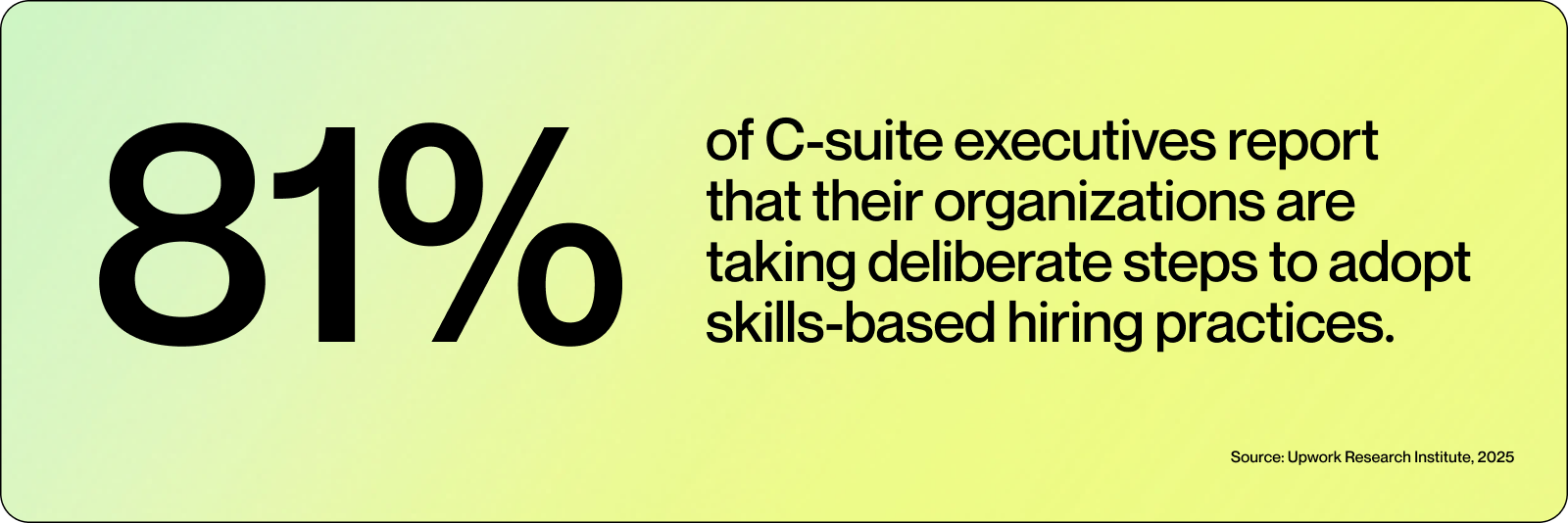
The dynamics of today’s labor market are shifting rapidly, reshaping how organizations assess talent and approach hiring. Business leaders increasingly recognize that yesterday’s talent playbook no longer works to meet today’s need for an effective, skilled, and flexible workforce. A significant 81% of C-suite executives report that their organizations are taking deliberate steps to adopt skills-based hiring practices, including removing degree requirements and emphasizing skills assessments.
The move to skills-based talent practices is impacting both incoming workers and existing employees. In fact, 35% of leaders acknowledge that in the past 12 months, they have required their companies’ people to expand their skillsets, in addition to performing their day-to-day work. Still, major skill gaps persist. Leaders estimate that only a quarter of their current employees can effectively work alongside AI solutions today, and even fewer (19%) can proactively leverage AI to solve problems.
For many, skilled freelancers have offered a solution. According to research fielded by the Upwork Research Institute in the summer of 2024, nearly half (49%) of full-time workers now rely on freelancers to address critical gaps to help them do their work, with 41% turning to freelancers for technical skills such as web design, data analytics, product management, generative AI, and video production.
CEOs are responding accordingly, with 48% planning to increase freelance hiring over the next 12 months. In fact, nearly one in three C-suite executives (29%) say that freelancers are highly essential to their business operations and that they couldn’t get by without all of their freelancers. Another 51% of the C-suite said that it would be difficult to conduct their business without their freelancer support.
Moreover, 76% of executives—and 78% of CEOs—assert that their top freelancers contribute more value than degree-holding employees. This view is supported by the fact that 74% of executives say degrees are irrelevant when hiring freelancers, focusing instead on proven expertise.
Because businesses are increasingly looking to freelancers to bring specific skills into their workforce, examining the most in-demand skills at scale illuminates what skills organizations are most seeking, which carry the greatest value, and what may be coming next. This research analyzed Upwork’s labor market data from January 1 to October 31, 2024, focusing on the fastest-growing skills on our platform. We evaluated these skills based on year-over-year growth rates, the earning premiums they command, and the volume of demand.
Here’s what we found: while developing a more generalist skillset helped to increase professional opportunities in the pre-AI era of work, today’s organizations are looking for specialists with deep expertise. This is especially evident when it comes to AI skills, as both upstream and downstream skills related to building, maintaining, and fully utilizing AI models are on the rise.
But for the first time in a while, skills related to coaching, guiding, and developing others have also gained momentum collectively to become some of the most sought-after skill types in terms of growth rates. This suggests that leaders are looking to freelancers not only to fill skill gaps, but also to help reshape how they and their workers learn and develop in a rapidly changing world of work.
Skills for AI development
In 2024, we saw continuing growth and development of AI and machine learning (ML) skills on the platform, echoing the broader industry trends and deeper integration of AI into everyday work. We see important skills—skills that are crucial to the full life cycle of ML and AI model development—continue to grow.
Data extraction, foundational and upstream to ML and AI modeling, is highly ranked both in terms of growth and volume. Similarly the downstream skills like data analytics and data visualization, which are useful for evaluating and applying such models, are also highly sought after.
AI data annotation & labeling stands out as one of the fastest-growing skills on the platform, by as much as 220%. This critical role, which ensures the accuracy and reliability of machine learning models by creating high-quality training datasets, has seen a remarkable surge in activity. The growth reflects an increasing recognition of the importance of data quality in achieving robust AI outcomes. As AI applications proliferate across industries, the demand for data annotation is expected to remain strong, particularly in areas like autonomous vehicles, healthcare imaging, multilingual AI models, and conversational AI.
Knowledge representation, while more niche, demonstrates significant value in structuring and organizing complex information. This skill is crucial for enabling AI systems to process data, make connections between disparate data points, draw conclusions, and generate output that is similar to what a person might have come up with. These tools are increasingly critical for applications like recommendation systems, semantic search, and enterprise data management, suggesting that this area will continue to grow in strategic importance.
The steady increase in demand for Generative AI Modeling skills indicates a growing reliance on generative AI not just as a novelty, but as a transformative tool for both productivity and creativity. Expertise in this area commands a premium, reflecting the technical sophistication involved in designing and fine-tuning these models.
These trends highlight the evolving and interconnected nature of AI development skills, with upstream and downstream processes, data preparation, and advanced modeling all playing integral roles in driving successful AI projects. As the AI landscape continues to mature, the platform's activity provides a window into the skillsets shaping the future of work.
The growing need for learning skills: Why coaching and development are essential in an AI-driven world
As workplaces everywhere undergo seismic shifts, one thing has become clear: workers need more than skills—they need guidance. Our data reveals a compelling trend: career coaching, training, and development are among the fastest-growing skills within their category on the platform.
This surge speaks to a deeper truth about the future of work in 2025. With industries evolving at breakneck speed, the ability to adapt, reskill, and navigate ambiguity has become essential. The very essence of learning how to learn is becoming a critical and growing skill set. And while technology is transforming how we work, it is the human-to-human connection that is proving irreplaceable in helping workers find their footing.
Ironically, in an age dominated by AI, the most valuable form of support lies in the lived experience and empathy that only a skilled coach can provide. The power of coaching isn’t only about learning new skills; it’s also about fostering confidence, perspective, and resilience—qualities that machines simply can’t replicate.
As businesses focus on future-proofing their workforce, investing in coaching and development is no longer optional: it’s a strategic imperative. Organizations that prioritize these human connections will build a workforce that is both highly skilled and deeply engaged, capable of thriving in an unpredictable and rapidly changing world.
Zooming out: In-demand skills and their values
One of the key advantages of the Upwork labor market data is we observe the actual size of contracts, in addition to the growth and volume of job posts. To better situate skill groups in the nexus of growth, volume, and value, we have selected key groups and visualized them in Figure 1 to show the relative differences of these skill groups (details of selection criteria in the Methodology section below).

Figure 1
The horizontal axis illustrates the overall volume, measured by the number of completed job posts, while the vertical axis represents the relative strength of growth rates. The size of each circle symbolizes the relative ranking of these skill groups in terms of hourly pay. In short, a skill group at the bottom right indicates high demand in volume, and medium demand in growth. Additionally, larger circles indicate greater hourly pay rates associated with that skill.
Two things are worth noting. First, not all skills are in demand in terms of growth and transaction volume simultaneously, and this makes sense. For instance, well-established skill groups like data analysis are consistently highly demanded, but the growth potential of this skill group may be eclipsed by more nascent categories like generative AI modeling. At the same time, within the Upwork platform, skill groups with emerging demand and high growth, such as pattern design, may in the future move more to the right-hand side of the quadrant, despite limited volume at the moment.
Second, specialized, technical skills do pay off. For instance, generative AI modeling and fractional CFO are highly technical, specialized skills. That their rates are higher than all other groups is unsurprising. Additionally, in absolute terms, the actual number of professionals able to fill these positions is lower than other less technical categories. But this doesn’t mean that more generalizable skills like email marketing and career coaching are less desirable: they have high demand both in terms of growth and volume, meaning there is sufficient space for good monetary payoff for freelancers doing this work.
Strategic positioning in the age of AI
What does this mean for freelancers? While the market message often emphasizes the importance of upskilling, it's worth rethinking this narrative. Upskilling is important, but strategically positioning yourself in the labor market is perhaps even more critical. Acquiring new skills comes with adjustment costs—time and money invested—which means that optimizing how you allocate your skills and choose the types of work you pursue is vital.
For example, while demand for data analysis remains high in terms of volume, exploring a comparable but higher-paying field like machine learning could unlock greater earning potential. The key is to find the sweet spot at the intersection of demand, growth, and value, aligning your efforts with your existing skill set and long-term potential.
What does this mean for businesses? For today’s businesses, staying competitive requires a fundamental shift in perspective: it’s no longer a competition for talent—it’s a competition for skills. Skills have become the new currency of success, and organizations that cling to traditional talent acquisition models will find themselves left behind. Instead, leaders must adopt a talent access mindset, enabling them to secure the precise expertise they need, precisely when they need it.
The dynamic freelancer market offers a transformative solution. By embracing skills-based hiring and moving beyond outdated models that prioritize degrees and tenure, leaders can tap into a broader, more dynamic talent pool. It’s time to move past conventional full-time employee structures and focus on accessing the capabilities that will drive innovation and growth. In a world that rewards agility and specialization, the future belongs to those who dare to rethink how they access talent and their respective skills.
Methodology
Skills data was sourced from the Upwork database and is based on freelancer earnings from January 1, 2024, to October 31, 2024, with demand originating in the United States. To ensure a strong signal of demand, we specifically analyzed completed jobs. Each skill had a minimum of $100,000 aggregate freelancer earnings in that category during the period. Year-over-year growth was estimated by comparing freelancer earnings in 2024 to freelancer earnings over the same period in 2023. The list of skill groups in Figure 1 was selected based on those with the highest growth rates in their respective domain, with outliers excluded.







Join the world's work marketplace
Find great talent. Find great work. Are you ready to move your business or career forward?
%20(1).png)