Work Innovators: A Playbook for Innovation in an Uncertain World
.jpg)
By Kelly Monahan and Gabby Burlacu
To ask questions and engage directly with the insights from this report, please visit our Work Innovator Research Assistant.
Executive Summary
The relentless pace of change in today’s business environment demands courageous leadership. While some companies respond by clinging to familiar strategies, others are capitalizing on this moment to redefine how they work and drive innovation forward. These forward-thinking organizations, known as Work Innovators, are more than surviving– they are thriving. Instead of relying on the outdated belief that innovation requires massive spending and big risks, these companies are optimizing operations, improving cash flow, and enhancing efficiency.
Our 2024 Work Innovator research, surveying 1,500 global business leaders, reveals that 27% of organizations are strategically combining distributed work, flexible talent strategies, and advanced technology into a unified operating model that sets them apart in an ever-evolving market. Work Innovators understand that simply adopting more technologies or flexible work options won't guarantee success. Instead, they prioritize seamless integration and addressing critical cultural and workforce barriers. They focus on equipping their teams with the autonomy, support, and tools needed to innovate and creatively solve problems. While they face the same challenges as their peers, what sets them apart is their ability to integrate and prioritize key practices that others often overlook.
These practices include aligning existing technology stacks for an integrated work experience, fostering ethical engagement with people and AI at work, cultivating a workforce ready to embrace innovation, and formalizing innovation as a core organizational capability. Together, these strategies create a resilient foundation that not only helps leaders successfully navigate today’s turbulence but also helps set them up for long-term success in a volatile world. The big takeaway? You don’t need a massive budget or an aggressive risk approach to lead your industry. Sometimes, the most surprising and effective changes come from within.
Change for the better
Disruption is no longer a temporary hurdle—it’s the new reality. While the pandemic has passed and generative AI is increasingly integrated into our workflows, the chaotic and ever-changing landscape surrounding businesses shows no sign of calming. For today’s leaders, the challenge is to navigate this turbulence without faltering, and the stakes have never been higher.
The harsh reality confronting many leaders today? Not every business will survive this tumultuous period. According to EY, the average lifespan of companies on the S&P 500 has dramatically declined, from 67 years in the 1940s to a mere 15 years. The first half of 2024 saw 346 U.S. corporations file for bankruptcy—the highest rate in over a decade, as reported by S&P Global Market Intelligence. This relentless pace of change underscores the critical need for leadership agility and execution excellence in an era in which the margin for error has never been slimmer.
It is not necessarily the strongest that will survive, but the most adaptable. Nassim Nicholas Taleb’s concept of antifragility suggests that organizations that embrace internal transformation in the face of external shocks are better equipped to thrive. These organizations gain an edge over those that cling to outdated notions of stability or that merely react to external pressures—because in a world where stability is elusive, resilience isn’t enough, and reaction is simply too slow. To succeed, businesses must be proactive in their evolution, using disruption as a catalyst for change rather than seeing it as a threat to be managed.
This reality makes antifragility—systems that grow stronger under stress—a strategic necessity. However, instead of reinventing work models to facilitate ongoing innovation, as illustrated in Figure 1 below, many leaders remain fixated on maintaining the status quo, pursuing efficiencies, or merely reacting to industry changes. The past few years have exposed deep flaws in our existing work models. Rigid, top-down management has struggled to adapt to distributed work environments, with leaders more focused on where work happens than on developing their leadership to meet the needs of an evolving workforce.
Technology companies that rapidly expanded during the pandemic to meet sudden demand have since faced mass layoffs as that demand fluctuated. Meanwhile, technology investments continue to outpace talent development, leading to persistent productivity challenges despite digital advancements. The next wave of innovation won’t come from simply taking risks but will come from leadership who introspect and address what’s no longer working within their organizations.
Figure 1. The number one strategic imperative leaders are focused on in the coming year
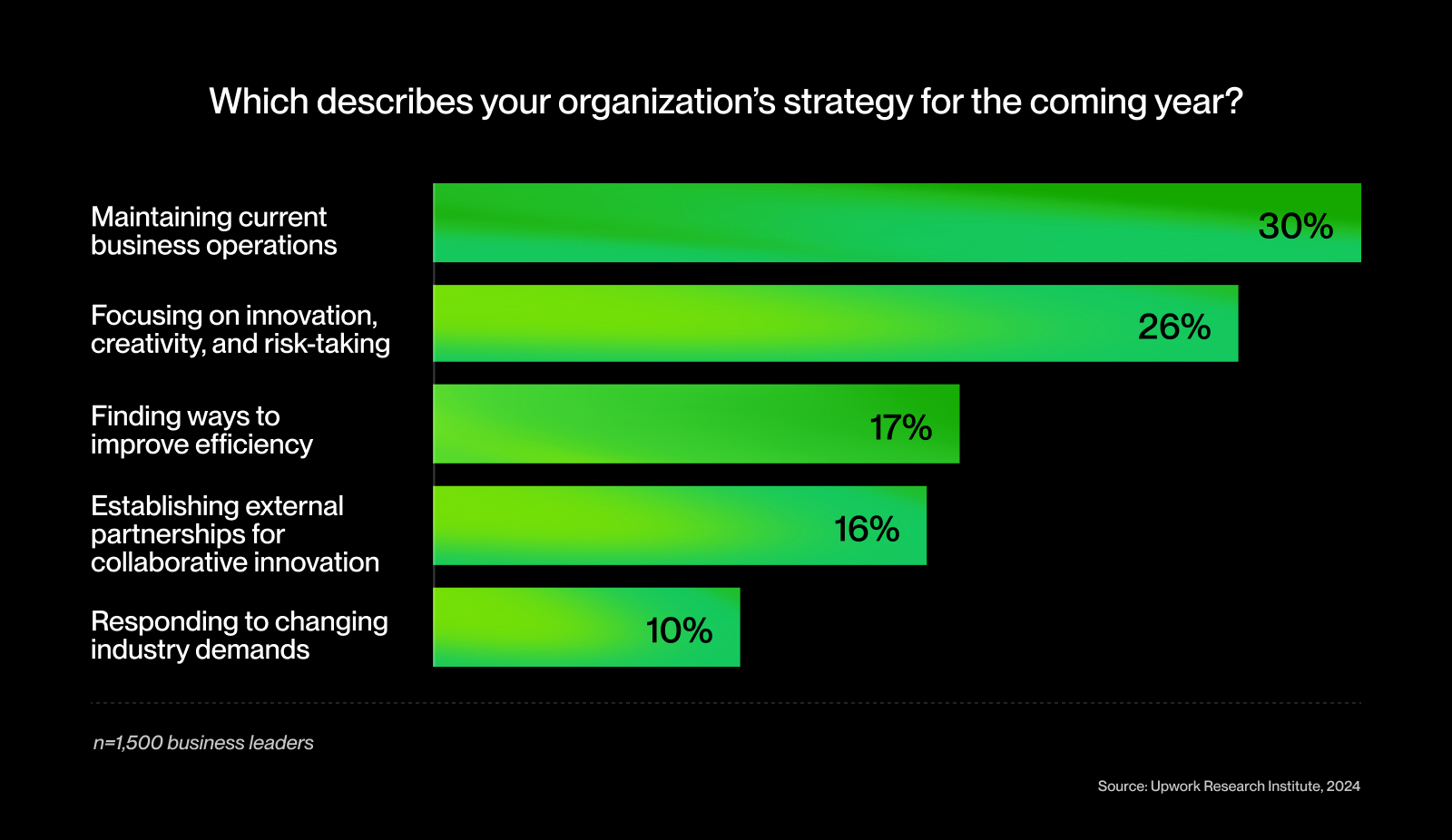
The strongest innovation efforts often go toward meeting customer demands, developing new products, or excelling in go-to-market strategies. Agile processes are implemented and customer data and analytics are relied on to ensure these aspects of business can adapt quickly. The concept of Kaizen, a Japanese term meaning "change for the better," has been widely adopted in manufacturing and supply chains, driven by the belief that small, incremental changes over time can lead to significant transformations. What this broad adoption makes clear is that many leaders have a strong track record of driving product and operational innovation within their organizations.
However, while the bar has been set high in product and operational innovation, approaches to managing people and technology have lagged behind. The same "change for the better" mindset must now be applied to how leaders manage teams, technology, and work. The way companies have traditionally operated has been exposed as fragile under the relentless pressures of the 2020s. Yet, by embracing incremental and continuous changes in how work gets done, resilient systems designed for future survival can be built.
The good news? Our research over the past two years has tracked companies that are successfully overcoming these barriers and building new, more resilient operating models. It’s a familiar playbook—one we’ve often seen applied externally—but rarely directed inward to the management of teams, technology, and work.
Work Innovators: Shaping the future with confidence
In 2023, the Upwork Research Institute identified a group of companies we termed Work Innovators. By analyzing the practices of over 1,900 global business leaders across seven industries and 14 countries, we discovered that 23% of businesses were consistently outpacing their peers. These Work Innovators view disruptions as opportunities for reinvention, skillfully identifying what’s broken, preserving what works, and proactively evolving their work methods. Notably, these companies were twice as likely to be confident in their organization’s future and their leaders boasted a 32-point higher satisfaction rate regarding financial performance.
Our initial research revealed what Work Innovators do—they trust their workforce to be productive regardless of location, are early adopters of AI-based technologies, and strategically look for external talent to enhance in-house capabilities. In this follow-up study, we dive into the how. We explore how Work Innovators achieve success in distributed teaming, technology integration, and flexible workforce models by creating a unified operating model around these core areas. These companies do more than simply adopt best practices—they integrate the right professionals, govern distributed teams effectively, and accelerate technology adoption, setting the stage for sustained success.
We identified that 27% of companies in our 2024 Upwork research are considered Work Innovators, putting their practices to work in a way that creates operational excellence and enduring organizational success. This is just a small uptick from the 23% we saw in 2023. Work Innovator companies excel by keeping their operations lean and cost-effective, and by recognizing where automation can best be introduced to free workers up for other, higher-level tasks.
By diversifying their workforce—across different locations, skillsets, and technologies—these companies create key advantages like productivity gains across time zones, a more flexible and skilled workforce, fewer manual tasks, and the ability to quickly adapt to new technologies. An analysis of financial data between 2021 and 20231 reveals that by leaning into these new ways of working, Work Innovators experienced:
- 30% lower operating expenses. Work Innovators were focused on optimizing human-driven processes and reducing manual labor costs, which they achieved in part through AI-based technology and automation. This enabled them to scale resources up and down effectively. For example, Palo Alto Networks noted in its August 2024 earnings call that its internal AI tools have increased developer efficiency by 40%, directly contributing to lower operating expenses.
- 18% greater likelihood to increase free cash flow. This was especially remarkable in an environment in which positive cash flow was not a given, with 57% of Work Innovator companies reporting positive free cash flow versus just 39% of others.
- 13% lower debt-to-equity ratio. Work Innovators had greater sustained financial discipline. Their lower leverage suggests that these companies are not only managing their resources more effectively but are also generating sufficient cash internally, even as they innovate.
Their peers, by contrast, struggled to keep up in the same timeframe—a gap that will grow as disruption continues.
Figure 2. Financial outcomes for Work Innovators

No matter where your business stands, this report offers valuable insights drawn from 12 in-depth interviews with global C-suite leaders who are driving innovation in their industries, along with surveys of 1,500 C-suite executives facing similar challenges. Our findings reveal that Work Innovators aren’t limited to large corporations, nor are they immune to obstacles—in fact, quite the contrary. These companies embrace new work models that spark innovation while also, seemingly paradoxically, reducing costs, positioning them for sustained financial health and competitiveness regardless of the ever-changing business landscape.
Work Innovators are confronting barriers too
One of the most surprising insights about Work Innovators is that they don't face fewer challenges in enabling distributed, flexible work and technology adoption. In fact, they often encounter technological, cultural, and procedural barriers to a greater extent than their peers. However, what sets Work Innovators apart are two key perspectives:
First, they prioritize quality over quantity. While flexible and distributed work models are central to their operations, Work Innovators understand that simply expanding these practices—offering more flexible work options, adopting more technologies, or hiring more freelancers—won't drive the transformation they need. What matters is the thoughtful integration of these elements into a cohesive work experience. Unlike their peers, Work Innovators don’t silo initiatives—freelancer management isn’t just a procurement task, distributed work isn’t left solely to HR, and the technology roadmap isn’t confined to IT. Instead, Work Innovators unite these efforts to create a seamless and integrated approach to work.
Second, Work Innovators know that not all barriers are created equal. They focus on the most critical challenge: enabling and engaging their people. As shown in Figure 2 below, Work Innovators prioritize overcoming cultural barriers, such as resistance to change and lack of trust, with 60% making this a central focus compared to just 36% of their peers. They also emphasize workforce skills as a key component of technology implementation, with 63% of Work Innovators focusing on skilling the workforce versus 37% of non-Innovators. Additionally, 79% of Work Innovators actively work to build trust and relationships across their workforce, far surpassing the 50% of their peers who do the same.
While barriers exist for everyone, Work Innovators have prioritized those that matter most to their workforce while their peers struggle to even articulate the benefits gained from new ways of working to their workforce. This is evident as Work Innovators place uncertainty about the benefits of new work models and the lack of clear use cases at the bottom of their concerns, while these challenges are among the top barriers for their peers.
These perspectives on quality and the prioritization of cultural and people barriers are what allow Work Innovators to successfully navigate the complexities of modern work and drive meaningful change within their organizations.
Figure 3. How Work Innovators and their peers prioritize barriers

How Work Innovators overcome barriers: The playbook for every business leader
Our research shows four key practices that Work Innovators undertake—and that every business leader should consider—to overcome barriers to distributed, flexible work and technology adoption and to drive both innovation and efficiency as the environment increasingly demands both.
Barrier to innovation: Integration of new technologies
The answer: Align existing technology stacks for an integrated work experience
When organizations chase the “shiny new object” implementation without adequately considering how they’ll integrate it into their existing technology infrastructure, they face an uphill battle. Their disparate systems often don’t work together and confuse employees about what to use and when. Leaders should assess the current state of their internal technology stacks to identify gaps, redundancies, and opportunities for integration. This technology audit will provide a roadmap for aligning technologies in a cohesive manner.
Work Innovator companies align existing technology stacks to speed innovation. They understand that, for example, generative AI may be in the limelight now, but that doesn’t mean they should ignore other emerging technologies and their possible roles throughout the organization—even if exploring these possibilities is uncomfortable and occasionally takes longer. For instance, Upwork platform data reveals growing demand not only for AI but also for robotics and Internet of Things (IoT) technologies, with job postings for these skills having tripled since 2020. Thirty-eight percent of Work Innovator companies are holistically focusing on the convergence and integration of new technologies versus 23% of their peers. As shown in Figure 3 below, cloud computing is more advanced among Work Innovator companies than their non-Innovator counterparts, enabling them to better integrate and expand their technology stacks. As a result, leaders should look beyond short-term implementations and adopt a strategy that emphasizes the convergence of multiple technologies. This means looking at AI, IoT, robotics, and other innovations in tandem rather than in isolation.
Leaders at Oshkosh Corporation recently highlighted their ongoing investments in new products and technologies, such as Moments of Autonomy and ClearSky SmartFleet, their next-generation IoT platform. Similarly, Equifax has emphasized the convergence of AI and cloud technologies, stating that, "Leveraging our patented explainable AI capabilities is a big priority for Equifax in ’24 and beyond as we complete the Equifax cloud."
Figure 4. Technology adoption rates, Work Innovators vs. peers

Barrier to innovation: Internal fear, lack of buy-in, and cultural resistance
The answer: Foster ethical engagement with people and AI at work
Work Innovators demonstrate more mature use of technology across their businesses because they intentionally design a human-centric culture around it. By focusing on integrating the right tools in ways that meet their people's needs, they ensure widespread adoption and effective implementation. Unlike their peers, who often struggle with uncertainty around innovation, Work Innovator companies approach strategies like AI adoption with both confidence and boldness.
For Work Innovators, innovation and workforce engagement are the same. They recognize that creating a culture that supports and rewards innovation is key to attracting and retaining key professionals, especially during labor shortages. Recent research from Miro shows that 82% of leaders believe innovation helps with recruitment and retention, while 70% of information workers say it reduces churn.
To foster this culture, Work Innovators keep employees better informed about the benefits and impacts of technology adoption (89% vs. 76% of others), solicit feedback throughout the process (92% vs. 71%), and build robust training and support resources (90% vs. 74%). They also engage employees to address concerns about new technologies (91% vs. 74%) and celebrate milestones and successes related to tech adoption (90% vs. 76%). This approach creates a psychologically safe, two-way relationship between leaders and employees, ensuring that technology adoption is more collaborative than top down.
Figure 5. Technology adoption practices, Work Innovators vs. peers

This transparency brings the right talent to further fuel innovation. Companies like Roper Technologies and Palo Alto Networks emphasize the importance of attracting and retaining professionals with in-demand skills as a key driver of innovation and performance and clearly demonstrate that to the market. As Palo Alto Networks shared in their Q4 2023 earnings call, "You cannot do this without the best people. Our employer brand has become phenomenal in the last five years as we continue to deliver great innovation."
Similarly, Roper Technologies stated in their Q2 2023 earnings calls, “During the quarter, the Washington Post awarded Deltek the number four top workplace in the D.C. Metro Area for large companies. As you know, we have a closely held belief that talent and culture can create long-term competitive advantage and this is certainly the case for Deltek. During Roper’s ownership with Deltek, the company has increased its organic growth rate, retention levels, recurring revenue, and margin structure and a big contributor to that success is the structural talent advantage that Deltek continues to build.”
In short, Work Innovators are not just adopting new technologies—they are building the right culture and systems to ensure those technologies drive real, sustained success. This is something that is gaining the attention of both the workforce and investors.
Barrier to innovation: Resource constraints
The answer: Cultivate a workforce ready to embrace innovation
Leaders in every company face the ongoing challenge of managing resources in the face of increasing regulatory pressures and concerns around data privacy and security. As the past five years have shown, additional shocks will continue to create turbulence, demanding that organizations do more with less. While Work Innovator companies share these resource concerns, they place a greater emphasis on ensuring their workforce has the necessary skills to drive innovation effectively.
Work Innovator companies prioritize developing AI-enabled professionals to bridge skill gaps and co-create use cases that drive further adoption and innovation. While this focus on AI is crucial for future success, our research reveals a concerning gap: Nearly half (46%) of global business leaders report that only a small portion (between 1% and 25%) of their workforce is currently prepared to work alongside AI. Additionally, over 57% state that fewer than one-quarter of their employees are skilled in proactively applying AI-based solutions to relevant work challenges. It is no surprise, then, that our previous Upwork research found 43% of global leaders believe their workforce lacks the necessary skills to effectively implement AI technologies.
Figure 6. Workforce AI readiness
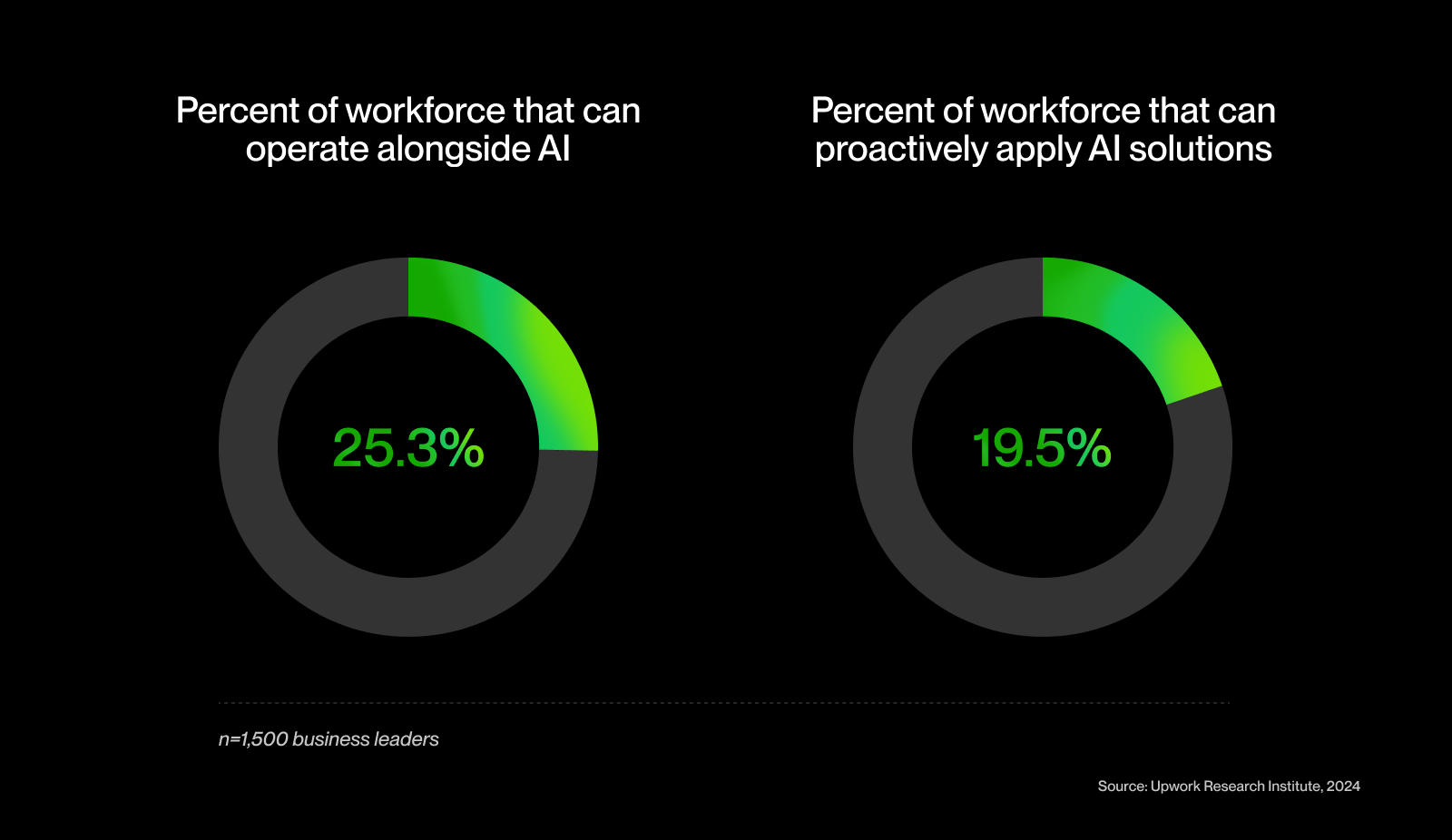
Work Innovators address these resource constraints by fully understanding how technologies like generative AI can maximize human labor amid growing financial pressures and skill shortages. They conduct thorough assessments of the AI-related skills within their workforce and actively pursue upskilling and reskilling initiatives to close gaps. Notably, 63% of Work Innovator companies make workforce skilling a central focus of technology implementation, compared to just 37% of their peers.
If an algorithm can outperform a human at a task, Work Innovators want to know about it—and they’re prepared to restructure operations and jobs to integrate these efficiencies. While they are more likely to provide training and support when introducing new technologies, they do so as part of a broader system that unlocks their people’s innovative potential. This system involves asking the right questions—not only about technology, but also about how distributed and flexible work practices integrate with it—and building the answers into a unified operating model.
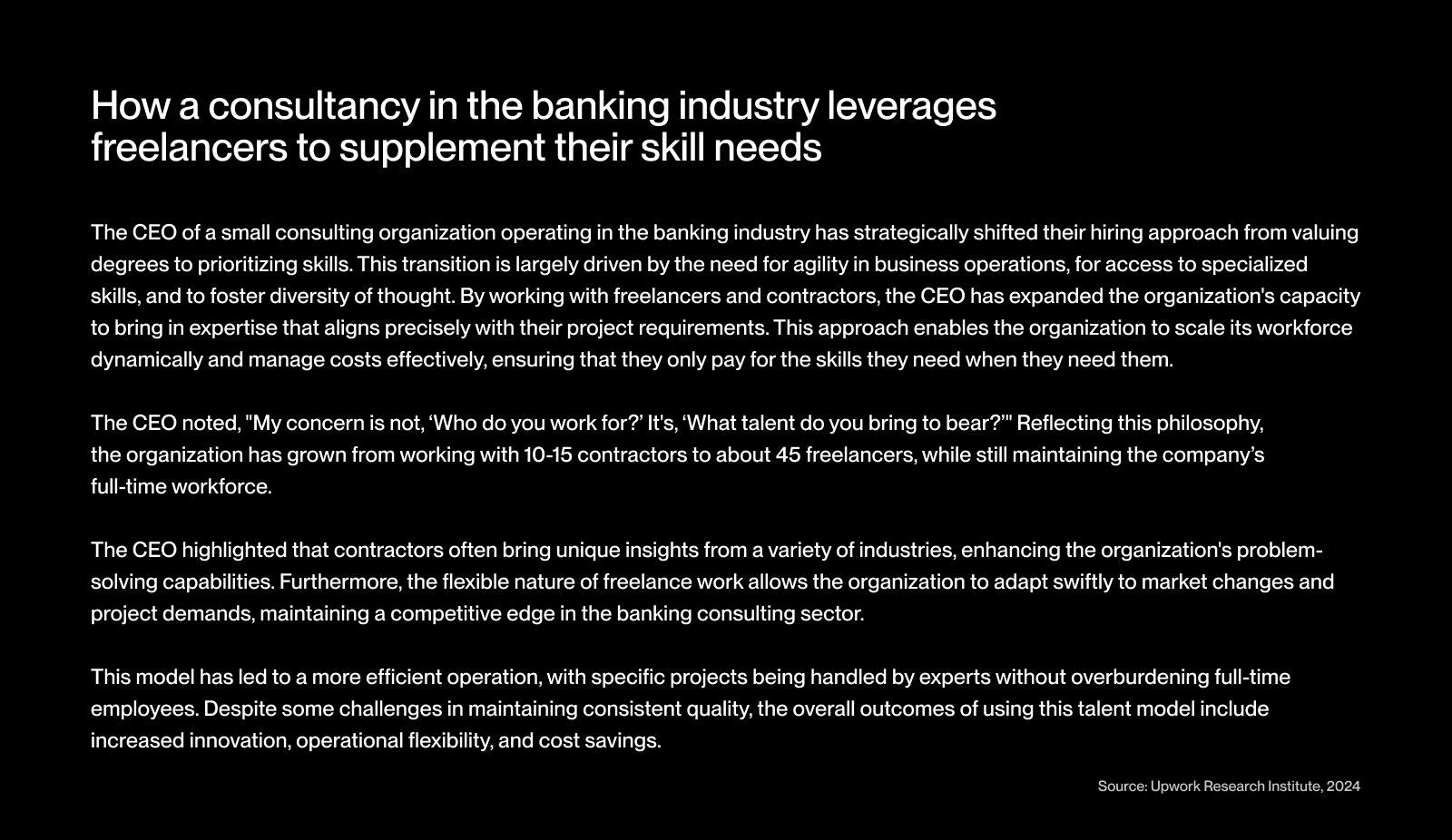
Work Innovator companies also know that sometimes external resources are needed to help make effective decisions about how best to leverage new technologies. They aren’t shy about hiring freelance or contract workers where skills gaps exist and are 1.6 times more likely to be looking to increase the number of freelancers in their organizations over the next 12 months. Work Innovators are also 1.3 times more likely to foster a culture where freelance workers are empowered to proactively experiment with new technologies and explore new approaches. Through this strategic combination of flexible approaches to talent and intelligent application of AI tools, Work Innovators create a streamlined path to innovation. (See: How a consultancy in the banking industry leverages freelancers to supplement their skill needs.)
Figure 7. How a consultancy in the banking industry leverages freelancers to supplement their skill needs
Barrier to innovation: Experimentation isn’t continuous
The answer: Formalize innovation as a core organizational capability
Last year, our research revealed that Work Innovators stand out from their peers by prioritizing the best talent available, whether it comes in the form of employees or independent contractors. These companies uniquely leverage freelance professionals, gaining efficiencies, cost-effectiveness, and innovation that others struggle to match.
This year, we've discovered that these outcomes are largely driven by the culture that Work Innovators foster—one that seamlessly integrates freelancers with their teams. Work Innovators are 1.3 times more likely to encourage a culture in which freelancers are empowered to pursue innovative solutions, experiment, and try new approaches alongside full-time employees. Unlike their counterparts, who often silo innovation within specific groups, Work Innovators promote creativity across all workers, regardless of their employment status.
But it’s more than the mere integration of innovative freelance professionals that helps Work Innovators excel. They also understand the value of partnering outside their organization to leverage the knowledge and proficiency of established experts. Work Innovators are 61% more likely than their peers to engage with managed services partners to tackle the challenges of enabling distributed, flexible, and technology-driven work. By leveraging deep outside expertise in vetting, quality control, and management of distributed teams, these companies streamline operations and overcome common barriers, thus optimizing their growth.
For Work Innovators, innovation is more than a buzzword—it’s an operational imperative. They are more likely than their peers to allocate dedicated budgets, staffing, and infrastructure to support innovation, putting systemic pieces in place while also empowering their workforce with the autonomy, resources, and support needed to adopt emerging technologies and pursue new ideas. This can be seen at Visier, a software company that provides AI-driven people analytics solutions. The organization only has 600 full-time employees spread across seven global offices, but counts hundreds of contractors among its workforce. This expands the company's collective intelligence and creativity while allowing full-time employees to focus on breaking ground in brand-new areas.
Visier’s chief marketing officer Jake Sorofman explained that Visier does not completely outsource any in-house functions. “It’s more of a question of supplement versus supplant,” he said. “Each of the areas where we outsource has core strength in our full-time employee base, but hiring contractors and agencies gives us the ability to scale flexibly without incurring additional fixed costs.”
In addition to leveraging managed services and different kinds of talent, Work Innovators are also more likely to seek external partnerships to bolster their innovation infrastructure. In today’s turbulent environment, they recognize that going it alone is not always the best strategy. Fewer than half (44%) of Work Innovators fund their innovation efforts primarily through internal budgets and organic growth, while the rest tap into government grants, private investors, venture capital, mergers and acquisitions, and strategic collaborations with startups, research institutions, and technology vendors.
In contrast, companies that are not Work Innovators continue to struggle with building all capabilities in-house. A third believes that business processes could eventually be outsourced to autonomous AI tools, but this vision is hampered by the low number of employees capable of building AI tools and the fragmented practices around people and technology. Meanwhile, Work Innovators have already identified the clearest path to sustained innovation and growth: creating an ecosystem that integrates internal practices supporting distributed and flexible work models and technology adoption, while also leveraging external partnerships, expertise, and funding where needed.
The lesson is clear. Innovation requires more than just in-house effort; it demands a strategic blend of internal and external resources, supported by a culture that embraces both traditional and non-traditional workforces. Those who fail to adapt risk falling behind in an increasingly competitive landscape.
Figure 8. The Work Innovator Playbook

Work Innovators in action
NASA exemplifies the qualities of a Work Innovator by cultivating a vibrant, engaged, and productive external workforce. With roughly one-third of its workforce as full-time employees and minimal turnover, NASA places a premium on innovation. Robert Gibbs, Administrator for Mission Support at NASA, explains that the agency’s mission demands sourcing professionals who are deeply committed and capable of bringing fresh perspectives.
Gibbs views contract workers and external partners as vital to NASA’s success. “Our workforce structure needs to be flexible enough to adapt to changes in administration, and mixed projects are cost-effective because we can invest in the skills we need at the moment,” he said in a recent interview with the Upwork Research Institute.
He also warns against “institutional arrogance,” a principle from the U.S. Navy in which an organization’s past success can lead to insularity. To counter this, NASA has a dedicated program that has successfully crowdsourced ideas from the private sector, partnering with over 2,000 organizations on critical projects.
Looking ahead, NASA’s 2040 strategy is focused on enhancing collaboration and innovation across its 10 centers. This includes seeking guidance from leading technology companies on AI implementation and developing exchange programs where NASA employees and contractors can work within other high-performing organizations.
At NASA, contract workers receive the same onboarding and engagement opportunities as full-time employees. “When we hold all-hands meetings, our contractors are always included, and we make sure their voices are heard in our surveys,” Gibbs says.
This inclusive approach has made NASA a magnet for talent, with 300 applications for every open position and a constant influx of new teams ready to innovate.
Unifying work models for innovation
The turbulence surrounding organizations today is likely to outlast some of the organizations themselves. However, the companies that are embracing new work models are more than surviving—they are thriving. By responsibly driving innovation, reducing costs, improving cash flow, and maintaining healthier balance sheets, these forward-thinking companies are gaining a competitive edge. Their innovative approach to work makes them more agile, more responsive to market shifts, and less dependent on traditional, often costlier, ways of operating. They are pulling ahead, and it’s time for other business leaders to take notice.
A year ago, The Upwork Research Institute identified distributed teaming, technology adoption, and flexible work models as critical competitive practices. While these remain vital, what’s changed is the urgent need to unify them into a single operating model—one that fosters experimentation and nurtures novel ideas while keeping costs in check. By mastering the strategies that set Work Innovator companies apart, other organizations can navigate disruptions more effectively and transform universal challenges into opportunities for growth and long-term success.
- Please see the Methodology section for more information.
Methodology
The Upwork Research Institute conducted a survey of 1,500 executives and C-suite leaders from Germany (n=500), India (n=500), and the United States (n=500) in July 2024, representing the manufacturing, business and professional services, software & technology, and retail & consumer goods and healthcare and medical industries. A majority of the organizations represented were operating in up to 10 countries (mainly in Europe, Asia, and North America), generated up to $9.9 billion in revenue in FY2023, and had over 5,000 employees worldwide. All executives had hiring responsibilities within their organization at the time of the survey.
Work Innovators were determined through a composite scale of items assessing organizations’ practices around flexible work, distributed work models, and technology adoption. An exploratory factor analysis revealed one unified dimension underlying these items. A Work Innovator was considered to be a company in the highest quartile of scores on the composite scale.
The extent to which being a Work Innovator drives economic outcomes was tested among all respondents using self-reported and public financial data, where available. Several econometric models including ordinary least squares, binary dependent variable, and quantile regressions were used to reveal the strength and statistical significance of the relationship between being a Work Innovator and company financial outcomes in 2021, 2022, and 2023. All models controlled for company location, industry, and workforce size and were used to simulate how the relevant financial metrics would, on average, differ between companies that were Work Innovators and those that were not.
About The Upwork Research Institute
The world of work is not the same as it was just a few years ago and leaders are facing brand new challenges as a result. The old work playbook is gone, and in its place, there are debates and decisions around workforce location, worker arrangements, and flexibility. However, leaders do not need to navigate this new world of work on their own.
The Upwork Research Institute is committed to studying the fundamental shifts in the workforce and providing business leaders with the tools and insights they need to navigate the here and now while preparing their organization for the future. Using our proprietary platform data, global survey research, partnerships, and academic collaborations, we will produce evidence-based insights to create the blueprint for the new way of work.
About the Authors
Kelly Monahan
Dr. Monahan is Managing Director of the Upwork Research Institute, leading our future of work research program. Her research has been recognized and published in both applied and academic journals, including MIT Sloan Management Review and the Journal of Strategic Management. In 2018, Kelly released her first book, How Behavioral Economics Influences Management Decision-Making: A New Paradigm (Academic Press/Elsevier Publishers). In 2019, Kelly gave her first TedX talk on the future of work. Kelly is frequently quoted in the media on talent decision-making and the future of work. She also has written over a dozen publications and is a sought-after speaker on how to apply new management and talent models in knowledge-based organizations. Kelly holds a B.S. from Rochester Institute of Technology, an M.S. from Roberts Wesleyan College and a Ph.D. in Organizational Leadership from Regent University.
Gabby Burlacu
Dr. Burlacu is Senior Research Manager of the Upwork Research Institute, where she studies how organizations are adjusting their cultures and talent practices to access skilled talent in a rapidly evolving world of work. Her research has been featured in a variety of peer-reviewed studies, articles, book chapters, and media outlets, and has informed strategy and technology development across a range of Fortune 500 companies. Gabby received her Ph. D. in industrial-organizational psychology from Portland State University.
Acknowledgments
The Upwork Research Institute would like to thank our partners who have given their expertise to make this research possible. In particular, McGuire Research, Dr. Tchicaya Ellis Robertson and the team at ELRO Consulting, and Alexandra Levit.


.jpg)


Join the world's work marketplace
Find great talent. Find great work. Are you ready to move your business or career forward?
%20(1).png)