Future Workforce Pulse Report: Trends & Statistics on the Growth of Remote Teams

The “new normal” is a phrase that’s been tossed around so frequently, it’s hard to know what it really means anymore. At the beginning of the pandemic, the new normal was largely used to describe elements of our daily lives that might have changed indefinitely as a result of COVID-19. For the millions of Americans learning how to work remotely, it helped to describe what seemed to be a long-term transition for many companies from conventional work environments to remote ecosystems and digital forms of communication.
With so many employers committing to making remote work a permanent part of their culture, what’s clear is that this new workplace “normal” offers complex and ongoing challenges. 2020 may have helped to normalize remote work on a massive scale, but the full impact and evolution of telecommuting still remain to be seen.
Using data from our December 2020 Future Workforce Pulse Report, let’s examine how the mentality toward working remotely has shifted, where WFH cultures offer positive benefits, and where employers and employees alike continue to struggle.
Companies continue to be remote
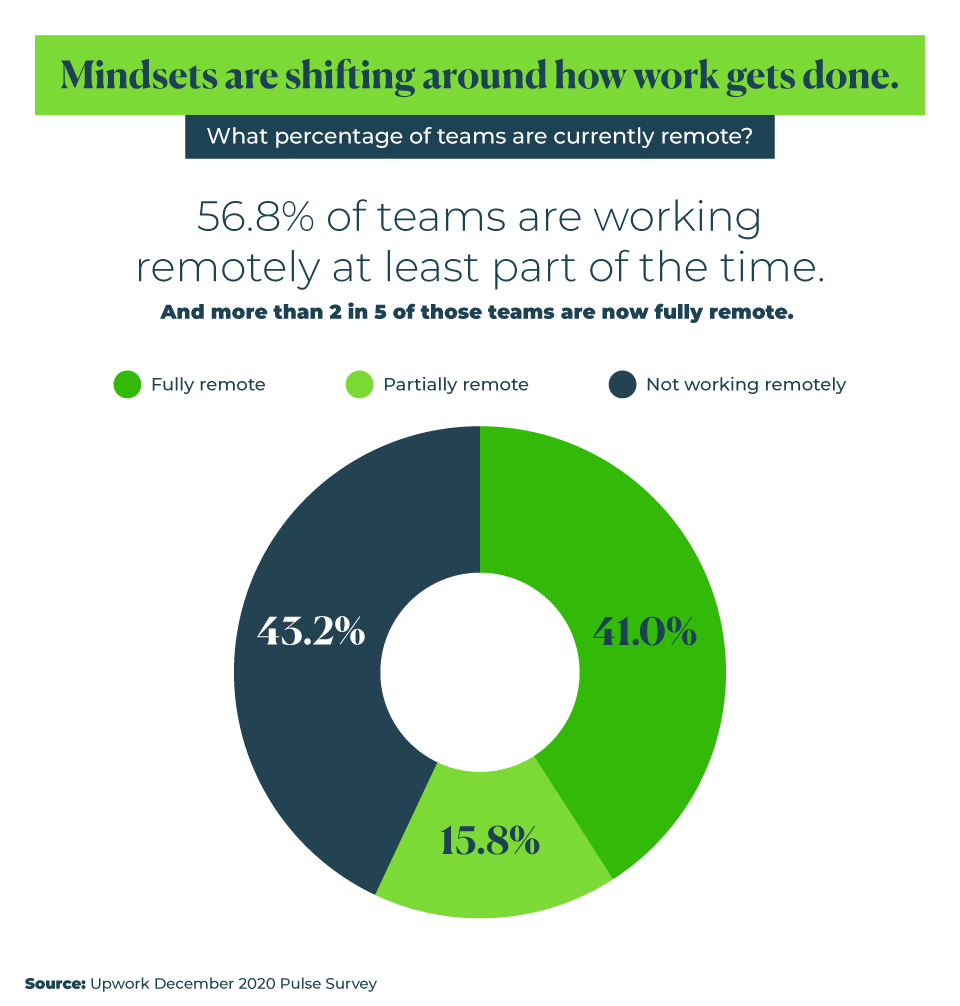
Some major companies, including Twitter, Facebook, and Google, have identified that remote work will be an ongoing policy, even after the pandemic subsides. But what does that mean for people who don’t work for big-name tech companies on the West Coast? According to the Upwork December 2020 Pulse Report of more than 1,000 hiring managers, 57% of teams across the country are currently working remotely in some capacity, including 41% of employees working remotely full time and 16% working remotely part of the time through a hybrid schedule.
Companies are positively adapting to remote work

The long-term shift to remote work isn’t just about where you sit down to clock in for the day. In reality, telecommuting is a cultural shift for most companies, and it’s redefining how we work as much as where we work for millions of Americans. More than half of knowledge workers are remote today, and as many as 36 million Americans could be working remotely by 2025.
Even though the grass isn’t completely green on the other side, months of transition into remote environments have illuminated some of the benefits of reimagining the workplace. 68% of hiring managers said that working remotely is better for them, and another 83% said their team or departments have been more effective since going remote. Overwhelmingly, the reduction in nonessential meetings has helped make schedules more flexible for people working from home. Not having to commute into the office has had more benefits than we may have anticipated—research indicates remote teams typically work longer hours than those still making it into the office, and they’re also more productive during that time.
Despite the success of remote work, companies continue to face resourcing issues
Even before the pandemic, people working remotely knew how challenging the transition from an office setting can be. From struggles with the technology necessary to complete assignments to being more easily distracted and reliant on yourself to set a realistic schedule, working from home (or wherever you happen to be) means being accountable to yourself as much as to your work. Lack of in-person interactions can also make team building more challenging and can put a strain on collaboration and load balancing.
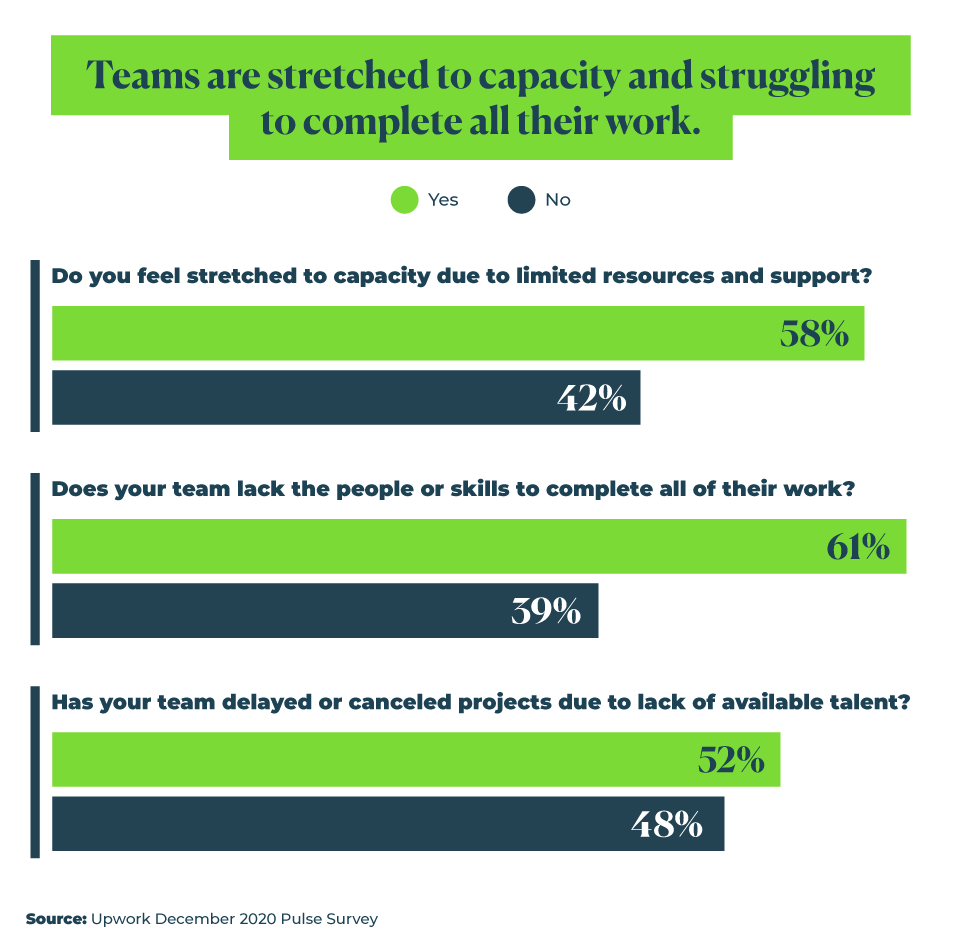
Working remotely has largely been a positive experience for most people, but challenges remain in implementing digital work environments on such a massive scale. Most notably, teams may be feeling stretched thin as staffing and resource challenges arise.
More than half of teams (58%) indicated feeling stretched to their full capacity due to limited resources and support, and even more (61%) said their teams lack the necessary number of people or talent to complete all of their work. As a result, 52% of teams have had to delay or cancel projects due to talent gaps.
Some are already finding relief with independent professionals
Another element shaking up the workplace is the growing acceptance of hybrid teams. In the same way that the COVID-19 pandemic has helped to normalize remote work, these changes to daily operations have also helped to normalize working with independent talent and the benefits they can provide companies and their teams. For businesses that are still trying to adapt to unexpected changes in workflow, bringing on independent professionals can offer the kind of agility they need while reevaluating cultural and performance benchmarks.
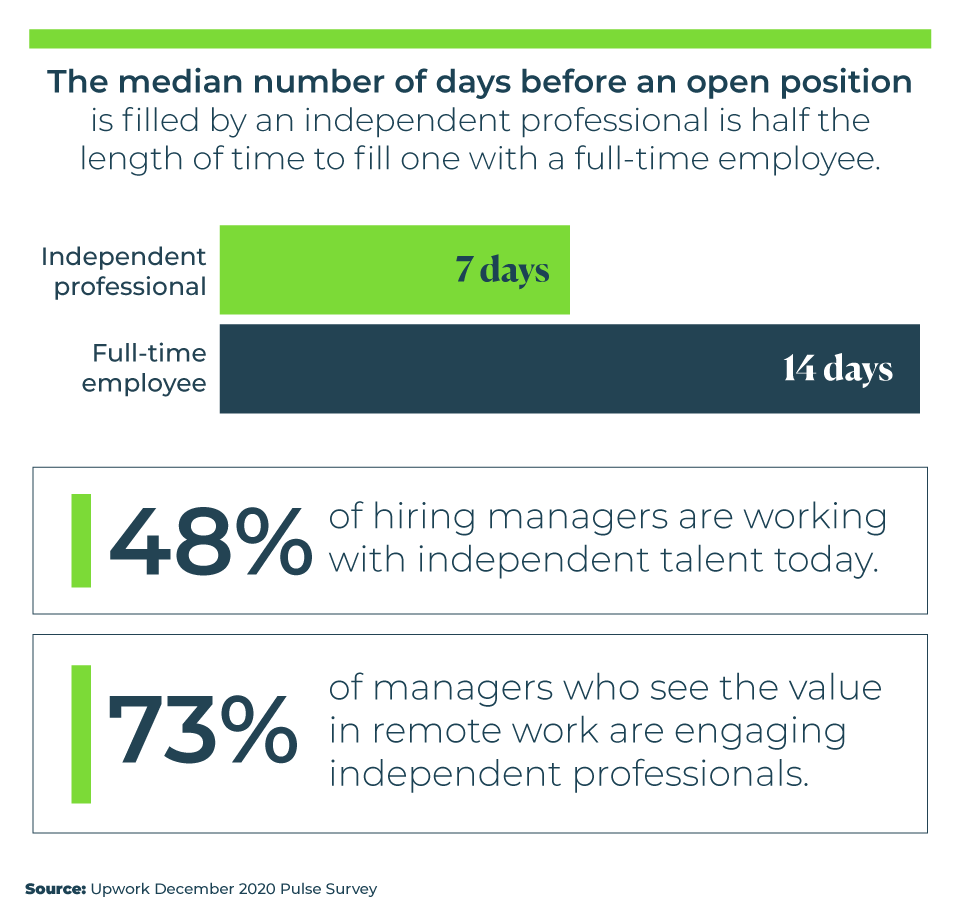
When hiring managers have roles to fill, it can take twice as long to locate and staff a full-time employee rather than an independent professional. Perhaps as a result of these benefits, 48% of hiring managers reported already working with remote talent, and 73% who see the benefits of remote work were presently engaging with independent professionals.
Now more than ever, we are beginning to unlock the potential of independent professionals as we grow our remote teams

More than half (52%) of businesses working either fully or partially remote utilized independent talent, followed by 38% of businesses operating entirely in office or on-site.
Engaging independent professionals offers a certain level of agility not found in full-time employees, but those aren’t the only benefits employers experience. By not having to pay for overhead or recruitment costs, independent talent can be cost-saving but also brings people onboard that are often more flexible in their hours and may have broader experience to contribute. Because of the backgrounds they bring to the table, independent talent can help encourage innovation as they stay updated with new ideas and technology.
Finding the talent you need
The remote work renaissance has been referred to as the “new normal,” but teams and their companies are still learning how to navigate these changes in a way that lets them take advantage of the benefits (including higher productivity) while mitigating the challenges (where teams may feel stretched too thin). One potential solution may be utilizing independent talent to help increase team flexibility while taking advantage of their unique skills and experiences.
You can start your remote hybrid team today by leveraging proven talent through Upwork. Whether you need support for short-term tasks or full-time contract work, you can get more done with top-quality independent professionals that are perfect for your projects. Post a job for free and wait for talent to come to you where you can easily compare their reviews, prior work, and rates. Learn more online at Upwork.com today.
Methodology
This report uses data from a survey of U.S. hiring managers conducted in December 2020. The survey polled 1,029 U.S. hiring managers to provide a holistic picture of growth trends among remote teams and independent talent. Find out how companies are building for the future.
Fair use statement
Are your readers still navigating how to efficiently work from home? Share the results of this study with them for any noncommercial use by including a link back to this page in your story as credit to the incredible team of creators without whom this report would not be possible.


Recommended research


.jpg)

Join the world's work marketplace
Find great talent. Find great work. Are you ready to move your business or career forward?
%20(1).png)