11 AI Customer Service Tools To Streamline Customer Support
Explore the power of AI customer service tools to automate support, enhance customer experience, and optimize workflows.

.png)
.avif)
Customer experience refers to individuals’ perceptions and feelings when engaging with a brand. This could include products, services, or the business environment. A positive customer experience can lead to increased loyalty and higher retention rates.
Artificial intelligence (AI) can be a powerful marketing tool for enhancing the customer experience. AI can analyze customer data to help identify unique behaviors and patterns, allowing for better segmentation and targeted marketing campaigns. AI customer service tools automate repetitive processes, offer 24/7 support through chatbots, and provide personalized responses to improve customer satisfaction.
This article explains how artificial intelligence is shaping the customer experience and covers some AI customer service tools worth considering.
How AI can help with customer service
We go into detail on how artificial intelligence can transform customer service.
- Streamline workflows and routing. Artificial intelligence can analyze vast amounts of data quickly, allowing businesses to identify key patterns and behaviors, gain real-time insights, and make predictions. AI also enhances routing by connecting customers with the appropriate customer care personnel.
- Automate repetitive tasks for support teams. AI can automate time-consuming tasks such as responding to initial inquiries, allowing support teams to focus on more complex activities. This automation improves productivity and helps support teams provide better customer service.
- Personalize responses with natural language processing (NLP). Artificial intelligence uses NLP to interpret human language (both written and spoken). AI-powered marketing tools can analyze customer questions and help businesses generate meaningful, personalized responses.
- Interact with customers in real time and conduct sentiment analysis. AI tools can connect to databases and customer relationship management (CRM) platforms to analyze customer data in real time. These tools can also help with sentiment analysis, allowing marketers to understand what customers are saying about their products or services.
- Enhance self-service with AI-powered chatbots and knowledge bases. AI tools use machine learning algorithms and NLP to provide meaningful responses with little or no human intervention. Connecting AI-powered chatbots to internal knowledge bases allows them to provide specialized customer assistance.
- Provide 24/7 customer support. Unlike human agents, AI systems can work continuously, making it easier and more cost-effective to allow businesses to provide round-the-clock customer support. This improves accessibility and responsiveness and enhances overall customer satisfaction.
Key features of AI customer service tools
AI-powered customer service tools can be a big asset in the workplace. We cover some features driving the performance of AI customer service tools.
- Templates and generative AI for faster responses to customer inquiries. Many AI customer service tools offer customizable templates businesses can use to quickly respond to customer inquiries. Some tools even use generative AI to assist in creating content, such as articles, social media posts, and email subject lines. While AI content isn’t publish-ready, it’s a good starting point.
- Multilingual support and omnichannel communication. AI customer service tools often support multiple languages, enabling businesses to communicate with customers from different regions. Additionally, these tools facilitate omnichannel communication, allowing organizations to integrate and manage customer interactions across various channels (e.g., email, phone, and SMS). This integration helps deliver a consistent customer experience.
- CRM integration and customer data utilization. AI customer service tools can integrate with CRM software, allowing businesses to streamline operations, foster healthy customer relationships, and boost sales. AI-powered tools can also analyze customer data, allowing organizations to gather valuable insight and make data-driven decisions.
- Support ticket management and help desk solutions. AI-powered customer support tools often use a support ticket system for teams to track customer requests and ensure they address concerns in an organized manner.
Top AI tools to consider
Let’s dive into nearly a dozen top AI customer service tools helping to transform the workplace, their pros and cons, and some use cases.
AI tools:
1. Zendesk AI
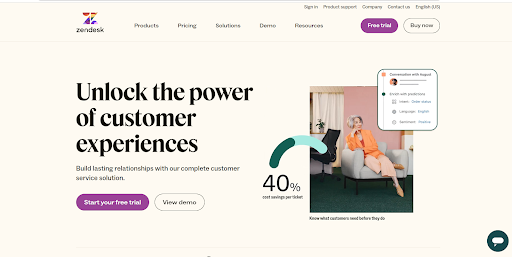
Zendesk AI helps businesses manage customer interactions and relationships. The platform features automated self-help tools capable of recognizing customer intent and providing helpful recommendations. Zendesk users can also contact customers directly from the workspace, access a smart ticketing and routing system, and take advantage of live chat and messaging features.
Best for: Midsize and large organizations dealing with many tickets
Pros:
- Omnichannel support—bringing together all communication happening via email, phone, live chat, and SMS
- Generates reports of historical and real-time data, helping businesses make data-driven decisions
- Supports multiple integrations, including Slack, Jira, and MailChimp
- Access to an API for creating libraries
- Customizable templates and themes to match brand
Cons:
- Agent-based pricing plans can be expensive, especially for large customer service teams
- Advanced customer support features only accessible in higher pricing plans
- Can be challenging for beginners to set up
Pricing: Free trial available; paid plans start at $49 per agent per month (billed annually)
2. Freshdesk

Freshdesk provides marketing, sales, and support tools to help organizations manage their workflows, optimize performance, and build healthy relationships. The platform features a robust ticket system for tracking customer issues. Freshdesk also offers a self-service experience to customers and curated reports and analytics, helping companies determine customer satisfaction rates and predict potential return on investment (ROI).
Best for: Ticket management and multidepartment collaboration
Pros:
- Simple and intuitive user interface
- Supports multiple products
- Customizable knowledge base—can add a wide range of information to Freshdesk’s knowledge base, including FAQ lists
Cons:
- Limited features in low-priced plans—customer metrics, report sharing, and a multilingual knowledge base available only in advanced versions
- Complex automation tools, making them challenging for new users
Pricing: Free plan for up to 10 agents; free trial available; paid plans start at $15 per agent per month (billed annually)
3. Pipeliner
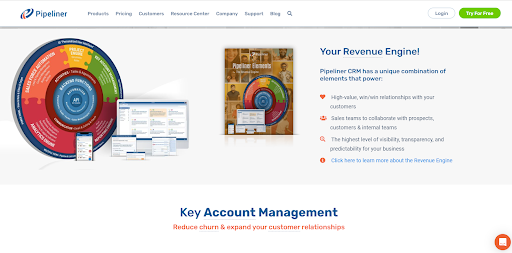
Pipeliner helps organizations optimize their workflows using features like access controls, audit management, activity tracking, and calendar management. Pipeliner also provides dashboards powered by AI technology and real-time data—allowing managers to track various departments’ performance and other key metrics.
Best for: Lead generation and managing sales activities
Pros:
- Ability to import and export data in different formats from Pipeliner’s CRM system
- Access to third-party applications via Pipeliner’s marketplace—also compatible with popular apps from Microsoft and Google
- Faster onboarding and implementation due to intuitive interface and self-guided learning system
Con:
- Could be expensive for small businesses
Pricing: Free trial available; paid plans start at $65 per user per month (billed annually)
4. Landbot
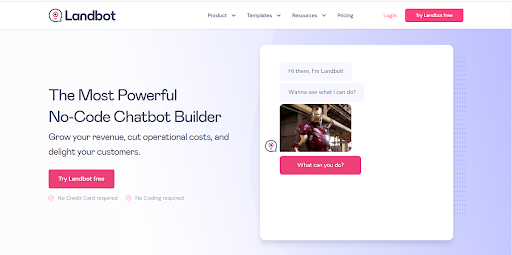
Landbot is a platform for building virtual assistants and chatbots capable of simulating conversations with customers in real time. The platform provides a visual builder and templates developers can use to create AI-powered chatbots. Organizations can also leverage Landbot’s API (application programming interface) and SDK (software development kit) to build and deploy personalized chatbots on their websites, social media accounts, or mobile applications.
Best for: Building chatbots with no coding experience
Pros:
- Simple and visual user interface
- Customizable templates available
- Extended free trial (Free Forever plan)
Con:
- Limited functionality since it focuses on the creation of chatbots
Pricing: Free plan available; free trial available; paid plans starting at $31 per month (billed annually)
5. Jitbit Helpdesk

Jitbit Helpdesk improves the customer experience by converting all incoming requests into tickets and storing them in a centralized place, making it easy for support personnel to track customer queries and address them appropriately. Jitbit Helpdesk is web-based, meaning you can access it from anywhere or host it locally on your server. The platform also supports features like time tracking, live chats, email integration, and report generation.
Best for: Building ticket management systems for support personnel
Pros:
- Integration with third-party apps
- Multilingual support (25 languages)
- Customizable, including ability to change fonts, colors, stylings, and email templates to match brand
- Access to audit logs for transparency and accountability
Cons:
- May be difficult to set up
- Can be costly, especially for large customer service teams
Pricing: One-time perpetual license fee starting at $2,199
6. Ada

Ada helps organizations shape customers’ experiences positively by providing communication and automation tools. The platform features a self-service AI tool that can answer simple questions and perform complex functions, such as issuing refunds and facilitating product exchanges. Integrated real-time analytics also allow businesses to track KPIs (key performance indicators) and events. Plus, Ada has a routing system, allowing chatbots or agents to take up issues depending on their complexity and urgency.
Best for: Building automation tools using a drag-and-drop user interface
Pros:
- Includes drag-and-drop builder tool for creating automation tools
- Supports multiple digital and voice communication channels
- Incorporates multiple layers of authentication and encryption to keep personal and sensitive information safe
- Supports 50+ languages
Con:
- Limited features in the core/basic edition—must pay more to access essential features like multilingual support, order scheduling, and tracking
Pricing: Ada is available in Core, Advanced, and Pro editions (specific prices aren’t publicly available). Contact the sales team for a price quote.
7. Gorgias
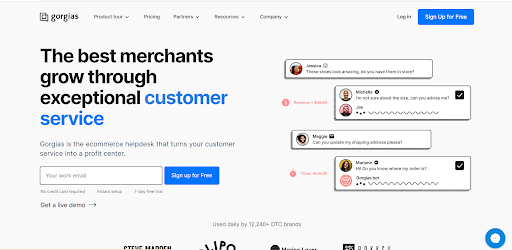
Gorgias is a customer support tool that helps e-commerce companies boost interactions and forge healthy client relationships. The platform is built around Shopify, allowing businesses to enjoy functionalities like managing orders, shipping issues, and returns. Gorgias also assists in generating product recommendations, enabling the delivery of items that match customer needs.
Best for: E-commerce companies dealing with many customer interactions
Pros:
- Highly automated, including the ability to assign issues or tickets to specific support agents or generate appropriate responses automatically
- Supports an unlimited number of users and agents
- User-friendly and offers a good onboarding experience
Con:
- Exclusively for e-commerce brands, meaning it could be ineffective in other sectors
Pricing: Starter plan available only with monthly subscription ($10 per month); annual plans start at $50 per month (billed annually)
8. ChatBot

ChatBot allows businesses to create conversational AI chatbots without coding experience. The platform provides templates for call scheduling, risk assessment, customer satisfaction, and more, saving organizations time and effort. ChatBot also allows team members in different locations to collaborate on a project.
Best for: Business wanting to automate customer service
Pros:
- An integrated visual builder tool that simplifies the bot creation process
- Compatible with many communication tools
Con:
- Must subscribe to Business and Enterprise plans to create more than five chatbots, which could be expensive
Pricing: Free trial available; paid plans start at $52 per month (billed annually)
9. Qualtrics

Qualtrics provides software for improving customer experiences, managing teams, and designing products and strategies. The platform features a self-service tool that assists customers throughout their purchase journey. Qualtrics also offers digital analytics and behavioral analysis tools to help businesses understand their customers. Other features include issue tracking, surveys, sentiment analysis, routing, and social media integration.
Best for: Businesses with large amounts of customer data
Pros:
- A robust visualization dashboard, allowing businesses to quickly gain useful insight from data
- Ability to analyze large data sets quickly
Con:
- Multiple products with complex features, which may be challenging for beginners to navigate
Pricing: Pricing unavailable on website; must request a demo
10. Cx Moments
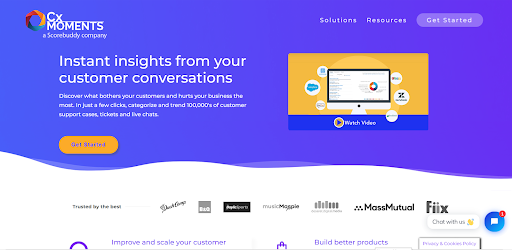
Cx Moments is a customer experience tool for tracking customer feedback, tagging tickets, summarizing and responding to customer queries, and conducting performance reviews. The platform’s issue-tracking feature helps businesses address all customer concerns. Cx Moments also facilitates market segmentation, enabling businesses to divide their audience into smaller groups that are easier to satisfy.
Best for: Marketing teams conducting sentiment analysis to understand what customers are saying about their brands
Pros:
- Automated ticket tagging
- Real-time customer query analysis
- Identifies marketing campaign issues and alerts the management team of faulty processes
Con:
- Beginners may find it difficult to set up and learn
Pricing: No pricing on website; request a quote from the sales team
11. HappyFox

HappyFox is a ticketing platform that helps businesses track customer issues and resolve them in an organized manner. The tool features an online knowledge base that allows users to find relevant answers quickly without contacting support agents. HappyFox also offers data protection features, including two-factor authentication, IP restrictions, a session-based system, and custom SSL certificates.
Best for: Organizations dealing with a high volume of customer support inquiries
Pros:
- Highly customizable
- Integrated reporting and analytics feature that provide access to valuable insights
- Auto assignment of tickets to support personnel
Con:
- Agent-based pricing, which can be expensive for large teams
Pricing: Paid plans start at $29 per agent per month (billed annually)
Streamline customer service with AI
Regardless of your business’s size, a positive customer experience can increase brand loyalty, enhance your customer retention rate, and give you a competitive edge. AI customer support tools can positively shape the customer experience by automating repetitive tasks, providing 24/7 support, and generating personalized responses.
Artificial intelligence can also assist in shortening response times, boosting customer engagement, and optimizing processes and workflows. If you’re looking for AI professionals to help you manage customer support, start your search on Upwork. AI chatbot specialists are ready to help.
For AI professionals looking for work, Upwork offers a flexible platform that can help you meet prospective clients and land AI jobs.
Upwork is not affiliated with and does not sponsor or endorse any of the tools or services discussed in this article. These tools and services are provided only as potential options, and each reader and company should take the time needed to adequately analyze and determine the tools or services that would best fit their specific needs and situation.
Prices are current at the time of writing and may change over time based on each service’s offerings.

.avif)

Author Spotlight

Upwork is the world’s largest human and AI-powered work marketplace that connects businesses with independent talent from across the globe. We serve everyone from one-person startups to large organizations with a powerful, trust-driven platform that enables companies and talent to work together in new ways that unlock their potential.