Fiverr vs. Freelancer Comparison Guide for 2026
Our Fiverr vs. Freelancer guide compares fees, features, pros, cons, and more for each platform. Discover which is best for freelancers and clients in 2026.

.png)
.avif)
The choice between Fiverr vs. Freelancer depends on your specific needs. Fiverr suits quick, fixed‑price gigs you can buy instantly, and Freelancer.com fits posting jobs, reviewing bids, and running contests or milestone projects.
What to know about Fiverr vs. Freelancer
- Fiverr focuses on seller-created, fixed-price gigs, so buyers browse packages and purchase quickly instead of running full job posts and proposal cycles.
- Freelancer.com revolves around client-posted jobs, bidding, milestones, and contests, plus the option to hire for some local, in‑person work.
- Fiverr’s pricing leans on 20% commissions for freelancers and a 5.5% buyer fee plus $3.50 fee on orders under $200, while Freelancer usually charges freelancers around 10% on standard projects and about 3% in client fees.
- Upwork offers a broader blend of hourly, fixed-price, consultation, and enterprise tools, making it a strong alternative to both.
According to the Upwork Future Workforce Index 2025 report, more than one in four skilled knowledge workers now freelance, and 36% of full-time workers are considering making the switch. Platforms like Fiverr and Freelancer.com can help you find the right projects or hire talent, but they work in very different ways. So which one’s right for you?
The right choice comes down to how you prefer to find talent, land work, and manage projects. In this guide, we'll walk you through everything you need to know about Fiverr vs. Freelancer including fees, features, and alternatives like Upwork.
High-level comparison of Fiverr vs. Freelancer
Fiverr and Freelancer.com are both popular freelance platforms, but they're built around different workflows.
Fiverr is a strong fit for clients who want to browse and buy ready-made service packages, and for freelancers who prefer to set their own offerings and pricing. Freelancer works better for clients who want to post detailed projects and review bids, and for freelancers who prefer competing for a wide range of work — including local and in-person jobs.
How Fiverr and Freelancer work
The biggest difference between Fiverr and Freelancer is how projects start. On Fiverr, freelancers create service listings called "gigs" and set their own packages and pricing. Clients browse those gigs and purchase directly — no job post or bidding required. A graphic designer, for example, might offer three tiers of logo design that a client can choose from and buy right away.
Freelancer.com takes the opposite approach. Clients post a job, freelancers submit bids, and work is managed through milestones. It also supports contests — where multiple freelancers submit finished work and the client picks a winner — and even local, in-person projects.
Each platform also uses its own terminology. Fiverr calls freelancers "sellers" and clients "buyers," while Freelancer uses "freelancers" and “clients” or "employers."
Beyond how each platform works, there are differences to consider between Freelancer vs. Fiverr, like signup costs and membership tiers, service fees, payment methods, and available work categories.
*Data sourced from Fiverr.com, Freelancer.com, and other public sources made available by Fiverr or Freelancer.
Pros and cons of Fiverr vs. Freelancer
Pros and cons are mostly around service fees, using the platform, and how payments work when comparing the Freelancer vs. Fiverr platforms. These pros and cons may impact workflow and budgeting depending on your process as a freelancer or client.
Now that we’ve covered the pros and cons between Fiverr and Freelancer, let’s look at each platform in more detail.
Fiverr overview

Fiverr is best known as a marketplace for quick, fixed-price freelance services called ‘gigs.’ It launched in 2010 and originally capped every gig at $5, which is how it got its name. It's a good fit for clients who want to browse and buy ready-made service packages, and for freelancers who prefer to set their own offerings and pricing.
Fiverr’s catalog spans more than 700 service categories across creative, technical, business, and AI work at all price points. It has a 4.3 rating from customers on G2 as of 2026, at the time of writing this comparison article.
How Fiverr works
One of the most unique things about how Fiverr works is the way its projects are structured. Many freelance marketplaces, including Freelancer, Guru, Toptal, and Upwork, allow potential clients to post their needs online and receive proposals from qualified talent.
On Fiverr, freelancers usually start this process by posting specific service packages, or gigs, on the marketplace. A graphic designer, for example, might offer three different levels of service that clients can choose from. Buyers can then browse all available options on the site and reach out to the sellers whose gigs interest them the most.
It is technically possible for buyers to post a request for help on Fiverr and get responses from sellers. The seller-first workflow for posting gigs is the most popular and well-known way to hire freelancers, however. Fiverr also offers Fiverr Go, an AI service that lets sellers train the AI on their brand and style so clients can prompt it to produce work in that seller's style.
Fiverr pros and cons
There are pros and cons to using Fiverr which may affect whether or not you choose to find work or hire talent using it instead of Freelancer or another platform.
Fiverr pros
- Service fees assessed at the time of payment. Sellers don’t have to pay any service fees upfront when starting a gig; these fees are deducted from payouts.
- Escrow-based payment protection. Fiverr holds on to buyers’ funds while sellers complete a gig, only releasing the funds once the work is completed, delivered, and approved.
- Wide array of payment methods. Buyers and sellers can carry out transactions on Fiverr using a range of payment methods, which vary by location.
- Collaboration tools. The Fiverr platform includes messaging tools to help buyers and sellers collaborate; Fiverr Pro sellers can collaborate with colleagues on the platform, too.
Fiverr cons
- No hourly contracts. If you’re using the standard Fiverr marketplace, you can’t set up or start an hourly contract — it’s all flat-rate services.
- High service fees. The 20% service fee assessed by Fiverr on all seller earnings is higher than the fees assessed by Freelancer and some other work marketplaces.
- Instant gig purchasing. Buyers can purchase a gig without contacting the seller first to discuss specific needs or questions.
- Usernames. Standard Fiverr seller profiles use usernames, not legal names, which may be off-putting to some sellers or buyers.
Searching for sellers on Fiverr
Business owners and leaders searching for freelancers can start a talent search right on Fiverr’s homepage, even before logging into the site. To search, buyers need to select a work category that they’re interested in or type a need into the search box.
Here’s what it looks like when searching for web designers on Fiverr:

Each of the boxes pictured above represents a gig offered by a seller on the platform. You can easily narrow down the results by using Fiverr’s available search filters, including budget amounts and turnaround times.
Clicking on a gig opens a page with more information about the service and the seller. Buyers can opt to purchase the gig right away, or they can message the seller for more information.
How sellers find gigs on Fiverr
Sellers can find work to grow their freelance career on Fiverr in two ways:
- By posting a gig and waiting for buyers to purchase the service or send a message with questions. This is the most common way sellers procure work on Fiverr.
- By browsing buyer requests and responding with information about an applicable gig.
Sellers can also apply to be a Fiverr Pro, which may expose them to more clients and work opportunities.
Fiverr profile features
Fiverr sellers can build their profile pages in a way that highlights their work and provides upfront information to interested buyers.
A seller profile can include:
- A headshot
- Profile badges indicating the seller’s rating and expertise on the platform
- Location
- Languages spoken
- A short bio
- Highlighted skills
- Available services and pricing options
- Feedback from previous buyers
Sellers who have a Level 2 or higher status on the platform can add Fiverr Go to their accounts as well. A Fiverr Go AI model is trained on the seller’s work and style. The AI model can then:
- Respond to buyer inquiries on the seller’s behalf
- Generate text, audio, or image content in the seller’s style
Fiverr Go is optional and the company says sellers retain full rights and control over how the model uses their work and likeness.
Fiverr subscriptions and pricing
Two account types are available to sellers on Fiverr: the standard free plan or a Seller Plus membership that incurs a monthly fee. Sellers must be invited to join the Seller Plus program.
With a Seller Plus membership, you can get access to:
- Advanced analytics
- Additional insights about buyers
- Faster payouts
- A dedicated success manager
- Priority customer support
Buyers on Fiverr can choose from a few different account types: the standard Fiverr account, Fiverr Pro, and Fiverr Enterprise. You can see the differences between the different Fiverr account types in the following table.
*Data sourced from Fiverr.com and other public sources made available by Fiverr.
Fiverr also offers a unique product called Fiverr Certified, which allows companies to create their own marketplace of experts certified in using specific tools.
For example, if your company produces a website builder used by dropshippers, you can create a curated list of independent professionals who know how to use your tool. You can then display this list to your customers who want or need product help.
Freelancer overview
Freelancer.com takes a different approach from Fiverr, centering on client-posted jobs, competitive bidding, and milestone-based payments. It's a good fit for clients who want to post detailed projects and review bids, and for freelancers who prefer competing for a wide range of work — including local and in-person jobs.
Freelancer has talent offering over 1,800 skill sets across 17+ broad work categories. Customers rate it similarly to Fiverr, with a 4.4 on Trustpilot and a 4.5 on G2 as of 2026, at the time of writing this comparison.
How Freelancer works
Clients post a project on Freelancer.com and freelancers submit bids to compete for the work. Projects are managed through milestones, giving both sides visibility into progress and payments along the way.
Freelancer offers a variety of ways for clients and talent to work together, including through contests. Contests are unique in that a client can see finished products, such as a logo design, from multiple professionals before making the decision about whom they're going to pay.
Clients also have the ability to find talent for location-specific, in-person tasks, which is uncommon across online work marketplaces. A franchise owner looking for a photographer in a specific city, for example, could use Freelancer to find the right person.
Freelancer.com pros and cons
Contests and local work opportunities are just two of the factors to consider when thinking about using Freelancer to find work or talent. Here’s a breakdown of the pros and cons for clients and freelancers.
Freelancer pros
- Multiple ways to work. Freelancer users can find clients and talent interested in online, in-person, hourly, fixed-rate, and contest-style work.
- Recruiter support. For $11.95, clients can engage the help of a recruiter on the Freelancer team.
- Lower fees. Freelancer service fees vary by the type of work engagement, but max out at 15% for talent and 3% or $3 for clients.
Freelancer cons
- Upfront fees. Freelancer charges upfront “introduction fees” to talent on fixed-price projects.
- Contest payments. Not all entrants into contests are guaranteed payments, despite submitting completed work for client review.
- Usernames. Like Fiverr, talent profiles on Freelancer use usernames, which may or may not be the same as the professional’s legal or business name.
Searching for talent on Freelancer
Clients can start browsing talent right on the Freelancer homepage without logging in. You can easily search for freelancers using filters to narrow results by:
- Type of work
- Type of project
- Talent location
- Hourly rate
- Talent rating
- Relevant skills
- Languages spoken
- Online status

Clients can reach out directly to any talent they’re interested in working with, or they can post a job and wait for talent to submit bids to complete the work. Anyone can begin posting a job on Freelancer by filling out a form or sending the project details to Freelancer via a text message.
How freelancers find jobs on Freelancer.com
Talent can seek out work on the platform by browsing Freelancer job listings organized by category and skill.This may seem overwhelming, as Freelancer lists out every single skill associated with one of its 17 work categories, and some skill pages don’t contain any jobs.
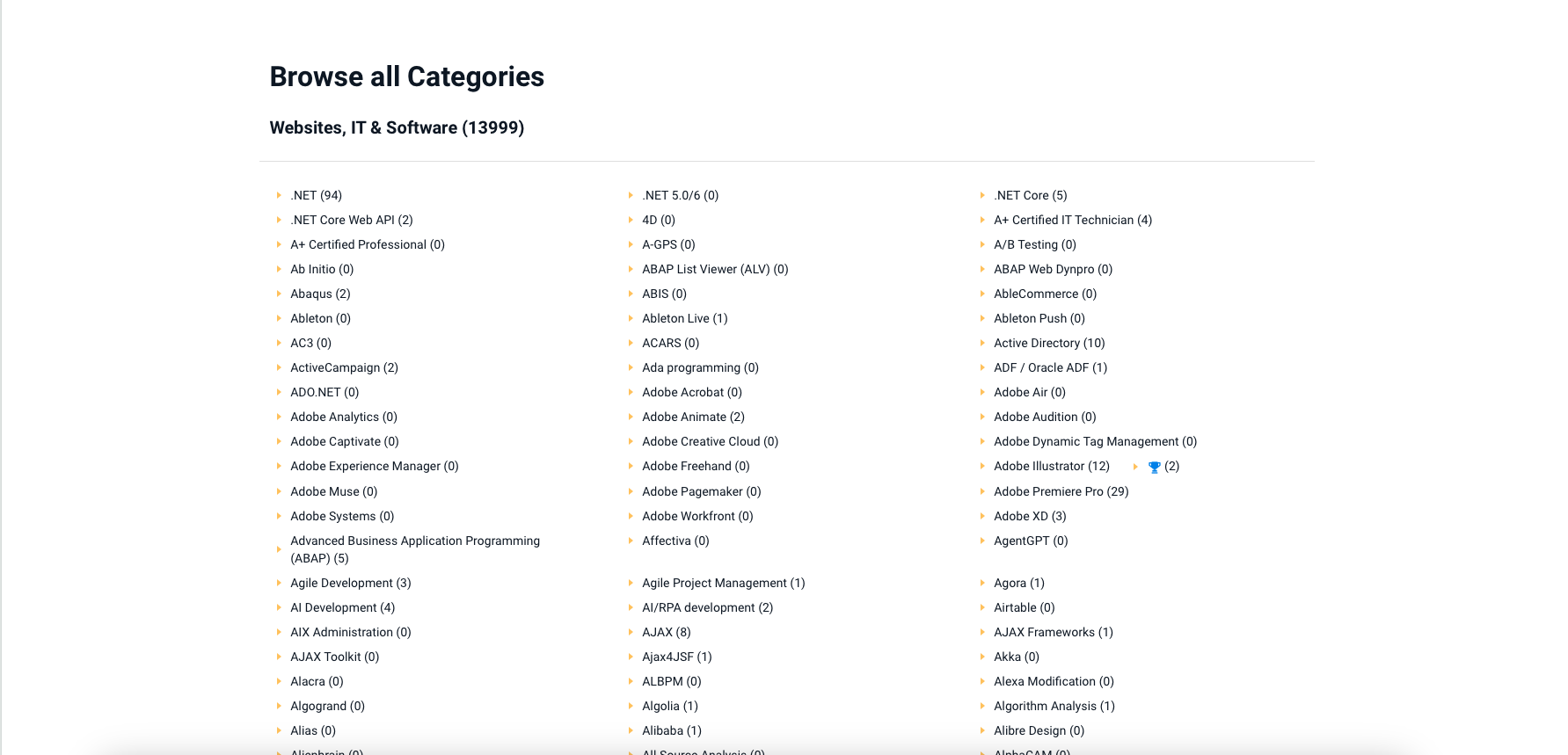
Skills that do contain jobs, though, can easily be filtered by a variety of criteria like:
- Budget
- Project duration
- Relevant skills
- Languages
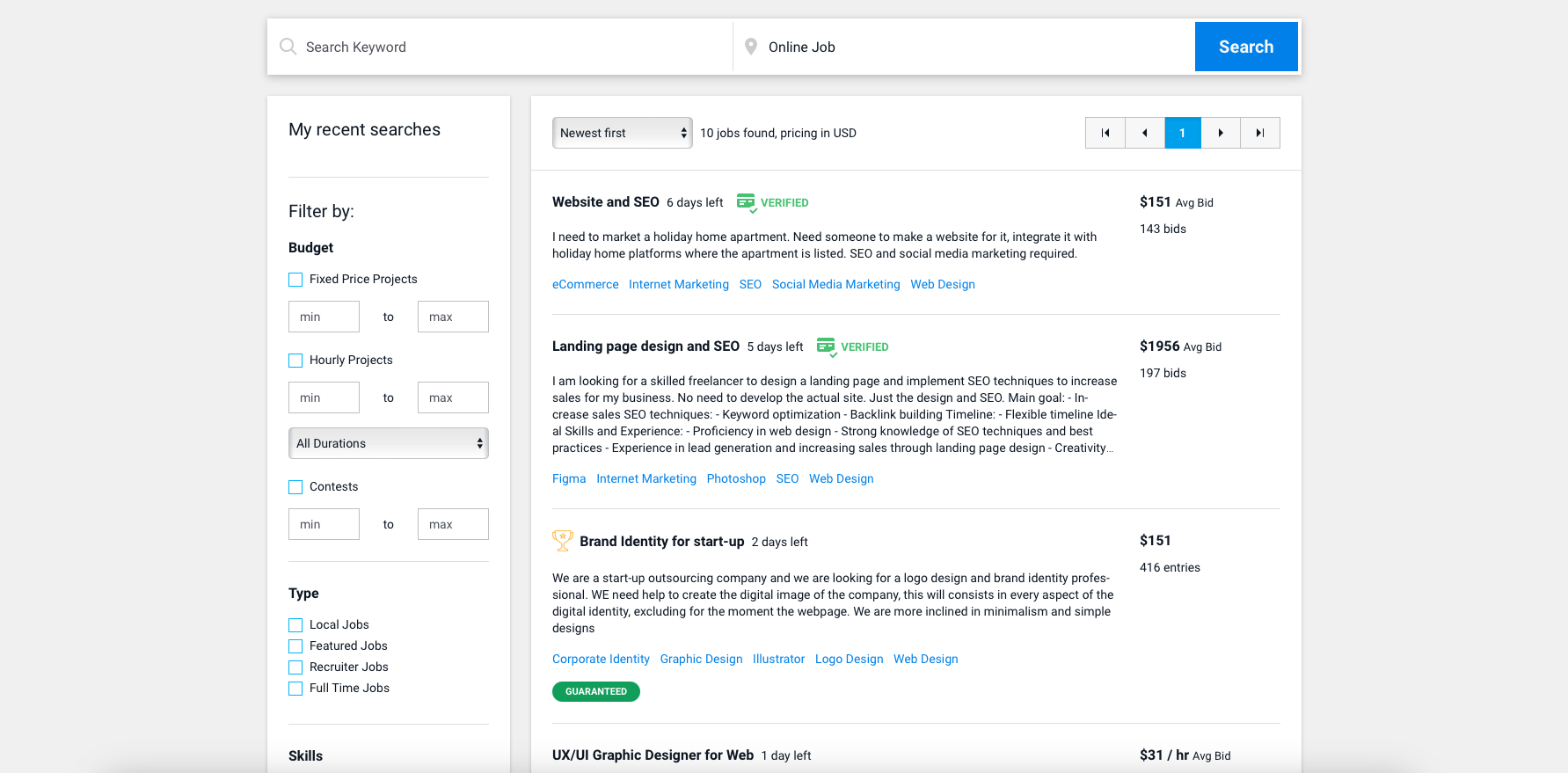
Talent can also see how long a job has been active, the number of total bids from other freelancers, and the average rate that others are bidding.
Freelancer profile features
Talent profiles contain helpful information to help clients decide whether or not they want to hire them, including:
- Average rating from prior clients
- Job completion statistics
- Repeat hire rate
- Hourly rate
- Length of time on the platform
- Location
- Professional bio
- Examples of work
Clients can reach out to talent directly from profile pages if they find someone they’re interested in working with.
Freelancer subscriptions and pricing
Several plan options are available to talent on Freelancer. While these plans aren’t necessary to use the platform, some users may find that a monthly subscription is cost-effective as it can increase the number of bids available each month and unlock other additional features.
Freelancer.com also charges specific service fees based on project type.
*Data sourced from Freelancer.com and other public sources made available by Freelancer.
Only two usage tiers are available for clients: Freelancer and Freelancer Enterprise. Neither type of account has upfront fees, but Freelancer Enterprise clients pay service fees based on usage.
The benefits of a Freelancer Enterprise account include:
- Access to pre-vetted talent with over 2,000 skills
- Curated Freelancer Clouds with talent that meets specific criteria
- Help from Freelancer recruiters
- Access to a cloud-based workforce management platform
Freelancer Enterprise can also support logistics and delivery needs.
Choosing between Fiverr vs. Freelancer
Fiverr and Freelancer are both great freelance platforms for talent or clients. The right choice depends on whether you're hiring or looking for work, and how you prefer to manage projects. You’ll want to use one that:
- Fits your budget
- Offers the work categories and skill sets that you need
- Is structured in a way that works well with how you prefer to work with clients
- Offers access to talent and quality work around the world
- Has an array of jobs and professionals available at different price points
- Offers support for hiring and professional development
- Has established processes and support channels for invoicing, timekeeping, dispute resolution, and more
There are also specific questions you can ask yourself as a client or freelancer choosing between these two freelance platforms that we’ll cover in the next section.
Fiverr vs. Freelancer for clients
Fiverr works well when you have a clear, defined task and want to browse ready-made service packages without posting a job. Freelancer is a better fit if you want to post a detailed project, review bids from multiple freelancers, and manage work through milestones. Clients who need local or in-person work will find that option on Freelancer but not Fiverr.
Ask yourself:
- Do I want to browse pre-packaged services or post a custom job and review proposals?
- Do I need milestone-based payments or a simple one-time purchase?
- Is local or in-person work part of what I'm hiring for?
Fiverr vs. Freelancer for freelancers
Fiverr gives you control over your services and pricing through gig listings which lets you set the packages and wait for buyers to come to you. On Freelancer, you'll spend more time bidding on client-posted jobs and competing for projects. Freelancer also offers contests, which let you submit finished work and get paid if a client picks yours.
Ask yourself:
- Do I prefer to list my services and let clients come to me, or actively bid on jobs?
- Am I comfortable competing in contests where payment isn't guaranteed?
- Do I want to set my own package pricing, or negotiate per project?
Choosing between Freelancer vs. Fiverr’s fee structure
Fiverr takes a 20% commission from freelancers on every order, while Freelancer typically charges around 10% or $5, whichever is greater. On the client side, Fiverr adds a 5.5% service fee at checkout with a small surcharge on smaller projects, and Freelancer charges ~3%. Both platforms are free to join so you can test out the fee structure.
Ask yourself:
- How much will platform fees affect my margins or budget?
- Do I need a free plan to start, or am I open to paid memberships for better visibility?
- Are upfront introduction fees (Freelancer) or higher commissions (Fiverr) more manageable for my situation?
Try Upwork as a Fiverr and Freelancer alternative
If Fiverr or Freelancer doesn’t cover everything you need, Upwork is often a stronger long‑term match for freelancers and businesses. You’ll find a flexible mix of hourly, fixed‑price, and consultation-based work, plus enterprise tools and AI-powered matching that help you build scalable, high-quality working relationships.
Freelancers on Upwork have collectively earned over $25 billion, and clients can find experienced professionals offering more than 10,000 different skills. It's free to sign up as a client or talent, so you can explore what's available before committing to a platform.
This analysis of services is provided for informational purposes only. Each reader and company should take the time needed to adequately analyze and determine the tools or services that would best fit their specific needs and situation.
If you are communicating with a hiring manager for a job through the Upwork platform, please note that sharing your personal contact information, such as email address, phone number, or LinkedIn profile, is not permitted in cover letters or at any time prior to the start of a contract. Additionally, all pre-contract communication should take place through the Upwork Messages feature. Learn more about using Upwork Messages here, and see more details on sharing information on Upwork here.

.avif)

Frequently asked questions
Upwork is one of the most popular freelance websites for clients and talent, and is a great alternative to Fiverr as well as Freelancer. New and experienced talent alike can benefit from all of the resources and features that are included in a free Upwork account, like:
- Getting peace of mind with Upwork payment protection
- Offering consultations or sending proposals in response to client job posts
- Drafting proposals more efficiently with help from Uma™, Upwork’s mindful AI
- Showcasing predefined, fixed-price projects on Project Catalog™
There are several ways for clients to use Upwork, too, including:
- Booking consultations
- Posting jobs
- Requesting talent shortlists with Business Plus
- Benefiting from fully managed services
Both clients and talent can sign up for Upwork for free and begin exploring all the ways the freelancing site helps to facilitate great work.
Freelancer or Fiverr can each be better than the other depending on how you like to work. Fiverr leans into fast, productized fixed‑price gigs, while Freelancer.com is built around posting jobs, collecting bids, and managing more customized projects through milestones or contests.
Yes, Fiverr offers a free account for both freelancers and clients. Freelancers can sign up and create gigs at no cost, with Fiverr deducting a 20% service fee from completed orders. Clients can browse and purchase gigs for free, though a 5.5% service fee and a small-order fee on purchases under $25 apply at checkout.
Yes, Freelancer.com offers a free account for both freelancers and clients. Freelancers can sign up and bid on jobs at no cost, though the number of monthly bids is limited. Clients can post projects and review bids for free, with Freelancer applying a 3% service fee (or $3, whichever is greater) when payments are made.
Fiverr typically charges freelancers a 20% commission on each order and adds a 5.5% service fee for clients, plus an extra fee on smaller orders. Freelancer.com usually takes around 10% from freelancers on standard projects and about 3% from clients per payment, so its headline fees often look lower but vary more by project type.
Fiverr and Freelancer are both good platforms for beginner freelancers. Fiverr works well if you want to list specific services and let clients come to you. Freelancer is a better fit if you'd rather browse job posts and submit bids. Upwork is also a great place for beginner freelancers to start building their careers.
Freelancer.com generally works better for long‑term or ongoing collaborations because it supports detailed job posts, bids, milestones, and even local or hourly work. Fiverr can handle repeat work through gigs and subscriptions, but its structure is optimized for clearly scoped, project‑based tasks rather than embedded, ongoing roles.
Many independent professionals work full time through Upwork, serving a variety of clients around the world.
- Margareth turned her customer service experience into a successful career as an independent project manager and bought her dream home in just three years
- Oleksii uses his work as an independent designer to support his family, friends, and countrymen in need during turbulent times
- Chisom works independently as an architect and enjoys the flexibility of working and spending time with her growing family
The rate each independent professional charges on Upwork is different based on location, skills, and years of experience.
You can use the Upwork Fee Calculator to get an idea of what you might be able to charge when you’re first starting out — and how that number can grow over time!
Author Spotlight

Upwork is the world’s largest human and AI-powered work marketplace that connects businesses with independent talent from across the globe. We serve everyone from one-person startups to large organizations with a powerful, trust-driven platform that enables companies and talent to work together in new ways that unlock their potential.