How the New Workforce Architecture Drives Higher Revenue
Companies that build diverse talent ecosystems see faster execution, higher revenue, and greater resilience in an era of relentless change.

.png)
.avif)
When architects design buildings in earthquake zones, they build for movement. Flexible structures bend and absorb pressure. Rigid ones break. The same principle now applies to workforce strategy.
As the business environment shifts rapidly and AI transforms how work gets done, companies can no longer rely on employees alone.
The companies pulling ahead aren’t just rethinking where work happens—onsite or remote—they’re redesigning for capability access at speed.
They’re building workforce ecosystems that blend full-time employees, freelancers, managed services teams, and AI-enabled contributors. Each is brought in at the right moment, for exactly as long as needed, to play a distinct role in delivering value.
The payoff is what many companies are chasing: faster execution, higher revenue, and greater resilience in an era of relentless change.
Traditional talent models can’t keep up
Amid geopolitical instability, accelerating AI, and ongoing economic uncertainty, business priorities can shift in days—sometimes even hours. The most resilient companies aren’t the ones slashing costs or automating the most.
The ones that survive and grow are those that move with speed and flexibility to keep up with the pace of business and find opportunities amid disruption. The thing is, a traditional talent model won’t get you there.
Adding headcount and navigating rigid organizational charts doesn’t allow teams to pivot quickly enough to meet fast-changing demands. And pushing employees to do more isn’t sustainable. Most full-time employees (71%) are already burned out.
So how can you succeed? By building a workforce designed for agility, speed, and innovation.
Leading companies are building flexible ecosystems
High-performing companies—those in the top 25% of year-over-year growth—don’t see their workforce as a monolith of employees. They see it as a modular network of skills.
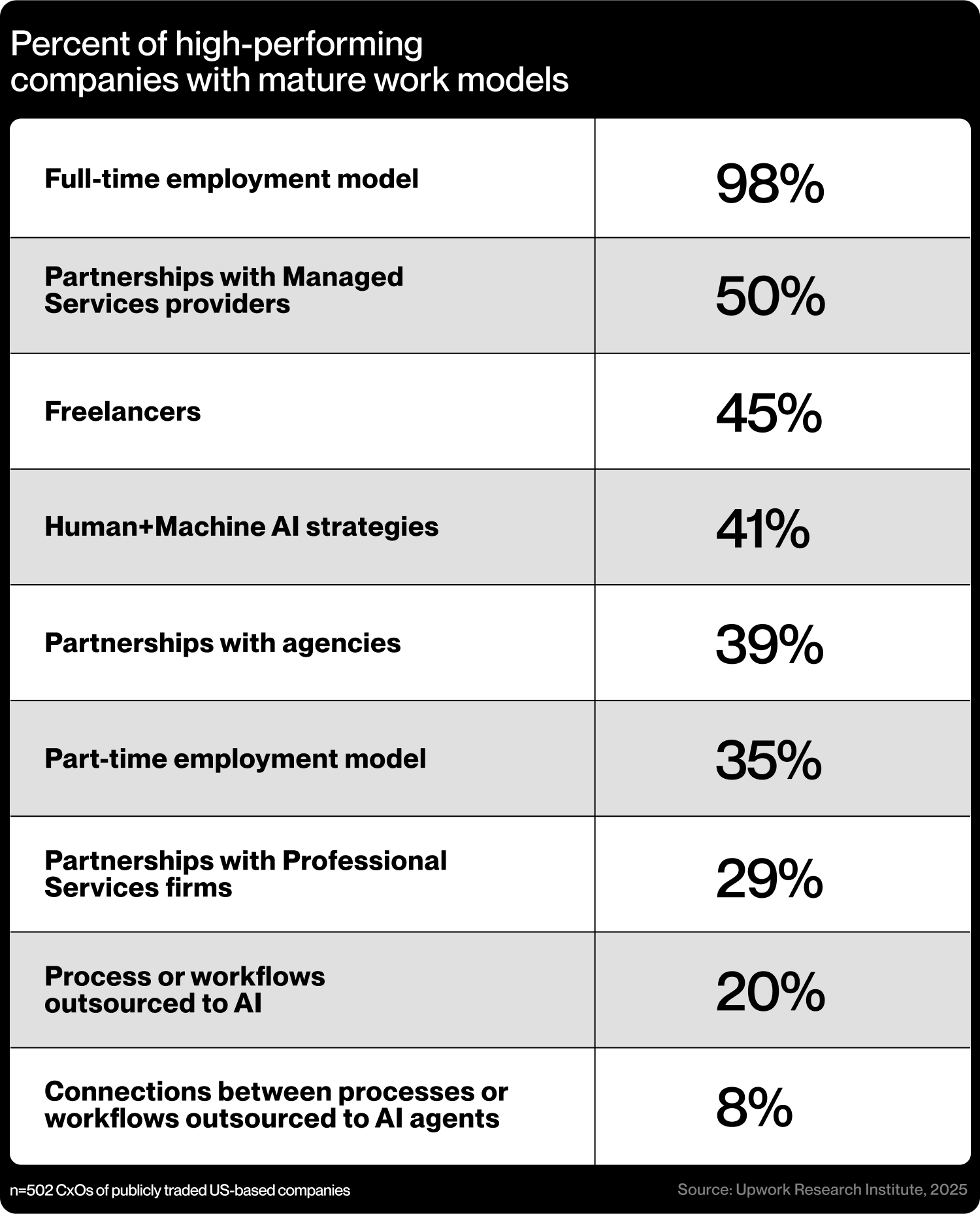
These successful companies are designing their workforce as flexible, blended ecosystems made up of both internal and external specialists. Analysis from The Upwork Research Institute shows:
- 50% rely on managed services partners to bring in external talent for key functions
- 45% embed skilled freelancers across roles and departments
- 41% leverage mature human+machine AI strategies, empowering both freelance and full-time workers to optimize their contributions alongside AI tools
The goal is straightforward: Gain fluid access to people with the right skills at the right time, and engage them in whatever way the work requires. That might mean bringing in a specialist for an hour to workshop an idea, contracting a fractional CFO for a year, or assembling a team to test proof of concept in days instead of months.
This approach reflects our earlier research on a standout group of companies we call Work Innovators. What’s important to note is that tapping a diverse workforce is not enough for business growth. Work Innovators also cultivate cultures that build trusting relationships between all talent and enable remote and distributed work. Everyone feels supported and has the tools, systems, and processes in place to deliver their best.
Yes, having the people, processes, and hearts in place requires intentional and regular effort, but the return is tangible. Our data shows Work Innovators experienced:
- 30% lower operating expenses
- 18 percentage points greater likelihood of increasing free cash flow
- 13 percentage points lower debt-to-equity ratio
By contrast, companies clinging to traditional models are increasingly at risk of falling behind. When change hits, they struggle to adapt and recover fast enough. They’re so busy reacting, they miss out on seizing new opportunities for growth.
Skilled freelancers pave the way in being future-ready
Skilled freelancers are a vital component of a workforce ecosystem. As stated earlier, 45% of high-performing companies use skilled freelancers throughout the organization.
Fading are the days when freelancers are seen as a secondary option who are used when budgets are tight and full-time hires aren’t available. Today, freelancers are at the forefront of future-ready talent strategies.
Skilled freelancers are knowledge workers with deep, specialized expertise built through years of education, practical training, and real-world experience. They apply that expertise to solve complex business challenges in areas like AI, software development, strategic consulting, and more.
But how do freelance knowledge workers compare to their full-time counterparts? To answer that, we created the Future Workforce Index, which evaluates how prepared skilled professionals are across a range of future-critical dimensions.
The results are clear: Skilled freelancers are leading the way.
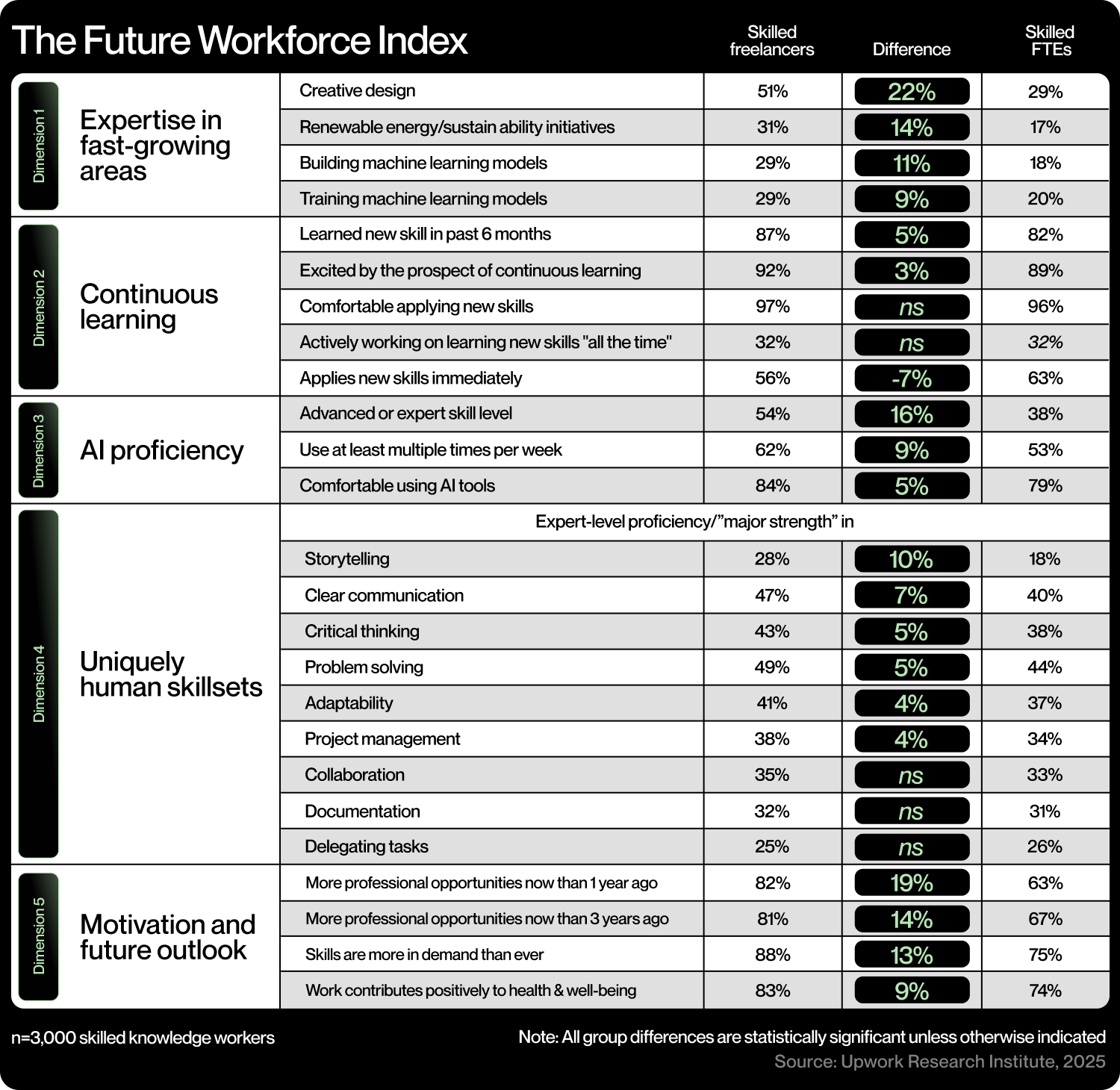
Businesses that remain closed to freelance talent may struggle to access the skills required to stay competitive.
More than one in four skilled knowledge workers now work as freelancers. They’re drawn by autonomy, financial control, and the ability to do meaningful work on their own terms.
And this shift is gaining momentum: 36% of full-time knowledge workers are considering a move to freelancing, with Gen Z already embracing it at scale.
Why some leaders are still holding back
Despite the clear upside, many business leaders remain hesitant to fully embrace nontraditional workforce models. Our research shows:
- 95% of CxOs express discomfort with workers who view themselves as business owners or entrepreneurs
- 59% are uneasy with the idea of workers contributing to multiple companies at once
- 29% are uncomfortable with workers developing skills, like AI, outside the organization’s walls
Their reluctance isn’t about performance. It stems from legacy thinking and a desire to maintain control.
Here’s the paradox: The very traits that make freelancers valuable—autonomy, adaptability, and self-directed learning—are often the ones leaders resist. Yet, the companies that embrace these qualities as strategic assets are the ones pulling ahead.
Three principles for building a future-ready workforce
Companies leading the way are designing their workforce for adaptability, speed, and performance. These three principles guide how they do it:
1. Access over ownership
Rather than relying solely on full-time headcount, high-performing companies build systems that give them flexible access to specialized skills when they need them.
Example:
Start up Ensemble Consultancy, which serves clients like NASA and the CDC, competes with larger government contractors by embracing a flexible talent model. In one case, the company delivered a mobile app for NASA for just $175,000—significantly less than the $4–6 million typically charged by larger firms—demonstrating how strategic use of skilled freelancers can create a meaningful competitive edge.
2. Composition over control
Instead of building teams around static roles, these companies assemble teams around outcomes. So, they can orchestrate the right mix of skills regardless of job title or contract type.
Example:
Mobile telecom company Mobileum, with operations in 52 countries, needed to unify its HR systems. Facing tight budgets and limited internal bandwidth, its CHRO partnered with Upwork Managed Services to build a global, self-service HR knowledge hub quickly and cost-effectively.
3. Technology as a team player
Forward-looking companies don’t just adopt AI—they integrate it into blended teams where it enhances creativity, accelerates output, and improves decision-making. Making that work requires both technical fluency and soft skills like adaptability and communication—areas where skilled freelancers consistently outperform their employed peers.
Example:
As managing director of The Upwork Research Institute, I often have opportunities to share our research with new audiences—but not always the time. So, I regularly tap into our diverse mix of internal and external talent to help extend my reach and increase productivity. A great example is our Work Week podcast, which isn’t hosted by me directly, but by an AI-generated proxy. Thanks to the collective skills of our team, we can share our research insights with more people without overwhelming my workload.
Workforce design is a business strategy for growth
The companies that thrive in the years ahead won’t necessarily be the ones with the most employees. They’ll be the ones that build workforces designed to unlock potential.
They enable success by creating a diverse talent ecosystem, processes, and culture designed for agility. So instead of asking, “Who do we hire?” they ask, “What do we need?” and “How do we get there faster?”
This is your opportunity to design a workforce that doesn’t just withstand disruption, but is fueled by it. A workforce that flexes with your boldest ideas and helps you reach new levels of speed, creativity, and impact.
Is your workforce built to adapt, lead, and thrive in what comes next? Find out in the Future Workforce Index.

.avif)

Author Spotlight

Dr. Kelly Monahan is Managing Director of the Upwork Research Institute, leading our future of work research program. Her research has been recognized and published in both applied and academic journals, including MIT Sloan Management Review and the Journal of Strategic Management. In 2018, Kelly released her first book, “How Behavioral Economics Influences Management Decision-Making: A New Paradigm” (Academic Press/Elsevier Publishers). In 2019, Kelly gave her first TedX talk on the future of work. Kelly is frequently quoted in the media on talent decision-making and the future of work. She also has written over a dozen publications and is a sought-after speaker on how to apply new management and talent models in knowledge-based organizations. Kelly holds a B.S. from Rochester Institute of Technology, an M.S. from Roberts Wesleyan College and a Ph.D. in Organizational Leadership from Regent University.