AI for Product Managers: Prompts and Use Cases To Streamline Your Workflow
Learn how to use AI prompts across the product lifecycle to streamline workflows, enhance UX, and support smarter decisions.
.png)
.avif)
AI prompts are an important tool for product managers (PMs) who need to stay relevant in a fast-changing business landscape. With the right inputs, generative AI can help PMs brainstorm, analyze data, test ideas, and build alignment—fast.
In this article, we’ll break down how to use AI across the product lifecycle with categorized prompts and use cases. Whether you’re refining a product strategy or preparing a launch, these AI tools can help accelerate your process and reduce risk. We’ll also highlight when to bring in freelance experts to make the most of AI’s potential.
Understanding AI prompts and how they help product managers
AI prompts are the details and instructions you input to a generative AI tool in order to manufacture a desired output. Generative AI models like ChatGPT, Gemini, and Copilot use natural language processing (NLP), so your prompts can be as conversational as if you were talking to a teammate or subordinate.
The key is specificity. The more detailed your prompt, the better your output. Effective prompts help PMs summarize user feedback, generate personas, identify gaps in product features, and more.
With prompt engineering, you can refine the results further—adjusting format, tone, or level of detail based on what you need. Below, we’ll explore prompt examples tailored to different stages of the product management lifecycle.
Crafting effective AI prompts
You need a reliable process to create effective AI prompts. When artificial intelligence models are given generic prompts, they often give generic outputs. Sometimes, they attempt to fill gaps in a prompt’s context with connections made in the model’s training; when these connections aren’t appropriate to the topic, it can result in an AI hallucination. The more precise your prompt, the more likely you are to get useful, error-free output.
Follow these steps to build your prompts the right way:
- Set clear objectives. Having a clear objective is the first step to creating good AI prompts. Define the goal you want the AI to achieve: Are you looking for ideas for a new product, or do you want to refine an existing idea? The more detailed information you include in your prompt, the better output you’ll see.
- Define your user personas. Crafting good prompts includes giving the AI tool enough context about your audience. Define your audience with user personas that represent demographics, interests, and other factors that may play a role in determining your product’s features.
- Narrow your focus. Creating overly general AI prompts is a real danger, even when you have clear objectives. While the AI needs important context, prompts need to be clear and concise. Try to narrow your prompt’s focus to avoid confusing the AI and getting unhelpful results.
- Experiment with prompt formats. Not all prompt formats are helpful, even if you have the right information. How you write your prompt and phrase requests can impact the AI’s output. Experiment with different prompt formats to find one that results in helpful content.
Now you know how to craft effective prompts, let’s look at some innovative AI prompts for product managers.
Set the stage: Assign the AI a clear role
Before jumping into your request, you’ll want to “set the stage” by assigning a role to the AI. This is one of the most effective ways to get focused, high-quality results, especially when working on tasks that require context or expertise.
Instead of starting your prompt with just a task, open with a brief role description. For example:
- “You are an expert senior product manager at a SaaS company…”
- “Act as a data scientist reviewing a product's usage trends…”
- “You’re a senior UX researcher evaluating user feedback for a mobile app…”
This pre-prompt helps guide the AI’s response style and decision-making, much like giving direction to a subordinate. You can also include context such as tone, output format, or persona constraints in this setup to tailor the results even more.
Try combining this structure with your goal:
- “You are an expert senior PM focused on B2B products. Based on this feedback, identify the top feature requests and group them by category.”
- “Act as a senior product marketing specialist, preparing a launch plan. Suggest five messaging angles based on these user personas.”
AI in product management: Common use cases across the lifecycle
AI is changing the fundamentals of product management. Across every phase of the product lifecycle—from ideation to launch to iteration—AI tools are helping product managers streamline workflows, uncover insights, and build better user experiences.
Here are some of the most common use cases for AI in product management:
- User research and ideation. Generative AI and large language models (LLMs) like ChatGPT can analyze customer feedback, social media conversations, and support tickets to surface unmet needs and product ideas.
- Product strategy and roadmapping. AI can evaluate performance metrics, competitor offerings, and datasets to help shape your product roadmap and prioritize high-impact initiatives.
- Feature design and prioritization. AI tools can suggest product features based on user segments or past usage patterns—helping PMs deliver more personalized, AI-powered products.
- Pricing and business model validation. By analyzing data science inputs such as competitor pricing, customer segments, and historical sales, AI can support better informed pricing decisions.
- Stakeholder communication. Natural language processing can help PMs summarize dense project management updates, explain product decisions to stakeholders, and auto-generate product documentation.
With AI integration in your product workflows, you can reduce manual tasks, improve collaboration with cross-functional teams, and make faster, more data-driven decisions.
AI prompts for product managers
In this section, we'll provide you with AI-driven prompts, insights, and strategies to help you navigate the evolving landscape of product development, enhance customer experiences, and drive innovation.
1. Ideation and market discovery
AI can help uncover trends, synthesize feedback, and identify gaps in the market—all critical in early-stage product work. Product managers can use these prompts to gain insights from data for better decision-making.
Sample prompts:
- Here is a list of features requested by customers. Please group and rank them by frequency.
- Compare our product’s features to this competitor’s list. What features are we missing?
- Summarize complaints from this social media dataset. Suggest product improvements.
- Analyze this sales data. What are our three most profitable products?
- Based on this article, what external trends could impact our product’s roadmap?
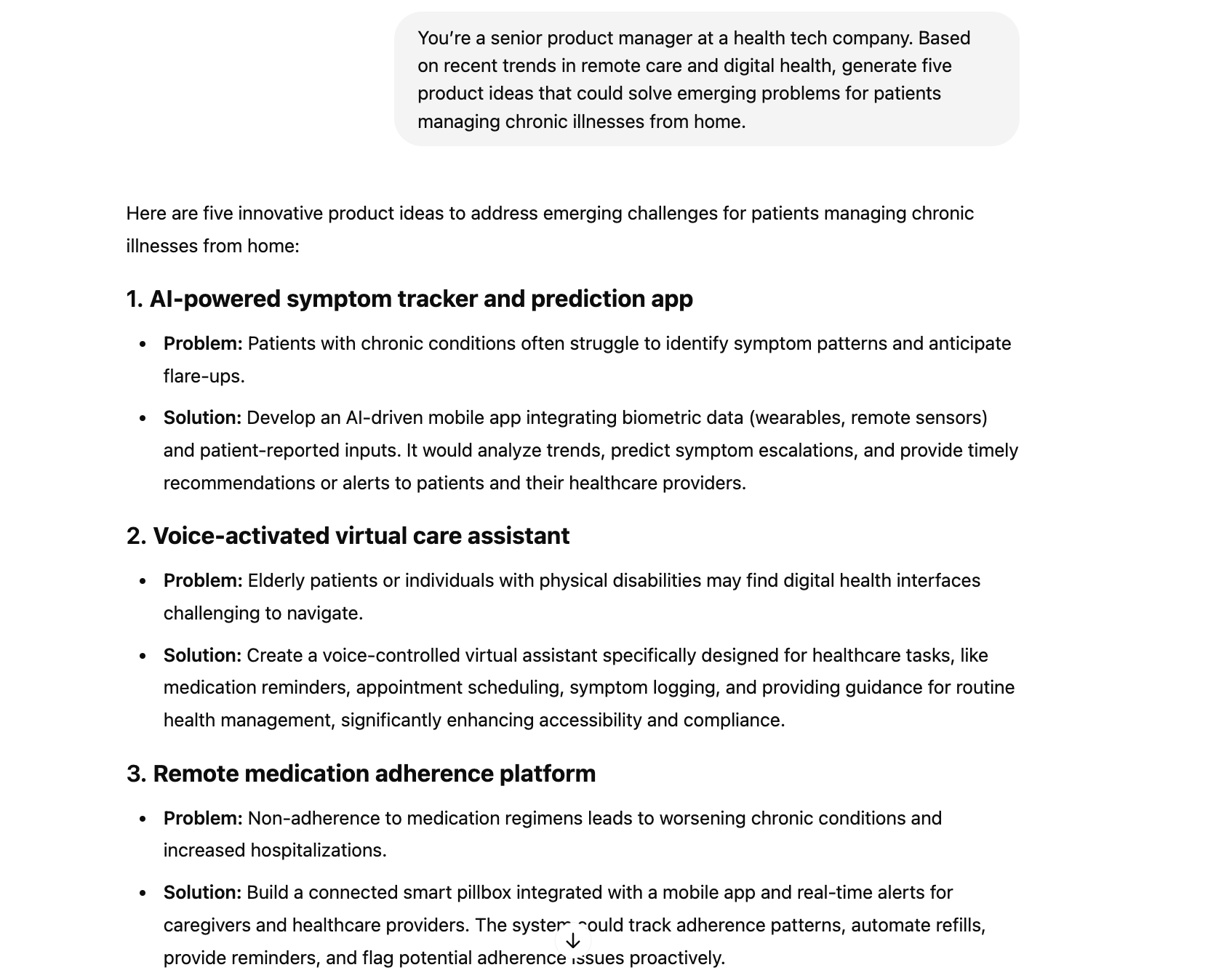
2. Product development and use case mapping
AI can help PMs define personas, validate features, and anticipate legal or operational risks.
Sample prompts:
- Create an ideal user persona for this product with [features].
- We’re solving [problem] for [user]. Will this feature help increase conversions?
- What legal considerations should we plan for in the [industry] when launching [product]?
- Summarize the benefits and risks of this feature list for internal stakeholders.
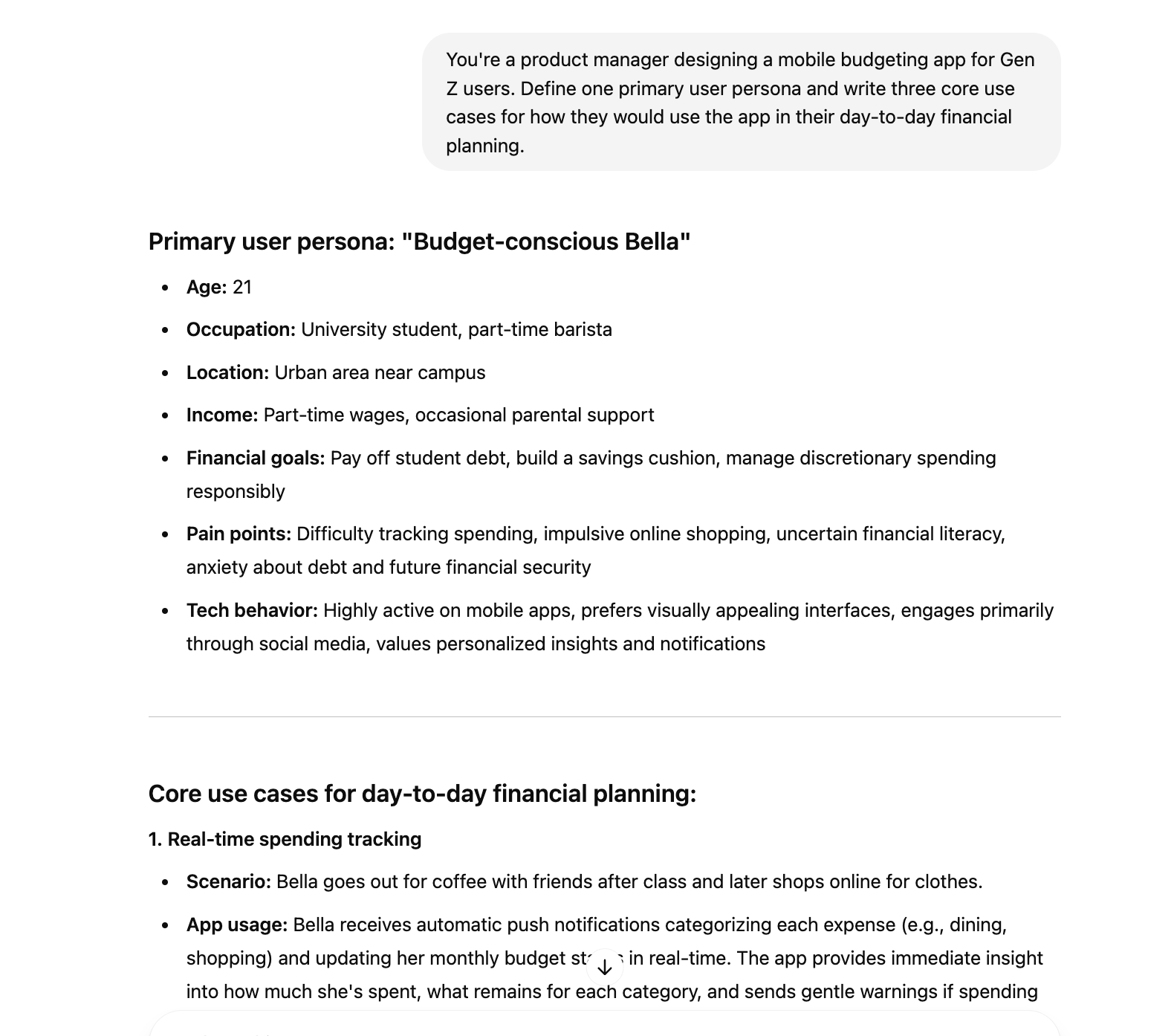
3. Prototyping and user testing
Use AI to simulate early user interactions or test flows in low-stakes environments.
Sample prompts:
- Pretend you're using [product] for the first time. What’s confusing?
- Create a usability test plan for this new feature with success metrics.
- Write user flow descriptions for [feature] to include in our prototype brief.
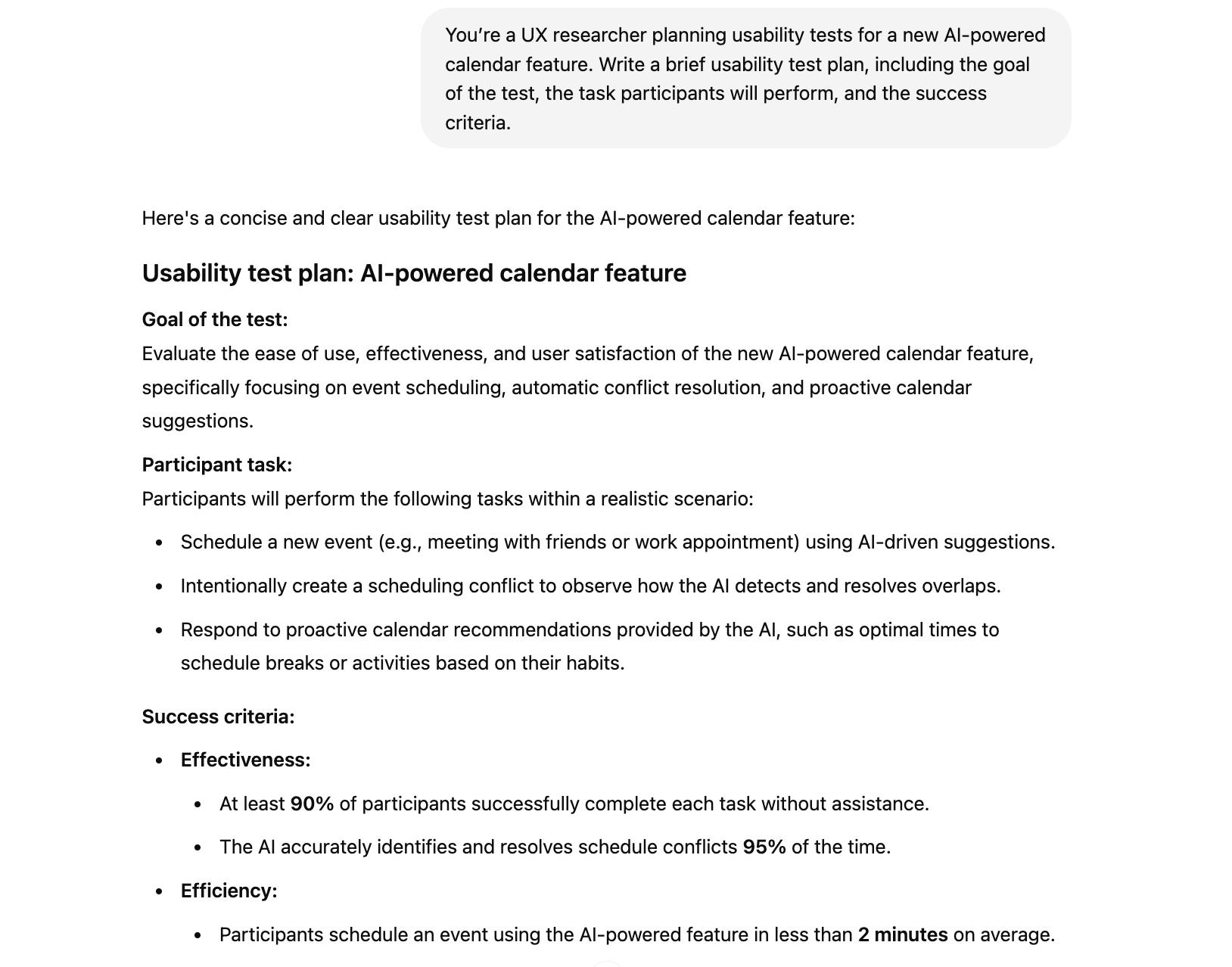
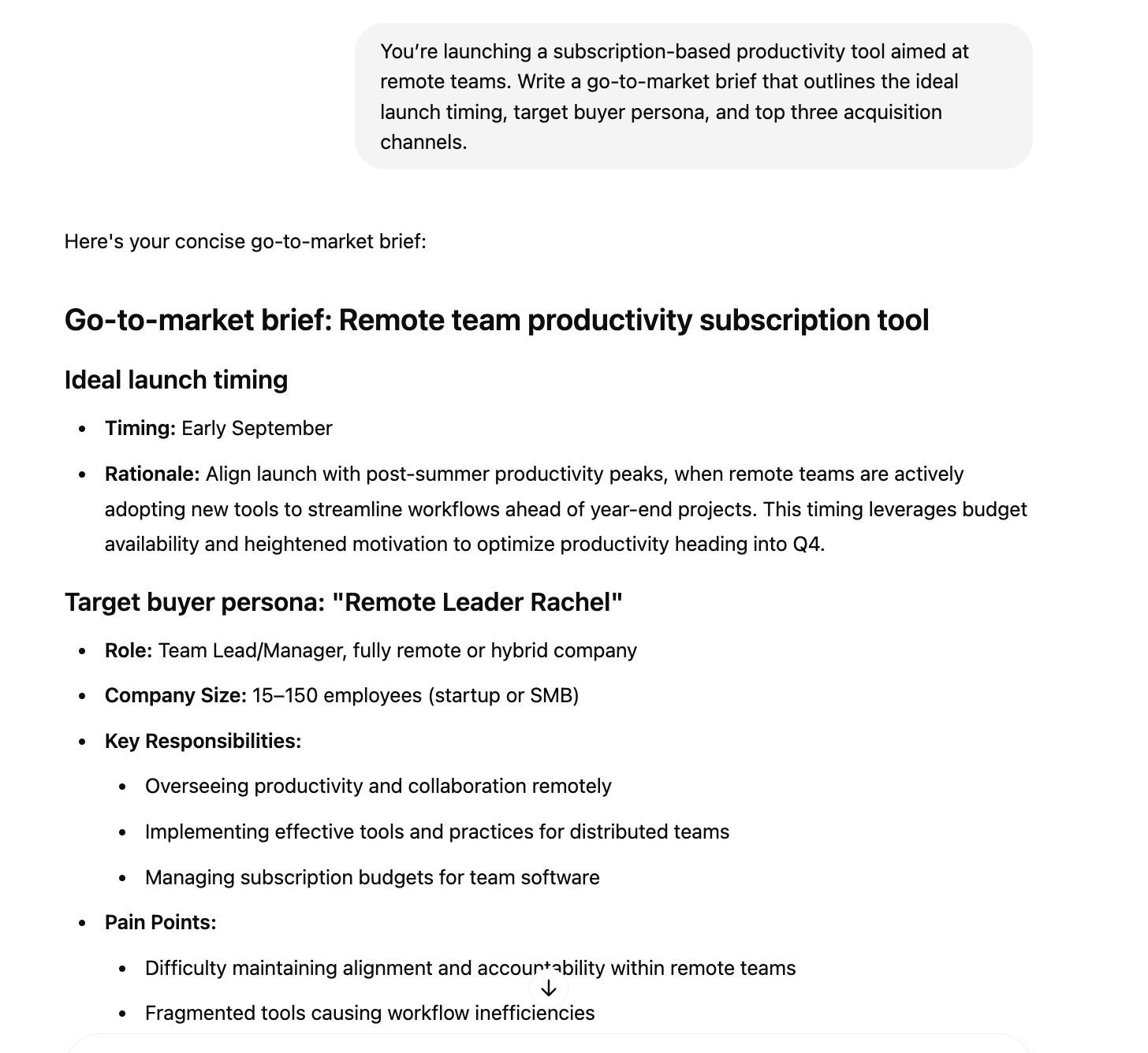
4. Product launch and go-to-market strategy
AI prompts can help you analyze beta feedback, align pricing, and map launch timing.
Sample prompts:
- When is the optimal time of year to launch [product] based on industry seasonality?
- Analyze this beta tester feedback. Create a table of issues and enhancement ideas.
- Is [price] competitive for [product] and [audience persona] in [industry]?
- Identify missing components in this go-to-market plan.
5. Documentation and stakeholder communication
Generative AI can help you write product descriptions, simplify specs, and create stakeholder summaries.
Sample prompts:
- Summarize these technical specs for a non-technical audience.
- Create an FAQ page based on these common customer questions.
- Write a stakeholder update summarizing the last sprint’s progress.
- Generate internal release notes based on this changelog.

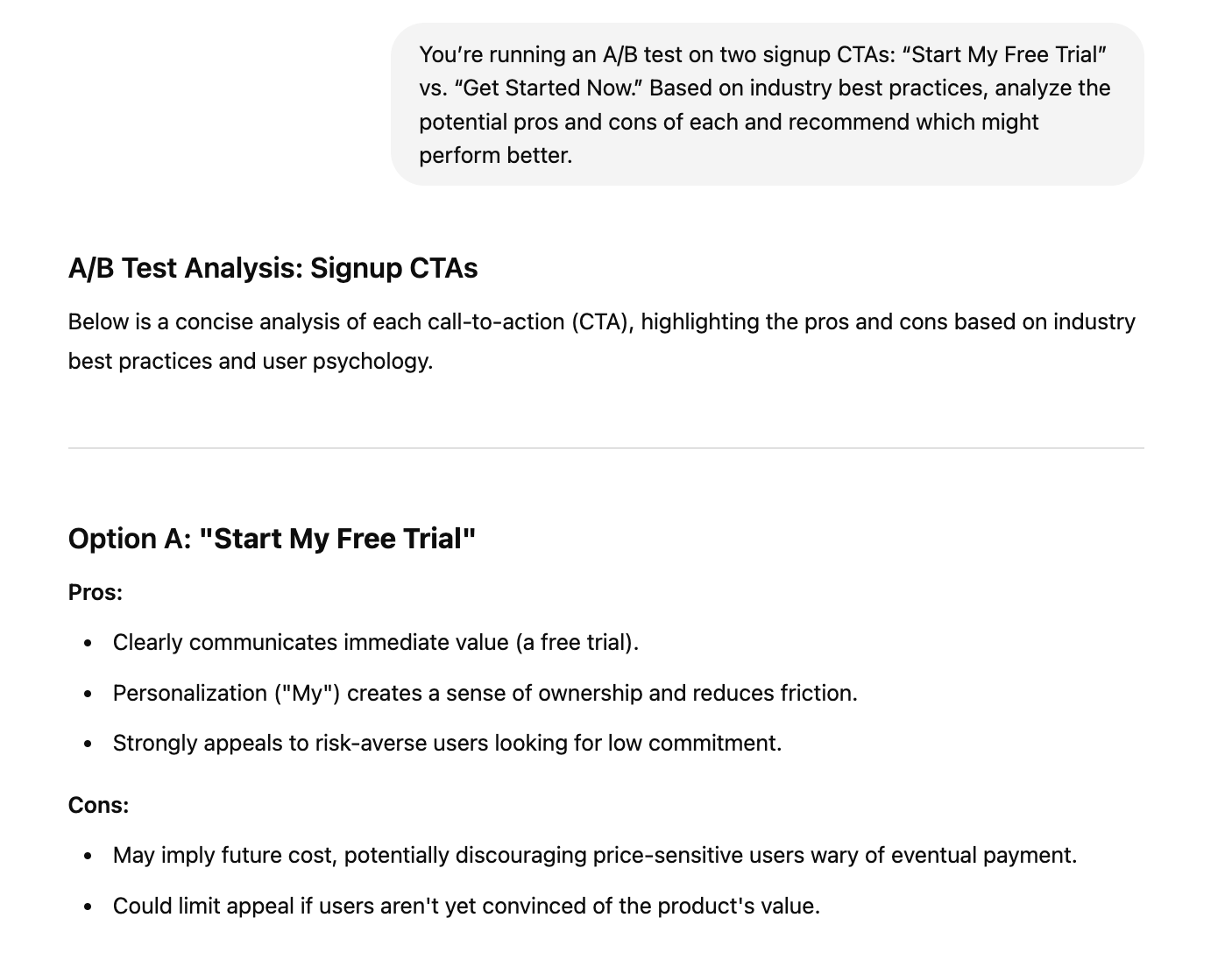
6. A/B testing and continuous improvement
AI can suggest experiments to optimize copy, features, and funnel performance with A/B testing.
Sample prompts:
- Analyze ad variation performance. Which should we scale?
- Suggest alternative email subject lines to improve open rates.
- Identify drop-off points in this product onboarding flow.
- Which recently launched features have the most engagement?
Tips for product teams experimenting with AI tools
If you're just starting to use AI for product development, you’ll want to test and learn with small experiments before scaling. Here are a few tips to help product teams integrate AI tools more effectively:
- Start with low-risk applications. Use AI technology for writing user stories, summarizing stakeholder feedback, or building AI knowledge bases. These tasks are high-impact and low-stakes, making them ideal for early exploration.
- Align your frameworks and workflows. Use established product management frameworks to guide how AI fits into existing team rituals—whether that's sprint planning, roadmap updates, or A/B testing.
- Define the role of the AI PM. An AI product manager role isn’t necessarily a new hire—it’s a mindset shift. A product leader embracing AI should know how to evaluate algorithms, weigh ethical considerations, and use AI-powered features responsibly.
- Document your use cases. Keep a running list of what works and what doesn’t. Case studies can help the rest of the organization understand what’s possible—and where human oversight is still needed.
- Work with specialists. Not every team has data scientists or machine learning engineers in-house. That’s where freelance AI professionals on Upwork can help you experiment, integrate new AI systems, or even build prototypes using tools like OpenAI and Excel.
As product teams grow more comfortable using AI in their workflows, they’ll be better positioned to build cutting-edge solutions that deliver business value.
Future potential of AI product development
AI has come a long way in the past several years, with generative AI tools offering new capabilities that are useful in many industries. These tools can help product managers get more done and refine new ideas.
AI tools are rapidly evolving, and product managers stand to benefit. Expect more integrations into daily workflows, from roadmapping tools to prototyping platforms, with AI built in. For example, ClickUp already embeds AI for summarizing tasks and drafting updates.
As these tools become more sophisticated, they’ll require sharper prompt writing and more human oversight. Freelance AI consultants and PMs can help bridge the gap, testing new tools, fine-tuning workflows, and scaling what works.
Elevating product management through AI-powered prompts
AI-powered prompts have a lot of potential to help product developers streamline their processes and create great products. They can analyze data to learn about the market and help managers refine their ideas to give customers exactly what they want. AI can also help optimize processes by helping with A/B testing and refining documentation and communication methods.
As the use of AI becomes more common, product managers will need to understand how they can best fit it into their workflow to keep up in the marketplace. Start embracing AI in your product development process today to get a head start with using the technology.
Are you a business owner ready to launch a new product? Browse the Upwork Talent Marketplace to find independent product managers who can help.
If you’re a product manager available to help companies launch their next big thing, check out the product management jobs on Upwork to find your next client.
Upwork is not affiliated with and does not sponsor or endorse any of the tools or services discussed in this article. These tools and services are provided only as potential options, and each reader and company should take the time needed to adequately analyze and determine the tools or services that would best fit their specific needs and situation.

.avif)

Author Spotlight

Upwork is the world’s largest human and AI-powered work marketplace that connects businesses with independent talent from across the globe. We serve everyone from one-person startups to large organizations with a powerful, trust-driven platform that enables companies and talent to work together in new ways that unlock their potential.