Will AI Replace Digital Marketers in 2026? Insights for Freelancers and Clients
Explore how AI is reshaping digital marketing roles in 2026. Essential insights for freelancers and clients navigating the evolving landscape.

.png)
.avif)
Will AI replace digital marketers in 2025—or simply reshape the work they do? As artificial intelligence evolves at a rapid pace, marketers face a mix of anxiety and opportunity. On one hand, AI-powered platforms like ChatGPT are helping marketing teams automate everything from copywriting to campaign optimization. On the other hand, there’s growing concern about what automation means for creative jobs and long-term roles.
In 2024, 69.1% of marketers reported incorporating AI into their marketing strategies, up from 61.4% the year before. This jump reflects a major shift: AI is no longer optional—it’s a core part of how brands operate. From generative AI tools that create content to systems analyzing vast amounts of data for insights, artificial intelligence is reshaping digital marketing.
This article explores what these changes mean for both freelancers and clients. You’ll learn how AI tools are impacting marketing strategies, which roles are evolving, and what practical steps you can take to succeed in this new era—whether you're a marketing professional navigating your next move or a business looking to hire effectively in a fast-changing landscape.
The current state of AI adoption in marketing
AI is no longer a side tool—it’s now central to how modern marketing teams operate. From budget allocation to campaign outcomes, the impact of AI-powered tools is undeniable. A growing number of teams are investing heavily in automation, machine learning, and generative AI to streamline workflows and elevate performance.
These stats from a 2024 AI marketing report highlight how deeply AI is embedded in today’s marketing trends:
- About one in five marketers now dedicate over 40% of their marketing budget to AI-powered campaigns, reflecting strong adoption of automation and AI tech.
- 34.1% of marketers have seen major gains in performance from using AI, proving the value of smarter marketing tools and data-driven workflows.
- Generative AI tools such as ChatGPT have reshaped marketing strategies for 42.2% of marketers, improving content production and streamlining digital campaigns.
These numbers confirm that marketing teams embracing AI are scaling up and seeing results.
AI as a marketing infrastructure
What began as a helpful add-on is now the backbone of many marketing efforts. AI isn’t just supporting isolated tasks—it’s driving the foundation of how campaigns are optimized, tested, and delivered in real time. Automation and AI marketing tools are becoming indispensable in daily operations.
Here are some of the ways AI is now baked into routine marketing tasks:
- Content optimization. AI analyzes engagement metrics and audience signals to tailor blog posts, ads, and landing pages for performance.
- Real-time personalization. Machine learning models power customized user experiences on websites, email, and social platforms.
- Automated A/B testing. AI tools handle continuous A/B testing for subject lines, CTAs, headlines, and visuals without the need for manual oversight.
- Predictive targeting. Algorithms process historical data to anticipate user behavior and suggest timely marketing campaigns.
- Campaign timing and delivery. AI schedules and sends marketing messages at optimal times to boost visibility and engagement.
As AI marketing becomes more integrated with campaign execution, marketers are increasingly relying on automation to keep up with expectations and deliver measurable outcomes.
Tasks AI can automate—and their impact
From content creation to testing ad variations, automation is now a core part of how marketing teams operate. While some entry-level tasks are declining, marketers who adapt by offering strategic oversight or creative direction are finding new opportunities.
Understanding which tasks AI can handle—and how they impact workflows—is key to staying competitive for both freelancers and businesses.
Content creation, A/B testing, and predictive analytics
AI tools have rapidly become go-to solutions for automating some of the most time-consuming parts of content marketing. From crafting product descriptions to running A/B tests at scale, AI is taking over many of the repetitive tasks that once defined entry-level roles in digital marketing.
Examples of tasks AI handles with speed and consistency include:
- Generating SEO blog content. Tools like ChatGPT can draft keyword-rich articles in minutes, helping teams hit tight deadlines.
- Creating product descriptions at scale. AI-generated content allows e-commerce brands to write hundreds of listings instantly.
- Testing ad variations. Predictive algorithms can run and optimize A/B tests across multiple audiences, boosting performance with less manual input.
- Drafting email subject lines. Machine learning models analyze open rates and engagement patterns to write compelling headlines.
- Repurposing content. AI helps turn long-form pieces into social posts, summaries, and landing page copy.
This shift has impacted freelance writing gigs. Entry-level copywriters who once thrived on volume-based work are now facing tighter competition and shrinking demand. Generative AI tools like ChatGPT have contributed to a 20–50% drop in demand for freelance writing and translation work, while overall freelance job demand has grown. AI has reduced demand for highly substitutable tasks but created new opportunities in complementary areas like chatbot development and natural language processing.
This trend poses real challenges for independent professionals focusing solely on low-level content creation. But for those evolving their offerings—like content strategy or brand messaging—AI can become a valuable assistant rather than a direct competitor.

AI in customer service and campaign optimization
AI's role in how brands manage customer interactions and optimize marketing campaigns is growing. From automated messaging to audience segmentation, AI tools are helping companies reduce costs, increase efficiency, and drive revenue. These tools are reshaping key marketing tasks, particularly where speed and scale matter most.
Here are a few powerful use cases:
- Chatbots. AI-powered chatbots handle real-time customer interactions, answering questions, resolving issues, and reducing support costs.
- AI-powered avatars. Virtual assistants simulate human engagement across websites and social channels, boosting customer engagement without human labor.
- Predictive campaign tools. AI analyzes data patterns to optimize campaign timing, audience targeting, and segmentation strategies.
- Automated email marketing. AI customizes email content and send times based on past behavior, increasing open rates and conversions.
- Dynamic content delivery. Marketing campaigns adapt in real time based on user interactions, improving relevance and performance.
When used strategically, AI can improve both customer satisfaction and ROI—especially by streamlining segmentation and automating core marketing tasks.
Where humans still excel: the human edge in 2025
As AI continues to automate routine marketing tasks, it's easy to overlook the areas where human marketers still outperform. But in 2025, emotional intelligence, creative vision, and strategic oversight remain essential to crafting campaigns that resonate. AI may drive efficiency, but human expertise brings meaning, connection, and long-term impact to marketing efforts.
Emotional intelligence, creativity, and strategic oversight
Even as AI reshapes digital marketing, some qualities remain uniquely human. Here’s where human marketers continue to lead:
- Emotional intelligence. People can read tone, adapt messaging, and respond to unspoken signals that algorithms miss.
- Cultural nuance. Human marketers understand context, trends, and sensitivities that vary across regions and communities.
- Ethical judgment. Strategists apply brand values and moral reasoning to guide decisions beyond just data points.
- Big-picture thinking. Marketing professionals make connections between audience insights, business goals, and creative campaigns.
Brand voice and authenticity challenges with AI
One of the biggest risks with AI-generated content is its tendency to sound generic or off-brand. Algorithms trained on vast amounts of data can produce clean, optimized text, but they may lack emotional depth and personality. This gap can create disconnects in customer experiences and weaken a digital marketing strategy.
Here’s an example:
AI-generated content: “Our new skin care line is scientifically formulated to deliver smoother, healthier skin in just 10 days. Shop now and experience the results.”
Human-written content: “You deserve skin care that actually cares. Our botanically blended formulas nourish your skin—so you glow, naturally.”
Both are grammatically correct, but only the second speaks to identity, tone, and emotional resonance. Maintaining a consistent brand voice is critical, and that’s where natural language processing still falls short. Human marketers ensure content feels authentic, emotionally connected, and tailored to real customer experiences.
Impacts and opportunities for freelancers
As AI tools take over more routine tasks, the demand for generalist work in content creation, design, and translation is declining. Freelancers who specialize, adapt, and embrace new digital marketing trends are the ones staying ahead.
Shrinking demand for routine work and how to pivot
Freelancers focused solely on low-skill or volume-based services are facing a tighter market. The shift is clear:
- The shift from general content writing shows increased demand for writers in niches like SaaS, e-commerce, digital marketing, and technical writing. Writers who position themselves as experts in these and other high-demand writing categories can attract better clients and command higher rates.
- The demand for traditional, generalist human translation has fallen sharply as AI-powered tools now support over 50% of professional translations.
Freelancers offering non-specialized services need to pivot fast. Here are some ways to evolve:
- Specialize your services. Focus on high-value niches like customer segmentation strategy, data-driven decisions, or UX content for digital marketing jobs.
- Expand your skill set. Learn prompt engineering, data literacy, or UX design to stay relevant.
- Use AI tools strategically. Position yourself as a content creator who enhances outputs with automation, rather than competing against it.
- Showcase adaptability on LinkedIn. Highlight how you integrate AI into your workflows to attract forward-thinking clients.
- Invest in learning. Explore short courses and certifications that align with where digital marketing trends are headed.
Growth in AI-adjacent services
As more businesses embrace AI-powered tools, freelancers with skills that support this shift, such as AI integration consulting, are in high demand. These tools are hybrid, strategic, and rooted in tech fluency and marketing knowledge.
Here are some of the fastest-growing AI-adjacent freelance services:
- Chatbot development. Helping brands create automated customer support tools that improve engagement and reduce costs.
- AI workflow design. Mapping out how AI fits into marketing strategies across email, social, and analytics.
- Prompt engineering. Writing effective inputs for tools like ChatGPT to ensure brand-aligned, actionable content.
- AI integration consulting. Guiding digital marketing agency teams on how to adopt and scale AI technology effectively.
What clients need to know when hiring in an AI-driven market
Hiring in today’s AI-driven market means knowing when to rely on automation and when to bring in human expertise.
When to use AI vs. human talent
AI is a powerful tool in digital marketing, capable of speeding up workflows and improving efficiency. But when it comes to decision-making that involves creativity, strategy, or emotional nuance, human marketers still have the edge. The most effective marketing strategies in 2025 will combine both—using AI where it excels and bringing in human talent where it matters most.
Consider this quick-reference table to help decide when to lean on AI tools and when to prioritize the human touch:

This balance means protecting brand integrity while taking advantage of automation. AI vs. human marketers isn’t a competition; it’s a collaboration.
Here’s an example: A mid-sized retail company might use generative AI to rewrite its landing page content to improve SEO and reduce costs. The copy is grammatically clean and keyword-optimized, but customer engagement drops. Visitors bounce quickly, and time on page declines.
The company brings in a freelance content strategist who revises the copy to reflect the brand’s tone, audience pain points, and emotional triggers. Conversion rates rise, since human insight can elevate AI-generated drafts into high-performing digital marketing assets.
How to evaluate freelancer adaptability and AI literacy
Hiring AI-savvy marketing professionals means looking beyond traditional resumes. Clients should assess how well a freelancer can work with AI tools, adapt to evolving workflows, and balance automation with human insight.
Use these quick tips to vet human marketers who can thrive in an AI-powered environment:
- Review hybrid portfolios. Look for samples that combine human creativity with AI-assisted outputs, such as content optimized using AI or campaign strategies built with automation tools.
- Ask the right interview questions. Try, “How have you used AI tools to improve marketing outcomes?” or “Can you describe a time when AI missed the mark and how you corrected it?”
- Search for relevant certifications. Check for courses or credentials in upskilling for marketers, especially around generative AI and data analysis.
- Use filters on Upwork. Search by tags like “AI tools,” “AI marketing,” or “machine learning” to find freelancers already working with advanced technologies.
- Prioritize adaptability. Seek talent that demonstrates curiosity, willingness to learn, and experience adjusting strategies based on AI performance insights.
Risks of over-automation and data privacy concerns
While AI-powered tools offer speed and scalability, relying too heavily on them can backfire. Hiring professionals with both marketing and ethical AI awareness is essential.
Here are a few concerns to watch for:
- AI hallucinations. Tools like ChatGPT may produce factually incorrect or misleading content that damages credibility.
- Customer data risks. Improper use of AI can expose sensitive information or violate privacy regulations.
- Data analysis errors. AI models may misinterpret patterns, leading to inaccurate targeting or segmentation in digital marketing strategy.
- Brand voice drift. Over-reliance on AI-generated content can erode brand personality and consistency.
- Platform penalties. Misusing automation in tools like Google Ads can trigger account suspensions or ad disapprovals.
- Algorithmic bias. AI tools may reflect or amplify existing biases in data, potentially leading to discriminatory messaging or unfair targeting.
Market forecast: Where we’re headed beyond 2025
The future of digital marketing lies in human-AI collaboration, with new hybrid roles emerging and budget strategies shifting to balance innovation and efficiency.
New roles emerging in human-AI collaboration
As AI marketing tools become more embedded in day-to-day operations, new hybrid roles are surfacing—roles that blend technical fluency with creative and strategic oversight. These emerging positions reflect the future of digital marketing, where success depends on human oversight guiding AI-driven outputs to elevate customer experiences and refine marketing strategy.
Here are a few of the marketing jobs evolving from this shift:
- Prompt strategist. Experts who know how to structure inputs for tools like ChatGPT to generate high-quality, brand-aligned content. Valuable skills: natural language processing, content creation, SEO, and brand storytelling.
- AI brand voice manager. Professionals responsible for training AI systems to reflect a company’s tone, values, and messaging across all channels. Valuable skills: brand strategy, copywriting, AI customization, and audience insights.
- Marketing automation consultant. Specialists who optimize workflows using AI marketing platforms for campaign execution and customer journey mapping. Valuable skills: digital marketing strategy, automation platforms, customer segmentation, and analytics.
- Data-enriched content creator. Creators who combine human storytelling with AI-generated insights to develop content that resonates and performs. Valuable skills: audience analysis, content marketing, predictive analytics, and performance tracking.
- AI customer experience designer. Focused on shaping AI-powered touchpoints across digital ecosystems to ensure intuitive and personalized customer experiences. Valuable skills: UX, customer journey mapping, machine learning familiarity, and personalization tactics.
Clients are increasingly willing to pay a premium for professionals who can bridge AI capabilities with creative, strategic execution. These hybrid roles aren’t just trends—they’re defining the next wave in digital marketing strategy.
Budget cuts and efficiency gains
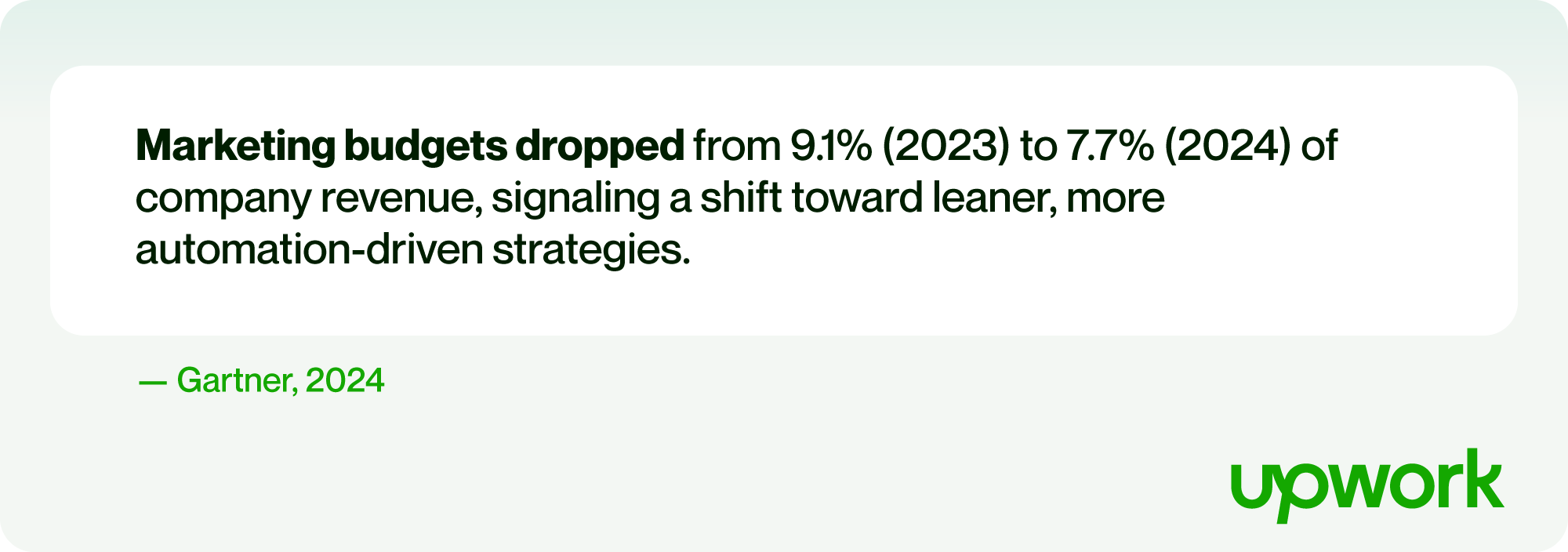
On the flip side, many companies are cutting back. Despite ongoing investment in automation, total marketing budgets have dropped from 9.1% of company revenue in 2023 to 7.7% in 2024—a 15% decline. This reflects growing pressure to justify spending and prioritize efficiency over expansion.
Increased budgets driven by AI investment
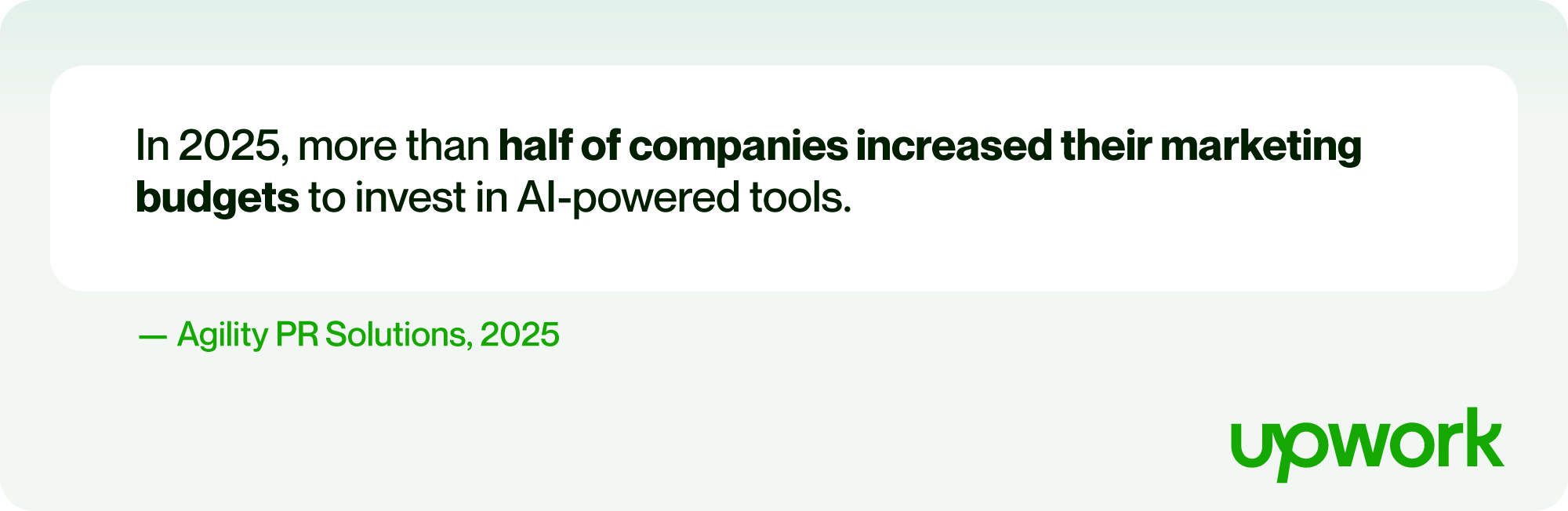
About 56% of companies reported marketing budget increases in 2025, often modest increases (under 20%), as teams invest in AI-powered tools to improve performance, streamline customer segmentation, and scale personalization. These increases reflect confidence in AI’s potential to enhance marketing strategies without necessarily adding headcount.
Evolution, not replacement: the path forward in digital marketing
AI is transforming how marketing campaigns are built, tested, and scaled—but it’s not replacing the human touch. Human marketers still lead when it comes to creativity, strategy, and ethical judgment—especially in areas that require deep audience understanding or brand nuance.
As AI-powered tools continue reshaping digital marketing jobs, the most successful strategies will blend automation with uniquely human strengths. From campaign ideation to long-term brand storytelling, people remain essential to driving meaningful marketing strategies. The future isn’t about choosing between humans and AI—it’s about building smarter, more collaborative workflows.
Take the next step in the AI-powered marketing era
To thrive in a market shaped by AI tools and evolving customer engagement strategies, freelancers and clients need to stay informed and proactive. Whether you're adapting your own digital marketing services or building a team of skilled marketing professionals, now is the time to take action and prepare for what’s next.
Explore digital marketing jobs on Upwork that integrate AI tools and help you stay at the forefront of marketing efforts. Or, hire experienced digital marketers on Upwork who understand how to balance automation with human insight to drive results and deepen customer engagement.

.avif)

Author Spotlight

Upwork is the world’s largest human and AI-powered work marketplace that connects businesses with independent talent from across the globe. We serve everyone from one-person startups to large organizations with a powerful, trust-driven platform that enables companies and talent to work together in new ways that unlock their potential.