25 Best AI Use Cases for Transforming Industries
Discover the top AI use cases revolutionizing industries. From health care to e-commerce, explore how AI is transforming various sectors.

.png)
.avif)
In the new digital world, artificial intelligence (AI) has become a transformative force in many industries. It’s enabling companies to realize advancements in areas like automation, innovation, and productivity.
AI tools can assist professionals in accomplishing more. They can help individuals summarize large amounts of data, analyze information more efficiently, and generate valuable insights, thereby augmenting human capabilities and enhancing productivity.
This guide covers the applications of AI that are helping transform industries. We’ll cover uses in marketing, e-commerce, finance, legal, and health care.
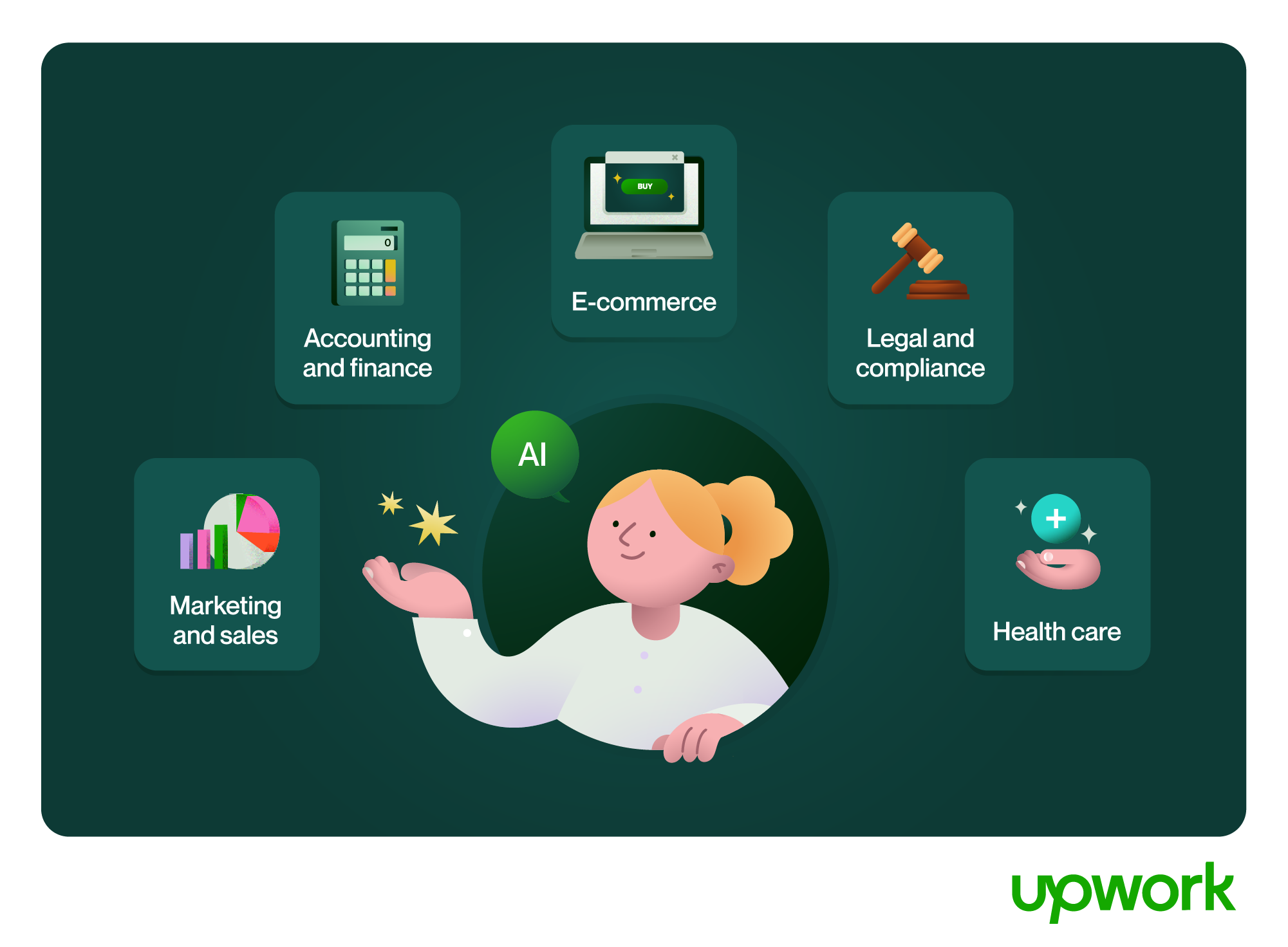
Best AI use cases
- Customer segmentation
- Predictive analytics for finding conversion optimization
- AI writing tools, chatbots and virtual assistants for customer support
- Personalized recommendations and dynamic pricing
- Sales forecasting and pipeline management
- Automated financial analysis and reporting
- Fraud detection and prevention
- Risk assessment and credit scoring
- Virtual assistants for financial advice and support
- Predictive analytics for investment portfolio management
- Product recommendations and personalization
- Demand forecasting and inventory management
- Visual search and augmented reality
- Chatbots and virtual assistants for customer support
- Dynamic pricing and promotional optimization
- Contract analysis and due diligence
- Regulatory compliance and risk assessment
- Legal research and document automation
- Predictive analytics for case outcome
- Data privacy and cybersecurity compliance
- Medical diagnosis and treatment
- Administrative tasks and patient management
- Precision medicine and personalized treatment plants
- Medical image analysis and diagnostics
- Virtual health care assistants and telemedicine
Marketing and sales

Marketing and sales have seen significant benefits from AI—from content generation and data analysis to finding new markets and consumer trends.
1. Customer segmentation and targeting
Targeting the right customers at the right time plays a big role in making sales. You need to give your audience relevant offers, or you risk wasting dollars and losing goodwill.
You can use AI to help determine which parts of your audience are most receptive to your offerings. AI can also help segment your audience so that your marketing campaigns target the right people with personalized marketing materials.
Providing personalized and tailored marketing materials that align with customers’ interests and preferences can increase the likelihood of engagement and conversion.
2. Predictive analytics for finding conversion optimization
Modern AI tools can analyze large amounts of customer data quickly, including information about their interests, demographics, and behaviors. You can then use big data tools and AI-driven analytics to gain insights into consumer patterns and trends.
Analyzing historical data can help you identify signals and indicators that suggest consumers who are more likely to make a purchase. This information can guide your marketing strategies and prioritize efforts toward potential buyers.
3. AI writing tools, chatbots, and virtual assistants for customer support
Advancements in generative AI technology provide several tools for content generation. These tools can help in the creation and ideation processes and can respond to questions conversationally. However, bear in mind that AI can make mistakes and misrepresents facts, and its output should be verified and quality tested, as appropriate.
These tools use natural language processing (NLP) to analyze user requests and output text relevant to the user. AI writing tools can automate content generation processes, create personalized messages, and assist in various writing tasks. For instance, ChatGPT allows users to ask questions and give commands to get a result relevant to the request.
Companies can also use chatbots and virtual assistants trained on their data to enhance and streamline the customer support experience. These AI-powered systems can handle common customer questions, provide information, troubleshoot issues, and offer personalized assistance. They can streamline customer support processes, provide around-the-clock service, and improve overall customer satisfaction.
4. Personalized recommendations and dynamic pricing
Relevant product recommendations are vital to the shopping experience today. Businesses can use their large amounts of data to learn a lot about their customers and what they like.
Analyzing large amounts of customer data, including browsing history, purchase behavior, and preferences, can help AI algorithms identify patterns and make personalized recommendations that align with individual customer interests and preferences. This enhances the shopping experience and increases the likelihood of customer engagement and conversions.
You can also use AI to gain insights into market trends and competitors’ pricing practices. This information allows you to dynamically adjust your pricing to remain competitive and maximize sales.
5. Sales forecasting and pipeline management
Understanding market trends and making sound, objective predictions is a vital skill set in business. AI can help analyze past performance and current economic indicators to help you forecast future sales.
Analyzing customer data, interactions, and historical sales patterns can help AI algorithms identify leads, prioritize prospects, and optimize the sales process. AI can also provide recommendations on the next best actions.
Accounting and finance

Accounting and finance are other industries seeing changes because of AI—giving professionals tools to make data-driven decisions and assisting with fraud detection and support.
6. Automated financial analysis and reporting
AI-powered financial tools can streamline a number of financial tasks, such as data entry, data collation, and the generation of financial statements. By automating these processes, AI can reduce manual effort, minimize errors, and improve efficiency.
AI financial tools can also assist accounting professionals by handling repetitive and time-consuming tasks. By automating data processing and analysis, AI allows professionals to focus on higher-value activities, such as interpreting results, making informed decisions, and providing strategic financial insights.
7. Fraud detection and prevention
Fraud detection is paramount in accounting and finance, and AI can help in a number of key ways. First, your AI application needs to be trained to learn patterns from historical data that indicate possible fraud.
Once trained, AI models can analyze large volumes of financial transactions even in real time—flagging suspicious activity and triggering alerts for further investigation. This allows businesses to detect and respond to fraudulent activities promptly, minimizing financial losses, protecting assets, and better enabling regulatory compliance.
8. Risk assessment and credit scoring
Machine learning and deep learning algorithms can help businesses manage risk assessments and offer financial services in a number of key ways, including faster processing, better risk assessment, and reduced bias.
AI can analyze a potential borrower’s credit history quickly and thoroughly, flagging potential issues for further review. AI can also build predictive models that, when coupled with the borrower’s information, can assess the likelihood of default.
When it comes to reducing bias, a word of caution is in order; AI is only as good as the data it’s trained on. If there’s bias in its training data, then the AI will later give biased outputs.
However, carefully modeled AI can also learn to spot any biases in existing systems that are easy for people to fall prey to. By supplementing traditional credit reports with properly modeled AI, lenders can make decisions that are more sound and less biased.
9. Virtual assistants for financial advice and support
Virtual assistants can improve the customer experience by interacting with them in an intuitive way, understanding their needs, and providing personalized support.
AI tools can make many financial tasks easier, including budgeting, data entry, and expense and investment tracking. AI can also help analyze trends by reviewing large amounts of data quickly and identifying patterns. This can be used by experts to offer their customers more data-driven financial advice.
10. Predictive analytics for investment portfolio management
AI can analyze past trends in investment markets, such as historical stock prices, past economic downturns, company performance, and other economic indicators. By processing and analyzing this data, AI algorithms can identify patterns, correlations, and insights that are valuable for investors in managing their portfolios.
AI can also provide insights into market trends, identify potential investment opportunities, and assist investors in making informed investment decisions.
E-commerce

Implementing AI solutions allows e-commerce companies to create better products, understand their inventory needs, and offer better support.
11. Product recommendations and personalization
One way e-commerce stores can increase sales is to offer relevant products to customers—whether they’re related to the items people are searching for or recommendations from previous purchases.
AI algorithms allow stores to analyze customer data to find these recommendations. AI can identify patterns and correlations to help determine which products are more likely to be of interest to specific customers. This information can lead to new product recommendations based on preferences, browsing history, and purchasing behavior.
12. Demand forecasting and inventory management
Knowing how much inventory you need and when you need it is necessary for efficient supply chain management. You need to understand your future inventory needs to balance inventory for customers and maintain a cash flow.
AI can help by looking at historical sales data and market trends to predict future sales. These predictions enable businesses to anticipate demand and determine the appropriate inventory levels needed to fulfill customer orders without excessive overstocking or stockouts.
AI can also help reduce waste by identifying products that aren’t selling and recommending that they be removed from inventory.
13. Visual search and augmented reality
Visual search involves using AI and computer vision to analyze real-world imagery and help users find products similar to what they see. By using image recognition algorithms, visual search allows customers to take a picture or upload an image on an app and receive relevant product recommendations based on the visual content. This technology can enhance the process of discovering products.
Similarly, AR tools allow shoppers to virtually visualize products in their current surroundings. Customers can use their smartphones or other devices to overlay virtual objects, such as furniture or home decor items, onto real-world environments. This enables them to see how the products would look or fit in their spaces before making a purchase decision.
14. Chatbots and virtual assistants for customer support
Quick and reliable customer service is necessary to compete in today’s market. We live in a world where customers have already become accustomed to loading a chat window and talking to a support specialist, and companies that lack this feature risk losing market share.
You can train AI-powered bots using customer information and program them to answer frequently asked questions (FAQ), provide product information, assist with order management, and resolve common issues. Chatbots are available 24/7 and can handle multiple customer questions simultaneously, ensuring prompt responses and reducing wait times.
And in cases where a chatbot cannot address a customer’s problem or question, the chat session can transfer to a human customer support agent. This ensures a human representative handles more complex or personalized issues, providing a higher level of support when needed.
15. Dynamic pricing and promotional optimization
Reacting quickly to market shifts helps companies stay competitive with other businesses. If your competitor lowers their price or offers a temporary discount, it can hurt your sales and give your competition a leg up.
Dynamic pricing involves adjusting prices in real time based on various factors, such as demand, supply, competitor prices, and customer behavior. AI algorithms can process large amounts of data and make pricing recommendations or automate price adjustments based on predefined business goals.
In addition to dynamic pricing, AI can optimize promotions. Analyzing customer behavior, historical sales data, and market trends helps AI algorithms identify the most effective promotional offers and discounts to attract customers and maximize sales.
Legal and compliance
The legal field is an industry that traditionally requires a lot of analysis. You need it to look at contracts, examine compliance issues, and handle research. We cover some ways AI can help.
16. Contract analysis and due diligence
Traditionally, lawyers would have to manually review contracts, which could be time-consuming and prone to human error. However, AI-powered software can analyze contracts more efficiently and help identify potential issues or unfavorable terms.
NLP enables AI algorithms to recognize and extract meaning from legal texts. AI software can be trained on large sets of legal documents to learn patterns, identify specific clauses or terms, and flag potential contract problems or risks. For example, it can search for language related to termination clauses, intellectual property rights, or noncompliance with regulatory requirements.
While AI can assist in contract analysis, it should be seen as a tool to support legal professionals rather than a replacement for their expertise. Human oversight and judgment are still necessary to interpret the results generated by AI software and make informed decisions based on legal knowledge and context.
17. Regulatory compliance and risk assessment
Depending on your industry, you may have legal requirements to follow—such as PCI compliance for finance and HIPAA for health care. These laws are complex and take a lot of work to follow.
AI can analyze operating procedures and compare them to the relevant regulatory requirements. Companies can train AI algorithms on the specific laws and regulations and use AI-powered tools to identify discrepancies and potential areas of noncompliance more efficiently than manual methods.
However, while AI can aid in regulatory compliance, it shouldn’t replace the expertise of legal professionals. AI tools can provide valuable insights and help identify potential risks, but human oversight and legal interpretation are still crucial to ensure comprehensive compliance and risk management.
18. Legal research and document automation
Legal research involves analyzing extensive amounts of information, including legal cases, laws, regulations, and precedents. AI-powered tools can process and analyze large volumes of legal data, making it easier for legal professionals to search for relevant information and extract key insights.
AI solutions can quickly retrieve and organize relevant legal documents, cases, and statutes, significantly reducing the time and effort required for manual research. These tools can help identify relevant precedents, legal arguments, and supporting evidence, allowing legal professionals to make more informed decisions and provide accurate client advice.
19. Predictive analytics for case outcome
Traditionally, legal professionals have had to spend significant time analyzing case details, comparing them with past cases, and considering various factors to estimate the potential success rate of a case. AI-powered predictive analytics can assist in this process by using machine learning algorithms and historical case data.
Providing relevant information about a case, such as details, arguments, and supporting evidence, can help a legal AI model analyze the data and generate predictions about the case’s potential success rate or outcome. The AI model learns from patterns and trends in historical cases and applies that knowledge to make predictions about new cases.
20. Data privacy and cybersecurity compliance
AI cybersecurity solutions can analyze attack patterns and identify potential security breaches in real time. By training AI algorithms on historical and ongoing cybercrime data, these solutions can detect anomalies and patterns associated with malicious activities (e.g., unauthorized access attempts, malware infections, or data exfiltration).
AI can also assist in data protection compliance by helping organizations monitor and enforce data privacy regulations. AI algorithms can analyze data flows, identify sensitive information, and ensure proper data protection measures are in place.
This includes monitoring access controls, data encryption, and compliance with regulations like the General Data Protection Regulation (GDPR) or the California Consumer Privacy Act (CCPA).
Health care

AI in health care can offer a transformative experience for both medical professionals and patients, impacting everything from diagnosis to personalized treatment plans.
21. Medical diagnosis and treatment
AI models, such as Google’s Med-PaLM 2, can be trained on vast amounts of health care data, including medical literature, research papers, and patient records. These models can help professionals by providing valuable insights and assisting in the diagnostic process.
Staying up to date with the latest research and diagnoses can be challenging for medical professionals. AI models—powered by language processing capabilities—can quickly analyze and interpret medical literature and provide relevant information to doctors. This can help doctors discover potential illnesses, explore treatment options, and make more informed decisions about patient care.
22. Administrative tasks and patient management
Medical professionals may have to deal with a number of repetitive tasks, such as appointment scheduling, billing, and documentation. AI can automate these tasks so health care professionals can focus on direct patient care.
AI algorithms can also analyze patient data, including medical records, symptoms, and treatment histories, and identify patterns and trends. This information can help health care professionals manage patient care more effectively by providing insights into potential diagnoses, treatment options, and patient progress.
23. Precision medicine and personalized treatment plants
Precision medicine aims to tailor medical treatments to individual patients based on their specific characteristics, including genomic data, past medical conditions, lifestyle factors, and current medications. AI algorithms can analyze these complex datasets to identify patterns, correlations, and treatment responses.
Health care providers can access a vast amount of data and apply machine learning algorithms to develop personalized treatment plans for patients. AI can help identify the most effective medications, dosage adjustments, and potential interactions or adverse reactions based on an individual’s unique characteristics.
24. Medical image analysis and diagnostics
AI systems can use computer vision and image analysis techniques to assist in the analysis and diagnostics of medical images like X-rays, MRIs, CT scans, and more. This technology can be particularly valuable in helping radiologists detect abnormalities and patterns that might be challenging to identify through manual examination.
However, AI should be seen as a supportive tool to aid radiologists, rather than as a replacement for their expertise and clinical judgment. Radiologists play a critical role in interpreting medical images, considering the patient’s medical history, and making informed decisions based on a holistic assessment.
25. Virtual health care assistants and telemedicine
Virtual health care assistants are digital applications that can interact with patients, provide information, offer basic medical advice, and assist in managing health care needs. They allow patients to access health care services and consultations from the comfort of their own homes, eliminating the need for physical visits to the doctor’s office in certain cases.
Virtual health care assistants rely on personal information and data analysis to offer effective and personalized services. AI plays a crucial role in enabling these applications to analyze patient data, understand symptoms, provide relevant health care information, and assist in managing health care devices remotely.
Transform your industry with AI
The use of AI in business is increasing, with 73% of C-suite executives feeling their company already embraces AI. Various industries—from health care to marketing—are learning how to make the most of the new tools available.
Another way to make the most of AI is to hire the right professionals. Businesses looking for AI professionals for hire can get started on Upwork. Browse the Talent Marketplace™ to find experts in every AI field.
If you’re a freelancer and want to increase your client base, check out the AI jobs available to find new business opportunities.
Upwork does not control, operate, or sponsor the tools or services discussed in this article, which are only provided as potential options. Each reader and company should take the time to adequately analyze and determine the tools or services that would best fit their specific needs and situation.

.avif)

Author Spotlight

Upwork is the world’s largest human and AI-powered work marketplace that connects businesses with independent talent from across the globe. We serve everyone from one-person startups to large organizations with a powerful, trust-driven platform that enables companies and talent to work together in new ways that unlock their potential.