As AI Reshapes the Workforce, Freelancers Are Leading the Way
Skilled freelancers are exceeding full-time workers with their AI skills and human-centric competencies. What does this mean for the future of work?

.png)
.avif)
Across industries, business leaders face increasing pressures to integrate artificial intelligence (AI) to drive efficiencies, reduce costs, increase productivity, and stay competitive. Effectively embracing AI and navigating other disruptors, including economic uncertainty and shifting customer demands, requires an agile workforce.
Many organizations recognize that traditional workforce structures—such as relying exclusively on full-time, in-house employees—are no longer sufficient in the age of AI and in the midst of changing business needs. Instead, forward-thinking companies are reshaping their workforces and tapping into the expertise of skilled knowledge freelancers—many of whom prove to be more future-ready than full-time employees.
AI expertise: Freelancers are ahead of employees
The Upwork Research Institute surveyed 3,000 skilled knowledge workers for its annual report, The Future Workforce Index: Evolving Talent Trends in 2025 and Beyond. One of the key findings from the report was that, in terms of AI adoption, skilled freelance knowledge workers are ahead of full-time employees.
More than half (54%) of skilled freelancers report advanced or expert-level skill in using AI tools for work, compared to 38% of skilled full-time employees. Additionally, 62% of skilled freelancers use AI tools at least several times per week, versus just 53% of full-time employees.
Why are freelancers standing out with their level of AI expertise from full-time employees? They’re more likely to proactively complete AI self-training, certifications, hands-on experimentation, and training courses. Skilled freelancers often have more autonomy and flexibility to pursue upskilling that aligns with their learning style, goals, and specific client needs—rather than simply completing required, formal organizational training.

Skilled freelancers also stand out with human-centric skills
While access to AI skills is a critical focus area for organizations across industries, human-centric soft skills remain essential to helping organizations communicate, collaborate, and shift priorities amid ongoing disruption. And the Future Workforce Index research shows that skilled freelancers outpace full-time employees in nearly every human-centric competency. Nearly half (49%) of freelancers report problem-solving as a strength, compared to 44% of full-time employees.
Freelancers also stand out from full-time employees on clear communication (47%, vs. 40%), critical thinking (43%, vs. 38%), and adaptability (41%, vs. 37%) skills.
These findings are perhaps explained by the fact that skilled freelancers often work in more flexible, autonomous work environments than full-time employees and regularly juggle multiple projects, deadlines, and client expectations. With their strong AI skills, eagerness to learn, and strong human-centric competencies, freelancers are well positioned to help your business thrive in a wide variety of business and economic conditions.
Jennifer Davis is one AI expert who understands the importance of soft, human skills. As a generative AI and data science freelancer, Davis helps clients avoid chasing the latest shiny AI objects. Instead, she helps them identify solutions to stay competitive in their target markets. For example, she recommends helpful and practical AI solutions, such as AI to automate billing and simple HR processes.
Davis also recognizes that many companies rely too heavily on AI. She emphasizes the importance of keeping a human in the loop and developing ethical, trustworthy AI solutions. As part of the process, Davis needs to effectively communicate with clients and business stakeholders—which is where her soft skills come into play.
“Having soft skills is really important when you're bringing up stressful or difficult topics,” explains Davis. “I try to understand the person I’m talking to by asking good questions, uncovering their motivations and their interests, and noticing who wants more technical details and who wants the business implications.”
How freelancers’ AI curiosity and expertise drive business agility
In addition to gaining AI expertise through self-guided learning, skilled freelance workers are also more confident that AI tools will enhance rather than replace their work. Future Workforce Index data shows that 84% of skilled freelancers are excited by the potential for AI tools to reshape their services, offerings, and workflows. This level of confidence can help freelancers better serve clients as they integrate the latest AI tools to drive efficiencies, agility, and innovation.

Take self-taught AI prompt engineering freelancer Greg Schwartz as an example. After ChatGPT launched in November 2022, prompt engineering jobs were on the rise, but limited resources were available to learn about the skills required for the role.
Schwartz, a UX designer at the time, took it upon himself to watch YouTube videos and read blog posts about prompt engineering, as well as experimenting with ChatGPT directly by inputting and polishing prompts. “Similar to developing any skills in life, part of the way to improve prompt engineering skills is to dive in and practice or play with [generative AI tools],” shared Schwartz.
Leveraging his new expertise, Schwartz expanded his offerings to include prompt engineering services. He helps a diverse range of clients solve business challenges and drive efficiencies through prompt engineering projects. One of his successful projects involved helping a real estate company improve its chatbot by identifying prompts for every possible way questions could be asked or answered—including obscure responses—to test and improve the chatbot.
The future of skilled knowledge work is freelancing
Whether your organization needs to access expertise to integrate AI into your business or fill another skills gap, if you’re limiting your search to full-time workers, you’re likely missing out on the most qualified talent. According to our Future Workforce Index research, skilled knowledge workers are increasingly turning to freelancing—and they’re more satisfied with their income and career prospects.
More than one quarter (28%) of skilled knowledge workers work in a freelance or non-traditional work capacity and 36% of full-time employees are considering freelancing to access better opportunities. Existing freelancers show limited desire to go back to traditional ways of working, with only 10% considering moving to a full-time role.

At a time when many workers are burned out and businesses and professionals are navigating economic uncertainty, skilled freelancers are also highly satisfied and energized with their work:
- 78% are satisfied with their income, compared to 64% of full-time employees
- 83% say their work contributes positively to their sense of physical, mental, and emotional well-being, compared to 74% of full-time employees
- 82% of skilled freelancers believe they have more work opportunities available to them than a year ago, compared to 63% of full-time employees
- 88% of skilled freelancers believe their skillsets are more in demand than ever, compared to 75% of full-time employees
Freelancing offers skilled knowledge workers increased flexibility, more earning potential, the opportunity to be their own boss, and the chance to pursue diverse, meaningful work.
As a business leader, engaging skilled freelancers can help you expand your talent pool to include diverse professionals with the latest in-demand skills. Adopting a flexible work model that includes freelancers also enables you to scale your team up and down as-needed, drive operational efficiencies, decrease fixed workforce-related costs, and be better prepared to respond to disruption. On the other hand, sticking to the old ways of working and the traditional organizational structure poses a risk for turning away skilled knowledge workers and exacerbating already existing skills gaps.
Listen to Work Week: Why Is Gen Z Embracing Portfolio Careers?
Understanding the four skilled freelancer personas
As more workers move away from traditional 9-to-5 roles, understanding how skilled freelance workers differ from gig workers and other non-traditional worker types is important. Specifically, skilled knowledge workers possess highly specialized expertise and help organizations address critical business challenges, even in the worker’s capacity as a freelancer.
Skilled freelancers are more likely to have post-graduate degrees (37%) than their full-time employee counterparts (20%). They apply their education, training, and experience to deliver skilled services such as AI engineering, user experience (UX) design, and software development.
Our Future Workforce Index research found that skilled freelancers don’t take a one-size-fits all approach to work. Rather, they typically fall into one or more personas to manage their work and deliver value to clients. Understanding the distinctions between each can help you determine which freelancer personas are the right fit to address skills gaps, complete projects, and deliver business outcomes across your organization.
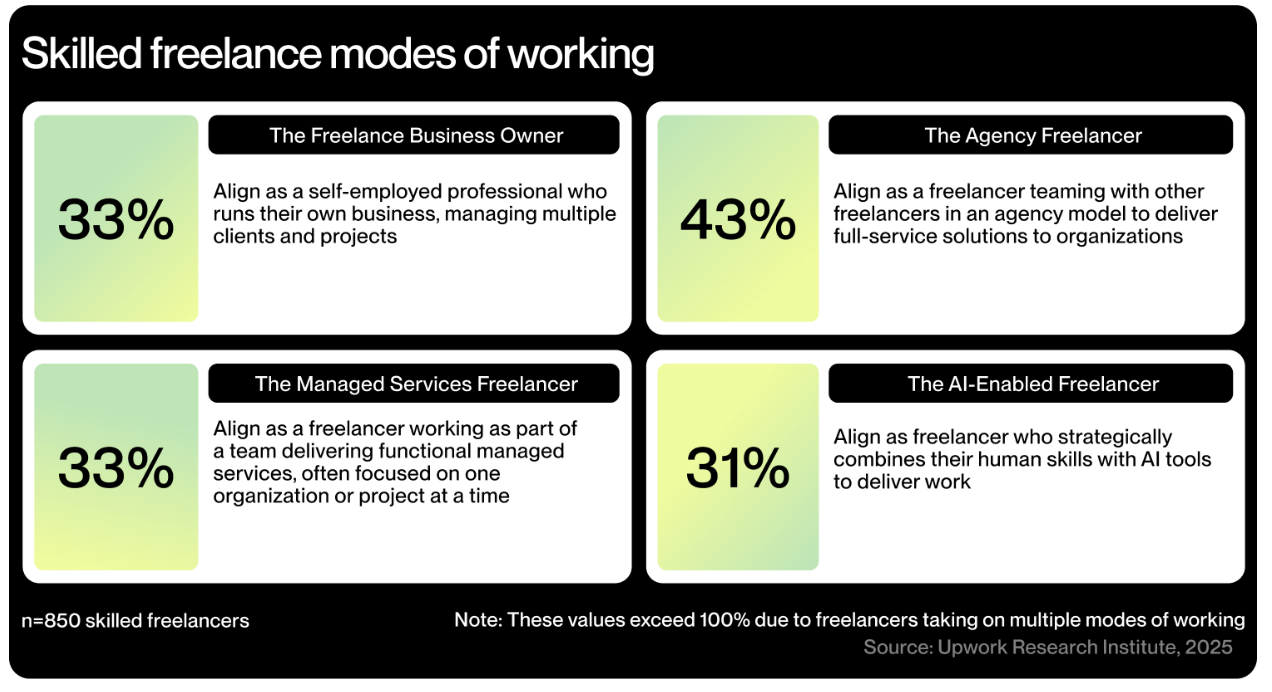
Freelance business owner
A freelance business owner is an independent, self-employed professional who runs their own business and manages multiple freelancer clients and projects simultaneously. This type of freelancer likely focuses on one or more areas of specialized expertise—such as content strategy, front-end development, or generative AI.
Your business may want to engage a freelance business owner if you need access to a specialized skill from a dedicated specialist who can independently deliver work, and you’re looking for flexibility and agility without sacrificing project quality.
Examples of freelance business owner projects include:
- Social media content calendar development
- New company logo design
- Technical search engine optimization (SEO) audit on a website
- Company training video production
Listen to Work Week: What's Driving the Rise of Independent Skilled Workers?
Agency freelancer
An agency freelancer works through an agency model that provides end-to-end services to organizations. An individual may choose to launch or join an agency as a freelancer to collaborate closely with other professionals who have complementary skills and complete more in-depth projects for clients.
Partnering with an agency can help your business access a broader range of skills and services—such as comprehensive web design, development, and copywriting services—through a centralized point of contact. This simplifies the process of managing more complex projects, rather than engaging professionals for each function separately.
Examples of projects you may pursue with an agency freelancer or team include:
- Full-scale brand identity refresh and website redesign
- E-commerce store setup, including branding, marketing, and maintenance
- Product development from initial minimum viable product (MVP) to launch
- Multi-channel digital marketing campaigns, including creative, budgeting, media buying, and analytics
Managed services freelancer
A managed services freelancer is part of a team that provides functional managed services to organizations. Managed services enable organizations to outsource one or more business functions to an outside team of experts.
While managed services are mostly commonly used to manage a company’s IT infrastructure, some managed services freelancers and providers also offer other capabilities, such as customer support, human resources, and project management.
Projects or services offered by a managed services provider include:
- Remote and hybrid workforce management
- Cloud services and support
- Full-service help desk and call center support
- Ongoing website support and security updates
AI-enabled freelancer
An AI-enabled freelancer combines their human and technical skills with AI to maximize outcomes and results for clients. Rather than using AI to replace or automate their work, AI-enabled freelancers augment their work with the latest AI tools.
An AI-enabled freelancer may be the right choice for your organization if you have an urgent AI skills gap, are interested in pursuing a short-term AI project, or are looking to experiment with AI capabilities before investing in a full-time role.
AI-enabled freelancer projects may include:
- Customer service chatbot development
- Content development and refinement using generative AI tools
- Workflow automation using AI scripting tools
- Data analytics dashboard development featuring AI-powered insights
See additional insights from the Future Workforce Index
Freelancers and AI are reshaping the workforce and organizations that embrace this transformation are in a better position to stand out from the competition, navigate shifting priorities, and drive long-term business agility.
In The Future Workforce Index: Evolving Talent Trends in 2025 and Beyond, the Upwork Research Institute highlights additional insights about how skilled freelance knowledge workers are reimagining careers, leading the AI race, and boosting U.S. economic growth.
Learn more—read the full report today.
If you’re looking to engage skilled freelancers to address skills gaps and integrate AI solutions at your organization, search on Talent Marketplace™. Sign up for a Business Plus plan to reach the top 1% of freelancers on Upwork, and short list the most qualified professionals based on your job requirements. Create an account or log in to your existing Upwork account today.

.avif)

Author Spotlight

Dr. Gabby Burlacu is Senior Research Manager at Upwork, where she studies how organizations are adjusting their cultures and talent practices to access skilled talent in a rapidly evolving world of work. Her research has been featured in a variety of peer-reviewed studies, articles, book chapters, and media outlets, and has informed strategy and technology development across a range of Fortune 500 companies. Gabby holds a Ph. D. in industrial-organizational psychology from Portland State University.

Latest articles