What Is DALL-E and How Does It Work To Generate AI Images?
Explore the revolutionary DALL-E AI by OpenAI, its image generation process, and its impact on the future of creative AI technology.
.png)
.avif)
DALL-E is an artificial intelligence tool by OpenAI that has the possibility to revolutionize image generation. Whether you’re a seasoned artist or just starting out, DALL-E allows you to produce images in different styles.
When you dissect the DALL-E application, you’ll find deep learning models, machine learning algorithms, and natural language processing technology powering it behind the scenes. The deep learning models are trained on vast amounts of data, facilitating DALL-E’s image generation capabilities. With natural language processing, DALL-E can process and interpret human inputs, determine the user’s intent, and generate desired outputs.
From realistic to abstract themes, DALL-E can produce unique and imaginative images and inspire your creativity. The generated images are of high quality and can be utilized in different use cases, including marketing, education, interior design, and entertainment.
In this article, we cover DALL-E, the different technologies powering it, and how it works to generate images.
What is DALL-E?
DALL-E is a generative AI tool that allows both artists and non-artists to produce images in a wide variety of styles from text prompts. It’s been trained on a huge dataset containing text and image pairs (each image has a textual description), enabling it to imitate different artistic styles and works of real humans to produce entirely new images.
At DALL-E’s core, you’ll find a transformer language model that accepts both image and text inputs—which are broken down into smaller units known as tokens. DALL-E then compares these tokens with its training data and uses the results to produce unique and original images.
Like GPT (generative pretrained transformer) models, DALL-E also utilizes a language model. Specifically, it accepts textual descriptions or prompts from users, then processes and interprets them to determine their intent, and quickly generates required outputs—in this case, images.
What can DALL-E do?
DALL-E supports several capabilities, including the following:
- Image generation. DALL-E can produce original, stunning, and captivating images in multiple styles, including minimalist, photorealistic, surrealistic, and mosaic.
- Contextual awareness. Like ChatGPT, DALL-E is also capable of processing and interpreting context. This ability allows it to generate images that capture different moods and atmospheres. For instance, DALL-E can generate images of happy people as well as those depicting sad moments.
- Image variations. DALL-E can produce multiple image variants from the same textual descriptions, providing you with more creative ideas.
- Outpainting. DALL-E can analyze an image and expand it to showcase more details than the original. For instance, if you have an image of a person beside a lake, DALL-E can expand the scene by including different objects like boats in the background to make it more interesting.
- Inpainting. DALL-E can also add and remove objects from an image, including their shadows, textures, and reflections.
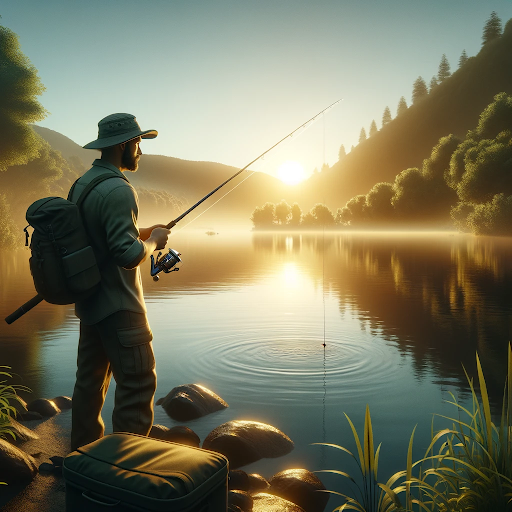
To illustrate DALL-E’s ability, we generated the following image using the prompt “a photorealistic image of a person fishing at a serene lake during sunrise. The scene should depict a calm and clear lake surrounded by lush greenery. The person should be wearing casual outdoor clothing with a fishing hat and is casting a line into the water.”
Background and evolution of DALL-E
The history of generative AI applications dates back to the 1960s, when the first chatbot, ELIZA, was developed. This chatbot accepted user prompts, scanned for specific keywords in the text, and then used this information to deliver pre-programmed responses. Though ELIZA had limited functionality, it helped demonstrate the power of AI and what the future held.
In the late 1990s, more research was done in areas like neural networks and machine learning. But it wasn’t until 2012 that more breakthroughs in AI were made. AI pioneers like Yoshua Bengio, Yann LeCun, and Geoffrey Hinton discovered how powerful neural networks could be when trained on vast amounts of data.
In 2019, OpenAI burst onto the scene by releasing generative AI models that were capable of producing new forms of data, including text and synthetic data. OpenAI’s access to large datasets allows it to train AI systems to perform specific tasks. In 2022, OpenAI released ChatGPT to the general public, where it quickly became popular, amassing one million users five days after launch.
ChatGPT was built on top of the GPT-3 model, which could perform tasks like analyzing and generating text, writing code, and providing explanations and answers. The GPT-3 model has since been updated to GPT-3.5 and GPT-4, which are capable of generating more relevant and meaningful responses.
With the release of the GPT-3 model, OpenAI noted that the neural network could be trained further to generate high-quality images. And this is where the idea of DALL-E was born.
DALL-E is a version of the GPT-3 model, but in this case, it’s been trained using a custom dataset containing images. As a result, it’s fine-tuned and tailored specifically for image generation tasks. DALL-E can also transform generated images according to the provided prompts.
Since its release, DALL-E has evolved to DALL-E 2 and now DALL-E 3. Each model iteration comes with improved features. For instance, DALL-E 3 can produce new images better compared to the previous version—DALL-E 2.
What’s more, DALL-E 3 has been integrated into ChatGPT Plus, which has an intuitive and easy-to-use interface, making it more accessible to all users. The ChatGPT integration also allows DALL-E 3 to process user inputs better and produce high-quality and realistic images that align with the provided prompts.
Understanding DALL-E
Generative AI tools like DALL-E follow a particular architecture that allows them to process user prompts and generate desired outputs. We dive deep into DALL-E’s architecture and explain how it differs from traditional image generation models.
DALL-E’s architecture
DALL-E is based on the GPT-3 architecture, which consists of a transformer model and neural networks. The transformer model allows DALL-E to accept text descriptions and perform natural language processing tasks. For instance, it can process prompts and determine the user’s intent. This information is then used for image generation or modifying existing images.
Compared to traditional image generation models, the transformer architecture is more adept at extracting context and identifying the relationship between words. This capability allows DALL-E to generate images that closely match the provided prompts.
DALL-E also uses the CLIP (contrastive language–image pretraining) neural network to predict the relationship between text and visual representations. In other words, CLIP aims to ensure that DALL-E shows images that align with what users want. For example, if a text input is about dogs, CLIP ensures that generated images are of dogs rather than cats.
Autoencoder architecture and its role in image generation
DALL-E uses an autoencoder architecture, which consists of two major components: encoder and decoder.
An encoder converts the input data, such as text and images, into a low-dimensional representation while still maintaining key features and characteristics of the data. On the other hand, a decoder takes the low-dimensional representation (from the encoder) and uses it to create new outputs that closely resemble the original ones.
Latent space representation and its significance
A latent space representation occurs when an encoder lowers the dimensions of the input data while still maintaining the core features and attributes. In other words, the input data, like images and text, is compressed into a latent space, so it can be processed and analyzed by deep learning models.
In DALL-E’s case, the encoder takes in textual descriptions and breaks them into smaller inputs, which are then converted to low latent representation. The decoder then leverages the low latent representation to generate images that align with the prompt.
Converting input data into a low latent representation allows DALL-E to process core attributes and features in the data better.
For instance, if a text prompt is converted into a vector representation, the underlying model, like CLIP, can process words and phrases much better and associate them with specific images. As a result, DALL-E can generate high-quality images that align with the user’s prompts.
Besides, DALL-E neural networks can also focus on different positions in the latent vector representation, allowing them to generate different image variations.
Training process and data used to train DALL-E
DALL-E is primarily trained using datasets containing text and image pairs. This training data allows DALL-E to generate images that match specific textual descriptions. During training, DALL-E receives image and text captions as a single stream of data. This data is broken down into smaller tokens for faster interpretation.
DALL-E’s pretraining process is done using diverse and comprehensive datasets. This allows the neural network to better perform natural language processing tasks as well as process different visual concepts. The diverse datasets also mean DALL-E can handle different user inputs effectively and generate images in varying styles.
How DALL-E generates images
In the above section, we discussed DALL-E’s architecture, neural networks, machine learning algorithms, and the different components that make it work. Now, here’s an overview of how DALL-E leverages these technologies to generate images.
First, a user enters a prompt that outlines what they wish to generate. An example of a DALL-E prompt can be “A vintage car parked outside a hotel. Two people should be standing near the car and appear to be conversing.”
Once the user submits a prompt, the autoencoder architecture comes into play. Specifically, the encoder component processes the prompt and converts it into a latent space representation while still maintaining its core attributes. The decoder then uses the low-dimensional vector to transform it into an original image that aligns with the user prompts.
After an image has been generated, it may go through extra post-processing steps to boost its quality. For instance, DALL-E’s neural networks can perform tasks like noise reduction and color correction to enhance generated images.
Example DALL-E images
Depending on your prompts, DALL-E can produce images in varying styles. Different prompts can lead to varied and creative outputs.
To demonstrate DALL-E’s capabilities, we generated the following images in photorealism, mosaic, and surrealism styles. Note that we used ChatGPT to generate the prompts and then added them to DALL-E to generate images.
Photorealism
Prompt: A photorealistic image of a serene lakeside landscape at sunset with reflections on the water and a colorful sky

Mosaic
Prompt: A mosaic of a phoenix rising from flames, using vibrant red, orange, and yellow colors for the fire and blue and green for the feathers. The tiles should show fluidity and embody the phoenix's renewal.

Surrealism
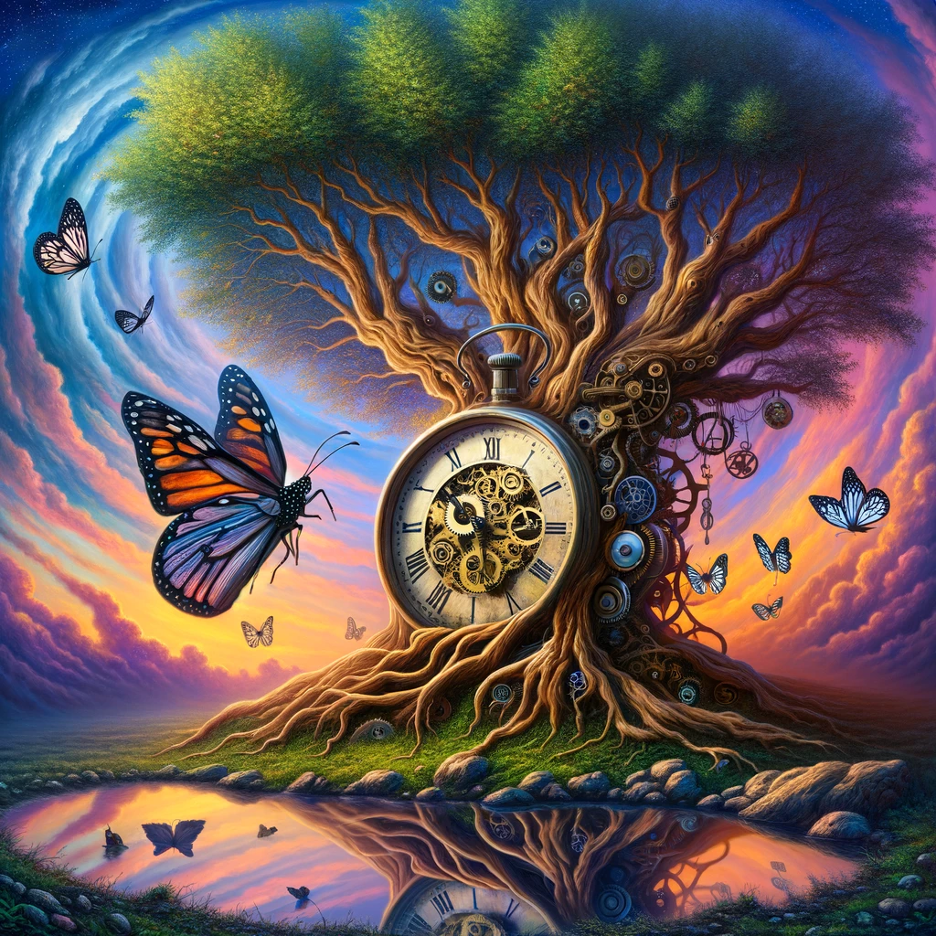
Prompt: A surrealistic artwork where nature and machinery merge. Imagine an ancient tree growing out of a vintage clock, its branches intertwining with gears and springs. This scene is set under a twilight sky with vivid, swirling colors. Nearby, a small pond reflects the surreal tree-clock while solar panel-winged butterflies flutter around, adding a whimsical touch.

Based on our prompt, we expected solar-winged butterflies in the above image—but that wasn’t the case. We can adjust the prompt as follows to get DALL-E to try to generate the desired output.
A surrealistic artwork where nature and machinery merge. Imagine an ancient tree growing out of a vintage clock, its branches intertwining with gears and springs. This scene is set under a twilight sky with vivid, swirling colors. Nearby, a small pond reflects the surreal tree-clock while butterflies with solar panels as wings flutter around, adding a whimsical touch.
Here’s the new output that’s a bit closer to our desired image.
DALL-E applications beyond image generation
DALL-E has broader real-world applications that extend beyond image generation. It can help revolutionize different tasks in various industries and creative fields. Here are some of DALL-E’s areas of application.
- Medical. DALL-E can help healthcare professionals in departments like radiology to produce and reconstruct X-ray images. However, DALL-E’s abilities are still limited—meaning it can’t be solely relied upon by medical experts.
- Finance. DALL-E can be used to generate a visual representation of data—enabling individuals to quickly make sense of information.
- Software development. Developers can use DALL-E to quickly produce responsive web layouts and designs.
- Law enforcement. DALL-E can help create sketches of suspects based on text descriptions. It can also produce visual aids which can be used for training law enforcement officers. However, DALL-E’s capabilities are limited, causing it to produce misleading information.
- Artistic exploration. DALL-E can be a source of inspiration for artists looking to research and try out different styles. With DALL-E, artists can quickly delve into the worlds of realism, surrealism, mosaic, minimalism, and other image styles.
- Graphic design. DALL-E can assist with the creation of complex illustrations for different purposes.
- Fashion and interior design. DALL-E can help fashion and interior designers with their roles. It can generate different image variations of clothing and house layouts, which designers can analyze to determine the right ones for their clients’ use.
- Product design. DALL-E provides a generative AI platform for product design teams to brainstorm how they want their new products to look.
- 3D modeling. OpenAI’s more advanced model—Point-E— can also assist professionals in creating 3D objects for prototyping or creative exploration.
Find AI artists on Upwork
DALL-E is a robust generative AI tool that can revolutionize your workflow. Whether you’re an artist or non-artist, DALL-E allows you to visualize your ideas and get the inspiration you need. Unlike Midjourney and the Stable Diffusion model, DALL-E 3 is directly integrated into ChatGPT, which has an intuitive and user-friendly design, making it suitable for all users.
But for DALL-E to generate relevant and high-quality images, you must submit clear and descriptive prompts. Consider working with AI artists on Upwork to help you harness the power of DALL-E effectively.
If you’re a professional looking for work, Upwork can connect you to different AI art jobs where you can build your portfolio while earning extra income. You can also offer AI art services on Upwork, find clients, and forge long-lasting relationships. Get started today.
Upwork does not control, operate, or sponsor the tools or services discussed in this article, which are only provided as potential options. Each reader and company should take the time to adequately analyze and determine the tools or services that would best fit their specific needs and situation.

.avif)
Author Spotlight

Upwork is the world’s largest human and AI-powered work marketplace that connects businesses with independent talent from across the globe. We serve everyone from one-person startups to large organizations with a powerful, trust-driven platform that enables companies and talent to work together in new ways that unlock their potential.