Will AI Replace Writers? What Freelancers and Clients Should Know in 2026
Discover how AI is reshaping writing in 2026. Learn essential insights for freelancers and clients navigating the developing content landscape.
.png)
.avif)
In 2025, the question “Will AI replace writers?” is more relevant than ever. With 71% of businesses using generative AI regularly for at least one business task, both freelancers and clients are reconsidering how work gets done. Popular tools like ChatGPT and other AI writing platforms are changing the game, accelerating production, automating repetitive tasks, and reshaping expectations.
Freelancers worry about being replaced by chatbots, and clients wonder if AI-generated content can meet their needs at scale. But while AI excels at speed, SEO, and structure, it still struggles with emotional depth, brand voice, and critical thinking. This is where human writers continue to lead.
The rise of AI isn’t eliminating the need for human input—it’s just redefining it. As freelance writing trends shift, content creation is becoming a hybrid effort. This article breaks down what AI can and can’t do, how writers can adapt, and when clients should rely on AI tools versus human intelligence. If you're navigating the future of writing, you’ll find clear, actionable guidance ahead.
What AI can do: 2025 capabilities that are shaping content creation
AI writing tools far beyond simple text generators have been developed. In 2025, these tools are helping professionals across industries streamline repetitive tasks, speed up brainstorming, and keep up with growing content demands. While not a replacement for skilled human writers, these tools have become essential to the content creation process.
Common use cases for AI writing tools in 2025
Today’s most popular platforms—ChatGPT, Jasper, and Copy.ai—offer fast, flexible solutions for everyday writing needs. These tools help creators save time, overcome blocks, and produce content at scale.
Key AI-powered applications include:
- Product descriptions. AI tools generate consistent, SEO-friendly descriptions across large catalogs.
- How-to guides. Many creators rely on AI to draft instructional content that’s later refined by human editors.
- LinkedIn posts. Quick-turnaround content like job updates, tips, and professional insights is often started with AI support.
- Social media captions. AI-generated content helps marketers brainstorm snappy, on-brand copy for platforms like Instagram and X (formerly Twitter).
Where AI excels and why businesses use it
AI writing tools offer tangible benefits to teams facing tight deadlines, high content volume, or multilingual demands. Their value lies in scaling output without scaling overhead.
Top reasons businesses turn to AI include:
- Speed and content churn. Drafts are produced instantly with tools like Copy.ai and Jasper, saving hours of manual writing time. Businesses reduce costs by automating low-impact content at scale.
- SEO optimization. Platforms such as Surfer SEO and INK integrate keyword targeting and on-page SEO best practices automatically.
- Translation. AI tools like DeepL and Google Translate support multilingual output, speeding up localization across markets.
- Automation. Services like Grammarly and Writer help handle routine updates, summaries, and metadata creation with ease.
What AI can’t do: The human touch in writing that machines miss
Despite major advancements, AI tools still fall short in replicating the depth, emotion, and nuance that come naturally to human writers. Clients and readers alike recognize when content feels robotic because it often lacks warmth, context, and creativity.
Why emotion, empathy, humor, and integrity still require humans
AI-generated content may sound correct, but it often misses the mark emotionally. It struggles to strike the right tone, especially in sensitive or emotionally charged topics.
Where AI falls short in this area includes:
- Personal storytelling. AI can mimic structure but not lived experience or vulnerability.
- Empathy in crisis communications. Machines can’t grasp human fear, loss, or hope.
- Humor and wit. Sarcasm, irony, and timing are difficult for AI to execute naturally.
- Emotional nuance. Content about grief, triumph, or social justice lacks authentic feeling.
- Integrity. AI lacks lived experience, but has the capacity to pull from its training and fabricate stories. Depending on your use, this may cross ethical boundaries.
The capacity of AI to fabricate stories is entrenched in its design. They are fundamentally programmed to deliver output that users will accept; this programming often supersedes the AI’s need to comply with reality.
While AI can churn out drafts for low-impact content at speed, for content that is core to your business, you’ll want a knowledgeable human-in-the-loop to ensure consistency and accuracy.
Creative and cultural limitations of AI content
Large language models can generate text at speed, but often fall flat in creative writing or in developing culturally nuanced material. AI lacks the originality, perspective, and critical thinking that define human storytelling.
Instead, AI has been trained on vast swaths of the internet to predict the next most likely string of characters in a long string of characters. In essence, it has been trained on so many grammatical sentences and on so many topics that it can guess the next word in a sentence. While a model will then undergo fine-tuning to help it better meet the needs of the company’s clients, it can’t escape the fact that it was trained as much on the works of great authors as it was on the social media posts of teenagers.
This is part of what makes prompt engineering so critical; a good prompt will guide the AI toward the output you want. If you want it to deliver output in the voice of a 17-year-old from England, it probably can. But if you want it to act as your research assistant and draft a synopsis of your dissertation, it can do that too. The quality of your results largely depends on the quality of your prompts.
Areas where AI struggles include:
- Satire and parody. These require a level of cultural awareness AI doesn’t possess.
- Story arcs and character development. AI may recycle tropes or produce flat narratives and struggle with long-form content.
- Fact-checking and truth. AI often hallucinates sources or makes up statistics, but states these creations boldly as facts.
- Outdated data. AI may reference events or information that are no longer accurate.
- Science fiction and speculative content. AI output tends to lack depth in worldbuilding and creating themes.

How AI is really affecting freelance writers in 2025
The advent of AI hasn’t eliminated the need for freelance writers, but it has shifted demand. Routine tasks are increasingly automated, while strategic, creative, and high-empathy writing roles are thriving.
Writing jobs most at risk from automation
AI is transforming how repetitive or templated writing tasks are handled, especially those that don’t require a distinct voice or critical thinking. According to a study by the Complexity Science Hub, demand for work like basic writing and translation has dropped by 20% to 50% as AI tools increasingly take over these responsibilities.
Jobs involving standard web copy, boilerplate product listings, or basic localization are now among the most vulnerable to automation.
Growth areas for freelancers post-AI adoption
Writers are increasingly finding opportunities in areas where human nuance and strategic insight are essential. These roles can’t be easily replaced by automation and often complement AI tools.
Freelancer-friendly growth niches include:
- Thought leadership. Writing ghost articles or bylined content for executives and founders.
- Ghostwriting. From memoirs to marketing books, demand is strong for skilled collaborators.
- Long-form editorial. In-depth content still requires research, voice, and storytelling.
- Content strategy. Writers with planning and audience development expertise are in demand.
- Brand voice development. Creating and maintaining a brand voice across channels is outside the scope of AI.
How freelancers can adapt and thrive in the age of AI
Freelance writers aren't really being replaced—their work is being redefined. The writers who are succeeding in 2025 understand how to adapt their skills, collaborate with AI tools, and embrace hybrid roles. Instead of resisting automation, successful professionals are using AI to improve their work, save time, and deliver greater strategic value to clients.
Skills that differentiate writers in an AI world
To stand out in an AI-supported market, writers need to lean into the capabilities machines can't match. These core skills will remain essential, no matter how advanced large language models become:
- Storytelling. Framing ideas in a compelling narrative is a uniquely human craft that drives emotional impact and engagement.
- Content strategy. Understanding audience behavior, content funnels, and performance metrics positions writers as strategic partners, not just executors.
- Audience development. Building loyal followings through tone, consistency, and community connection gives brands a lasting advantage.
- Integrity. AI lacks ethics, and professions with high ethical standards should keep a human-in-the-loop to verify that sensitive data is secure and outputs meet expectations.
These abilities blend human creativity and emotions with an understanding of the writing process, which is critical for delivering content that AI can’t match alone. Professional writers who refine these strengths will remain indispensable, even as human intelligence increasingly works alongside artificial intelligence.
Collaborating with AI tools to boost productivity
Writers using the right tools can break past writer’s block, get to first drafts faster, and streamline their process.
Here are some top tools and how freelancers can use them:
- ChatGPT. Brainstorm angles, structure outlines, or generate early drafts to get unstuck fast.
- Jasper. Produce long-form content drafts with built-in SEO optimization features.
- Grammarly. Tighten grammar, tone, and clarity while maintaining your unique voice.
- Sudowrite. Break through creative blocks with story and metaphor suggestions tailored for fiction and narrative work.
Freelancers who use AI tools effectively spend less time on the first draft and more time refining, editing, and delivering client-ready work.
Changing writer roles: How to position yourself as a hybrid writer
As content marketing evolves, new hybrid roles are emerging—blending human writing with technical fluency and AI know-how. Freelancers can future-proof their work by stepping into one of these emerging specialties:
- Writer-strategists combine copywriting with high-level planning, messaging frameworks, and campaign design.
- Writer-technologists understand how to integrate AI tools into workflows and measure content outcomes.
- AI editors and AI content reviewers refine AI-generated content for tone, accuracy, and originality. They may also review content for nuance, bias, accuracy, and brand alignment.
- Prompt engineers craft high-quality prompts to guide large language models like ChatGPT into generating more effective output.
Should clients choose AI or human writers? Here’s how to decide
For clients trying to balance quality, speed, and budget, deciding between AI tools and human writers depends on the task at hand. The most effective content strategies often combine both, matching the right talent to the right project.

When AI is sufficient for your project
AI tools work well for structured, low-nuance content where time and scale are top priorities. Examples include:
- FAQ content. Straightforward answers can be generated and refined quickly using AI.
- Product specs. Short, repetitive product features or technical details are ideal for automation.
- Internal documentation. For SOPs or internal guides, AI-generated drafts save time without sacrificing clarity.
These tasks benefit from automation, search engine optimization, and consistent formatting—areas where AI content and AI writing tools excel.
When you need a human writer for quality and depth
Human writing is irreplaceable in content that requires:
- Brand storytelling. Voice, emotion, and connection can’t be automated.
- Niche authority content. Thought leadership and subject matter expertise require knowledge, research, judgment, and originality.
- Nuanced editing. Revising AI-generated drafts for tone, bias, and brand alignment demands a human touch and critical thinking.
These scenarios highlight the power of content creation led by human intelligence, where storytelling and insight matter more than automation.
What the experts say: Survey data and predictions about AI in writing
AI adoption is accelerating across industries, and marketers are betting big on AI-powered workflows in 2025.
AI usage in content marketing
Research shows that 90% of content marketers will use AI in 2025, up from 83.2% in 2024 and 64.7% in 2023. The trend is consistent in both B2B and B2C settings, signaling mainstream adoption of AI tools to support the writing process and scale content marketing with automation and AI-generated output.
Industry leaders weigh in on the AI-human balance
Leading voices in tech are embracing artificial intelligence as a creative accelerator, not a replacement:
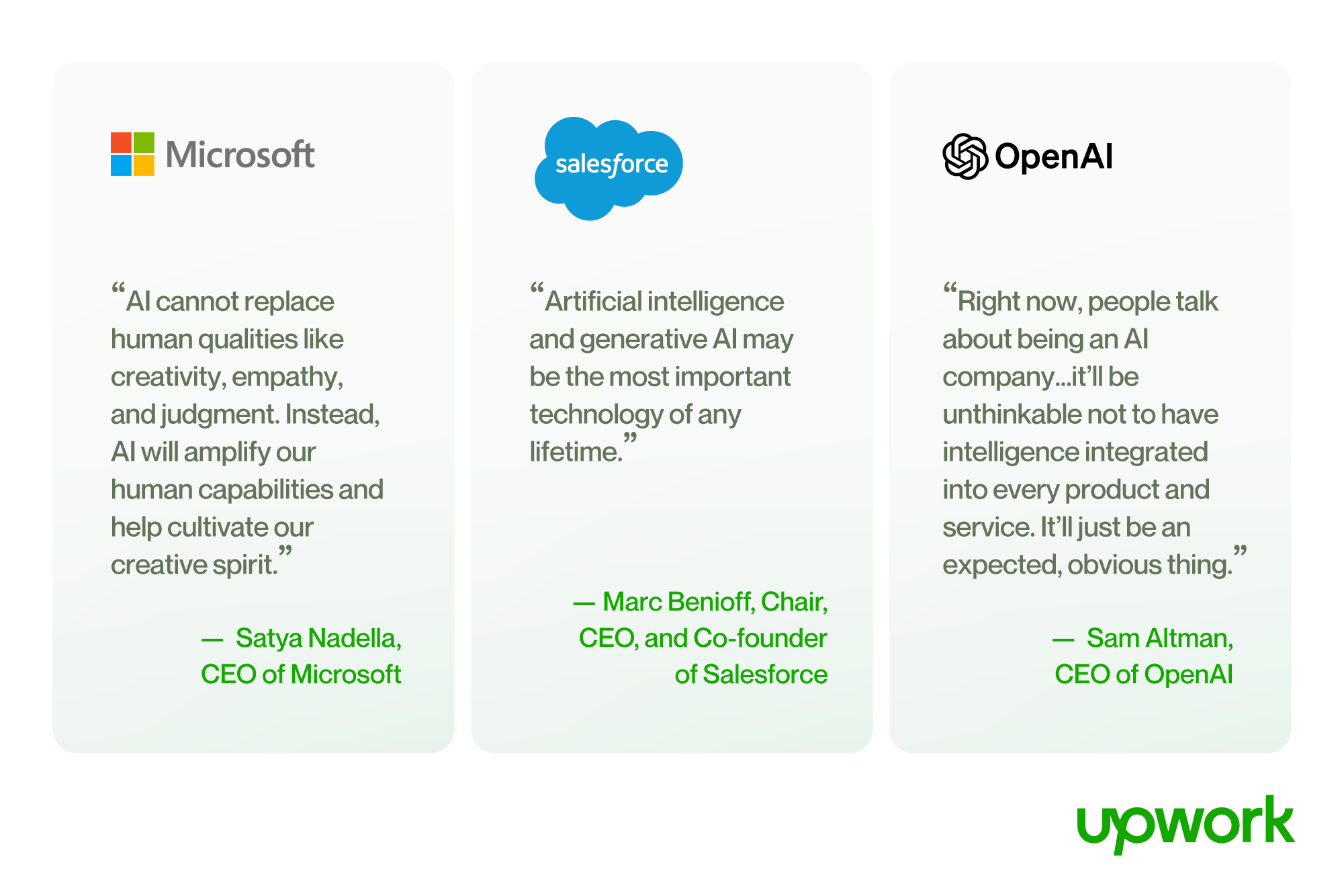
These perspectives reflect a future where human creativity and AI models work in harmony, amplifying each other’s strengths.
What’s next: The future of human-AI collaboration in content work
As workflows adjust to these new tools, so will the roles of content creators. Writers who embrace AI tools and understand how to prompt large language models are stepping into high-value positions. The future of writing is both human and machine.
Strategic advantages of AI-human pairing
When used well, AI enhances what human writers already do best. The pairing offers a strategic edge in a content marketing landscape driven by both scale and quality.
The benefits of hybrid writing roles are:
- Faster production. AI handles the repetitive work so writers can focus on refinement.
- Greater originality. Humans bring the creative spark that algorithms can’t replicate.
- Improved agility. Teams using AI-human workflows can respond to trends and feedback in real time.
- Scalable storytelling. Writers can maintain quality while expanding their output.
This synergy leads to content creation that blends human creativity with artificial intelligence, producing smarter, more effective content rooted in human experience and intelligence.
FAQs about AI replacing writers
As artificial intelligence continues to reshape how content is produced, freelancers and clients alike have big questions about its limitations and potential. We have quick answers to some of the most common concerns about AI replacing human writers.
Can AI write as well as a human?
AI can generate grammatically sound content quickly, but it still struggles with nuance, empathy, and originality, and prompting AI well enough to create high-quality text can be challenging. AI is a tool, not a replacement for human insight.
What writing jobs are least likely to be automated?
Creative writing, thought leadership, brand storytelling, and content strategy roles rely on emotional intelligence and critical thinking—areas where humans excel. Industries with high stakes and ethical standards, such as finance, medicine, and law, need a human-in-the-loop at minimum.
Should clients use AI for all content projects?
No. AI is ideal for repetitive tasks, but complex or strategic content still benefits from a human writer’s touch.
What makes human writers irreplaceable in 2025?
Human writers bring authenticity, creativity, and emotional resonance—qualities that drive trust, connection, and impact in every piece of content.
AI isn’t replacing writers—it’s redefining them
The question isn’t “Will AI replace writers?”— the question is, “How will human writers adjust to AI?” In 2025, successful professionals will be those who understand how to collaborate with AI tools while leaning into their own personal strengths. From emotional depth to big-picture strategy, human experience and human intelligence is needed.
In content marketing and beyond, the future belongs to those who balance creativity with innovation.
Final advice for freelancers
Now’s the time to lean in. Freelancers who upskill, experiment, and use AI tools effectively are already leading the way. Embrace AI writing assistants to accelerate your workflow, but keep developing the storytelling, structure, and originality that make your work stand out.
Adapt your writing skills in the AI era and find writing jobs on Upwork.
Final advice for clients
Hiring in 2025 doesn’t mean choosing between AI and people—it means hiring professionals who know how to use AI effectively. Look for writers who understand the writing process, but also know how to integrate AI tools for scale and precision.
Hire human experts or hybrid-savvy freelancers on Upwork.
Upwork is not affiliated with and does not sponsor or endorse any of the tools or services discussed in this article. These tools and services are provided only as potential options, and each reader and company should take the time needed to adequately analyze and determine the tools or services that would best fit their specific needs and situation.

.avif)

Author Spotlight

Upwork is the world’s largest human and AI-powered work marketplace that connects businesses with independent talent from across the globe. We serve everyone from one-person startups to large organizations with a powerful, trust-driven platform that enables companies and talent to work together in new ways that unlock their potential.