ChatGPT vs. Google Gemini: How Do the AI Tools Compare?
Understand the differences between ChatGPT and Google Gemini. Explore their architecture, capabilities, and applications in this comprehensive comparison.
.png)
.avif)
In nearly every industry, artificial intelligence (AI) and new AI tools promise to increase efficiency and lower costs. When OpenAI released ChatGPT in November 2022, the generative AI tool set records for the fastest adoption of a consumer application. Today, it continues to be one of the most popular AI chatbots.
But consumers now have more options in their generative AI chatbots than ChatGPT. Google, which contributed to the foundational research behind generative AI technology, has developed and launched its own competitor: Google Gemini.
So, what makes each of these popular tools unique? This guide will help you understand the differences between ChatGPT and Google Gemini. We’ll show you how each product works and offer a few examples showing what each can do.
What is ChatGPT?
ChatGPT is an AI chatbot built from a generative pre-trained transformer (GPT) developed by OpenAI. GPTs are a type of large language model (LLM) that uses artificial neural networks and natural language processing (NLP) to enable intuitive, conversational interactions with users.
GPTs are pre-trained on extensive data sets, including massive amounts of data publicly available on the internet. Early in their training, they are essentially given a word or sentence that is missing a piece of text, and asked to fill in the blank. When the program gets that task right, it is able to reinforce its own programming in a way that makes that result more likely in the future.
This process is repeated billions or even trillions of times, with tasks getting progressively more challenging as the model goes through a process of fine-tuning. The end-result of this training and fine-tuning is a chatbot capable of receiving a user’s input and, in real-time, providing an output that its algorithms predict the user will accept.
In addition to text responses, ChatGPT can also help with text translation, programming problems, and reasoning tasks. Today, ChatGPT is available via browser as well as mobile app for Apple and Android.
OpenAI’s future plans for ChatGPT include continuously enhancing and adapting the model to meet customers’ dynamic needs. Updates will aim to improve its performance, expand platform compatibility, and potentially introduce new features.
What is Google Gemini?
Google Gemini (originally branded as Bard) is an AI model developed by Google DeepMind. Like ChatGPT, Gemini is a type of large language model (LLM) that uses artificial neural networks and natural language processing (NLP) to enable intuitive, conversational interactions with users.
Google has not made the details of Gemini’s underlying technology publicly available. What we do know is that the earlier generation of Gemini (Bard) was powered by PaLM 2, a transformer-based model that was trained using a mixture of objectives. We also know that Gemini was built from the ground up to be multimodal and trained using text, images, video, and audio.
Google rebranded Google Bard to Gemini on February 7, 2024 as part of a broader strategy to align the branding with Google’s advancements in AI technology. It introduced new features and capabilities, including the Gemini Advanced model with Ultra 1.0, which is designed for complex tasks like coding and creative collaboration. This move also included the launch of a new Gemini AI mobile app for Android and integration with the Google app on iOS.
Gemini shares similarities with ChatGPT in using NLP and transformers to chat with users. But it also has web search capabilities that allow it to look for up-to-date information for more currentl, relevant, and accurate responses.
Since Google’s new language model has built upon its earlier models (LaMDA, PaLM, and PaLM 2), it offers more features that weren’t initially available. It can perform translation, coding, and creative writing tasks.
Is Google Search the same as Google Gemini?
Google Search and Google Gemini are both Google products but serve two separate functions.
The Google search engine offers fast results for user search queries. It searches its website index to find the most relevant websites based on the user’s search intent.
Google Gemini is an AI chatbot designed to be a conversational AI. It can use Google search when necessary to find information relevant to the user’s query—but it was designed to provide a good user experience while helping consumers with creative tasks.
Google also plans to expand Gemini’s capabilities with new features, including integrations with Google Docs, Gmail, Maps, and other Google services. There are also collaboration efforts with Adobe Firefly to allow Gemini users to generate AI images in the chat.
Key comparisons between Gemini vs. ChatGPT
Although ChatGPT and Google Gemini aim to provide a similar service, the two products have a few key differences.
We’ve broken down a quick comparison in this table:
Architecture and technology
ChatGPT and Google Gemini both use advanced machine learning techniques and neural networks, but their designs differ because of their designers’ different approaches.
ChatGPT uses the generative pre-trained transformer (GPT) architecture. This is an LLM designed for a variety of natural language tasks.
A key feature of the GPT architecture is the transformer model. These models weigh the importance of each word in a sentence and use transformers to determine the text characters most likely to come after the text input.
The technology behind Google Gemini uses advanced language models developed by Google DeepMind as the successor to PaLM 2. These are Gemini Ultra, Gemini Pro, Gemini Flash, and Gemini Nano.
Like the GPT architecture, Gemini uses the transformer architecture to process data and predict the next sequence of words. However, Gemini incorporates additional multimodal training, enabling it to excel in tasks such as image generation, coding, and translation.
This multimodal approach allows Gemini to handle and integrate different types of information, including text, images, audio, and video, making it highly versatile and capable of advanced reasoning across multiple modalities.
Natural language processing capabilities
ChatGPT has some of the most advanced natural language processing capabilities on the market. Its GPT model, trained on vast amounts of text data, enables it to work with language nuances and interpret user queries with relative accuracy.
One of the parameters in ChatGPT’s training was to create outputs that users would accept. And it does that remarkably well. It interprets instructions such as to stay on topic and be concise. It can also pull relevant information from data in its training and provide summaries that are adequate for a general audience.
However—that ChatGPT was trained to provide outputs that users would accept means that when users accepted inaccurate, biased, or otherwise problematic outputs, ChatGPT learned to provide more of those kinds of outputs. Especially for important, customer-facing, or technical documents, users need to fact-check outputs and ensure they match the needed tone and style.
Google Gemini operates a little differently. Instead of fully relying on NLP to process a user’s input and generate output, it looks through a wide array of documents and websites to find relevant information. Gemini then takes that information and produces creative and contextually relevant information for the user.
However, in terms of accuracy and tone, output from Google Gemini also needs to be fact checked and edited. The information it provides, while apparently well written, is not always factual or appropriate for audiences that expect a high level of accuracy.
Training and learning
ChatGPT uses datasets created from vast amount of text gathered from the internet. The most recent update to ChatGPT’s training data extends up to October 2023.
There was no human feedback in ChatGPT’s initial training. OpenAI uses unsupervised machine learning algorithms to create its base AI models. OpenAI then further trains ChatGPT through a process of fine-tuning that includes feedback from users for specific tasks.
Google Gemini uses training data from several sources of information, including both publicly available and licensed data. Google used unsupervised machine learning in the initial training of PaLM 2, leveraging large-scale datasets. However, the Gemini models which succeeded PaLM 2 incorporated an even more advanced training regimen.
The new ecosystem of Gemini models relies on a combination of unsupervised learning and specific, supervised examples to enhance their capabilities. This includes multimodal training, which exposes the models to diverse data types such as text, images, audio, and video. This approach improves the models’ ability to generate useful output and enables advanced tasks such as image generation capabilities, coding, and translation.
Additionally, Google employed reinforcement learning from human feedback (RLHF) to fine-tune these models, ensuring they align closely with human intent and exhibit improved accuracy and reliability across various applications.
Integration and use cases
ChatGPT has a wide range of capabilities. Text generation is one of the most basic features, but it also offers:
- Programming. This includes generating code snippets, debugging, and assisting with other programming tasks.
- Translation. It can translate text between multiple languages with high accuracy.
- Creative writing. You can use it for help in drafting stories, poems, and other creative content.
ChatGPT offers a lot of flexibility for users to integrate it into various applications. OpenAI provides API access, allowing users to incorporate ChatGPT into their own systems, such as chatbots, question-answering systems, and website summarizers.
This integration is possible through OpenAI’s API, which supports functions such as making calls to the ChatGPT interface and displaying results within custom applications.
In April, 2024, OpenAI completed its transition from using traditional plug-ins to integrating specialized models known as GPTs in ChatGPT. This change allows for more tailored interactions and capabilities within the ChatGPT environment.
GPTs are designed to perform specific tasks with high efficiency and accuracy. Examples include:
- The Web browsing GPT. Accesses up-to-date information from the internet.
- The Wolfram Alpha GPT. Connects to Wolfram Alpha for performing complex mathematical operations.
- The Zapier GPT. Enables automation by connecting ChatGPT to various automation platforms.
- The Expedia GPT. Assists users in planning trips by connecting to travel websites.
This shift enhances the usability and functionality of ChatGPT, providing users with more powerful and flexible tools to integrate into their workflows.
Recent advancements with the Google AI models have significantly expanded Gemini’s capabilities. The models are trained on multimodal data, allowing them to handle and integrate text, images, audio, and video. This training approach enhances its proficiency in various tasks, including translation and programming.
Gemini’s enhanced programming capabilities and translation accuracy are bolstered by its extensive training on diverse datasets and reinforcement learning from human feedback (RLHF).
Gemini offers several types of APIs for general users catering to different needs, including a REST API for accessing market data, account management, and order placement, and a WebSocket API for real-time market data.
Accuracy and reliability
Accuracy is a concern when generating text with large language models. In the case of ChatGPT, the accuracy can vary significantly based on your inquiry. If you’re asking for specific information, it can give false results known as hallucinations—as highlighted when a lawyer included fake cases in legal work.
Google Gemini was integrated with web browsing from its inception, which in some ways gives it the upper hand for information retrieval. It uses the context it reads on web pages to generate output to give the user better information.
However, Google Gemini still uses generative techniques to both scan webpages and to create an output that its algorithms predict the user will accept. This means it can still give false information that isn’t appropriate in situations where accuracy is needed.
And because these models were created to generate text that a user will accept, they are very good at generating convincing falsehoods. If you want accurate information from either product, you’ll need to monitor and fact-check their output carefully.
Privacy and data handling
Understanding how AI companies handle your data is vital if you want to use them, especially if you put sensitive information into the chat window.
OpenAI has an in-depth privacy policy regarding data handling. You can manage your data storage from settings, but the app can store the data you enter, which you can access in your conversation history. Once you delete that data, OpenAI claims to remove it from its servers. However, data entered into the ChatGPT prompt can be used to improve the model’s performance, and data is stored on OpenAI’s systems around the world.
If you’re handling proprietary or sensitive information, you’ll want to review industry best-practices for using bots like ChatGPT, and establish robust controls around your data.
For users accessing the API, OpenAI removes the data after 30 days.
Google Gemini’s policy aligns with the rest of Google’s products. Google states that they can use data from Gemini to provide information to third-party marketers, but no personally identifiable information is included.
Pricing
ChatGPT and Google Gemini both offer free versions. Each requires you to sign up for an account to access the chatbot.
ChatGPT also has a subscription model called ChatGPT Plus. The free version of ChatGPT allows you unlimited access to GPT-3.5 and limited access to GPT-4o. Although GPT-3.5 is faster than GPT-4 (depending on the current ChatGPT usage), it has a harder time properly analyzing the context of user questions and its results are less valuable.
Once you sign up for the $20 monthly subscription, you get access to the more powerful GPT-4 version of ChatGPT. In addition, you get access to web browsing, image generation with Dall-E 3, and unlimited access to the GPT store. You’ll also get up to 5x more messages for GPT-4o.
Gemini offers a free tier that provides assistance with writing, planning, learning, and more. It is integrated with Google apps, making it a seamless addition to your existing tools.
Gemini Advanced introduces the new 1.5 Pro, a next-generation model with a 1M token context window. For $19.99 per month, it allows users to upload Google Docs, PDFs, and more for summaries, answers, and feedback. Additionally, you can upload spreadsheets for faster data cleaning, charts, and insights. Subscribers receive priority access to new and exclusive features and can edit and run Python code directly in Gemini Advanced. This tier also includes 2 TB of storage from Google One.
ChatGPT vs. Google Gemini response examples
It can be helpful to see what outputs look like on both ChatGPT and Google Gemini. Let’s do a head-to-head example to see what kind of response to expect.
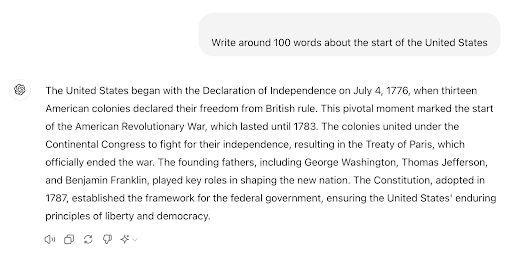
We asked ChatGPT and Google Gemini about the founding of the United States.
ChatGPT response
In this example screenshot, ChatGPT has plenty of reference material. It has analyzed information on history, so it can analyze the user’s question and find an answer. While the answer may not be completely accurate, it does provide relevant information. It is up to the user to verify the accuracy of the information.
You can also rate the answer as positive or negative, giving ChatGPT future training data to help the chatbot make better responses. You can request additional versions of the response.
Google Gemini response
Google Gemini can also answer questions. You can also quickly regenerate the drafts if you aren’t satisfied with the response.

In comparing ChatGPT with Google Gemini responses, it’s clear that each AI model has its strengths and limitations. To determine which is a better fit for your specific needs, try out both models and evaluate which provides more accurate and satisfactory results. Several tests will help you to make an informed decision based on your requirements and preferences.
ChatGPT vs. Google FAQ
ChatGPT and Google Gemini are still relatively new and being updated regularly, so you may have questions. Let’s look at a few common questions people have when deciding which product to use.
Which is the best AI? ChatGPT or Google Gemini
The chatbot that’s better for you will depend on your needs.
You may find that Google Gemini is better at creating human-like responses and giving users more relevant information. On the other hand, you may notice that ChatGPT is better at processing text and can help with data analysis, summarization, and other related tasks. It all depends on your preferences and use cases.
What’s the difference between ChatGPT, Google Gemini, and Copilot?
Google Gemini, ChatGPT, and Copilot are all chatbots designed to interact with people conversationally. ChatGPT operates independently, drawing on its training data and user input to output responses.
The purpose of Google Gemini and Microsoft Copilot is to generate outputs users will accept using the Internet as a resource. Copilot uses Bing Search to find information relevant to the user, and Google Gemini uses Google for the same purpose.
Will ChatGPT replace Google?
ChatGPT isn’t intended to replace Google. OpenAI designed ChatGPT to interact with users, not interact directly with search engines.
Although it can browse the web to find new information with a Plus subscription, it still can’t generate answers that eliminate the need to view search results and visit websites. Verifying accuracy is an important part of the human intervention needed when using any AI.
Will Google Gemini replace Google Search?
While Google Gemini demonstrates capabilities in generating conversational responses, it’s unlikely to replace Google Search entirely.
Google Search is a comprehensive information retrieval system that includes various formats, such as web pages, images, videos, and more. Google Gemini’s conversational abilities complement search by enabling interactive dialogue, but the two technologies are designed to serve different purposes and can coexist to enhance the overall search experience.
Will ChatGPT replace programmers?
ChatGPT has shown that it can solve some programming tasks, but it still sometimes gets things wrong and doesn’t always interpret the problems programmers solve. The tool helps programmers write code and work more efficiently. When an AI system does some of the repetitive tasks and helps with debugging code, programmers have more time to work on the complex elements of their projects.
Whether we’re discussing programming or any other function made easier by using AI tools, we should remember that human creativity and decision-making are central to our processes. Humans are likely to oversee the algorithms that AI uses to deliver results for the foreseeable future.
Will ChatGPT replace customer service?
ChatGPT can automate some customer service processes—such as identifying what customers want and addressing their problems—but it may not be able to solve every problem. When the tool can’t resolve an issue, it can escalate the problem for human intervention. In addition, even for simple problems, some customers simply prefer talking to humans.
What are the key differences between ChatGPT, Gemini, and Claude?
GPT, developed by OpenAI, is highly versatile with capabilities in text generation, programming, translation, and creative writing. Gemini, from Google DeepMind, offers advanced multimodal capabilities, handling text, images, audio, and video.
Claude, created by Anthropic, is a bot that emphasizes safety and ethical AI use. It is designed to be cautious and transparent, ideal for handling sensitive or complex queries responsibly. Claude also allows for customization through APIs, focusing on aligning AI behavior with human values.
Leverage the power of AI with Upwork
ChatGPT and Google Gemini are powerful tools for businesses and independent professionals who need help with text processing and other tasks. They can help you refine ideas, summarize text, and generate content in ways you wouldn’t think of.
Businesses can find help using artificial intelligence programming and tools, like ChatGPT and Gemini, by looking for AI professionals for hire.
With AI adoption growing, plenty of businesses are searching for talent to help them integrate it into their businesses. Freelancers can also look for AI jobs on the Upwork Talent Network.
Upwork does not control, operate, or sponsor the tools or services discussed in this article, which are only provided as potential options. Each reader and company should take the time to adequately analyze and determine the tools or services that would best fit their specific needs and situation.
Prices are current at the time of writing and may change over time based on each service’s offerings.

.avif)

Author Spotlight

Upwork is the world’s largest human and AI-powered work marketplace that connects businesses with independent talent from across the globe. We serve everyone from one-person startups to large organizations with a powerful, trust-driven platform that enables companies and talent to work together in new ways that unlock their potential.

Latest articles