Top AI Skills To Include on Your Resume, With Examples
Discover the top AI skills for resumes in 2026. Find what AI skills are in demand, and how to include them on your resume to stand out as a qualified candidate.

.png)
.avif)
Generative artificial intelligence (AI) is having a big impact on the way companies conduct business today—making the technology front of mind for hiring managers across a range of industries.
A study by The Upwork Research Institute found that data analytics, machine learning, and deep learning are some of the most in-demand AI skills right now.
Increasing numbers of companies are emphasizing the importance of soft skills like communication, too. So if you’re looking for a new project or job, it’s important to cultivate both soft and hard skills for AI—and then emphasize this experience in your resume or on your Upwork profile.
Let’s take a closer look at why AI skills are so important right now … and how you can upskill for maximum career success.
AI’s role in today’s job market
Many roles and industries now rely on AI to help streamline computer-based work. AI technologies help workers analyze data, draft communications, create mock-ups, and more.
You can find people working with AI in a wide range of roles, including:
- Office manager
- Prompt engineer
- Midjourney artist
- Administrative assistant
- Chatbot developer
- Scientific researcher
- Financial analyst
- Data scientist
- AI writer
- Robotics engineer
- Data analyst
- Computer vision engineers
But you'll also find the need for people with AI skills in industries that typically rely on manual labor, too. A forest ranger may use AI to assess data collected by sensors on animal trackers or park cameras, while a factory operations manager may use AI to help ensure that production lines are operating at peak efficiency.
These are jobs that AI won't replace, but will rather improve the efficiencies and outcomes through collaboration.
This is why it’s important to mention any relevant qualifications, technical abilities, and AI techniques you have experience with when preparing your resume for an AI job search. Spelling out AI skills on your resume can help your job application catch the attention of both human recruiters and any AI-powered applicant tracking systems they may be using, too.

9 top artificial intelligence skills for resumes
AI is constantly changing, so the skills you’ll need are likely to change over time. That said, these nine things are some of the top AI concepts and skills that can help you in your job search now.
1. Machine learning
Machine learning is a subset of artificial intelligence that automates data analysis and iterative learning. In part, it uses data to create accurate predictions.
You can find machine learning engineers working on e-commerce shopping recommendation algorithms, facial recognition programs, digital ad platforms, and more. This prediction-based approach to AI is a central part of generative AI. As tools like ChatGPT become more and more commonplace, more companies will need skilled machine learning pros on hand.
2. Neural networks and deep learning
Neural networks are a complex approach to machine learning. In a neural network, multiple layers of processing connect to each other in nodes. These connections are structured so that information passes through them in different ways, resulting in a variety of outputs.
If a neural network has more than three layers, it's considered a deep learning algorithm. Being specific about any skills in or experience with neural networks and deep learning can help you find interesting companies to partner with and projects to work on.
3. Natural language processing (NLP)
NLP is a subset of computer science that's focused on programming computers to interpret human language. Computer systems trained with NLP may be able to analyze written text as well as spoken audio—and produce responses that mimic our speech patterns, too.
When you use a conversational AI tool, like Claude or Google Gemini, you're experiencing NLP in action. As more businesses roll out customer-facing AI applications, they'll need NLP engineers to help make sure that the user experience is as natural and seamless as possible.
4. AI programming languages
Programming skills are imperative for AI development. Skilled programmers build and train the machine learning models that power tools like ChatGPT—and they typically know one or more computer languages.
The most in-demand languages for AI programmers are:
- Python: A general-purpose language often used in the development of generative AI applications
- Java: A popular language used in machine learning algorithms and neural networks
- R: A language used for data visualization and developing neural networks
- Lisp: A 64-year-old programming language used to manipulate strings of data
If you’re a beginner learner, you can use AI tools like ChatGPT to help you upskill further and even debug your code—just be careful not to share proprietary information with public tools. Here’s an example of how ChatGPT can work with Python:

5. Scripting and automation
Automation scripts that leverage machine learning to do routine tasks quickly are one common use for the Python language. For example, if a business owner needs to pull a set of CSV reports every Friday, sort the data by source, and compare it to the previous week, a script can speed up this process.
Similarly, if a marketing team regularly scrapes the web for keyword data, they could benefit from a Python script that automates this data-collection process.
More companies are becoming familiar with the benefits of scripting and automation, and demand is increasing for freelancers with this skill set. ChatGPT can help you develop scripts like the one pictured here:

6. Prompt engineering
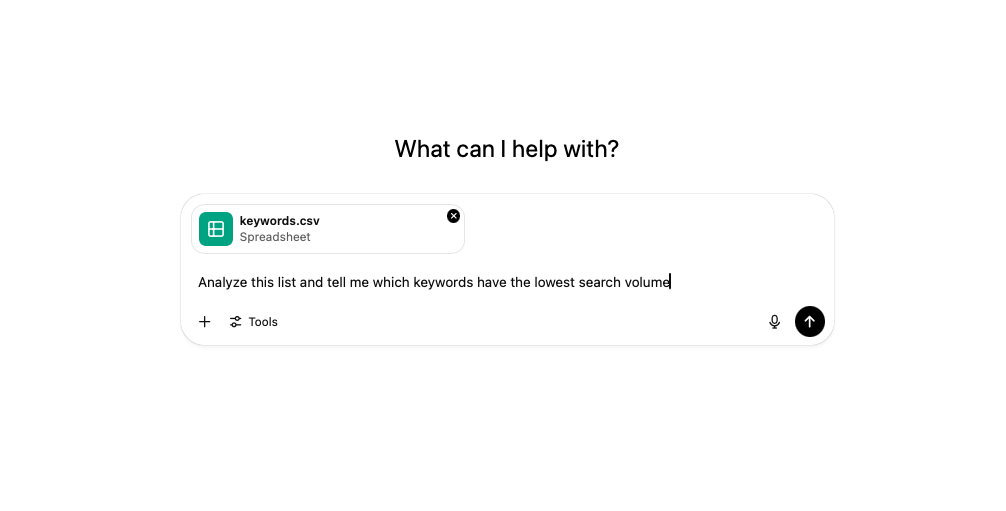
Prompt engineering is the process of instructing large language models (LLMs) via text commands.
Sometimes prompts are very simple. For example, when I wanted ChatGPT to analyze a spreadsheet, I simply uploaded the file and stated what I wanted it to do.
Other prompts need to be more complex, such as this one that I used to ask ChatGPT for help developing a video outline:

The way you write a prompt can change the results generated by AI. And because many AI tools—including ChatGPT—retain conversation history, you can craft prompts that layer on top of each other.
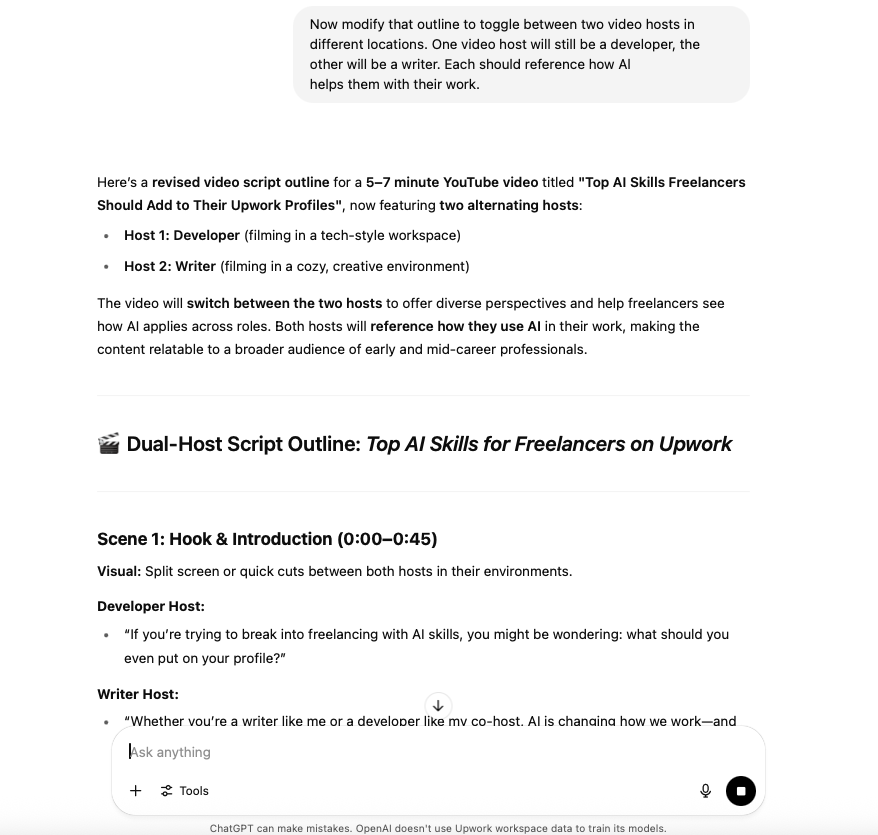
Skilled prompt engineers can quickly coax high-quality, complex results out of AI tools by using the right requests.
7. Data analytics
AI skills are very useful when it comes to data analytics, as machine learning can greatly speed up the processing and analysis of large data sets. You can combine AI and data analytics experience to more quickly find, clean, and build reports out of data for a variety of business applications.
8. Custom GPTs and AI agents
Python and other machine learning languages aren’t the only way to use AI models in complex ways. An increasing number of AI tools allow users to build AI agents and, in the case of ChatGPT, custom GPTs that carry out specific actions. These agents and GPTs may be built to emulate your writing style, act as a coach, send emails on your behalf, and help with other real-world functions.
Knowing how to build GPTs and agents can give you a competitive edge, as you’ll be able to help your clients or employer get more work done faster. You may even be able to provide them with a tool that offers them customized support when you’re not available.
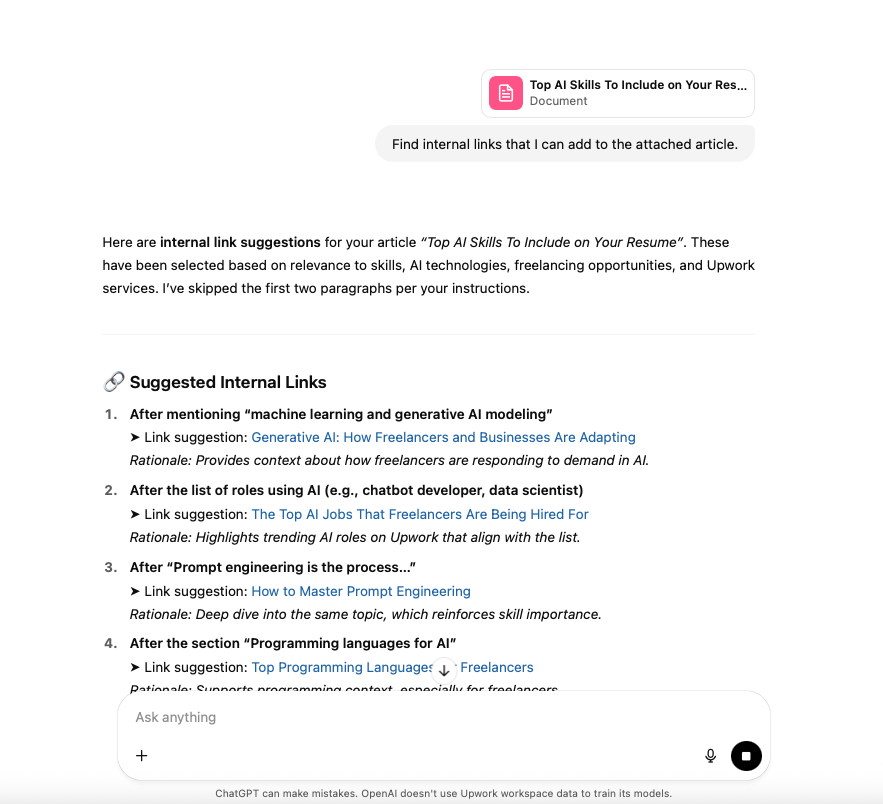
Here's an example: I’m not a machine learning engineer. But I used OpenAI’s GPT builder to create a tool that would analyze Upwork articles and return suggestions for internal links. The content you’re reading is written 100% by me; the GPT simply speeds up the process of hunting for other resource articles and blog posts on various topics.
9. Clear communication
Working with AI isn’t just about data analysis and Python scripting. It’s also about communication. Good written and verbal communication are some of the most essential skills you can have when working with AI, as they help you:
- Craft prompts and work with AI interfaces trained on natural language
- Communicate the value of AI tools (and your work with them) to clients and other stakeholders
- Work cross-functionally with technical, support, and creative teams on projects involving AI tools
- Explain AI concepts to beginners and colleagues who aren’t using the technology
Learning new concepts and strengthening AI skills
The field of AI changes rapidly. To grow your career in the industry at a comparable pace, you'll need to focus on ongoing AI education and upskilling. Online courses are an accessible (and often affordable) way to do this.
You can even learn new AI skills for free—these three AI courses and learning paths are a great place to start:
- The IBM AI Academy. This free series of videos on IBM’s YouTube channel cover different topics related to AI and business.
- The IBM Technology YouTube channel. If you want to learn AI concepts in an accessible way, the IBM Technology channel is a good place to start.
- Freelance with AI on Upwork. We put together a series of free resources that will help you get the most out of working with AI as a freelancer—it’s great material for anyone who’s early in their freelance career.
How to add AI skills to a resume
Because hiring managers are often looking for very specific AI skills, you’ll want to be as clear as possible when writing a resume or proposal. Adding a strong headline to your Upwork profile and quantifying your achievements is a good way to do this.
A quantifiable outcome can be expressed as a countable number. For example:
- Quantifiable skill statement. My team used AI-driven sentiment analysis to improve postpurchase customer satisfaction by 20%, quarter over quarter.
- Nonquantifiable skill statement. I led my team in using an AI text analysis tool to find customer pain points when shopping in our retail stores.
- Quantifiable skill statement. By building a custom application that used machine learning to spot patterns in production line data, we reduced unexpected line shutdowns by 10%.
- Nonquantifiable skill statement. We used ChatGPT to analyze data and improve efficiency at our London-area production facility.
You may not be able to quantify the outcome of every project you've ever worked on, and that's OK. But try to do this whenever you can.
It’s also important to highlight any relevant soft skills that you’ve developed, particularly those related to thinking through problems, facing change head-on, and communicating with others.
Other important soft skills include:
- Adaptability
- Creativity
- Critical thinking and problem-solving
- Emotional intelligence
- Analytical thinking
You don't need to list every relevant skill as bullet items—instead, try working them into your descriptions of jobs and projects like this:
"In this role, I led a cross-functional team of five to evaluate problems in current workflows and develop generative AI solutions. When deployed, our solutions led to a 10% increase in delivery speed.”
(If you’re feeling stuck, you can find professional resume writers and resume builders on Upwork!)
Leveraging AI skills in interviews
If your resume catches the attention of a hiring manager, you may be asked to interview—so you’ll want to be prepared to talk about your skills verbally.
Practice discussing your work in the following ways:
- Explain your fundamental AI experience in quantifiable terms, just like on your resume
- Walk the interviewer through how your AI skills have evolved over time and show that you're committed to growth
- Reference specific machine learning skills and concepts when discussing your approach to real or hypothetical problems
- Explain how you used specific soft and hard skills to address a problem on one of your recent projects
- Be familiar with the history and background of your AI skills—such as how Python use has evolved over time
- Mention any other AI skills that, even if they're not your specialty, you've been exposed to through your work
- Highlight examples of ways you’ve leveraged AI systems, agents, and custom GPTs to help streamline your work
You can try practicing these statements by yourself or with a friend. You can even ask ChatGPT to act as an interviewer and create questions for you to answer in real time.
AI skills equal freelancing opportunities
No matter where you currently are in your AI career, continuing to evolve, define, and explain your skills can help you land more opportunities—including independent work.
How to include AI skills in your Upwork profile
When you set up your Upwork profile, you can specify up to two main areas of focus. You can then fill out each section of your profile with more information—this is a perfect spot to share quantifiable details about your success and any related AI skills.
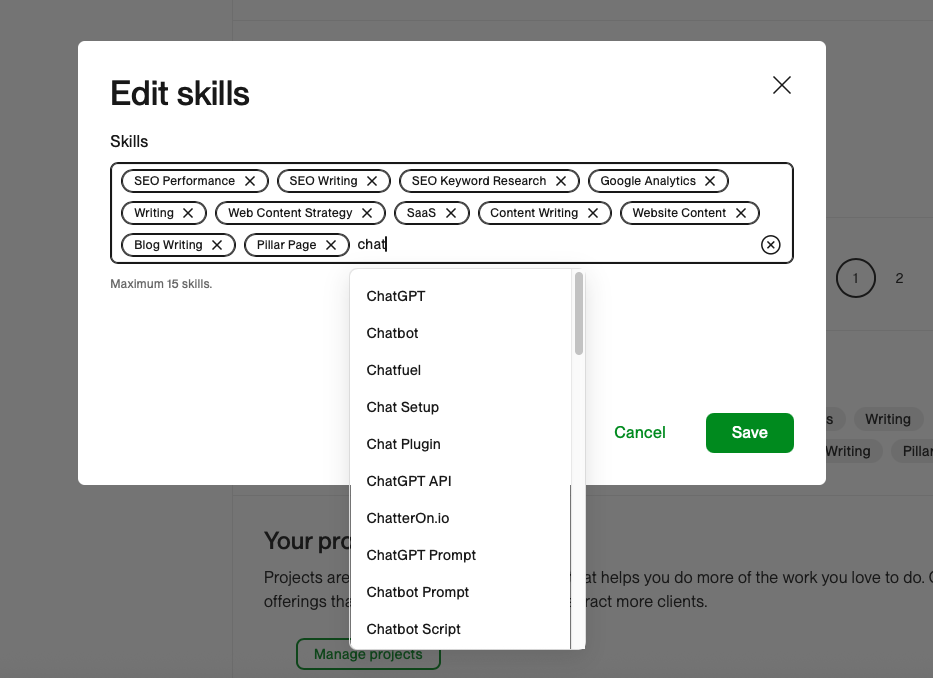
Your Upwork profile also comes with a skills section. You can add in a variety of skills, including the use of particular AI tools or techniques.
Market your AI skills on Upwork
Regardless of how you prefer to work—be it through Talent Marketplace™ or via consultations—you’ll find that increasing numbers of clients are looking for AI help on Upwork every day.
Once you set up an Upwork profile, you can start connecting with clients in need of your AI expertise. Getting started is easy with Upwork’s AI services hub, where you can find jobs that fit your skills and continue to grow your AI expertise.
There’s room for every AI expert to grow their career by working independently on Upwork. All it takes is an account to get started—sign up for free today.
If you are communicating with a hiring manager for a job through the Upwork platform, please note that sharing your personal contact information, such as email address, phone number, or LinkedIn profile, is not permitted in cover letters or at any time prior to the start of a contract. Additionally, all pre-contract communication should take place through the Upwork Messages feature. Learn more about using Upwork Messages here, and see more details on sharing information on Upwork here.

.avif)

Author Spotlight

Emily Gertenbach is a B2B writer who creates SEO content for humans, not just algorithms. As a former news correspondent, she loves digging into research and breaking down technical topics. She specializes in helping independent marketing professionals and martech SaaS companies connect with their ideal business clients through organic search.

Latest articles