Skills-Based Hiring for SMBs: Benefits, Challenges, and How To Do It Right
Discover how skills-based hiring helps SMBs find the right talent faster. Learn key benefits, challenges, and 7 steps to implement it effectively.

.png)
.avif)
Hiring trends are evolving quickly and many businesses are turning to skills-based hiring to find the right person for a role faster than before. The hiring model is a game changer, but for small and medium-sized businesses (SMBs), making the switch isn’t always straightforward.
While this approach opens up several benefits—including a broader talent pool and more accurate hires—it also comes with unique challenges for SMBs.
Let’s explore the hurdles and how to successfully implement skills-based hiring in your business.
What is skills-based hiring?
Skills-based hiring is also called skills-first hiring. This talent model focuses on hiring and promoting workers based on their skills, knowledge, and abilities rather than their degree, previous employers, or job titles.
In short, skills-based hiring values potential over pedigree.
Let’s say you’re hiring a back-end web developer, for example. Many companies require a college degree for this role. But in a skills-based hiring model, you focus on what really matters—whether the candidate has the programming expertise, communication skills, and problem-solving abilities to succeed. If they check all the right boxes, does having a degree really matter?
Why the buzz around skills-first hiring?
Although hiring growth has slowed compared to the post-pandemic boom, businesses still struggle to fill open positions and retain employees. Adopting a skills-first approach helps solve these challenges by instantly expanding the talent pool. Having more candidates to choose from means businesses can:
- Make more accurate hires
- Improve retention rates
- Increase diversity
- Save time recruiting
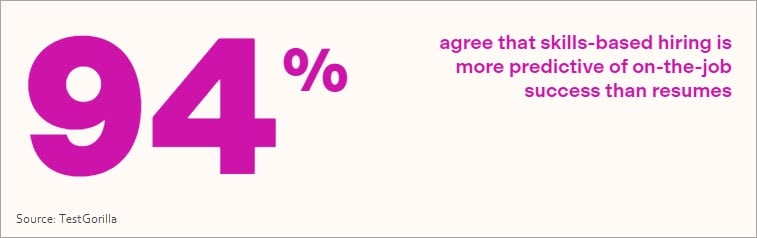
The impact is significant: A TestGorilla survey found that 81% of employers already use skills-based hiring. And 94% of them say evaluating a candidate’s skills is a better predictor of job success than their resume.
Skills-first hiring in real life
Skills-based hiring isn’t for every role. Doctors and lawyers need degrees, but sales supervisors and customer support agents? Not necessarily.
That’s what Kevin Conway, Director of Renewal Strategy at iCIMS, realized when hiring customer support managers. Conway explained:
“When hiring employees, you get a little dialed in with what roles a person must have had before and the years of experience they need to be qualified. [But] we don’t need to bring in people with a ton of industry experience if we look for people with the right transferable skills like communication, empathy, and problem-solving. Focusing on soft skills really opens us up to a lot of talent who we might not have had an opportunity to consider previously.”
By shifting focus to skills, Conway hired Ireland Metz, who had never worked at a SaaS company or held a traditional customer support role. But she had the soft skills to excel. Today, Metz is one of the team’s top contributors.
“She’s so passionate and does such an incredible job,” Conway said. “Even though she doesn’t have the traditional background, she proved she can do the work.”
The appreciation is mutual.
“I can honestly say this is the first time that I've had a project that I thoroughly enjoy doing. I love helping customers solve their problems,” Metz shared.
Read the full iCIMS case study.
Your window of opportunity is wide open (for now)
SMBs regularly compete with larger companies for top talent. But SMBs often lose out due to smaller recruiting budgets, lower salaries, and fewer flashy perks.
Here’s the good news: Most companies talk about skills-based hiring but haven’t acted on it yet.
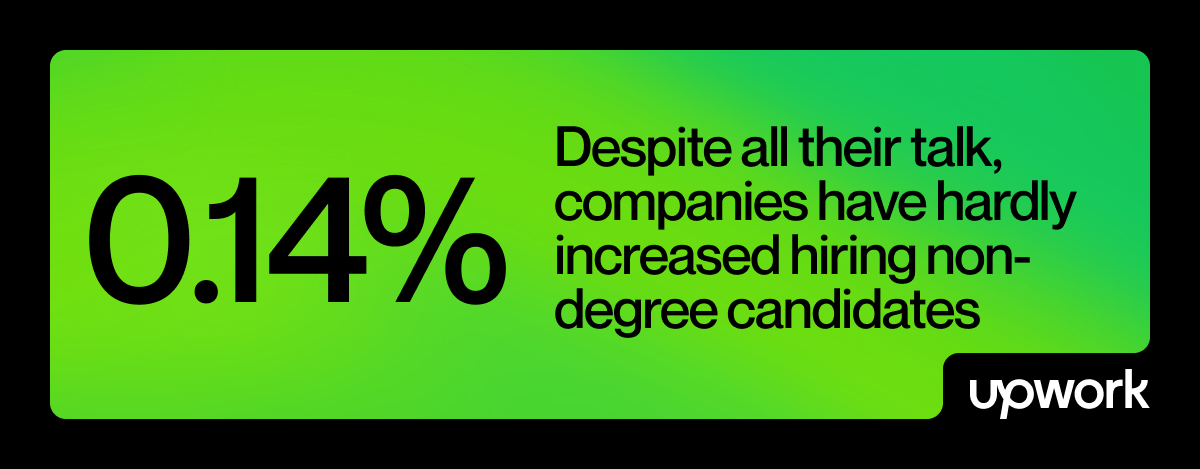
Even those that have removed degree requirements from job postings haven’t significantly changed who they hire. A Harvard Business School and Burning Glass Institute study found that companies have increased hiring non-degree candidates by just 0.14%—a tiny shift despite all their talk.
And that’s good news for you.
While big companies drag their feet, you can use your small business nimbleness to act fast and build a stronger workforce before the competition catches up.
But the window won’t stay open forever. Once large companies fully commit to skills-based hiring, your advantage will shrink.
7 ways to implement skills-based hiring
Making the shift to skills-based hiring doesn’t have to be overwhelming. Here are seven practical steps to help you attract, assess, and hire the right talent based on skills—not just resumes.
1. Create new job descriptions
Instead of reworking an old job description, start fresh. This helps break free from outdated thinking and ensures you define the right skills for the role.
For a great job description, you may want to:
- List the soft and hard skills required for someone to be successful in a role (with proficiency levels)
- Gather input from employees and managers on the skills really required
- Focus on the skills needed within the first 6-12 months—allowing room for learning on the job
If you’re unsure of the skills required, ask an expert on Upwork. Choose from two time-saving options, which are also forms of skills-based hiring:
- Contract a freelance job description writer to craft compelling job posts that attract strong candidates
- Book a consultation with an industry expert who can identify essential skills and perhaps give tips for qualifying candidates
Short on time? Use Upwork’s Job Post Generator, powered by Uma™, Upwork’s Mindful AI. Just type what you’re looking for in a sentence or two and then you’ll get a strong, skills-focused draft in seconds.

2. Implement or update skills assessments
Resumes tell only part of the story. Assessments help measure candidates’ actual abilities. A few tips to consider:
- Tailor it. Instead of a one-size-fits-all, choose the best approach to assess the skills and behaviors required for a role. This may include skills tests, self-assessments, and 360° feedback (when employees are reviewed by their peers and direct reports as well as their managers).
- Leverage free. No budget for assessments? Use the starter options offered by some preemployment testing companies like TestGorilla, HiPeople, and Equip. Many of them are free.
- Test them in action. Get top candidates down to a short list and then offer them a small, paid project to compare skills before committing.
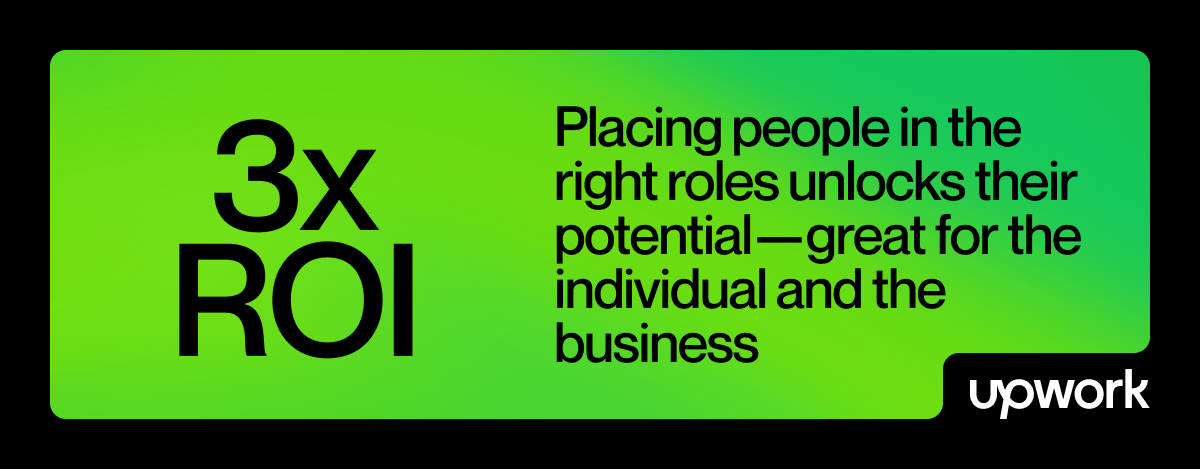
A Korn Ferry study found that when people are placed in roles that align with their behaviors, skills, and motivations, businesses see a tripling in return on investment.
3. Align mindsets companywide
Adopting a skills-first approach means hiring managers need to screen candidates in instead of screening them out. This not only means determining qualifications differently, but also adjusting how they onboard, manage, and assess their performance.
The mindset shift can, understandably, cause confusion and pushback. You could ease everyone into alignment by:
- Starting small by piloting the model in one department
- Sharing success stories with teams throughout the company
- Appointing internal champions to share best practices and encourage usage
If bandwidth is an issue, contract a freelance HR consultant, project manager, or whichever skill your team needs to help design, implement, and monitor the pilot for success.
4. Onboard and track
When hiring based on skills, new employees might have different learning curves. So you may need to adjust your onboarding and job support to help them thrive.
Unlock their full capabilities by:
- Pairing them with an onboarding buddy—a current employee who can be a friendly go-to for questions
- Defining what success looks like up front for the employee and company, and setting clear performance metrics
- Creating a clear plan for their skills growth to close minor gaps and expand their potential
- Checking in regularly to keep them on track and adjusting plans as needed based on feedback
5. Commit to upskilling and reskilling your workforce
Skills-based hiring maximizes the potential of every hire. The longer they stay with you, the more value they bring—when given the right support.
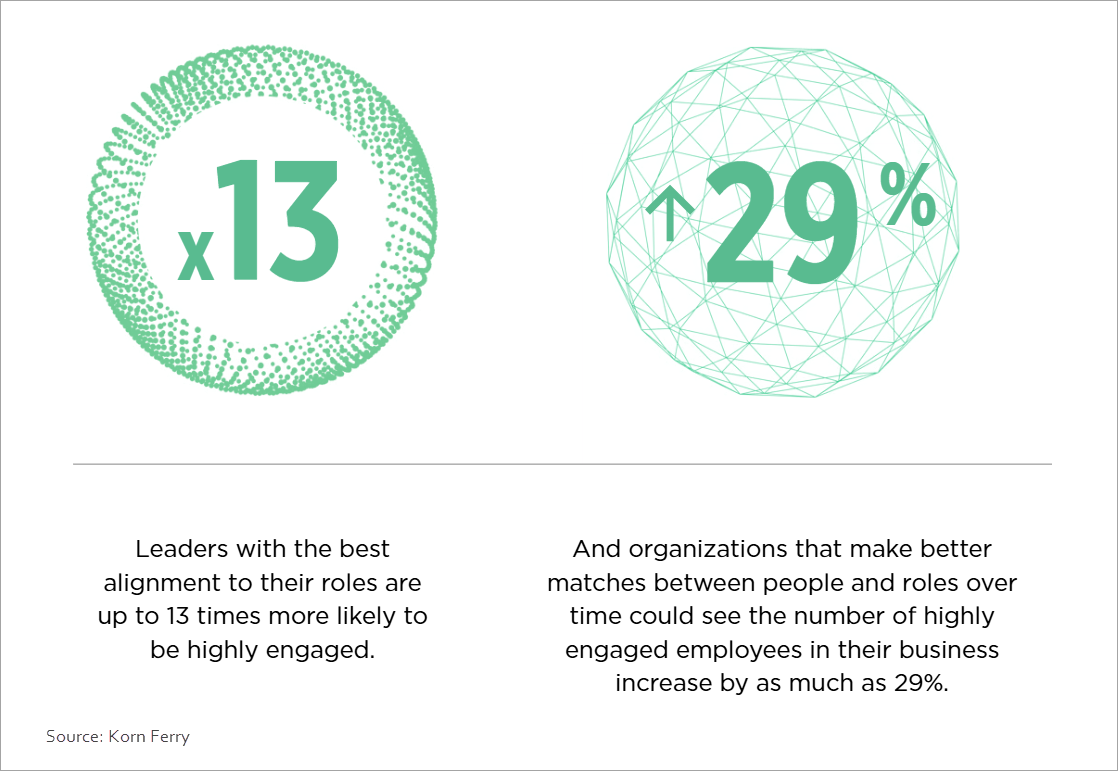
Bringing out the best in each employee starts with understanding their strengths and growth areas so that you can align a person’s skills with work that they not only do well, but also enjoy. This alignment creates a foundation for long-term success and is shown to boost employee engagement by up to 29%.
Of course, engaged employees are far more likely to stay. And when you provide these engaged workers with regular upskilling opportunities, they’re empowered to continue growing and contributing at a higher level.
Investing in training programs can be costly for small businesses, but learning opportunities don’t have to break the bank. Here are a few cost-effective ways to fuel employees’ long-term success:
- Provide learning stipends. Offer funds for online courses and certifications—but don’t limit it to work. Consider supporting the whole person by funding classes that fuel personal passions, such as photography and coding.
- Pair them with a mentor. Pair junior employees with experienced team members for hands-on learning, career guidance, and a little insider wisdom along the way.
- Hire a freelance guide. Bring in an expert to help employees tackle challenging projects—an affordable way to get top-quality work done while upskilling your team.
- Foster a knowledge-sharing culture. Encourage team members to share insights from webinars, industry articles, and hands-on experience via Slack, lunch-and-learns, or team meetings.
6. Learn from the successes
Hiring based on skills isn’t just about filling roles faster—it’s about building a high-performance team where every person is in the right role, thriving, and contributing at their best.
An effective way to refine your approach is by studying your success stories. Start by identifying patterns among your top performers by looking at:
- Their backgrounds or prior work histories
- The roles they were originally hired for
- Their career progression within your company
- The training, mentorship, or development opportunities that helped them grow
Use the insights to adjust your processes so that every person hired reaches their full potential:
- Analyze what’s working. Identify the skills, experiences, and qualities that made top hires successful. Conduct interviews or surveys with them (and their managers) to understand key success factors.
- Refine your hiring criteria. If certain tests, work samples, or assessments correlate with strong performance, double down on them. Eliminate any hiring steps that don’t add real value.
- Encourage internal mobility. Help skills-based hires grow within the company by assessing their competencies—not just past job titles—when filling leadership and new roles.
- Continuously improve. Take a page from the agile playbook: Test, measure, refine, and repeat. Stay open to feedback from new hires and hiring managers to ensure your process stays effective and adaptable.
7. Just go for it
Don’t wait for the perfect setup or the “right time” to start. If you follow the steps above, you’ll have a solid foundation—and you can refine your process with every hire.
A great way to test and tweak your job descriptions is by hiring freelancers for short-term projects. Not only does this get work done, but it’s also a low-risk way to assess skills in action. If a candidate isn’t the right fit, you simply move on to the next—no long-term commitment required.
The future is skills-based—Upwork can help you be ready
With the rise of AI and automation, entirely new types of work are emerging—jobs that didn’t exist a few years ago. In many cases, past job titles no longer indicate a candidate’s ability to succeed. What matters more are their skills.
The pace of change is so rapid that schools can’t predict what skills will be needed in the coming years. That means traditional college degrees may not always align with the demands of today’s workforce.
Instead, the professionals who take the initiative to learn cutting-edge skills—whether through online courses, industry forums, or hands-on experience—may be the ones who bring the most relevant expertise to the table.
Upwork can help you embrace skills-based hiring quickly and affordably. Our platform is designed for you to quickly connect with the ideal freelance professional who’s ready to jump in and help you get critical work done. Explore what’s possible.

.avif)

Author Spotlight

Brenda Do is a direct-response copywriter who loves to create content that helps businesses engage their target audience—whether that’s through enticing packaging copy to a painstakingly researched thought leadership piece. Brenda is the author of "It's Okay Not to Know"—a book helping kids grow up confident and compassionate.