How To Build a Research Team in 2026: 13 Essential Steps
Discover how to build a research team that aligns with your business goals. Learn helpful steps to develop, lead, and adapt your research team over time.

.png)
.avif)
While research teams are most commonly known in academic, scientific, and medical settings, increasingly more organizations across industries are forming internal research teams to stay up to date on the latest market trends and better serve their target audiences.
Building a research team offers many benefits, including establishing your organization or institution as a thought leader in your space, improved problem-solving capabilities, better quality control, higher quality research outcomes, and opportunities for knowledge sharing and learning.
While building a research team may seem overwhelming, especially if you’re starting from scratch or don’t have a research background, with the right processes, resources, and strategies in place, it doesn’t have to be. Learn more about what a research team is, how to build an effective one, and examples of companies with successful research strategies.
What is a research team?
A research team is a group of professionals who work collaboratively toward discovering information on a specific topic. An effective research team typically has a designated leader, often called a principal investigator, to ensure project accuracy and success.
In addition to the team leader, identifying the right roles for your research team—such as a co-investigator, research assistant, statistician, and qualitative researcher—is important. The leader and other members of the research team need to possess the right qualifications to collect and analyze relevant data without introducing bias or fallacies. In some fields, such as academia, a Ph.D is required to conduct independent research or lead a research team.
Common types of research teams include:
- Academic research teams
- Market research teams
- Corporate research and development labs
- Government research organizations
- Independent research institutes
- Industry associations or consortiums
How to build a research team: 13 steps for success
Building a research team requires a thoughtful approach to ensure you have the right team members and strategies in place to deliver quality research outcomes. Key steps to build a high-impact research team are outlined below.
Steps include:
- Determine whether you need to engage an experienced researcher
- Outline your research needs and goals
- Define your research focus area
- Create a research strategy and agenda
- Develop a list of skills needed on your team
- Identify the team structure and key roles
- Align on a budget and funding
- Source qualified team members
- Implement technology to drive efficiencies
- Communicate effectively
- Offer ongoing training and development
- Measure the effectiveness of your team
- Develop your research team over time
1. Determine whether you need to engage an experienced researcher
Before you start to build a research team, determine whether you or another member of your existing workforce possess the knowledge, qualifications, and experience to create and implement a research strategy. In some cases, an organization may benefit from conducting research, but lack the in-house expertise to design and oversee a research team on its own—especially if the research is complex.
For example, if your business simply wants to conduct A/B testing on a webpage, turning to internal resources or quickly engaging qualified team members may be sufficient. However, if you’re interested in launching a long-term strategy involving in-depth research methodologies, surveys, or analyses on large data sets, you may want to start the process by consulting with an external research expert.
If your team is in need of outside expertise, consider engaging an independent researcher on Upwork. Skilled researchers are available to provide consultations on how to approach your research efforts, help you set goals, develop and implement your research strategy, and structure and build your research team.
2. Outline your research needs and goals
Whether or not you enlist the support of an external research expert, outlining the purpose of your research and the goals you hope to achieve can help you set the stage for building a successful research team and securing stakeholder buy-in and funding. Make sure to focus on goals that are specific, measurable, attainable, relevant, and time-bound (SMART goals), to help your team stay focused and accountable.
Answer the following questions to help you outline your research needs and goals:
- What is the overall problem the research is looking to address or solve?
- Who is the target audience for your research?
- What are the expected benefits of the research for your organization or institution?
- How will the research positively impact your field or industry?
- What are the key performance indicators (KPIs) you’ll use to determine research success?
- What’s the expected timeline for the research project?
- How will research findings inform your team or organization’s decision-making?
3. Define your research focus area
Rather than conducting broad research, narrow your focus to cover specific and manageable research that’s relevant to your target audience, organizational objectives, and industry trends. Overly broad research can lead to information overload, scope creep throughout the project, limited options for in-depth analysis, and vague or irrelevant findings.
As part of the process of defining your focus area, conduct market and competitive research to understand information that already exists, along with potential gaps. Also stay updated on the latest market and industry trends to conduct timely research.
Examples of specific research focus areas include:
- Education. Assessing the effectiveness of digital learning platforms on improving science, technology, engineering, and mathematics (STEM) skills in elementary school students.
- Marketing. Evaluating the impact of influencer marketing on consumer behavior for a retail brand.
- Health and medicine. Understanding how evening screen time disrupts sleep quality for baby boomers.
- Human resources. Measuring Generation Z job seeker perceptions of artificial intelligence (AI) in the hiring process.
4. Create a research strategy and agenda
With your goals and focus area in mind, the next step is to create a research strategy and agenda. An impactful research strategy should strike the right balance between covering essential information stakeholders may want to know about your research while remaining concise.
Elements of a strong research strategy include:
- The purpose and relevance of your research
- A defined focus area, target audience, and goals
- A research agenda, including how often you plan to publish research, such as quarterly or annually
- Achievable milestones and deadlines to track progress and maintain accountability throughout each phase of research
- Specific research deliverables, including reports, charts and graphs, presentations, talking points, and press releases
- Required resources like team members, office space, tools, technology, and funding
- Research methods, such as qualitative and quantitative
- Details about how your team will approach data collection and analysis
- An overview of KPIs to measure research progress and success
- The process for disseminating research results, including publishing research in a journal or media publication, attending industry conferences, and hosting webinars or other virtual events
- Ethical considerations related to consent, privacy, bias, and other potential issues
- A list of potential risks, challenges, and mitigation strategies
5. Develop a list of skills needed on your team
One of the benefits of building a structured research team is that you can assemble a group of individuals with a diverse set of skills. Think of both soft and hard skills you need to drive success on your team, so you can identify professionals who will collaborate well with one another and possess the technical skills to achieve your research goals.
By understanding which skills are needed to complete your research, you can take a skills-based approach to building your team. According to Upwork’s 2025 In-Demand Skills report, 81% of C-suite executives surveyed report that their organizations are taking deliberate steps to embrace skills-based hiring, such as removing degree requirements in favor of emphasizing skills assessments.
While not an exhaustive list, the following skills can be beneficial as you build a research team:
- Data analysis
- Statistical analysis and modeling
- Research methodology
- Data visualization
- Scientific writing
- Experimental design
- Industry- or field-specific expertise
- Proficiency with software related to research
- Communication
- Collaboration
- Adaptability
- Time management
- Project management
6. Identify the team structure and key roles
Based on the list of skills you compiled in the previous step, you can map essential skills to identify specific roles needed on your research team. Most research teams are structured with a leader, such as a research manager or a principal investigator
The principal investigator is typically responsible for the overall research project, including writing proposals and grant or budget requests, identifying and hiring team members, reporting to their employer or other stakeholders, and overseeing the research publication and distribution.
Another leadership role on many research teams is a project manager, who ensures day-to-day research functions and responsibilities stay on track.
In addition to the principal investigator and project manager, roles on research teams may include but aren’t limited to:
- Data analysts
- Market research analysts
- Statisticians
- Qualitative researchers
- Academic researchers
- Scientific researchers
- Survey designers
- Data managers
- Project coordinators
As you identify the roles and structure for your research team, write clear job descriptions that outline job requirements—such as a Ph.D or experience in specific research methodologies—responsibilities, and collaboration expectations for each role. In doing so, you can attract the right candidates for essential positions and hold individuals accountable for their specific outcomes.
7. Align on a budget and funding
Developing a budget and securing funding is critical to ensuring you have the stakeholder buy-in and resources necessary to implement your research strategy. As you determine your budget, break your spending down into specific categories. Also create a list of potential funding sources and brainstorm how you’ll present proposals to secure funding.
Research project costs may include:
- Pay and benefits for team members
- Recruitment and training resources
- Equipment and supplies
- Software subscription fees
- Administrative costs, such as office space rent, utilities, and furniture
- Promotional costs associated with publishing research findings in journals, at conferences, or through other marketing channels
Examples of funding sources for research include:
- Budget allocated directly from your business
- Government grants
- Private foundations or individual donors
- Industry associations
- University or institutional funding
- Crowdfunding or other sources of public support
8. Source qualified team members
Once you have budget approval and secure funding, you can begin actively sourcing individuals for your research team. Conduct a thorough hiring process that includes promoting your open role across candidate sourcing channels and candidates screening steps such as skills assessments, interviews, paid test projects, reference checks, and background checks.
Also consider sourcing a mix of both full-time, in-house workers and independent professionals for your research team to reach a broader talent pool and identify workers with the skills you need. According to Upwork’s Work Innovator Framework, 94% of high performing companies and leaders (Work Innovators) surveyed believe that engaging freelancers enables their team access to specialized skills, compared to 56% of leaders overall.
Candidate sourcing channels for your research team include:
- Your organization’s career page
- Traditional job boards like Indeed and Glassdoor
- Research-specific job boards including ResearchGate, AIR Job Board, jobRxiv
- Social media platforms such as LinkedIn
- Industry conferences and events
- Educational institutions and alumni networks
- Talent marketplaces like Upwork
9. Implement technology to drive efficiencies
Even with a qualified team in place, manual research tasks and responsibilities, such as data analysis and data visualization, can be time-consuming and prone to human error. Identifying and implementing the right technology solutions can drive efficiencies across your research team and increase the accuracy and credibility of your research.
Available technology solutions for research teams include:
- Project management software
- AI-powered data analysis tools
- Survey platforms to design, distribute, and analyze survey data
- Data storytelling and visualization tools
- Cloud-based storage and sharing platforms
10. Communicate effectively
Effective communication and collaboration is essential to research project accuracy and deadline adherence. Ineffective communication can lead to risks such as lost productivity, increased errors, missed deadlines, and research team member disengagement.
Whether you’re working directly with team members in an office or research lab or interacting with individuals in a remote or virtual work environment, the following tips can help you support strong communication and collaboration:
- Clearly communicate research goals and ensure goals and strategy documents are easily accessible to all team members
- Determine a regular cadence of team meetings
- Record meetings for individuals who can’t attend
- Schedule one-on-one meetings with individual team members
- Develop an agenda for every meeting
- Follow up with next steps and action items after each meeting
- Limit unnecessary meetings
- Embrace asynchronous communication for answering simple questions, collaborating on feedback, and providing quick updates
- Leverage collaboration tools such as video conferencing software, messaging apps, shared documents, and project management software
- Collect feedback from team members to improve communication and collaboration
11. Offer ongoing training and development
Research trends, required skills, and technology solutions change over time. Offering your research team access to ongoing training and development can help ensure individuals’ skills and expertise, as well as your research tools, processes, and methodologies remain relevant.
Upwork’s 2025 In-Demand Skills report cited above found that more than one-third (35%) of leaders surveyed acknowledge that in the 12 months leading up to the survey, they required workers to expand their skillsets, in addition to focusing on their day-to-day responsibilities.
Training and talent development opportunities that empower workers to enhance existing skills and develop new ones include:
- Mentorship programs
- Internal knowledge-sharing sessions
- Training on new technology solutions
- Access to online learning platforms such as LinkedIn Learning, Udemy, and Coursera
- Stipends for conferences, professional development events, and courses
- Tuition reimbursement
- Skills and talent assessments
- Structured goal-setting and performance reviews
12. Measure the effectiveness of your team
Once you have a research team in place, regularly measuring effectiveness can help you identify strengths and areas for improvement to hold your research team accountable for being as productive and impactful as possible.
While KPIs will vary depending on the initial goals and type of research—such as academic versus corporate market research—here are some common metrics to track:
- On-time project completion rate
- Data quality, accuracy, and error rates
- Project costs and budget adherence
- Return on investment (ROI) of your research projects
- Technology adoption rate
- Team productivity
- Team member retention and engagement rate
13. Develop your research team over time
Building and managing a research team is an ongoing process rather than a one-time effort. Continually evolving can position your research team to meet the shifting needs of your organization and key stakeholders.
Consider the following tactics to develop your research team:
- Regularly reviewing organizational objectives to align your research with strategic goals
- Staying updated on the latest industry-specific and research trends and adapting research focus areas as needed
- Implementing and training team members on emerging technology solutions
- Adding new roles or restructuring your research team to achieve new goals
- Engaging outside expertise to supplement your internal research team
- Seeking additional budget or funding to expand your research efforts
- Identifying additional efficiencies to drive cost savings when budget is limited
Successful research team examples
Now that we’ve covered how to build a research team, the following research team examples can be used as inspiration as you identify your goals and strategy.
P&G Research & Development
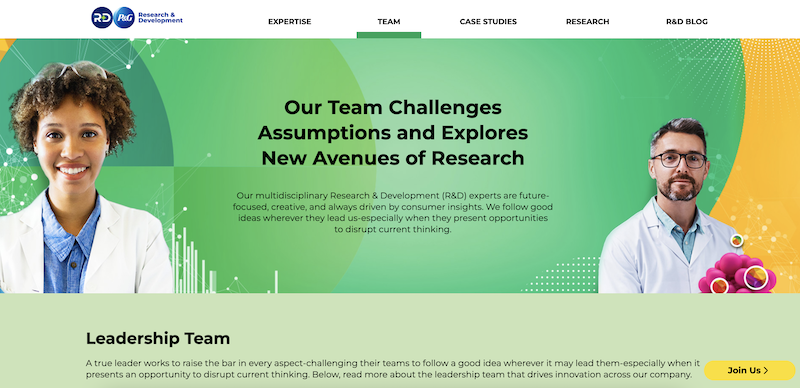
The Procter & Gamble Company (P&G) is a consumer goods corporation with a portfolio of well-known brands including Bounty, Tide, Gillette, Old Spice, and Febreeze. The company has a dedicated research team, P&G Research & Development, which aims to solve consumer problems, develop methodologies that define future research, and redefine industry standards.
Rather than conducting broad research, P&G has defined key areas of expertise and three specific areas of focus: sustainable consumption, health and hygiene, and human-centered innovation. The team has worked with more than 7,600 engineers and scientists, published more than 6,000 articles, and is responsible for more than 37,000 patents.
Netflix
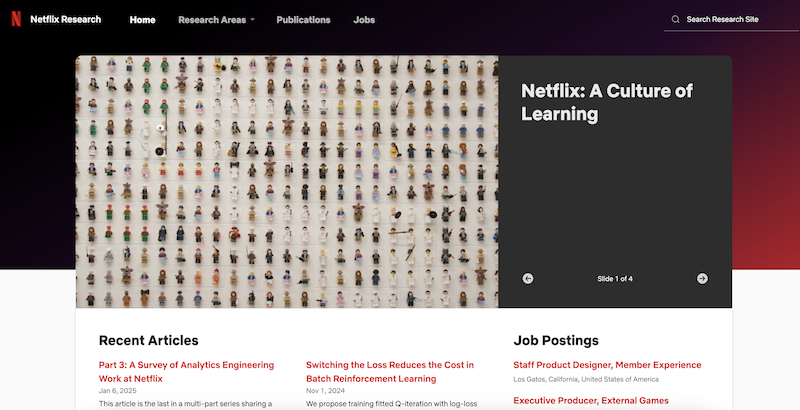
Netflix, the video streaming platform, prioritizes research across several focus areas relevant to the company’s target audience, including content recommendations, streaming optimization, and user insights. Netflix uses a variety of research methods, including A/B testing, market research surveys, and focus groups, to more accurately personalize content recommendations.
Employees in departments across Netflix are encouraged to try new ideas, conduct evidence-based experiments, and take smart risks. Because of its culture of innovation, Netflix Research takes a unique approach to research efforts. Rather than having a dedicated, separate research team, departments across the organization are encouraged to pursue research by closely collaborating with business teams, engineering teams, and other researchers.
The Upwork Research Institute
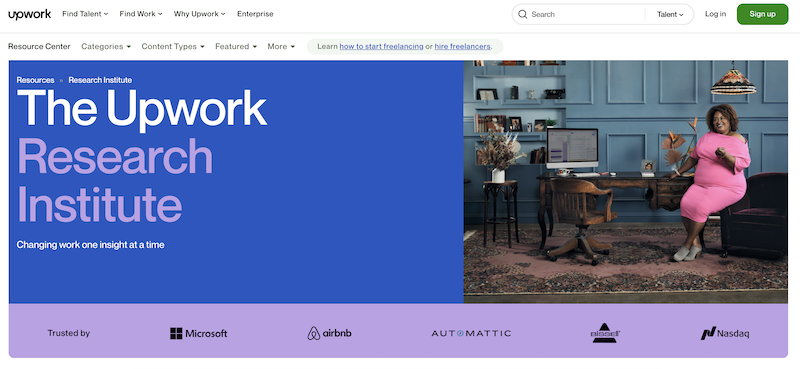
Upwork connects businesses and freelancers from around the world and is committed to being at the forefront of work Innovation. In 2023, Upwork launched The Upwork Research Institute. The team has a clearly defined focus area of studying fundamental shifts in the workforce and providing business leaders with critical insights they need to navigate workforce disruptors both now and in the future.
The Upwork Research Institute uses a combination of our proprietary Upwork platform data, global survey research, partnerships, and academic collaborations to produce evidence-based insights and offer a blueprint for the new way of work. The team has released several in-depth reports, including the 2025 In-Demand Skills report and the Work Innovators Framework cited above.
Build your research team on Upwork
Building a research team offers the opportunity for your organization, institution, lab, or association to conduct and distribute research relevant to your target audience, address industry challenges, and be seen as an expert in your field. Because determining your specific research needs, building a team, and overseeing your research strategy can be complex, engaging outside expertise can be beneficial.
In addition to consulting with an independent research expert as highlighted in the first step above, consider engaging a research assistant or partnering with a market research agency, along with sourcing qualified individuals for roles across your research team on Upwork. You can also engage a skilled recruiter to help you source and evaluate professionals for your research team. Get started now—create an account and post a job on Talent Marketplace.
If you’re a research expert looking for new opportunities, browse research jobs on Upwork.
This article is intended for educational purposes and should not be viewed as legal or tax advice. Please consult a professional to find the solution that best fits your situation.
Upwork is not affiliated with and does not sponsor or endorse any of the tools or services discussed in this article. These tools and services are provided only as potential options, and each reader and company should take the time needed to adequately analyze and determine the tools or services that would best fit their specific needs and situation.

.avif)

Author Spotlight

Beth Kempton is a B2B writer with a passion for storytelling and more than a decade of content marketing experience. She specializes in writing engaging long-form content, including blog posts, thought leadership pieces, SEO articles, case studies, ebooks and guides, for HR technology and B2B SaaS companies. In her free time, you can find Beth reading or running.