You will get CRE Deal Assumptions Intake — Structured Excel Questionnaire
Project details
Before a single formula is written, the assumptions have to be right. Wrong inputs locked in at scoping stage don't get caught until a lender or investment committee asks a question the model can't answer.
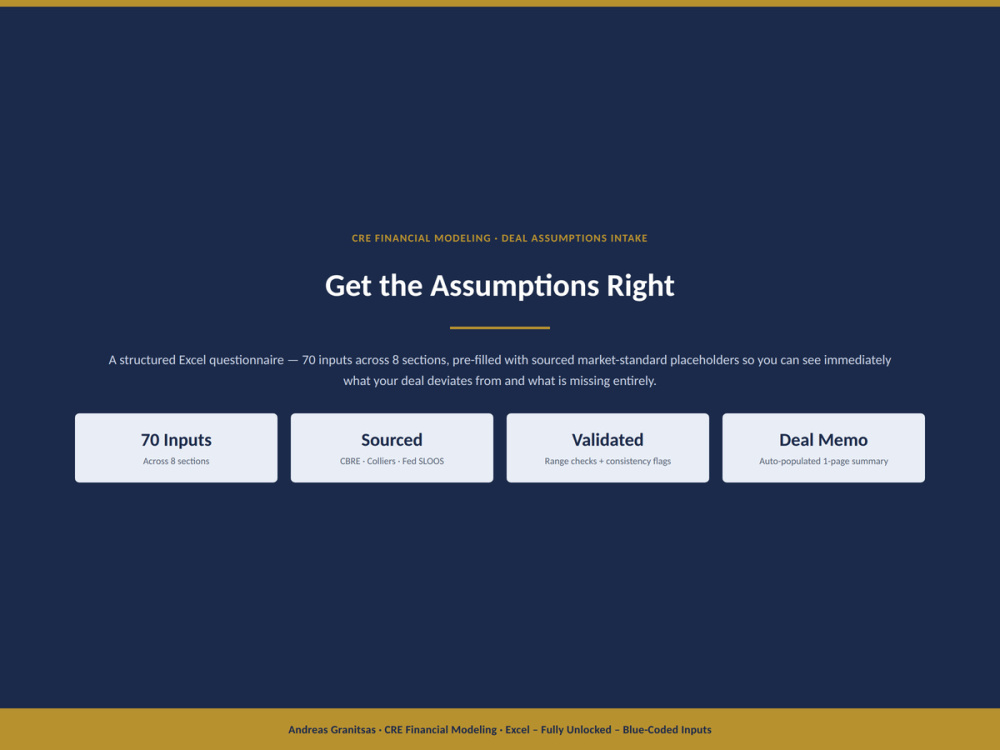
This project delivers a structured Excel assumptions workbook covering every input needed to build or validate a CRE financial model: deal identification, purchase price, development cost, revenue and lease-up parameters, operating expenses, financing terms, exit assumptions, and equity structure.
Every input is pre-filled with a market-standard placeholder sourced from the CBRE H2 2025 Cap Rate Survey, Colliers CMBS data, and Fed SLOOS Q1 2026 — so you can see immediately what your deal deviates from and what is missing.
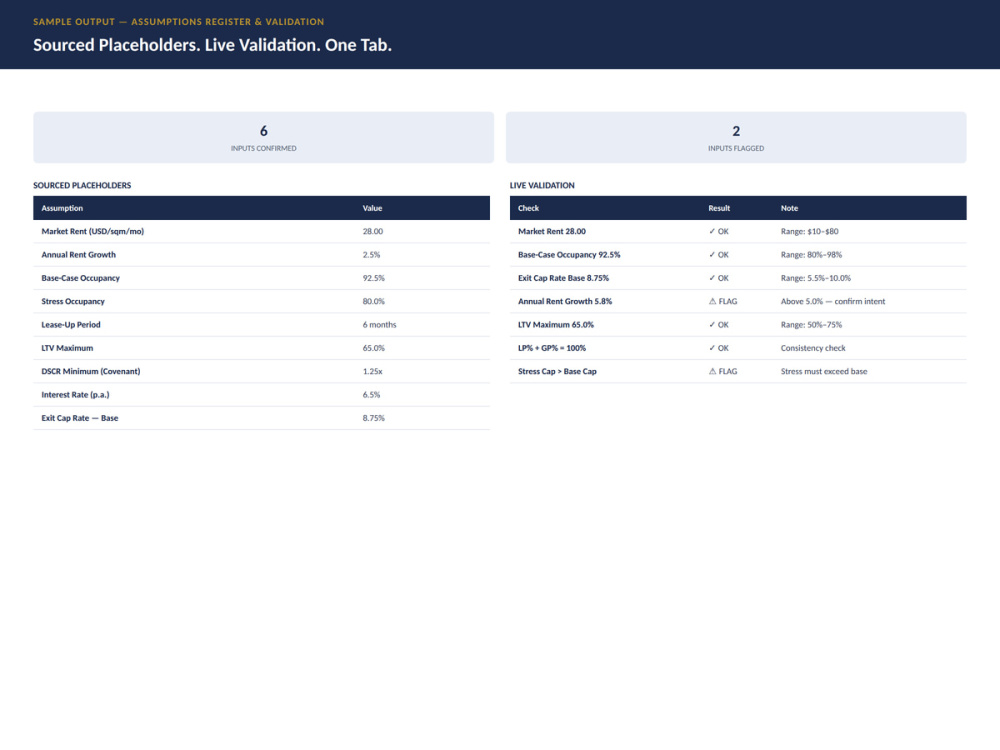
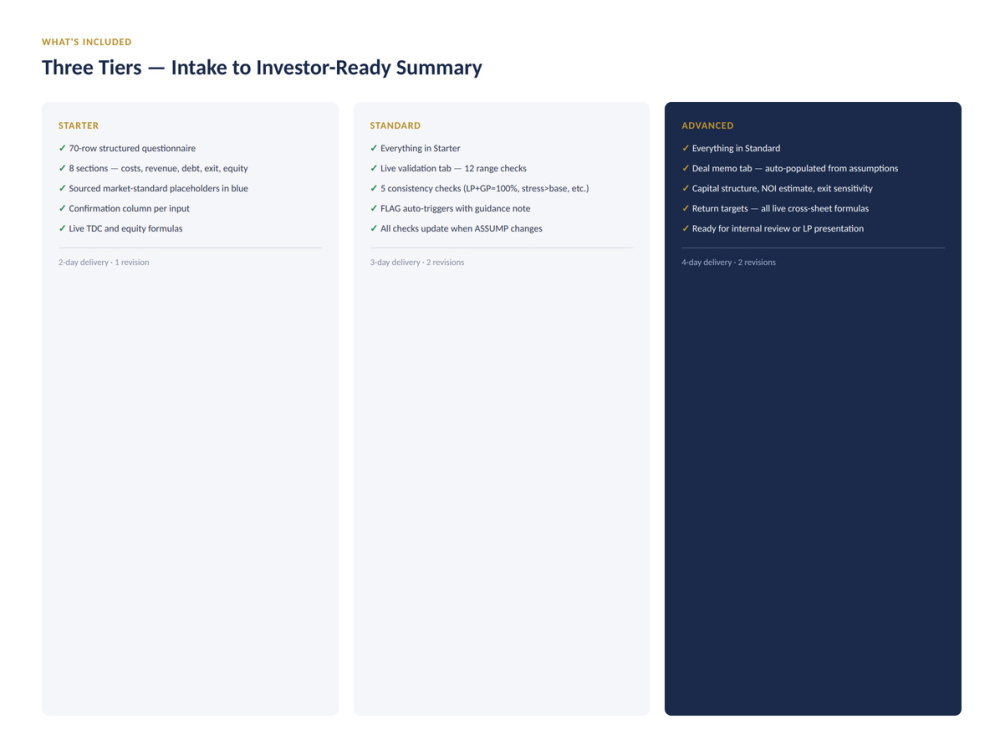
Starter delivers the questionnaire with sourced placeholders. Standard adds a live validation tab that flags inputs outside typical market ranges or internally inconsistent with your other assumptions. Advanced adds a deal memo tab that auto-populates a one-page summary from your confirmed inputs — no manual reformatting required.
This project delivers a structured Excel assumptions workbook covering every input needed to build or validate a CRE financial model: deal identification, purchase price, development cost, revenue and lease-up parameters, operating expenses, financing terms, exit assumptions, and equity structure.
Every input is pre-filled with a market-standard placeholder sourced from the CBRE H2 2025 Cap Rate Survey, Colliers CMBS data, and Fed SLOOS Q1 2026 — so you can see immediately what your deal deviates from and what is missing.
Starter delivers the questionnaire with sourced placeholders. Standard adds a live validation tab that flags inputs outside typical market ranges or internally inconsistent with your other assumptions. Advanced adds a deal memo tab that auto-populates a one-page summary from your confirmed inputs — no manual reformatting required.
Industry
Real EstateWhat's included
| Service Tiers |
Starter
$175
|
Standard
$325
|
Advanced
$475
|
|---|---|---|---|
| Delivery Time | 2 days | 3 days | 4 days |
Number of Revisions | 1 | 1 | 1 |
Formatting & Clean Up | - | - | - |
Frequently asked questions
About Andreas
CRE Financial Modeler | Acquisition, Development & Debt | IRR, DSCR
Nicosia, Cyprus - 4:44 am local time
You have a model. It produces an IRR, a DSCR, an equity multiple. But when a lender, partner, or board member asks "where does this number come from?" — someone has to dig through six tabs of hardcoded cells and circular references to find out.
Criteria — What a Model Should Be
Every number a stakeholder sees should trace back to a single, labelled assumption. Change one input — rent, exit cap, interest rate — and the entire model should update correctly, with no manual patching.
Effect — So What?
• The model can't be updated quickly when terms change. So what?
• You're rebuilding sections under deadline instead of just changing an input. So what?
• A lender or investor asks a follow-up question your model can't answer cleanly. So what?
• Credibility on the deal — and the relationship — takes the hit, not just the spreadsheet.
Cause — Why This Happens
Most models are built bottom-up, deal by deal, under time pressure — assumptions get embedded directly into formulas because it's faster in the moment. Nobody goes back to separate them out, because the next deal is already starting.
Recommendation — What I Build Instead
Every model I deliver is built in three layers from day one:
1. Assumptions — rent, vacancy, growth, costs, financing, exit. All in one place, clearly labelled.
2. Cash Flow Engine — NOI, debt service, capex, lease-up, refinancing. Fully linked to Assumptions.
3. Decision Outputs — IRR, NPV, equity multiple, DSCR, debt yield, sensitivities. Traceable back to source.
Change one assumption, and the entire model — every tab, every output — updates correctly. No patching, no circular references, no "let me rebuild that section."
________________________________________
What I Build
• Acquisition & value-add underwriting (office, logistics, multifamily, retail, mixed-use)
• Development cash flow models (construction draws, absorption, phased leasing/sales)
• Refinance / debt sizing (LTV, DSCR, debt yield, amortisation, covenant headroom)
• GP/LP waterfall models
• Portfolio dashboards & rent roll analysis
• Sensitivity tables (rates, rents, exit cap, delays)
Process
1. Quick brief or call to confirm scope and assumptions
2. First working version delivered fast
3. Refine based on your feedback
4. Final model + short notes on how it's structured
________________________________________
Send me your deal, term sheet, or existing model — I'll tell you the fastest path to a model that holds up under questions, not just calculations.
________________________________________
Model Architecture — 10-Tab Excel Workbook
📊 Dashboard
KPIs, milestones, budget breakdown, exit sensitivity, waterfall summary, ICR/DSCR — one-page command centre
⚙️ Assumptions
16-section assumption register (A–P) with IFRS annotations, risk index, sensitivity flags, ECL framework overview
📅 IS — Monthly
Month-by-month income statement: revenue ramp, lease-up, COGS, overheads, NOI — full construction-to-stabilization timeline
📈 CashFlow — Annual
10-year annual cash flow (indirect method): NOI → EBITDA → after-tax levered FCF, IAS 7 compliant presentation
🏗️ PPE Note — IAS 16
Full PPE schedule: land, building (39yr), FF&E (10yr), tech (5yr) — gross cost, additions, disposals, net book value 🧾 Tax Computation
IAS 12 tax model: current tax at 30%, deferred tax on timing differences, EBT bridge, effective tax rate Y1–Y10
🛡️ IFRS 9 — ECL Schedule
Full ECL framework: trade receivables (simplified), financial assets (3-stage), PD/LGD/EAD inputs, SICR triggers, write-off policy
📋 Sources & Uses — Rent Roll
Capital stack build-up, per-tenant rent roll, SF, lease terms, NNN recoveries, phased revenue ramp by tenant
💧 Equity Waterfall & S-Curves
LP/GP waterfall tiers, preferred return accrual, promote calculation, construction S-curve, cumulative equity deployed
💳 Debt & DSCR
Full amortization schedule: IO phase, P&I phase, DSCR by year vs 1.25x covenant, ICR vs 1.75x covenant, 100bps rate shock
Steps for completing your project
After purchasing the project, send requirements so Andreas can start the project.
Delivery time starts when Andreas receives requirements from you.
Andreas works on your project following the steps below.
Revisions may occur after the delivery date.
Step 1
I confirm your asset type, deal stage, and which assumptions you already have versus which need market-standard placeholders.
Step 2
I deliver the assumptions workbook pre-filled with sourced placeholders for your asset class — cap rates from CBRE H2 2025, LTV and DSCR benchmarks from Fed SLOOS Q1 2026, OPEX rates from Colliers CMBS data.