You will get automate your business operations with customized reliable ai agents
Rising Talent
Project details
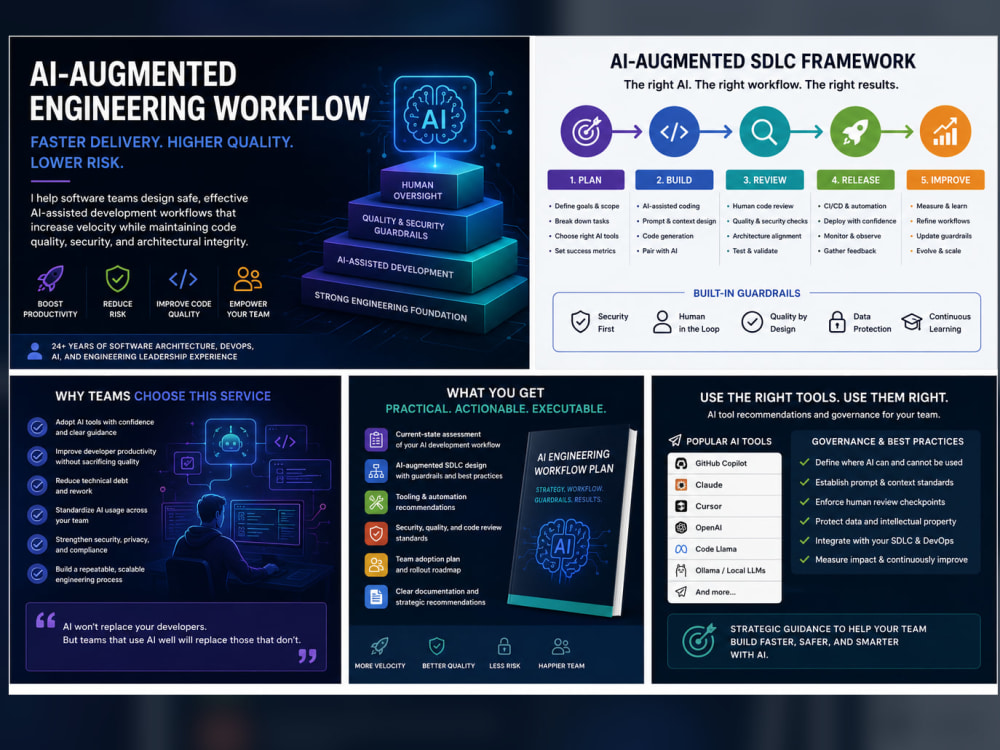
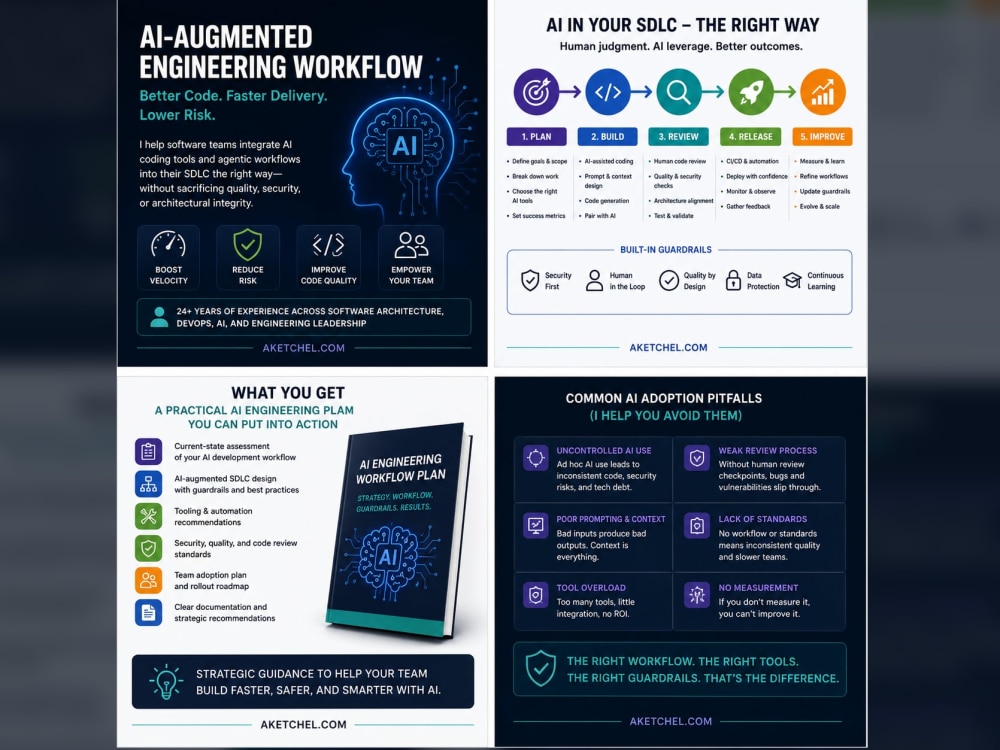
AI coding tools can accelerate development, but they can also create hidden technical debt, security issues, inconsistent architecture, and low-quality code if they are not integrated into a disciplined engineering workflow.
I help founders, CTOs, and engineering teams design practical AI-augmented software development processes that improve delivery velocity while maintaining human oversight, code quality, security, and architectural control.
This project is ideal if your team is using or considering tools such as GitHub Copilot, Claude Code, Cursor, OpenClaw, local LLMs, autonomous coding agents, agentic workflows, prompt-driven development, or AI-assisted code generation.
I can help you define:
• Where AI should and should not be used in your SDLC
• Developer workflow patterns
• Prompting and task decomposition standards
• Human review checkpoints
• Code review and QA expectations
• Secure use of AI-generated code
• Documentation and architecture guardrails
• CI/CD and testing integration
• Local LLM or private workflow considerations
• Team adoption plan
• Risk controls for production systems
I help founders, CTOs, and engineering teams design practical AI-augmented software development processes that improve delivery velocity while maintaining human oversight, code quality, security, and architectural control.
This project is ideal if your team is using or considering tools such as GitHub Copilot, Claude Code, Cursor, OpenClaw, local LLMs, autonomous coding agents, agentic workflows, prompt-driven development, or AI-assisted code generation.
I can help you define:
• Where AI should and should not be used in your SDLC
• Developer workflow patterns
• Prompting and task decomposition standards
• Human review checkpoints
• Code review and QA expectations
• Secure use of AI-generated code
• Documentation and architecture guardrails
• CI/CD and testing integration
• Local LLM or private workflow considerations
• Team adoption plan
• Risk controls for production systems
AI Development Type
Deep Learning, Knowledge Representation, Recommendation System, Software MaintenanceAI Development Language
PythonWhat's included
| Service Tiers |
Starter
$750
|
Standard
$1,500
|
Advanced
$3,000
|
|---|---|---|---|
| Delivery Time | 3 days | 5 days | 10 days |
AI Model Integration | - | - | - |
Detailed Code Comments | - | - | - |
Knowledge Graph | - | - | - |
Model Documentation | - | - | - |
Ontology | - | - | - |
Source Code | - | - | - |
Taxonomy | - | - | - |
Optional add-ons
You can add these on the next page.
AI code review standards document
(+ 2 Days)
+$750
Secure AI development checklist
(+ 2 Days)
+$750
Team training session
(+ 5 Days)
+$1,000Frequently asked questions
About Arthur
Fractional CTO | SaaS Architect | AI & Web Development Strategist
Fort Mill, United States - 11:25 pm local time
I’m a strategic technical leader, Fractional CTO, software architect, and technical advisor with 24+ years of experience scaling software systems for startups, mid-market companies, and global enterprises. My work focuses on reducing architectural risk, improving delivery velocity, modernizing legacy systems, and giving teams clear technical direction.
I’ve served in roles ranging from Senior Director of R&D to Software Development Manager, leading full-stack SaaS, cloud, DevOps, AI-augmented engineering, and application modernization initiatives across industries including fintech, logistics, nonprofit technology, insurance, healthcare, legal technology, real estate, global trade, and enterprise financial systems.
I can help with:
• Fractional CTO advisory and technical strategy
• SaaS architecture reviews and modernization roadmaps
• AI-augmented engineering workflows and agentic SDLC strategy
• Cloud architecture across AWS and Azure
• DevOps, CI/CD, observability, and application lifecycle management
• Codebase audits, technical diligence, and production-readiness reviews
• Engineering leadership, Agile/SAFe delivery, and team scaling
• MVP architecture, technical roadmaps, and founder advisory
• Full-stack system design and implementation
My technical background includes C#/.NET, Java, Python, React, Node.js, TypeScript, PHP, SQL Server, PostgreSQL, MySQL, MongoDB, Kafka, etc. with modern cloud-native delivery practices.
I’m especially useful when you need someone who can move between executive strategy and hands-on technical judgment. I can review your architecture, evaluate code health, identify hidden risks, simplify complexity, and create a practical roadmap your team can actually execute.
Clients usually bring me in when they are facing questions like:
• Is our MVP ready for real users?
• Is our architecture secure, scalable, and maintainable?
• How do we modernize this legacy system without disrupting the business?
• How do we use AI tools safely and productively in our engineering workflow?
• Do we need a full-time CTO, or can we get senior technical direction now?
• Why is our development process slow, unpredictable, or fragile?
• What technical risks would an investor, buyer, or enterprise client notice?
I combine architecture, engineering leadership, cloud strategy, DevOps maturity, and practical AI implementation to help teams move faster with less risk.
If you are building an MVP, modernizing a SaaS platform, scaling an engineering team, adopting AI-assisted development, preparing for technical diligence, or trying to improve delivery execution, I can help you make the right technical decisions and move forward with confidence.
Steps for completing your project
After purchasing the project, send requirements so Arthur can start the project.
Delivery time starts when Arthur receives requirements from you.
Arthur works on your project following the steps below.
Revisions may occur after the delivery date.
Requirements and workflow review
I review your submitted requirements, current development process, AI tools, team structure, technology stack, and any uploaded workflow or technical materials.
Current-state assessment
I assess how AI tools are currently being used or considered, including workflow fit, engineering maturity, code quality risks, security concerns, and team adoption challenges.