You will get a codebase refactor, quality guardrails, and a full verification report
Project details
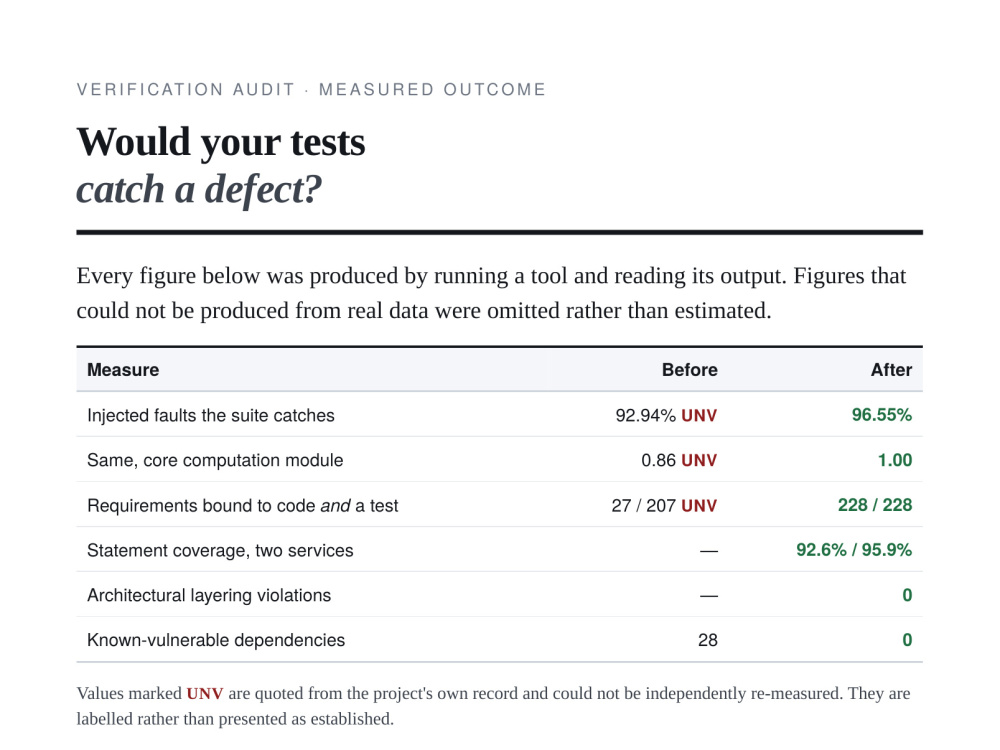
Most quality tooling answers one question: do the tests pass? I answer a second:
would those tests catch a defect if one were introduced?
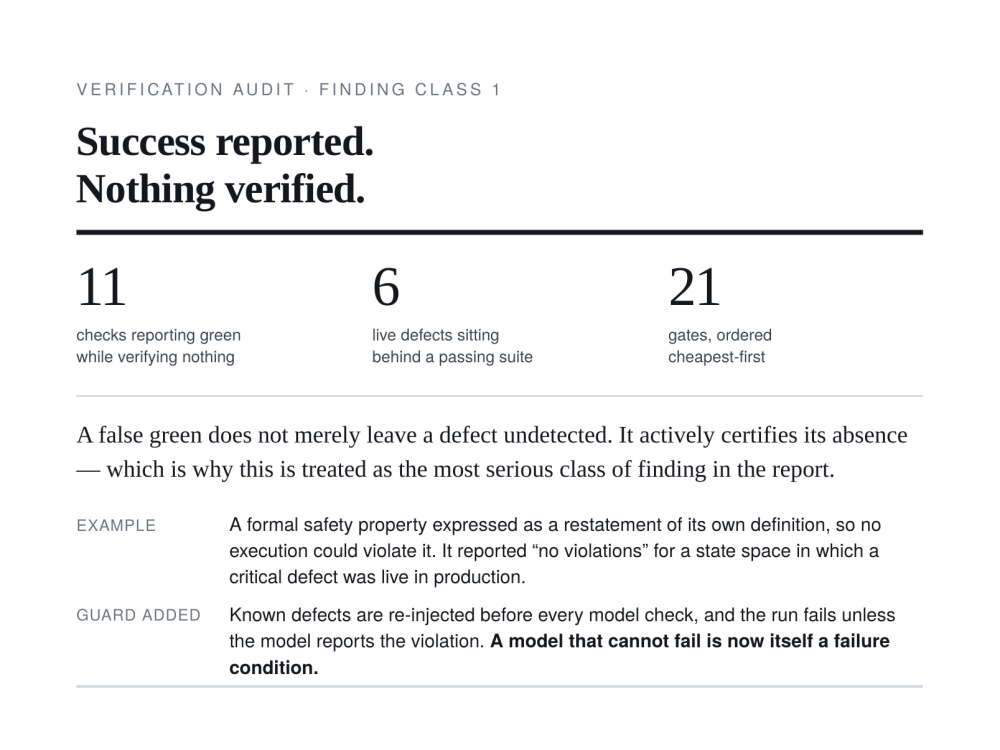
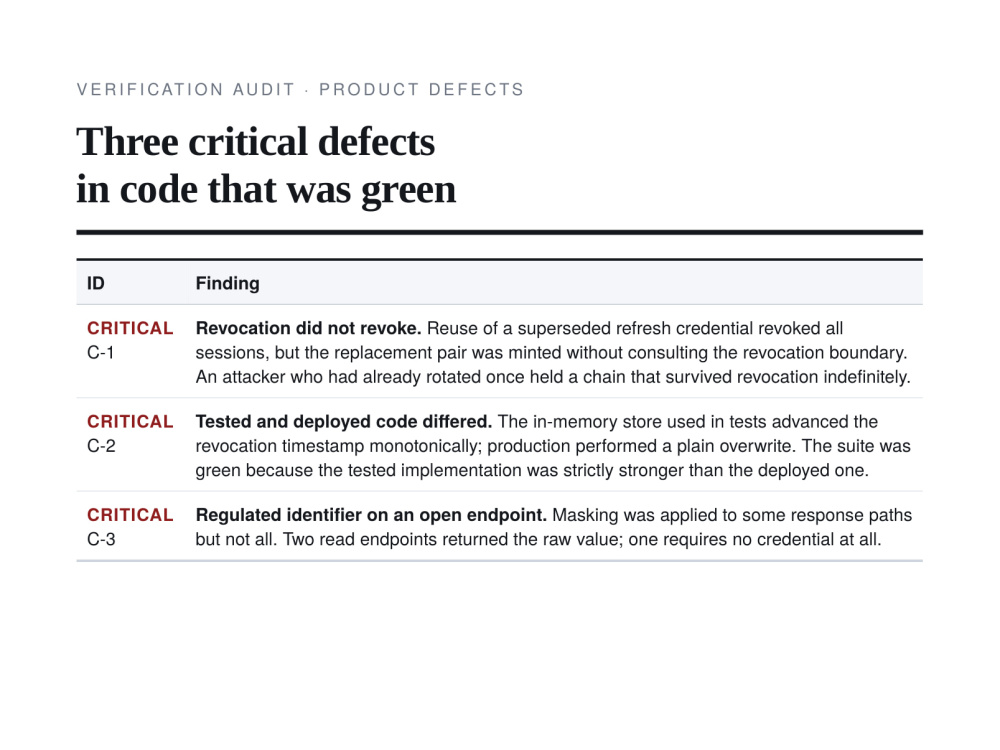
On the codebase in my portfolio the suite was green. Behind it sat six live
defects, three capable of letting a revoked session keep operating or exposing a
regulated identifier on an endpoint needing no login. Eleven checks reported
success while verifying nothing, including a formal safety property written so
that it could never fail.
I find that class of problem, fix it, and install guardrails that stop it
returning.
Starter delivers the audit and the report, no code changes. Standard adds
remediation of the critical and high findings as pull requests. Advanced also
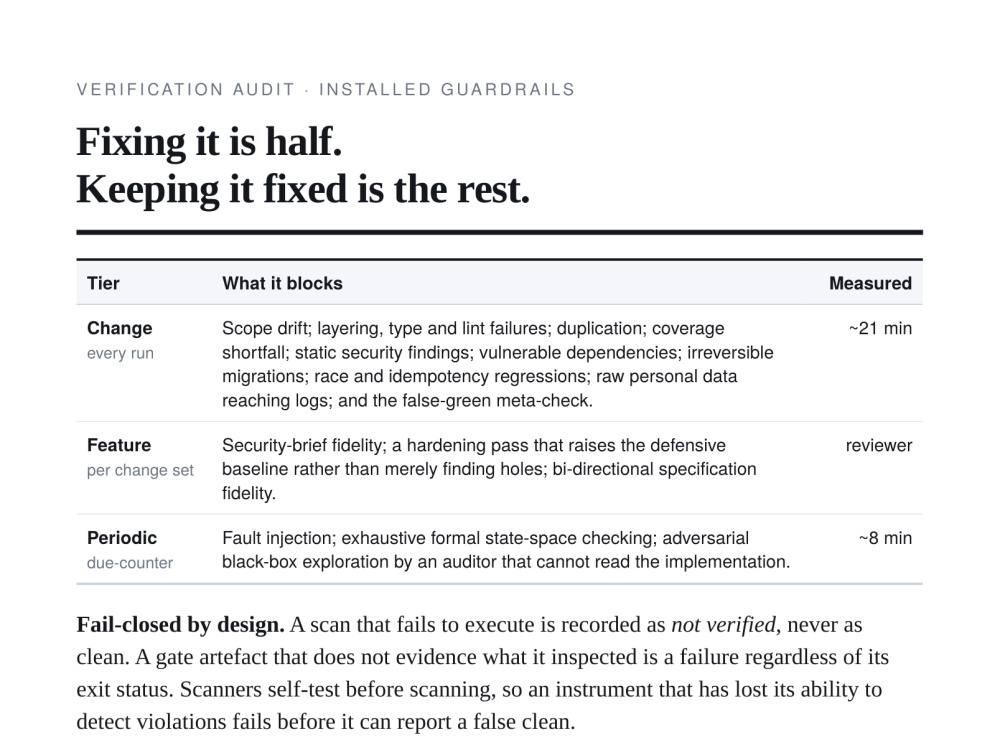
wires a tiered pipeline into your CI, with fail-closed conditions and false-green
detection.
This is engineering work, not advisory. I need repository access, and I do not
deliver policy documents or roadmaps. Every figure in my reports comes from
running a tool and reading its output; anything that cannot be measured is marked
unverified or omitted.
Message me before ordering with your repo size, language and what broke most
recently. If it is not worth doing, I will say so.
would those tests catch a defect if one were introduced?
On the codebase in my portfolio the suite was green. Behind it sat six live
defects, three capable of letting a revoked session keep operating or exposing a
regulated identifier on an endpoint needing no login. Eleven checks reported
success while verifying nothing, including a formal safety property written so
that it could never fail.
I find that class of problem, fix it, and install guardrails that stop it
returning.
Starter delivers the audit and the report, no code changes. Standard adds
remediation of the critical and high findings as pull requests. Advanced also
wires a tiered pipeline into your CI, with fail-closed conditions and false-green
detection.
This is engineering work, not advisory. I need repository access, and I do not
deliver policy documents or roadmaps. Every figure in my reports comes from
running a tool and reading its output; anything that cannot be measured is marked
unverified or omitted.
Message me before ordering with your repo size, language and what broke most
recently. If it is not worth doing, I will say so.
Programming Languages
JavaScript, Python, TypeScriptCoding Expertise
Localization, Performance Optimization, SecurityWhat's included
| Service Tiers |
Starter
$600
|
Standard
$1,800
|
Advanced
$4,500
|
|---|---|---|---|
| Delivery Time | 7 days | 21 days | 30 days |
Number of Revisions | 1 | 1 | 1 |
Bug Investigation | |||
Fix Documentation | |||
Detailed Code Comments |
Optional add-ons
You can add these on the next page.
Monthly verification & reporting — first month
(+ 7 Days)
+$400Frequently asked questions
About Abdurrahman Burak
AI Codebase Refactoring, Quality Guardrails & Verification Reports
Iskenderun, Turkey - 1:40 am local time
I found exactly that in a live production system: a "critical" test marker
matching nothing, and a collection error silently dropping all 18,034 tests —
with output that looked completely healthy. This is the class of failure
AI-assisted development produces at scale, and code review does not catch it.
I build and install code quality pipelines for teams shipping AI-generated code.
WHAT I DELIVER
1. Remediation — I refactor the existing codebase: architectural violations,
circular dependencies, duplicated logic, dead paths, missing coverage.
2. Guardrails — I install a tiered verification pipeline that gates every change
before merge. Deterministic tools produce the verdict, not an LLM's opinion.
Fake-green detection is built in: zero tests passed, collection errors, unmapped
mutation targets and step timeouts all fail the build.
3. Evidence — Every run produces a report: what was checked, what failed, what
was deferred and by name. Silent skips count as failures. You get proof you can
hand to an auditor, a customer, or your board.
MEASURED RESULTS (my own production system)
Gate agents were burning 10-21 minutes per gate re-discovering context; 41 gate
runs consumed roughly 9 hours and finished inconclusive. After moving the
deterministic backbone out of the agents into a single orchestrated script and
splitting it into fast/full tiers, the fast tier runs in 1.3 minutes against a
10-minute budget. Same coverage. Verdicts became reproducible, because they come
from tool exit codes instead of model judgment.
STACK
Python / FastAPI, Flutter / Dart, PostgreSQL. DDD, TDD and SOLID enforced by the
pipeline, not aspirational.
HOW THIS WORKS
This is engineering work, not advisory. I need repository access. I do not
deliver policy documents, roadmaps or gap assessments.
Message me with your repo size, language and what broke most recently. I'll tell
you whether this is worth doing before you spend anything.
Steps for completing your project
After purchasing the project, send requirements so Abdurrahman Burak can start the project.
Delivery time starts when Abdurrahman Burak receives requirements from you.
Abdurrahman Burak works on your project following the steps below.
Revisions may occur after the delivery date.
Baseline measurement and scope confirmation
I inventory the repository, count production and test lines per component, record current coverage and the state of any existing CI, then confirm with you exactly what is in and out of scope before anything runs.
Automated verification run
The pipeline runs: static analysis, type and architectural contract checks, change-scoped and full test tiers, dependency and secret scanning, and fault injection to measure whether your tests would actually catch a defect.