You will get a custom MCP server to connect your tools to AI agents
Project details
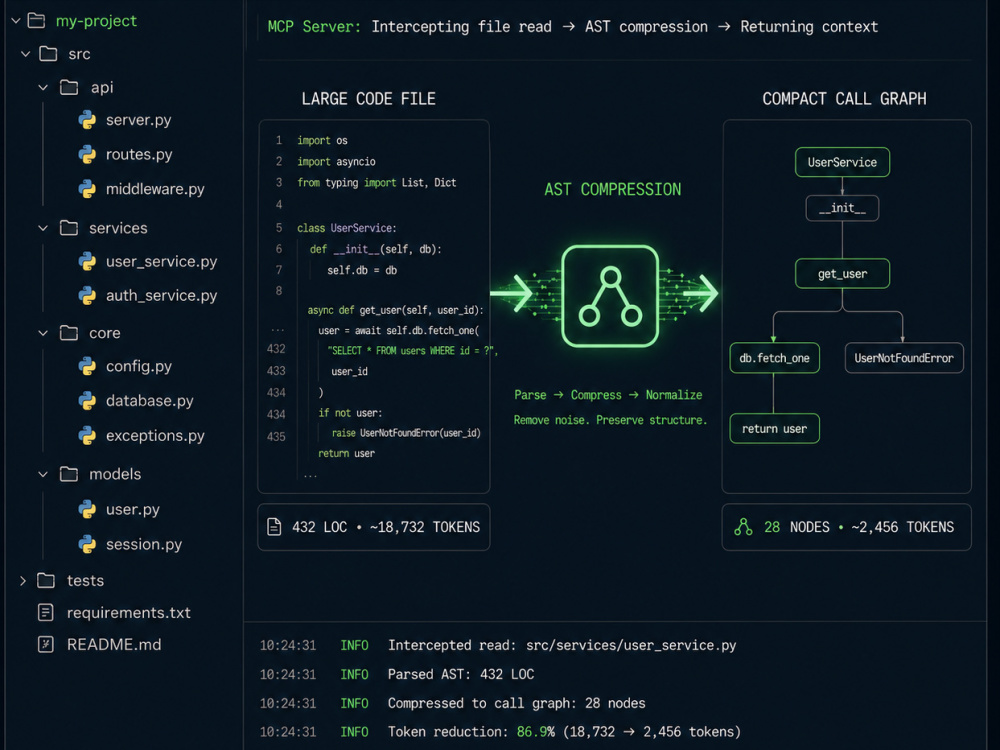
I've shipped a public MCP server in production -- LLM Diet on PyPI -- that intercepts Claude Code file reads and returns AST-compressed call-graph representations. It achieves 69-86% token reduction in live benchmarks. That's not a tutorial project. That's a real tool used by real agents.
An MCP server is how you make your data, tools, or workflows accessible to AI agents natively -- without scraping, without brittle APIs, without prompt hacks.
What you get:
-- Custom MCP server built for your specific use case
-- Works with Claude Code, Cursor, or any MCP-compatible agent
-- Clean Python code, documented and tested
-- Setup instructions included
-- One revision
Best fit for: developers and founders who want their internal tools, databases, or APIs to be first-class citizens in their agent workflows.
An MCP server is how you make your data, tools, or workflows accessible to AI agents natively -- without scraping, without brittle APIs, without prompt hacks.
What you get:
-- Custom MCP server built for your specific use case
-- Works with Claude Code, Cursor, or any MCP-compatible agent
-- Clean Python code, documented and tested
-- Setup instructions included
-- One revision
Best fit for: developers and founders who want their internal tools, databases, or APIs to be first-class citizens in their agent workflows.
AI Algorithms
Large Language Model, Multimodal Large Language Model, Transformer ModelAI Applications
AI-Generated Code, AIOps, Conversational AI, Natural Language UnderstandingAI Development Language
PythonAI Tools
Azure OpenAI, Hugging FaceAI Models
ChatGPT, GPT-4, LLaMAWhat's included $100
These options are included with the project scope.
$100
- Delivery Time 4 days
- Number of Revisions 1
- AI Model Integration
- Detailed Code Comments
- Source Code
About Shresth
AI Agent Engineer | LangGraph, MCP, RAG & Production LLM Systems
Patiala, India - 2:52 am local time
Most "AI developers" on here are wrapping APIs and calling it an agent. I've been in the mud -- shipping systems that fail in interesting ways and fixing them under real pressure.
At GetHelpDesk.ai, I built a Brain+Hand system from scratch -- a Gemini vision model paired with GUI automation to operate dental practice management software with zero human input. Not a demo. 355 passing tests, a recorded production run, and a pile of hard-won lessons about what actually breaks when an agent meets legacy software.
I also shipped LLM Diet -- an open-source MCP shadow server on PyPI that intercepts Claude Code file reads and feeds agents compressed call-graph representations instead of raw source. 69-86% token reduction in live benchmarks. Built because I was annoyed at how wasteful standard file reads are for agentic workflows. That's the kind of problem I notice.
What I actually build --
-- AI agent systems using LangGraph, CrewAI, or custom architectures depending on what the problem needs
-- MCP servers and agent-native infrastructure
-- RAG pipelines built for production -- hybrid retrieval, reranking, eval loops, not just a Pinecone quickstart
-- LLM integration into real business workflows
-- Desktop and GUI automation driven by vision models
I'm a first-year CS student at Thapar Institute, currently working full-time as an AI Automation Engineer. I move fast, I write tests, and I don't disappear mid-project.
If your agent system needs to actually ship -- let's talk.
Steps for completing your project
After purchasing the project, send requirements so Shresth can start the project.
Delivery time starts when Shresth receives requirements from you.
Shresth works on your project following the steps below.
Revisions may occur after the delivery date.
Scope & design
Review your use case, define tools and schemas
Build & test
Implement MCP server, test with your agent