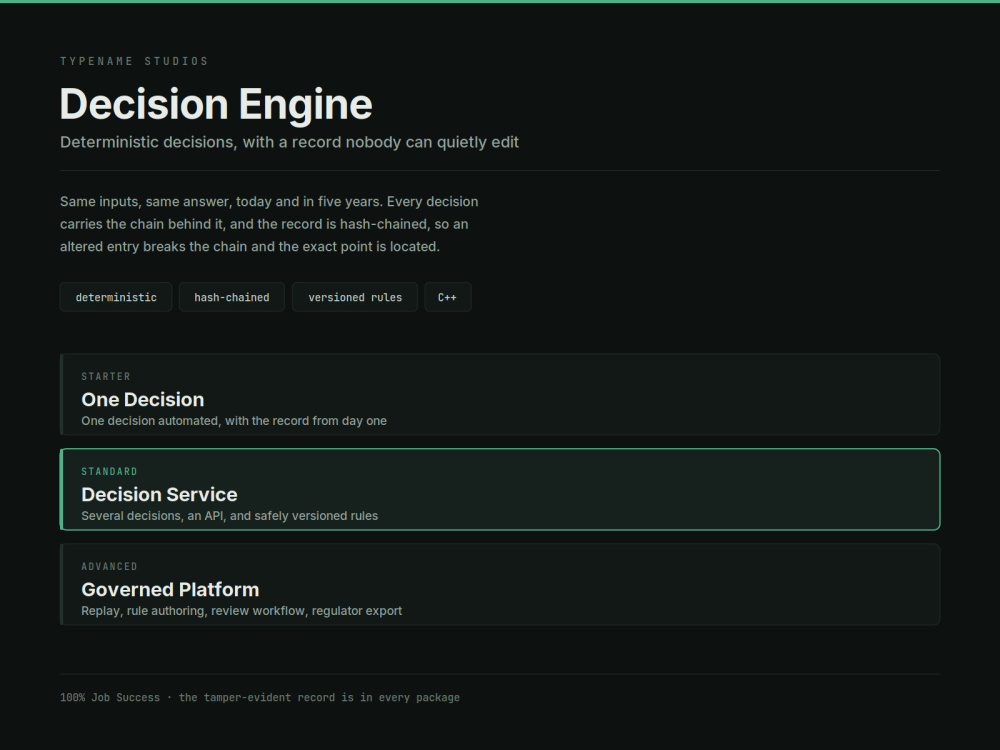
You will get A decision engine with a tamper-evident record of every decision
Project details
Most rules that run a business are not written down anywhere complete. Some are in code, some in a spreadsheet, and the rest live with the person who has been there longest. Nobody can say with certainty what the current policy is, and two of the rules quietly contradict each other.
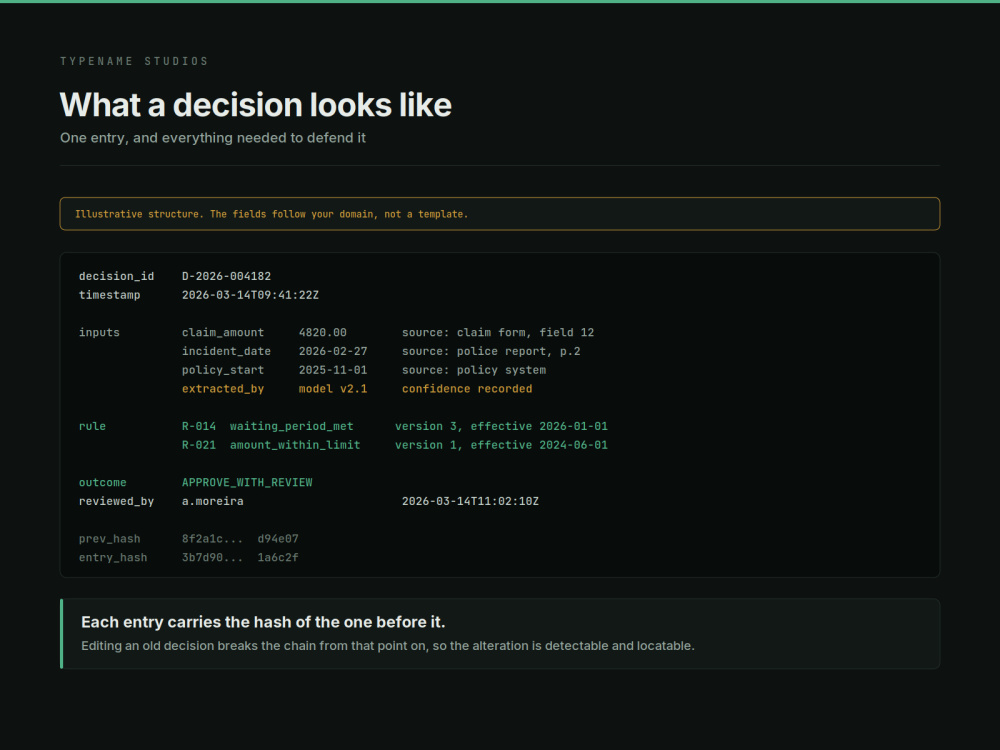
Every package here delivers a working engine and a tamper-evident record. Deterministic evaluation, so the same inputs give the same answer today and next year, and every decision carries the chain behind it: which inputs, which rule, which version. The record is hash-chained, so altering a past decision breaks the chain and the exact point is located. That is the difference between evidence and a log file.
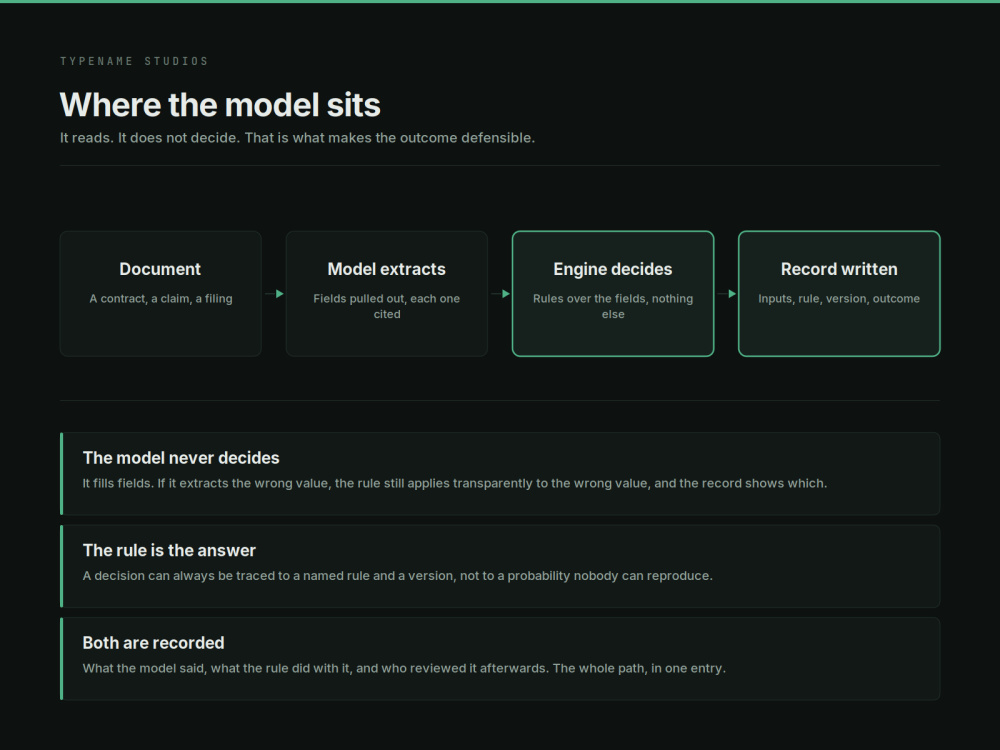
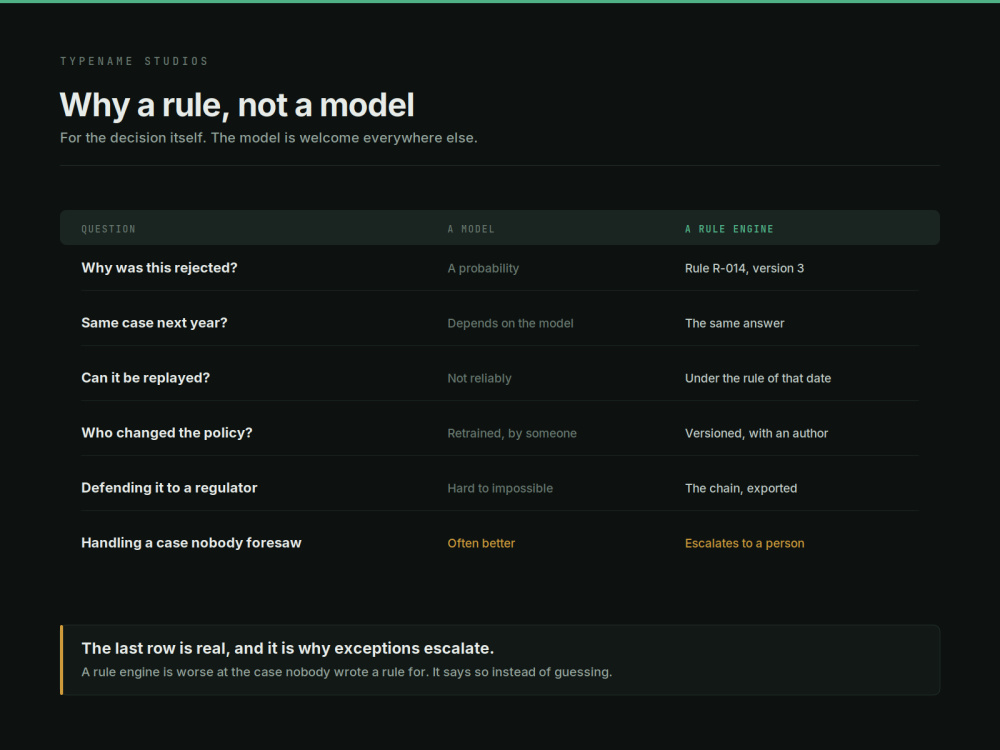
Most teams that need this already have a model in production. The usual shape is that it reads the document and extracts the fields, the engine decides using those fields, and the record shows both. The model never makes the decision, which is what makes the outcome defensible to an auditor, a regulator or the person it affected.
I built an auditable reasoning engine in C++ for exactly this class of problem, which is where the design comes from.
Every package here delivers a working engine and a tamper-evident record. Deterministic evaluation, so the same inputs give the same answer today and next year, and every decision carries the chain behind it: which inputs, which rule, which version. The record is hash-chained, so altering a past decision breaks the chain and the exact point is located. That is the difference between evidence and a log file.
Most teams that need this already have a model in production. The usual shape is that it reads the document and extracts the fields, the engine decides using those fields, and the record shows both. The model never makes the decision, which is what makes the outcome defensible to an auditor, a regulator or the person it affected.
I built an auditable reasoning engine in C++ for exactly this class of problem, which is where the design comes from.
AI Development Type
Knowledge Representation, Model Tuning, Software MaintenanceAI Development Language
C++What's included
| Service Tiers |
Starter
$1,600
|
Standard
$3,600
|
Advanced
$6,800
|
|---|---|---|---|
| Delivery Time | 15 days | 28 days | 42 days |
Number of Revisions | 2 | 4 | 5 |
AI Model Integration | |||
Detailed Code Comments | - | ||
Knowledge Graph | |||
Model Documentation | |||
Ontology | |||
Source Code | |||
Taxonomy | - | - |
Optional add-ons
You can add these on the next page.
Fast Delivery
+$700 - $2,900
Additional Revision
+$250
Rule authoring interface
(+ 10 Days)
+$1,200
LLM extraction front-end
(+ 8 Days)
+$1,000
Simulation and impact analysis
(+ 8 Days)
+$900Frequently asked questions
7 reviews
(7)
(0)
(0)
(0)
(0)
This project doesn't have any reviews.
HW
Huitong W.
Jun 16, 2025
C++ Game Development
Very good Developer!
HW
Huitong W.
Oct 20, 2024
Next Game Development
Very Good
HW
Huitong W.
Jul 1, 2024
Implement NavPower in GameEngine.
HW
Huitong W.
May 14, 2024
C++ game Development
Very good developer.
We are about to start more contracts.
We are about to start more contracts.
CG
Chris G.
Mar 8, 2024
Desktop .EXE Application Development for Data Simulator
Was a pleasure working with Francisco! A+++ work and was able to help develop our application very quickly and effectively. Would highly recommended!
About Francisco
Security & Systems Engineer | C/C++, Anti-Cheat, Infrastructure
100%
Job Success
Novo Hamburgo, Brazil - 2:35 am local time
What I do for clients falls into four areas. Game integrity: anti-cheat detection built on behaviour rather than signatures, client-side and server-side, with the evidence behind every flag. Native engineering: C++17 and C++20 systems, stable C ABI layers and language bindings, legacy modernization, and the profiling to prove a change actually helped. Security: application and infrastructure audits ranked by what an attacker can reach rather than by a generic score. Infrastructure: VMware assessment, migration planning to Proxmox or Hyper-V, and backup designs that get tested instead of assumed.
Different domains, same question underneath. What breaks, under what conditions, and who pays for it when it does. That is the question I am useful for, whether the answer lives in a memory allocator, a permission model or a renewal quote.
I also build products under TypeName Studios, which is where that standard comes from. Praetor is a game integrity platform with a C++ SDK that links into the game server and runs statistical detectors without a kernel driver or a client agent. Ethereal is the C++ middleware underneath everything I ship, thirty one modules exposed through a C ABI so it embeds into non-C++ codebases. Living with those architectural decisions for years changes how you make them.
I ask the hard questions before writing a line of code, because the wrong architecture costs far more than the wrong syntax. You get direct communication, realistic timelines, and code your team can still read a year from now. Tell me what you are trying to build and I will tell you straight whether I am the right person for it.
Steps for completing your project
After purchasing the project, send requirements so Francisco can start the project.
Delivery time starts when Francisco receives requirements from you.
Francisco works on your project following the steps below.
Revisions may occur after the delivery date.
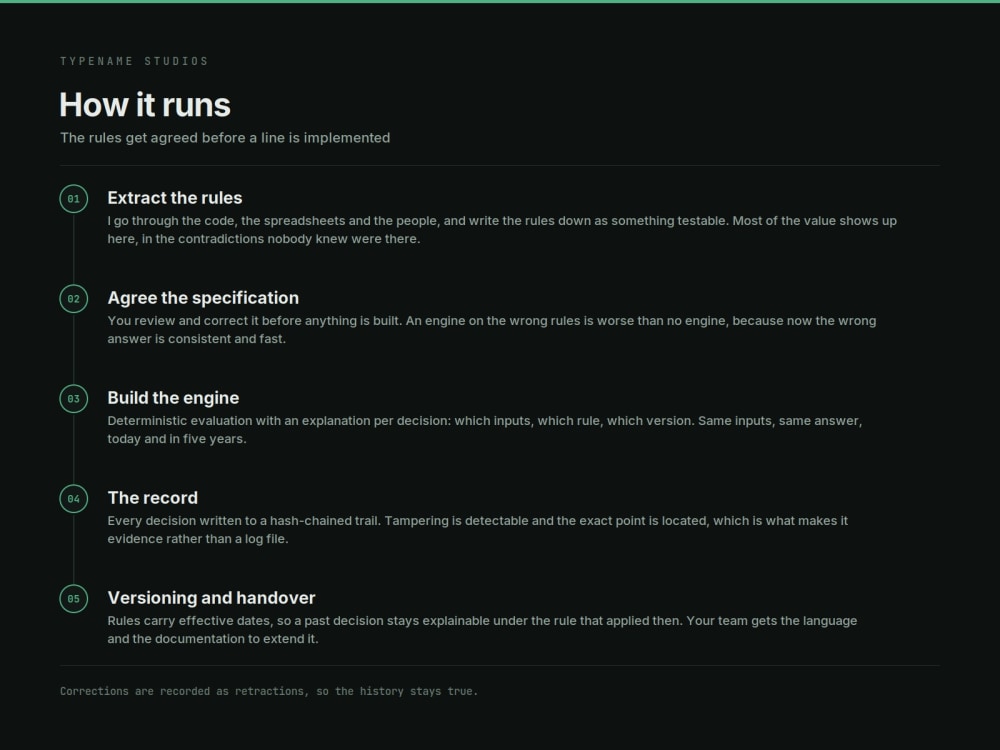
Extract the rules
I go through the code, the spreadsheets and the people, and write the rules down as something testable. Most of the value shows up here, in the contradictions nobody knew were there.
Agree the specification
You review and correct it before a line is implemented. An engine built on the wrong rules is worse than no engine, because now the wrong answer is consistent and fast.