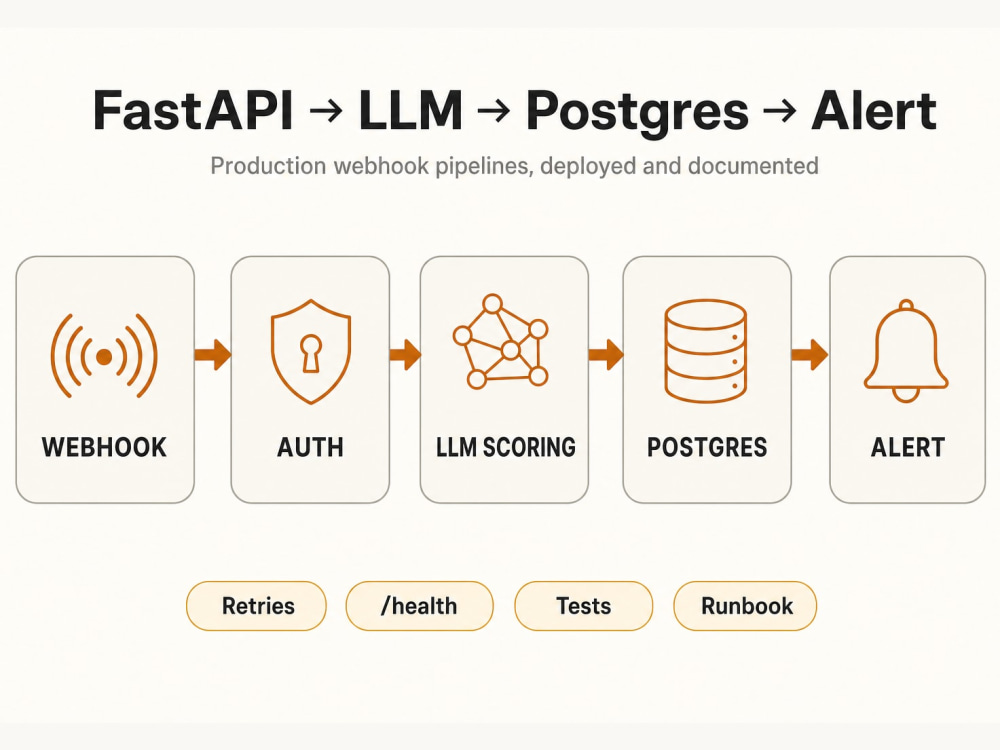
You will get a FastAPI webhook to LLM to Postgres pipeline with alerts, deployed
Project details
You will get a working, deployed backend that receives an event, decides something about it with an LLM, stores the result, and tells you about it. Not a prototype in a notebook: an authenticated FastAPI service running on your infrastructure, with the schema, the deploy and the documentation handed over.
The pipeline is inbound webhook, token or signature authentication, payload validation, LLM scoring or classification, write to Postgres, notification out. Every stage is typed and validated, so malformed payloads fail loudly at the edge instead of quietly corrupting your data.
I build with Python 3.11, FastAPI and Pydantic v2 models on every boundary. Configuration loads from environment variables and is validated at startup, so a missing key fails on boot rather than at 3am on your first real event. LLM calls are wrapped with timeout and retry handling, and a Docker image keeps the deploy reproducible.
The reference stack behind this service, which I built and maintain, runs 700+ passing tests with a clean mypy --strict check. Your delivery follows the same structure.
The pipeline is inbound webhook, token or signature authentication, payload validation, LLM scoring or classification, write to Postgres, notification out. Every stage is typed and validated, so malformed payloads fail loudly at the edge instead of quietly corrupting your data.
I build with Python 3.11, FastAPI and Pydantic v2 models on every boundary. Configuration loads from environment variables and is validated at startup, so a missing key fails on boot rather than at 3am on your first real event. LLM calls are wrapped with timeout and retry handling, and a Docker image keeps the deploy reproducible.
The reference stack behind this service, which I built and maintain, runs 700+ passing tests with a clean mypy --strict check. Your delivery follows the same structure.
AI Algorithms
Large Language Model, Transformer ModelAI Applications
AI-Enhanced Classification, AIOpsAI Development Language
PythonAI Models
ChatGPT, GPT-4What's included
| Service Tiers |
Starter
$220
|
Standard
$650
|
Advanced
$1,450
|
|---|---|---|---|
| Delivery Time | 5 days | 8 days | 14 days |
Number of Revisions | 1 | 1 | 1 |
AI Model Integration | |||
Batch Normalization | - | - | - |
Database Integration | |||
Detailed Code Comments | |||
Image Upscaling | - | - | - |
MLOps | - | - | - |
Model Deployment | |||
Model Documentation | |||
Model Monitoring | - | ||
Model Testing & Optimization | - | - | |
Model Tuning | - | - | - |
Natural Language Processing | |||
NLP Tokenization | - | - | - |
Pre-Training | - | - | - |
Prompt Engineering | - | - | - |
Setup File | - | - | - |
Source Code | - | - | - |
Frequently asked questions
About John
AI Automation & Backend Engineer | Python, FastAPI, LLM Integrations
Las Vegas, United States - 5:06 pm local time
Most of my work is systems I designed, shipped and now operate for my own company, so I've had to live with every decision I made:
• A live signal-processing service on Railway with a Supabase/Postgres backend — authenticated webhook ingestion, LLM scoring of each event, structured persistence, and Telegram alerting. Held at 714 passing tests with mypy --strict and ruff clean, with execution paths gated and disarmed by default.
• The GD3 operations platform (gd3co.net) — CRM, payroll, scheduling, agent tooling and SEO, plus public lead capture with click-ID attribution flowing into an internal store.
• Third-party API integrations (CourtListener, Federal Register) behind an evidence-writing layer and an inter-agent message bus, so an agent's output is auditable rather than just displayed.
• A live Google Ads search campaign built and managed end to end: conversion tagging, geo and match-type targeting, negative keywords, assets and hard spend controls.
What you get working with me:
I care most about whether a thing is actually true and actually working. That means verifying against the real system instead of trusting a status screen, refusing to ship claims I can't back, and telling you plainly when something failed rather than burying it. A lot of automation work looks finished and isn't — I check.
I work heavily with frontier AI tooling and agentic workflows, which is why I can move fast on builds that would normally need a team. Everything ships with tests and honest status.
Availability: I work 24/7 and am flexible across time zones — fine with quick turnarounds or ongoing engagements, and happy to start immediately.
Good fits: Python/FastAPI backends, webhook and data pipelines, LLM and agent integrations, API integration work, and automating manual internal processes.
Steps for completing your project
After purchasing the project, send requirements so John can start the project.
Delivery time starts when John receives requirements from you.
John works on your project following the steps below.
Revisions may occur after the delivery date.
Scope confirmation and schema design
I confirm the event source, the LLM decision, the alert destination and the host, then design the Postgres schema and share it for your sign-off.
Build the pipeline
Authenticated webhook endpoint, payload validation, the LLM step and Postgres persistence, developed against your sample payload.