You will get a full Angular app architecture and performance audit
Project details
Most Angular apps accumulate technical debt silently - components that don't use OnPush, routes that aren't lazy loaded, bundle sizes creeping past targets, accessibility gaps that only surface during an audit, and security patterns that looked fine two Angular versions ago.
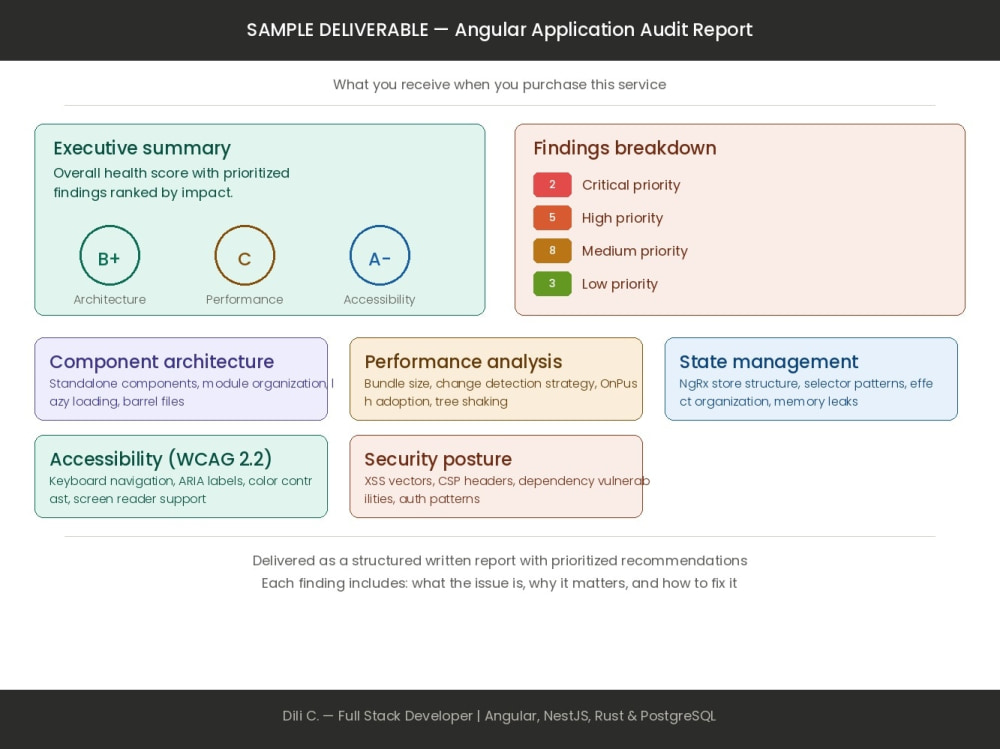
I review your Angular codebase across five dimensions: component architecture, performance, state management, accessibility (WCAG 2.2 AA), and security posture. Every finding comes with a severity rating, a plain explanation of why it matters, and a concrete fix with estimated effort.
I build and maintain an 80+ library Angular/NestJS/Rust monorepo with enforced architectural boundaries, so the recommendations aren't theoretical - they come from patterns I use in production daily. You get a structured written report you can hand directly to your engineering team and start acting on immediately.
I review your Angular codebase across five dimensions: component architecture, performance, state management, accessibility (WCAG 2.2 AA), and security posture. Every finding comes with a severity rating, a plain explanation of why it matters, and a concrete fix with estimated effort.
I build and maintain an 80+ library Angular/NestJS/Rust monorepo with enforced architectural boundaries, so the recommendations aren't theoretical - they come from patterns I use in production daily. You get a structured written report you can hand directly to your engineering team and start acting on immediately.
Programming Languages
HTML & CSS, JavaScript, TypeScriptCoding Expertise
Cross Browser & Device Compatibility, Performance Optimization, SecurityWhat's included
| Service Tiers |
Starter
$300
|
Standard
$500
|
Advanced
$800
|
|---|---|---|---|
| Delivery Time | 3 days | 5 days | 7 days |
Number of Revisions | 1 | 1 | 2 |
Design Customization | - | - | - |
Content Upload | - | - | - |
Responsive Design | - | - | - |
Source Code | - |
Frequently asked questions
About Dili
Full Stack Developer | Angular, NestJS, Rust & PostgreSQL
San Francisco, United States - 2:05 pm local time
This isn't Rust bolted onto a Node stack as an afterthought. In my architecture, Rust is the default implementation layer: business logic, data transformation, cryptography (Argon2id, JWT signing), and database queries via sqlx with compile-time verified SQL. A dual-pool PostgreSQL setup - sqlx for the 95% of queries that benefit from compile-time checking, deadpool-postgres with tokio-postgres pipelining for batch-critical paths - keeps correctness and throughput from competing with each other. Security is baked in at every layer - constant-time comparison in Rust, Content Security Policy, Trusted Types, and custom ESLint rules blocking unsafe patterns. NestJS handles what it's genuinely best at - routing, dependency injection, middleware, request lifecycle - and delegates everything else across the napi boundary.
I'm currently building Afterlife Licorice, a journal and civic media platform with real-time public data monitoring and verified sources. The entire backend runs on this pattern: coarse-grained napi exports per domain, feature-gated bindings so all core logic is testable without Node.js, and pedantic Clippy lints enforced as errors across the workspace.
I take on a limited number of projects at a time. If you're working with Angular, NestJS, Rust, or PostgreSQL - or you're trying to figure out where Rust fits in a Node.js stack - send me a message describing what you're building.
Steps for completing your project
After purchasing the project, send requirements so Dili can start the project.
Delivery time starts when Dili receives requirements from you.
Dili works on your project following the steps below.
Revisions may occur after the delivery date.
Codebase orientation and initial scan
I clone the repo, run the build, and do an initial pass across module structure, routing, dependencies, and bundle analysis to identify focus areas.
Deep review across all five dimensions
Systematic review of component architecture, performance, state management, accessibility (WCAG 2.2), and security posture. Each finding is documented with severity.