You will get a geospatial data pipeline that resolves and validates your coordinates
Project details
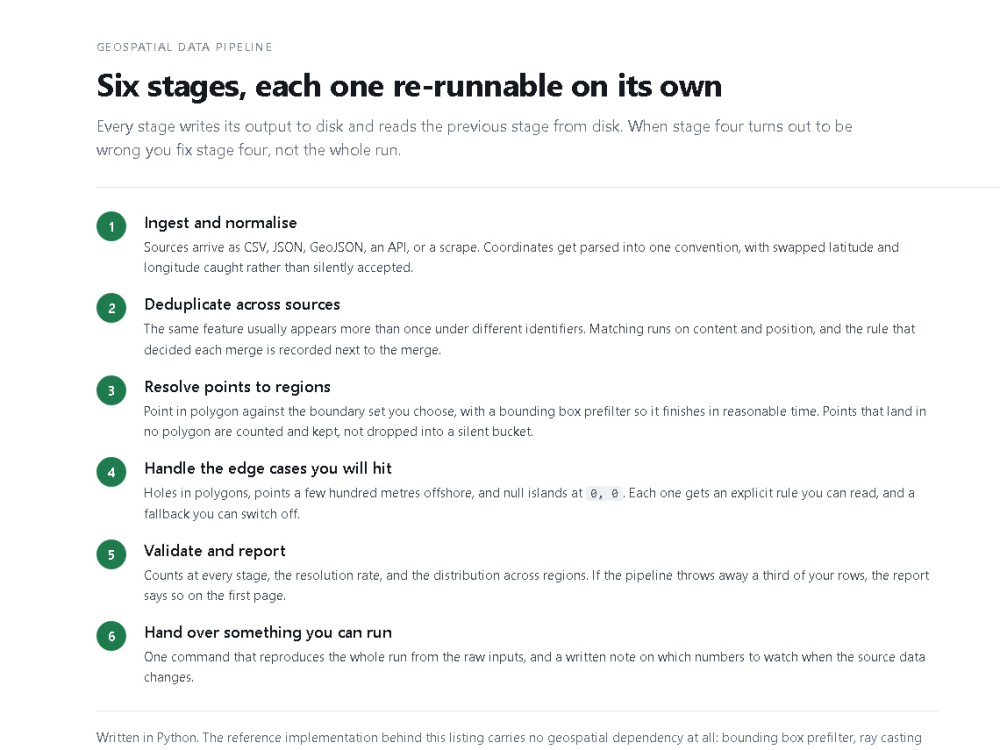
Coordinate data is almost never as clean as the schema suggests. Latitude and longitude arrive swapped, the same place turns up three times under different identifiers, and a block of rows sits at zero, zero in the Gulf of Guinea.
I build the pipeline that turns that into something you can query, and I report what it lost on the way.
Points get resolved to whatever boundary set you choose, with holes in polygons handled and offshore points given an explicit rule rather than a silent drop. Every stage writes to disk and reads from disk, so a wrong rule in stage four costs one stage to redo instead of the whole run.
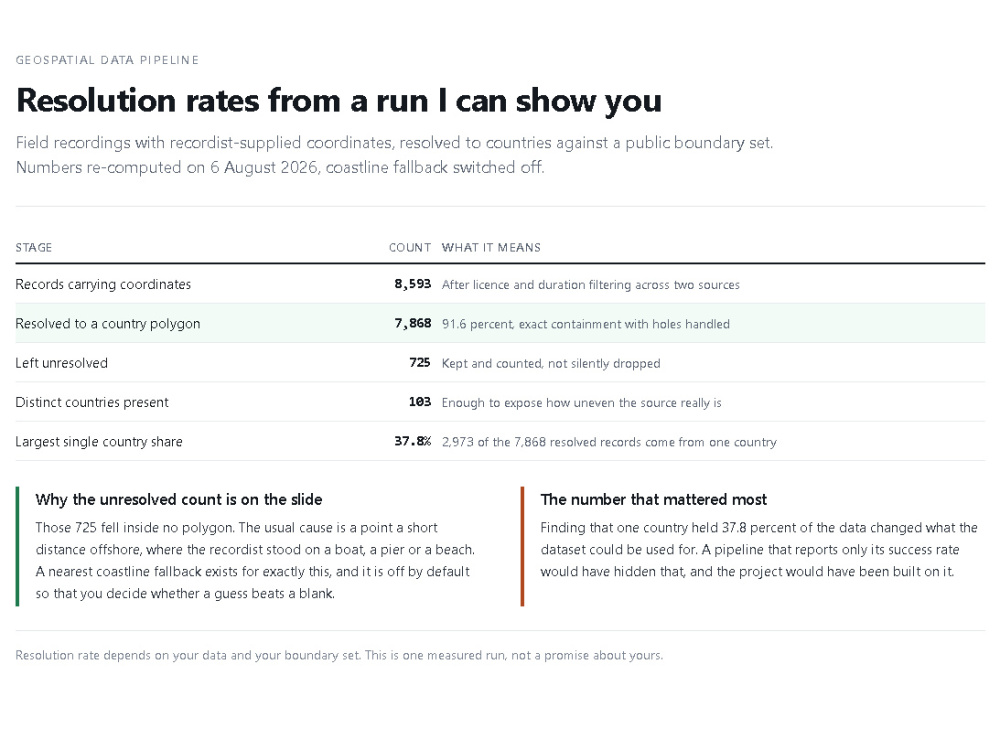
The part most pipelines skip is the report. You get counts at every stage, the resolution rate, and the distribution across regions. On the dataset in the gallery, that report is what showed one country holding 37.8 percent of everything, which changed what the data could honestly be used for.
Written in Python. Output as GeoJSON, CSV, or SQLite.
Everything runs in writing. I am new on Upwork, which is why the price is what it is.
I build the pipeline that turns that into something you can query, and I report what it lost on the way.
Points get resolved to whatever boundary set you choose, with holes in polygons handled and offshore points given an explicit rule rather than a silent drop. Every stage writes to disk and reads from disk, so a wrong rule in stage four costs one stage to redo instead of the whole run.
The part most pipelines skip is the report. You get counts at every stage, the resolution rate, and the distribution across regions. On the dataset in the gallery, that report is what showed one country holding 37.8 percent of everything, which changed what the data could honestly be used for.
Written in Python. Output as GeoJSON, CSV, or SQLite.
Everything runs in writing. I am new on Upwork, which is why the price is what it is.
Data Tool
PythonWhat's included
| Service Tiers |
Starter
$200
|
Standard
$400
|
Advanced
$600
|
|---|---|---|---|
| Delivery Time | 5 days | 9 days | 14 days |
Number of Revisions | 1 | 2 | 3 |
Number of Sources Mined/Scraped | 1 | 2 | 3 |
Frequently asked questions
About Daniil
Technical writer for software teams | specs, doc audits, pipelines
Brussels, Belgium - 11:13 am local time
The usual problem with documentation is age. It was true when someone wrote it, three refactors ago, and now nobody on the team can say which paragraphs still hold. So my specifications open with a table listing what is built and what is only specified. The sample document on my architecture project has three rows marked "specified, not built", and all three describe my own work.
Specifications and architecture documents. I read the system first, then write the document your developers can build from: components, data flow, constraints, and the reasoning behind each decision, so the next engineer knows why a rule exists before they delete it.
Documentation audits. I test every checkable claim in your docs against the code. Each finding names the document line and the code line that contradict each other, so anyone on your team can settle it in a minute, including the findings where I turn out to be wrong. Setup instructions get executed on a clean machine. Findings are ranked by what a wrong answer costs the reader.
Geospatial and data pipelines, written in Python. Coordinates parsed, deduplicated across sources, resolved to boundaries, with counts kept at every stage. On my own corpus of 8,593 field recordings, 7,868 points resolved to a country and 725 did not, and both figures are in the report.
I build systems as well as write about them. An economic strategy simulation in TypeScript and Node on PostgreSQL with PostGIS, modelling company formation, supply chains, banking and regulation against World Bank and IMF country data. A deterministic strategy game in Godot where the same input has to produce byte-identical output on any machine. An autonomous agent harness where every acceptance check is re-run inside the container the work happened in, because the model's own report of success carries no weight.
I also wrote the commercial licensing audit for one of those projects: which dependencies and data sources are safe to ship, where share-alike applies to the derived database but not the game, and two problems that would have surfaced at release.
Everything runs in writing. No calls. You get considered answers and a record of every decision, for when someone asks about it six months later. Where I could not verify something, the document says so.
Python, TypeScript, SQL and PostgreSQL, C#, GDScript. English and Russian, based in Brussels.
Send me what you have and I will tell you honestly whether I am the right person for it.
Steps for completing your project
After purchasing the project, send requirements so Daniil can start the project.
Delivery time starts when Daniil receives requirements from you.
Daniil works on your project following the steps below.
Revisions may occur after the delivery date.
Read the data before writing anything
I go through a sample by hand first and write down what is actually in it. Most of the surprises in a coordinate dataset are visible in the first hundred rows, and finding them later costs far more.
Agree the rules for the awkward cases
Offshore points, holes in polygons, zeros at the origin, rows with no coordinate at all. You decide what happens to each one before I build anything, and the decision goes in writing.