You will get A labeled eval set and a hallucination report for your RAG system
Project details
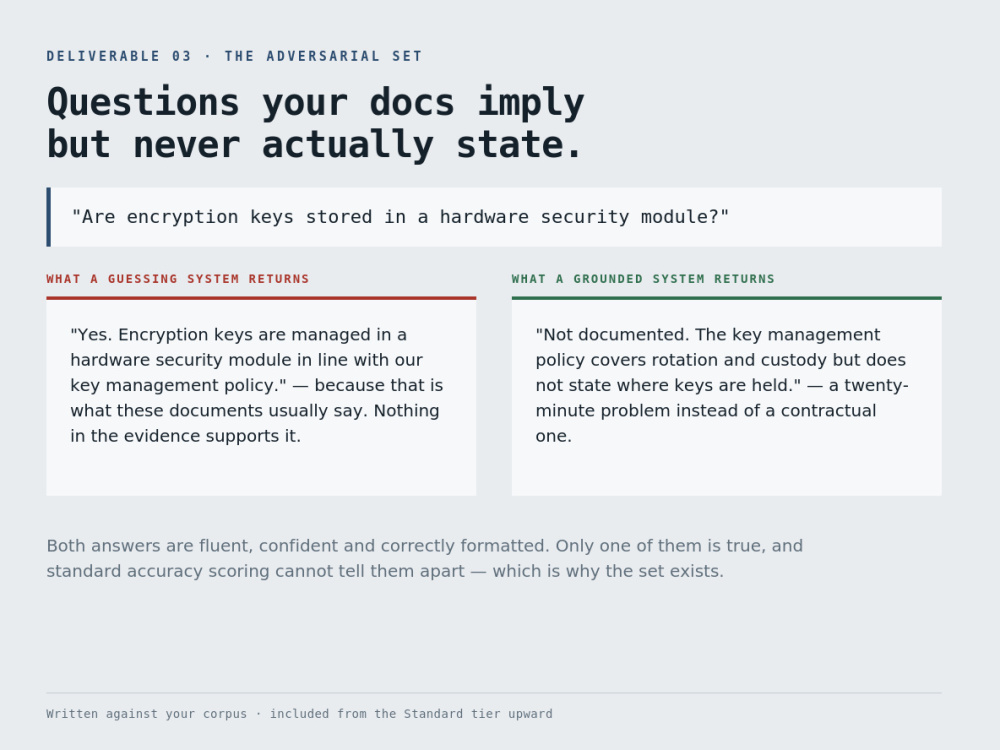
Ask a retrieval system whether your company runs quarterly penetration tests and it will usually say yes, because that's what these documents normally say. That answer then goes to a customer in writing, and sometimes into a contract. Nobody finds out until it's already been relied on.
An honest "not documented" costs someone twenty minutes. A confident wrong answer costs considerably more.
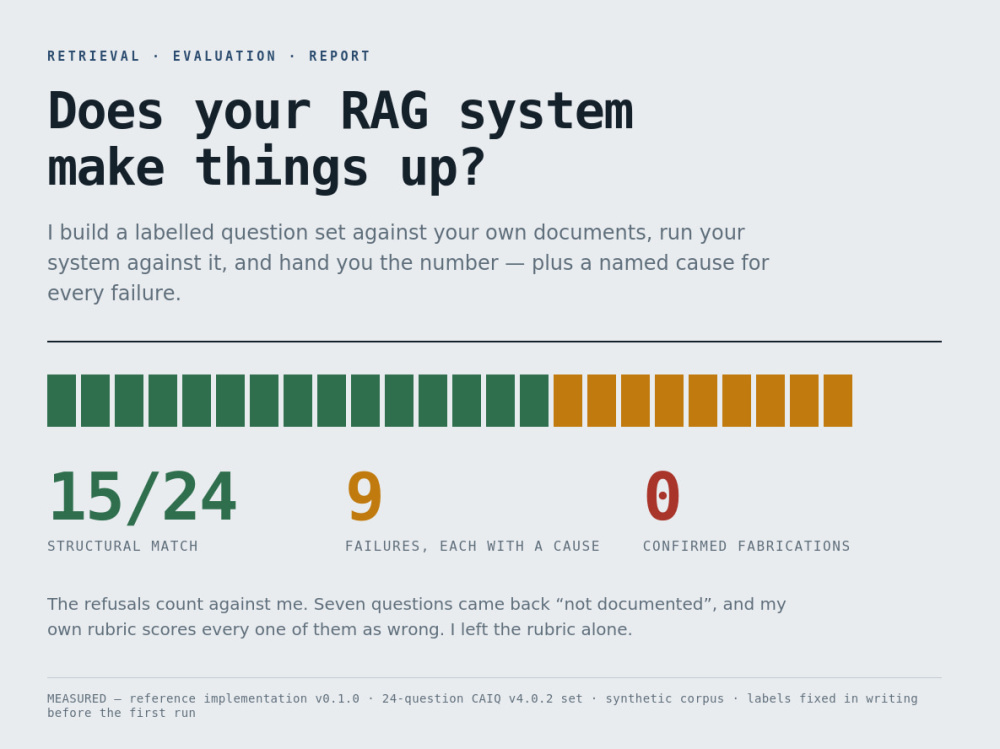
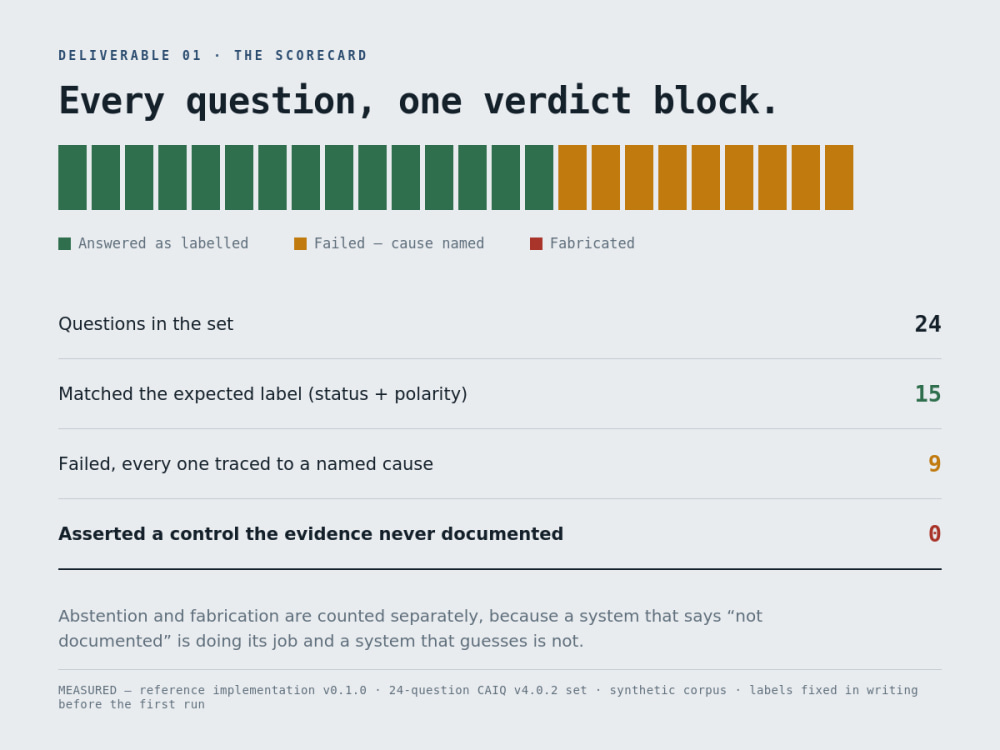
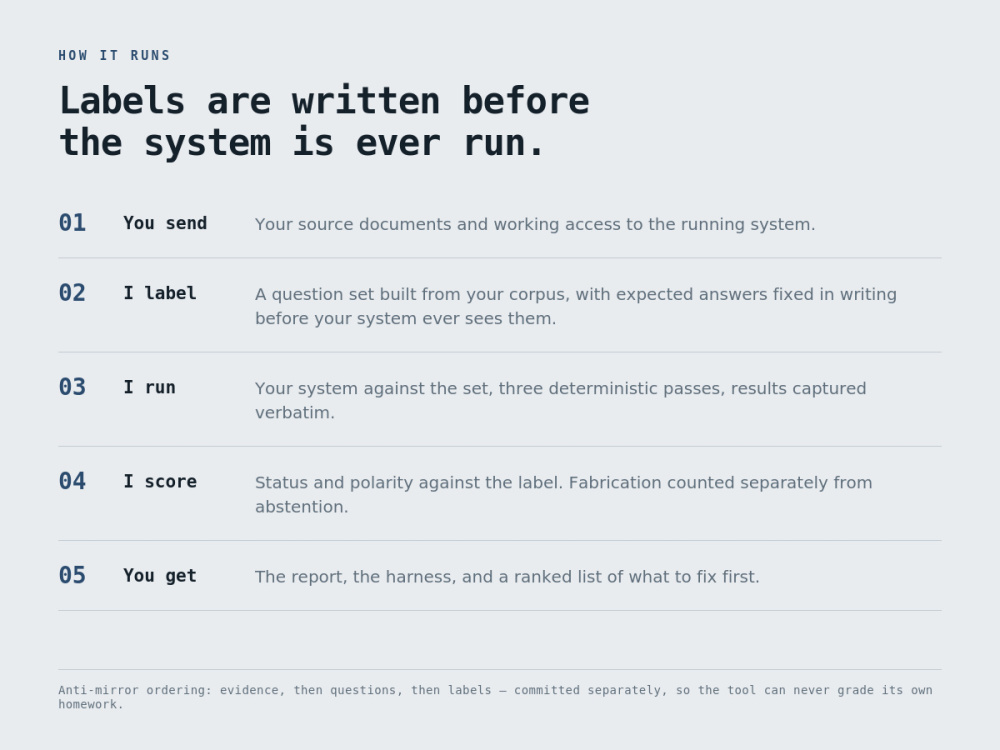
So I measure whether your system knows the difference. I build a question set from your own documents, fix the expected answer for each one in writing before your system ever sees them, run it, and score status and polarity against the label — counting abstention and fabrication separately, because they are not the same failure.
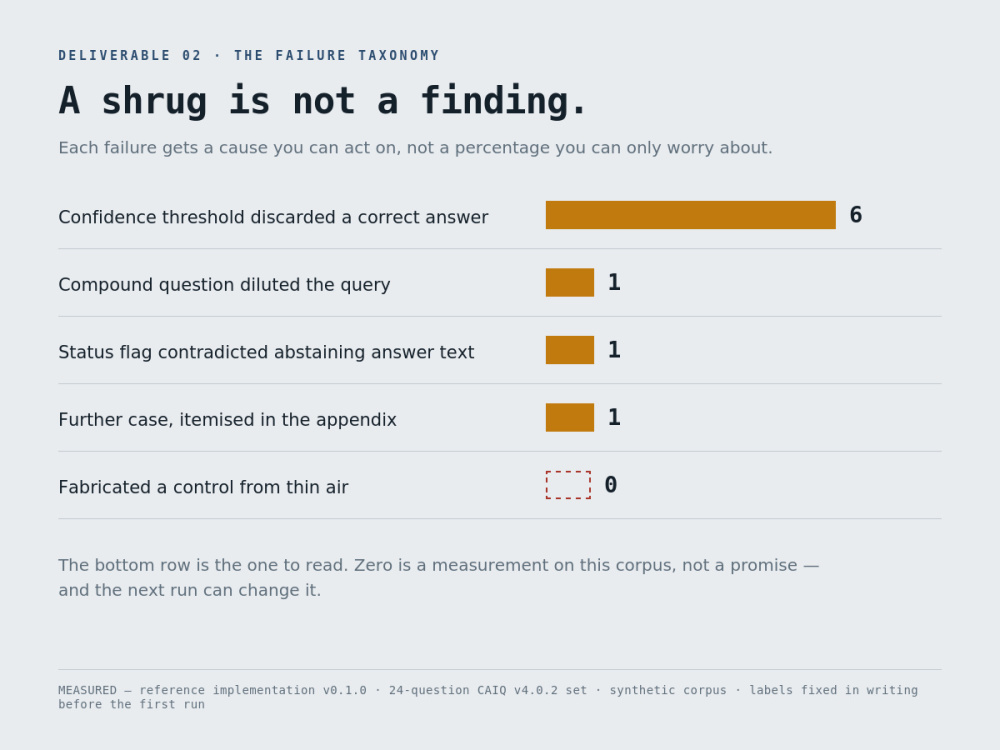
You get a number, and a named cause for every failure. Not "68% accurate." Six failures caused by a confidence threshold discarding correct answers, one by a compound question diluting the query, and so on. Causes you can act on.
The harness that produced my published numbers is open source, along with the labels and every tuning pass — including the ones that made things worse. Check my work before you buy.
An honest "not documented" costs someone twenty minutes. A confident wrong answer costs considerably more.
So I measure whether your system knows the difference. I build a question set from your own documents, fix the expected answer for each one in writing before your system ever sees them, run it, and score status and polarity against the label — counting abstention and fabrication separately, because they are not the same failure.
You get a number, and a named cause for every failure. Not "68% accurate." Six failures caused by a confidence threshold discarding correct answers, one by a compound question diluting the query, and so on. Causes you can act on.
The harness that produced my published numbers is open source, along with the labels and every tuning pass — including the ones that made things worse. Check my work before you buy.
AI Algorithms
Large Language Model, Transformer ModelAI Applications
AI Chatbot, Conversational AI, Natural Language Generation, Natural Language UnderstandingAI Development Language
PythonAI Tools
Hugging Face, PyTorch, StreamlitAI Models
BERT, ChatGPT, GPT-4What's included
| Service Tiers |
Starter
$250
|
Standard
$550
|
Advanced
$1,100
|
|---|---|---|---|
| Delivery Time | 4 days | 7 days | 12 days |
Number of Revisions | 1 | 2 | 3 |
AI Model Integration | - | - | - |
Batch Normalization | - | - | - |
Database Integration | - | - | - |
Detailed Code Comments | - | - | |
Image Upscaling | - | - | - |
MLOps | - | - | - |
Model Deployment | - | - | - |
Model Documentation | |||
Model Monitoring | - | - | |
Model Testing & Optimization | |||
Model Tuning | - | - | - |
Natural Language Processing | |||
NLP Tokenization | - | - | - |
Pre-Training | - | - | - |
Prompt Engineering | - | - | - |
Setup File | - | - | |
Source Code | - |
Optional add-ons
You can add these on the next page.
Additional Revision
+$75
Regression re-run after your fixes
(+ 3 Days)
+$180
15 extra adversarial questions
(+ 2 Days)
+$150
60-minute walkthrough call
(+ 2 Days)
+$95Frequently asked questions
About Patric
AI Automation Engineer | n8n, Python, RAG & Document Workflows
Salistea de Sus, Romania - 4:43 am local time
I build the n8n workflows that do that work instead.
The part I care about more is what happens when something goes wrong, because automation usually doesn't break loudly. An API times out at 3am, a feed sends back garbage, a duplicate sneaks through, and nobody notices for three weeks. So I put the boring stuff in: dedupe checks, retries, thresholds you can change without opening up the workflow, and a log that says what the system decided and why.
Things I build:
- Scheduled pipelines. Pull from an API, a feed, an inbox or a database, do something with it, put it somewhere useful.
- Document extraction. PDFs, scans and spreadsheets into structured data you can actually query.
- AI steps that know when to stop. Every answer cites where it came from, anything uncertain gets flagged for a person, and anything the documents don't support is left blank instead of made up.
- Integrations between tools that don't have one.
- Fixing workflows somebody else built and abandoned.
Two recent ones:
A news pipeline in n8n that polls five feeds every hour. Each article gets embedded and checked against everything already stored, so the same story never shows up twice. If the similarity is ambiguous it goes to an LLM to decide, otherwise it skips that call, which keeps the cost tied to how much new stuff arrives rather than how noisy the feeds are. A second workflow puts the week's picks into a brief and emails it. It's been running on its own since I built it.
A responder for CAIQ security questionnaires, this one in Python. It indexes your policy documents once, then fills in incoming questionnaires with the source listed next to each answer. Processing takes about 25 minutes for something that normally takes days.
How I work:
I default to n8n because you can look at a flow and see what it does, then hand it to someone who isn't technical. Some jobs are a bad fit for it, and then I'll write Python. I'll tell you which one yours is before you pay me anything.
I try to measure things. If a workflow gets 80% of a document right, I'd rather give you the list of what to check than tell you it's perfect. With document work a confident wrong answer does more damage than a blank one.
Stack: n8n, Python, LLM APIs, vector search, PostgreSQL, OCR, Make, REST APIs, webhooks.
If you've got a process like this, tell me what it looks like now. How often it happens, roughly how long it takes, and what the files look like. I'll tell you whether it's worth automating. Sometimes the answer is no, and I'd rather say that at the start than halfway through.
Steps for completing your project
After purchasing the project, send requirements so Patric can start the project.
Delivery time starts when Patric receives requirements from you.
Patric works on your project following the steps below.
Revisions may occur after the delivery date.
Requirements check
I confirm the corpus is complete and the system access actually works, end to end, before the clock runs down. If something's missing you hear from me the same day, not in week two.
Build the labelled question set
I write the questions from your corpus and fix the expected answer for each one, in writing, before your system ever sees them. Standard and Advanced add an adversarial subset: questions your docs imply but never actually state.