You will get a multi-LLM gateway for OpenAI, Claude and Gemini API integration
Project details
Calling one LLM provider directly works right up until it doesn't. A rate limit during your peak hour, a model that returns 200 OK with empty content, a provider outage, or a bill that grows faster than your usage.
I put a gateway in front of it.
What it does:
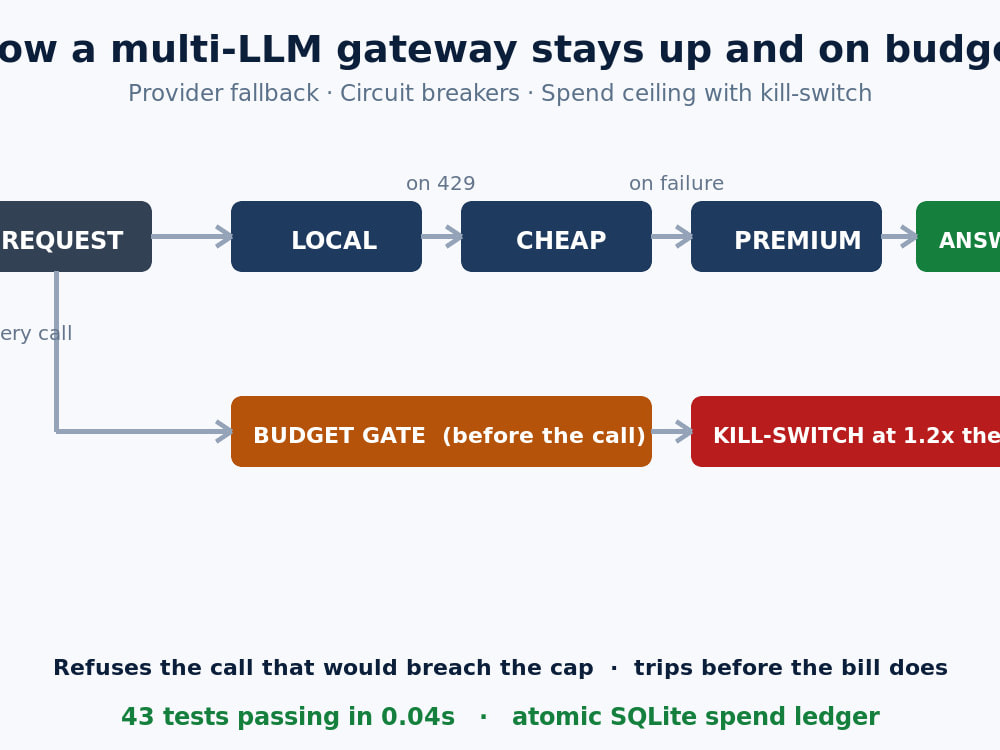
• Tier-ordered cascade: local, then cheap, then premium. On failure or a 429 it moves to the next tier automatically, honouring Retry-After.
• Per-provider circuit breakers, with a short cooldown on a rate limit and a long one on an auth error — an expired key does not fix itself in ten seconds.
• A spend ledger written atomically, so concurrent callers cannot race the balance.
• A pre-flight gate that refuses a call which would breach your cap, plus a sticky kill-switch at 1.2x for when real usage overshoots the estimate.
One detail that matters: a 200 OK with empty content is treated as a failure, not a success. Reasoning models can burn the whole output budget internally and return nothing.
You get the gateway code, a test suite that runs with no network and no keys, and a short runbook.
I put a gateway in front of it.
What it does:
• Tier-ordered cascade: local, then cheap, then premium. On failure or a 429 it moves to the next tier automatically, honouring Retry-After.
• Per-provider circuit breakers, with a short cooldown on a rate limit and a long one on an auth error — an expired key does not fix itself in ten seconds.
• A spend ledger written atomically, so concurrent callers cannot race the balance.
• A pre-flight gate that refuses a call which would breach your cap, plus a sticky kill-switch at 1.2x for when real usage overshoots the estimate.
One detail that matters: a 200 OK with empty content is treated as a failure, not a success. Reasoning models can burn the whole output budget internally and return nothing.
You get the gateway code, a test suite that runs with no network and no keys, and a short runbook.
AI Algorithms
Large Language Model, Transformer ModelAI Applications
AIOps, Conversational AI, Natural Language Generation, Natural Language UnderstandingAI Development Language
PythonAI Models
ChatGPT, GPT-4, LLaMAWhat's included
| Service Tiers |
Starter
$450
|
Standard
$850
|
Advanced
$1,500
|
|---|---|---|---|
| Delivery Time | 4 days | 6 days | 8 days |
Number of Revisions | 1 | 2 | 3 |
AI Model Integration | - | ||
Batch Normalization | - | - | - |
Database Integration | - | - | |
Detailed Code Comments | |||
Image Upscaling | - | - | - |
MLOps | - | - | |
Model Deployment | - | - | |
Model Documentation | |||
Model Monitoring | - | ||
Model Testing & Optimization | - | ||
Model Tuning | - | - | - |
Natural Language Processing | - | - | - |
NLP Tokenization | - | - | - |
Pre-Training | - | - | - |
Prompt Engineering | - | - | |
Setup File | |||
Source Code |
Frequently asked questions
About Remi
AI Systems & Automation Engineer | n8n, RAG, Multi-LLM Architecture
Montpellier, France - 8:21 pm local time
I build AI backends and automation pipelines that keep working when an API rate-limits, a model returns garbage, or a provider goes down at 3am. Most AI integrations break in production — not because the model is wrong, but because there is no fallback, no output validation, no cost ceiling and no alerting. I engineer the boring layer that keeps them running.
What I run in production today:
• Multi-provider LLM routing with automatic fallback, per-provider circuit breakers, and hard cost ceilings with a kill-switch that trips before the bill does
• Retrieval pipelines with hybrid search and freshness gating, so stale sources are down-weighted instead of being served as fact
• Resilient n8n workflows with error branching, retry with backoff, dead-letter handling and failure alerting
• Supervised services with health probes, structured logging, automated backups and recovery runbooks
Stack: n8n, Python (FastAPI), Node.js, PostgreSQL, pgvector/Qdrant, OpenAI, Anthropic, Gemini, Ollama, webhooks, REST and GraphQL APIs, systemd.
If your AI feature works in a demo but falls over on a Monday morning, that is the problem I solve. Tell me your data source, your providers and your failure mode, and I will scope it.
Steps for completing your project
After purchasing the project, send requirements so Remi can start the project.
Delivery time starts when Remi receives requirements from you.
Remi works on your project following the steps below.
Revisions may occur after the delivery date.
Map your calls and your ceiling
I look at how you call the models today, which providers can serve as fallbacks, and what spend ceiling you actually want enforced. You approve the tier order before I build.
Build the cascade and the budget gate
Provider abstraction, typed-error fallback, circuit breakers, atomic spend ledger, pre-flight budget check and the kill-switch. Structured logs, with prompt text excluded by default.