You will get a perfectly SSIS ETL Prod-Ready with the logic requested 100% implemented.
Rising Talent
Rising Talent
Project details
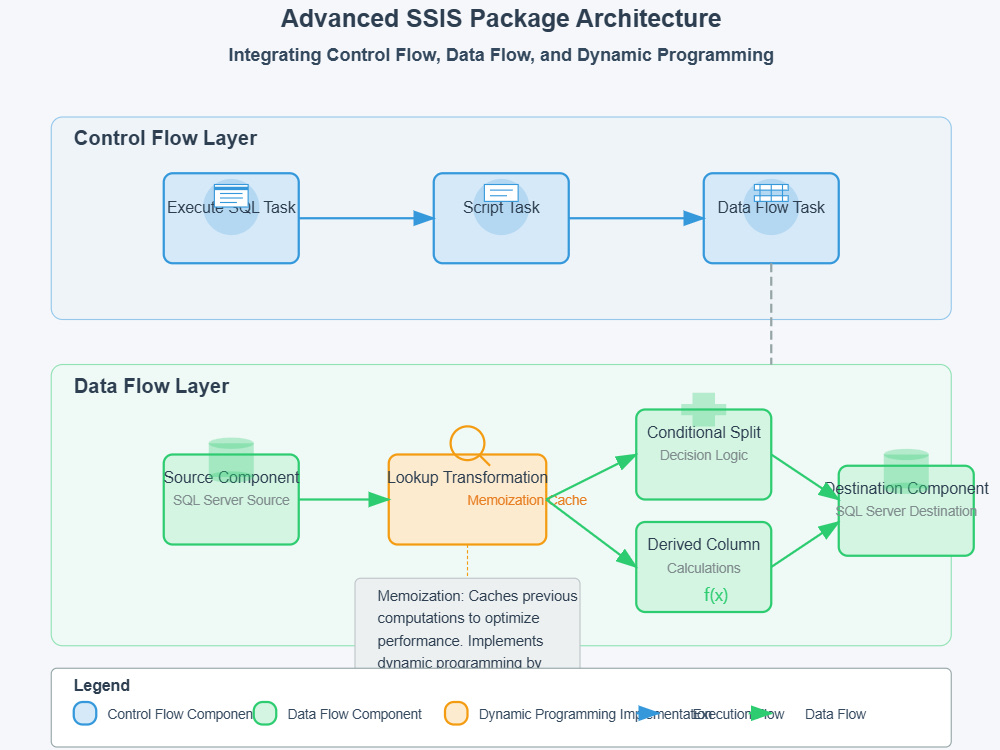
I've revolutionized SSIS development by creating the first Dynamic-Programming-driven ETL architecture. While 90% of practitioners remain GUI-dependent, I built a code-first C# SDK that generates/reverse-engineers DTSX XML w/ computer science fundamentals most ETL developers never apply.
My CoreCraft Analytics framework delivers breakthrough performance: 60% faster execution, 50% memory reduction, 98% faster lookups (5ms vs 120ms) & sub-200ms RAG queries I implemented O(1) memoization caches Big O complexity analysis for transforms & SOLID design principles with dependency injection.
It supports 30+ data engines—from traditional RDBMS to modern vector stores—with 100K msgs/sec Kafka throughput and PB-scale MPP clusters. I've achieved $250K/year maintenance savings through automated legacy migration & 99.9% SLA adherence for Enterprise workloads.
What sets me apart is applying algorithmic transparency to ETL processes. Unified GUI vs code-first, ETL vs ELT + waterfall vs DataOps paradigms into 1 scientifically-grounded framework. I don't just build data pipelines, fundamentally reimagined how they should be architected using CS principles that deliver measurable enterprise impact
My CoreCraft Analytics framework delivers breakthrough performance: 60% faster execution, 50% memory reduction, 98% faster lookups (5ms vs 120ms) & sub-200ms RAG queries I implemented O(1) memoization caches Big O complexity analysis for transforms & SOLID design principles with dependency injection.
It supports 30+ data engines—from traditional RDBMS to modern vector stores—with 100K msgs/sec Kafka throughput and PB-scale MPP clusters. I've achieved $250K/year maintenance savings through automated legacy migration & 99.9% SLA adherence for Enterprise workloads.
What sets me apart is applying algorithmic transparency to ETL processes. Unified GUI vs code-first, ETL vs ELT + waterfall vs DataOps paradigms into 1 scientifically-grounded framework. I don't just build data pipelines, fundamentally reimagined how they should be architected using CS principles that deliver measurable enterprise impact
Data Tool
SQLWhat's included
| Service Tiers |
Starter
$35
|
Standard
$53
|
Advanced
$71
|
|---|---|---|---|
| Delivery Time | 1 day | 3 days | 7 days |
Number of Pages Mined/Scraped | 5 | 10 | 18 |
Number of Sources Mined/Scraped | 2 | 5 | 10 |
Number of Revisions | 1 | 3 | Unlimited |
Optional add-ons
You can add these on the next page.
Fast Delivery
+$12 - $17
Additional Page Mined/Scraped
(+ 1 Day)
+$12
Additional Source Mined/Scraped
(+ 1 Day)
+$21
Additional Revision
+$14
SDK C# .NET Native Custom ORM EF-Like Builder
(+ 10 Days)
+$378Frequently asked questions
About Janoch
Resume & Cover Letter SME | Transform App to Standout Career Stories
Cartago, Costa Rica - 2:06 am local time
At CoreCraft Analytics, I forge data infrastructures as unbreakable as steel: architecting, optimizing, and maintaining every stream so each byte works in perfect harmony. Picture real-time insights that spark bold moves; not surprises or bottlenecks.
With over +10 years building global solutions, I don’t just hand you reports: I sculpt your data into a strategic advantage. My approach? Equal parts creativity, precision, and a healthy dose of skepticism; because in my world, every question demands a poetic solution.
Ready to transform your mountain of data into a finely crafted masterpiece? Let’s connect on Upwork or Fiverr. At CoreCraft Analytics, we don’t just analyze data… we elevate it.
Steps for completing your project
After purchasing the project, send requirements so Janoch can start the project.
Delivery time starts when Janoch receives requirements from you.
Janoch works on your project following the steps below.
Revisions may occur after the delivery date.
Step 1: Requirements Analysis & Architecture Planning
Description: Analyze client's existing SSIS environment, identify performance bottlenecks, assess Big O complexity of current transforms, and design the DP-optimized architecture with memoization strategy and custom component requirements.
Step 2: Legacy DTSX Assessment & Migration Planning
Description: Reverse-engineer existing SSIS packages using LINQ-to-XML reconciliation, document current metadata structures, and create migration roadmap from GUI-based to code-first SDK approach.