You will get a Postgres schema review: indexes, constraints, and modeling risks
Project details
Before you build more on top of it, find out whether your schema will hold.
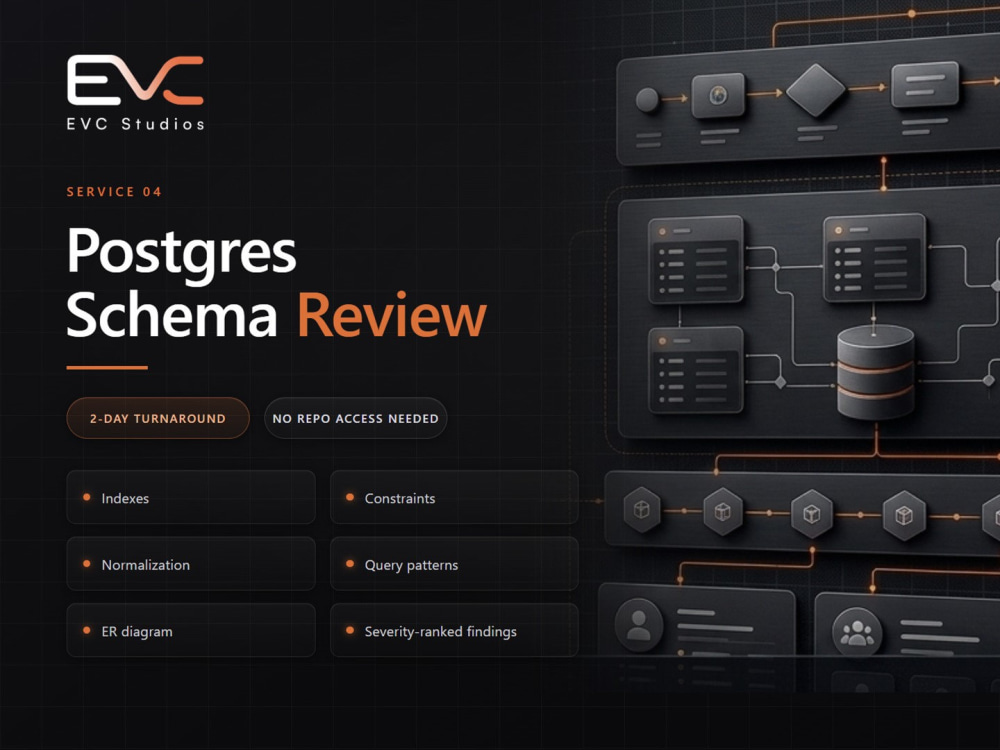
Send me your Postgres schema - a dump, a Prisma or Drizzle file, or plain SQL. No repo access, no application code, nothing to install. In two days you get a written findings list ranked by severity, and an ER diagram of what you actually have.
What I check:
• Indexes: what is missing, what is redundant, and which queries slow down first
• Constraints: absent foreign keys, missing unique rules, columns that should not be nullable
• Modeling: normalization problems, denormalization that will drift, and relationships that will not survive real data
• Types and defaults: cheap to fix now, expensive after a million rows
Every finding says why it matters and what to change. No linter output, no generic checklist - I have shipped multi-tenant SaaS on Postgres, and HerpSync and MapProx are both mine, both live.
Scope: one database, up to 25 tables. Schema only.
Early is the cheapest time to fix a data model - once real customer data exists, schema changes become migrations. Want the whole application reviewed? See my full code and database audit; this fee applies toward it.
Send me your Postgres schema - a dump, a Prisma or Drizzle file, or plain SQL. No repo access, no application code, nothing to install. In two days you get a written findings list ranked by severity, and an ER diagram of what you actually have.
What I check:
• Indexes: what is missing, what is redundant, and which queries slow down first
• Constraints: absent foreign keys, missing unique rules, columns that should not be nullable
• Modeling: normalization problems, denormalization that will drift, and relationships that will not survive real data
• Types and defaults: cheap to fix now, expensive after a million rows
Every finding says why it matters and what to change. No linter output, no generic checklist - I have shipped multi-tenant SaaS on Postgres, and HerpSync and MapProx are both mine, both live.
Scope: one database, up to 25 tables. Schema only.
Early is the cheapest time to fix a data model - once real customer data exists, schema changes become migrations. Want the whole application reviewed? See my full code and database audit; this fee applies toward it.
Database Type
PostgreSQLWhat's included $195
These options are included with the project scope.
$195
- Delivery Time 2 days
- Number of Revisions 1
- Schema Diagram
Optional add-ons
You can add these on the next page.
Fast 1 Day Delivery
+$95
30-minute review call
(+ 1 Day)
+$95Frequently asked questions
About David
Custom Software & AI Solutions Developer
Selma, United States - 9:48 am local time
Two systems I designed and built end to end are live:
• HerpSync — a multi-tenant SaaS for reptile breeders, serving public tenant pages on both platform subdomains and customer-owned custom domains (soft launch).
• MapProx — a field-sales mapping, route-optimization, and visit-tracking platform, with a React web app and a native iOS/Android app sharing one backend (publicly available).
Typical engagements:
- Focused SaaS MVPs
- Multi-tenant platforms with organization-level isolation and role-based access
- Internal workflow dashboards and customer portals
- CRM, payment, and third-party API integration layers
Stack: Next.js, React, TypeScript, Node.js REST APIs, PostgreSQL (Prisma/Drizzle), Stripe, RBAC, webhook and queue-based integrations, Claude and OpenAI API integration, and React Native/Expo mobile delivery.
My background is design first — a graphic design degree and web work since 2004 — so what I build is usable, not just correct. I've run EVC Studios since 2007.
AI-accelerated engineering speeds the repeatable work: research, implementation, testing, analysis, and documentation. It's an execution multiplier, not the product. Every requirement, architecture decision, data boundary, security-sensitive choice, and production release passes through my review and stays my accountability.
How I work: most projects start with a paid discovery and architecture review — data model, tech stack, permission structure, integration surface, and a build estimate — so we scope from evidence instead of assumptions. If the architecture is right, the build is predictable.
Good fit if you can describe the one core workflow your system must support first. Not a fit for template sites or page-builder work.
Steps for completing your project
After purchasing the project, send requirements so David can start the project.
Delivery time starts when David receives requirements from you.
David works on your project following the steps below.
Revisions may occur after the delivery date.
Read the schema and map it
I read your schema end to end and map the entities, relationships, and cardinality - including the places where the model and the product you described do not agree.
Check indexes, constraints, and modeling
I look for missing or redundant indexes, absent foreign keys and unique constraints, nullable columns that should not be, denormalization that will drift, and types that will bite at scale.