You will get a production MCP server for your internal tools
Project details
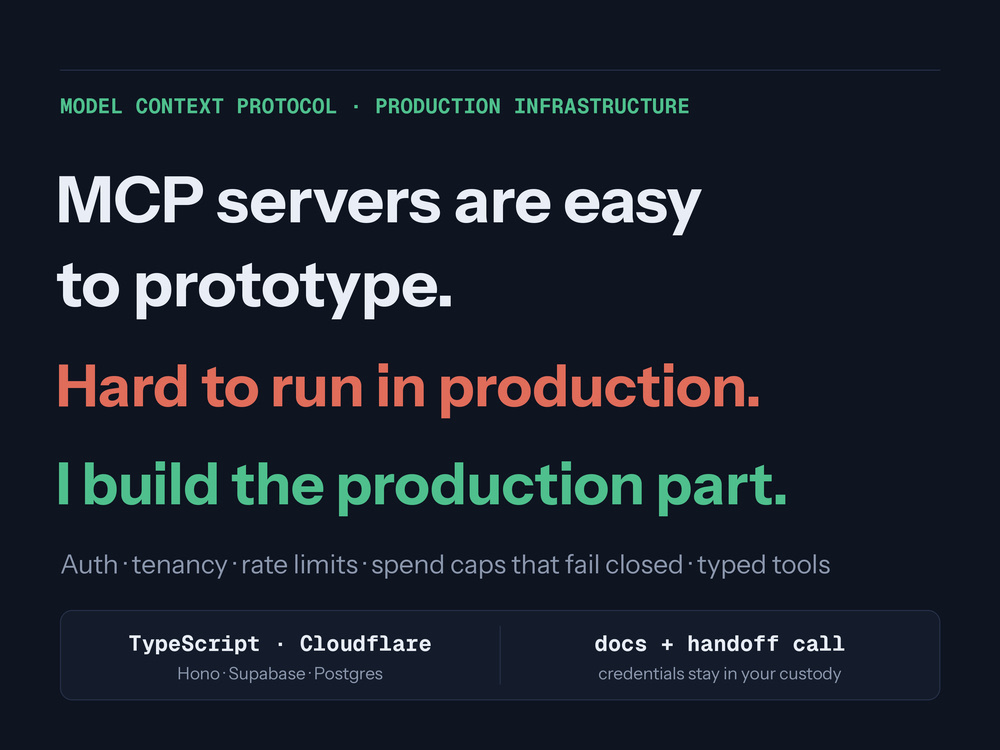
Model Context Protocol servers are easy to prototype and hard to run in production. The gap is auth, tenancy, rate limiting, spend control, and error semantics: everything the tutorial skips.
I build MCP servers that survive contact with real users.
You get:
• A working MCP server exposing your tools, data, or internal APIs
• Proper authentication and per-tenant scoping
• Rate limiting and hard spend caps that fail closed
• Typed tool schemas with validation, so agents get useful errors instead of silent failures
• Deployment (Cloudflare Workers, Fly.io, or your infrastructure)
• Documentation and a handoff call
Standard covers up to 10 tools with a database or API backend.
Premium covers complex multi-source integration, observability wiring, and an eval suite for tool-calling behavior.
Stack: TypeScript, Hono, Supabase/Postgres, Cloudflare. I've built MCP infrastructure including credential-custody gateways with enforced spend ceilings.
I build MCP servers that survive contact with real users.
You get:
• A working MCP server exposing your tools, data, or internal APIs
• Proper authentication and per-tenant scoping
• Rate limiting and hard spend caps that fail closed
• Typed tool schemas with validation, so agents get useful errors instead of silent failures
• Deployment (Cloudflare Workers, Fly.io, or your infrastructure)
• Documentation and a handoff call
Standard covers up to 10 tools with a database or API backend.
Premium covers complex multi-source integration, observability wiring, and an eval suite for tool-calling behavior.
Stack: TypeScript, Hono, Supabase/Postgres, Cloudflare. I've built MCP infrastructure including credential-custody gateways with enforced spend ceilings.
AI Algorithms
Large Language ModelAI Applications
AIOpsAI Models
BERT, GPT-4What's included
| Service Tiers |
Starter
$2,000
|
Standard
$4,500
|
Advanced
$8,000
|
|---|---|---|---|
| Delivery Time | 7 days | 14 days | 21 days |
Number of Revisions | 1 | 1 | 2 |
AI Model Integration | - | ||
Batch Normalization | - | - | - |
Database Integration | |||
Detailed Code Comments | - | ||
Image Upscaling | - | - | - |
MLOps | - | - | |
Model Deployment | - | ||
Model Documentation | |||
Model Monitoring | - | - | |
Model Testing & Optimization | - | - | |
Model Tuning | - | - | - |
Natural Language Processing | - | - | - |
NLP Tokenization | - | - | - |
Pre-Training | - | - | - |
Prompt Engineering | - | - | - |
Setup File | |||
Source Code |
Frequently asked questions
About Ted
Full-Stack + AI Engineer | Custom Agents, MCP, RAG | Automations & WP
Fort Smith, United States - 2:17 am local time
WHAT I ACTUALLY DO
I get called in when an AI feature works in the demo and breaks under real traffic. Usually the diagnosis is the same: the team asked a model to do the work instead of building infrastructure around the model. Agents that call the same tool six times. Prompt chains nobody can debug. No evals, so nobody can prove a change made things better or worse. Spend that nobody's watching until the invoice arrives.
I build the harness. Deterministic gates before LLM judgment, task contracts, observability that traces a full loop instead of fragmenting into a span per tool call, and eval suites that turn "it feels better" into a number you can defend in a standup.
Models are commodities. The harness is what you own.
WHERE I'M USEFUL
- Rescue work: inheriting an AI codebase that three contractors and a coding assistant have already been through
- AI agent systems: multi-agent orchestration, tool-calling architecture, agent-vs-workflow decisions, human-in-the-loop flows that survive a page refresh
- MCP servers: production Model Context Protocol servers for internal tools, with real auth, spend caps, and credential custody
- RAG and memory: retrieval pipelines, embeddings, and multi-tenant memory layers with proper tenant isolation
- Evals and observability: LangSmith / LangFuse instrumentation, golden sets, regression gates in CI
- Full-stack product: TypeScript end to end when the AI layer needs an actual application around it
THE PREFERRED STACK
TypeScript, Hono, Mastra, React (React Router 8), Supabase with row-level security, Drizzle, Postgres, Cloudflare Workers, Fly. Functional patterns: Zod, neverthrow, ts-pattern, Effect. Claude and OpenAI APIs, LangSmith, LangGraph. Also fluent in PHP / WordPress when a project needs it, and I run local inference and image / video pipelines on my own GB10 hardware.
HOW I WORK
I write specs before code. If you hire me and the first thing I send is a document instead of a pull request, that's the process working. Most AI projects fail on unclear contracts between components, not on model choice.
I'll tell you when you don't need what you asked for. I've talked clients out of custom builds more than once, and I'd rather lose the scope than ship you something you'll regret owning.
Fixed-scope work gets a fixed price. Ongoing work gets a retainer with a defined hour block. I don't do open-ended time-and-materials on unclear requirements. It's bad for you and worse for me.
BACKGROUND
Founder of Digital Spirit Technology, running since 2008. 25+ years full-stack. U.S. Army veteran. I've been the lead engineer on a commercial content platform for over a decade, and rebuilt it into an AI platform over the last four years. I know what a codebase looks like after ten years of shipping, not just after a hackathon.
If you're at the stage where the demo works and production doesn't, that's the conversation I'm best at. Send me what's broken.
Steps for completing your project
After purchasing the project, send requirements so Ted can start the project.
Delivery time starts when Ted receives requirements from you.
Ted works on your project following the steps below.
Revisions may occur after the delivery date.
Tool contract design
We agree the exact tool list, each tool's inputs/outputs, and error semantics before any code.
Core build
Server scaffolded with typed schemas, validation, and auth wired to your backend(s).