You will get a secure REST API in Node.js, Express and PostgreSQL with auth
Project details
Most APIs fail in the same three places: authentication that leaks, validation that trusts the client, and a database schema that made sense at ten records and stops making sense at ten thousand.
I build REST APIs in Node.js and Express, backed by PostgreSQL with Prisma. Typed end to end, validated on the server, with proper status codes, consistent error shapes and pagination that still works when the table grows.
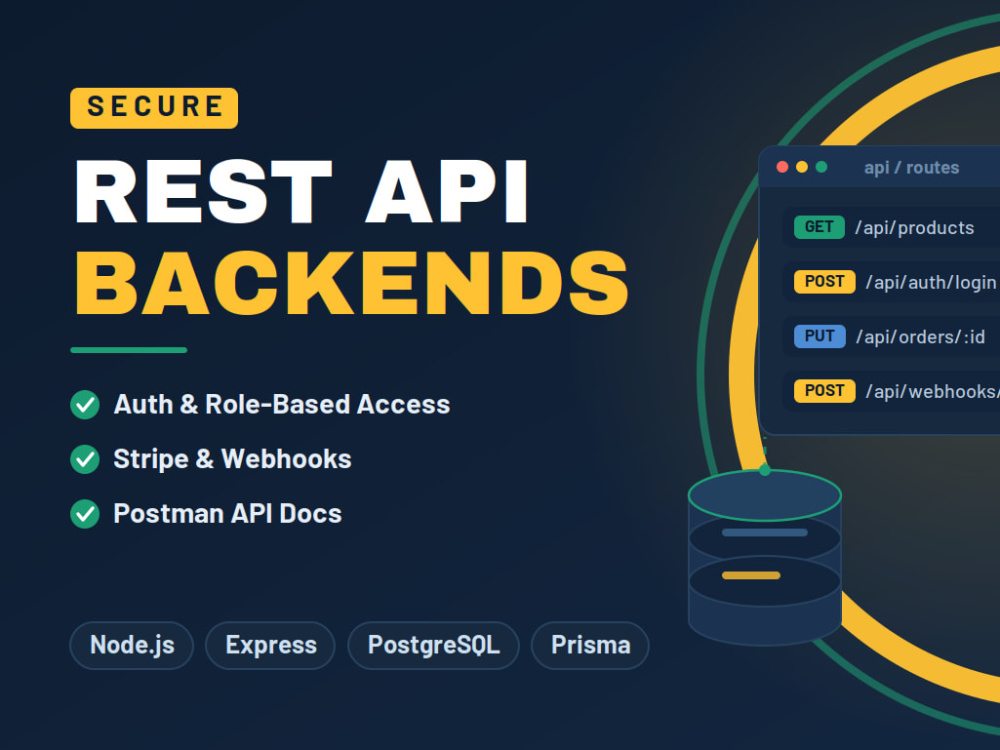
You get a schema designed around how your data actually relates, not a flat table per screen. Authentication with roles. Endpoints documented well enough that whoever builds the frontend never has to ask you what a field means.
Send me a description of what the API needs to do before you order and I will tell you honestly which package fits, or whether you need a custom quote.
I build REST APIs in Node.js and Express, backed by PostgreSQL with Prisma. Typed end to end, validated on the server, with proper status codes, consistent error shapes and pagination that still works when the table grows.
You get a schema designed around how your data actually relates, not a flat table per screen. Authentication with roles. Endpoints documented well enough that whoever builds the frontend never has to ask you what a field means.
Send me a description of what the API needs to do before you order and I will tell you honestly which package fits, or whether you need a custom quote.
Programming Languages
HTML & CSS, JavaScript, TypeScriptCoding Expertise
Cross Browser & Device Compatibility, Performance Optimization, SecurityWhat's included
| Service Tiers |
Starter
$40
|
Standard
$120
|
Advanced
$200
|
|---|---|---|---|
| Delivery Time | 6 days | 12 days | 20 days |
Number of Revisions | 2 | 3 | 5 |
Number of Pages | 8 | 25 | 40 |
Design Customization | - | - | - |
Content Upload | - | - | - |
Responsive Design | - | - | - |
Source Code |
Optional add-ons
You can add these on the next page.
Additional Revision
+$5
Additional Page
(+ 1 Day)
+$5
OpenAPI / Swagger documentation
(+ 1 Day)
+$50
Third-party integration (payments, email, storage)
(+ 2 Days)
+$50
Deployment, environment and database setup
(+ 2 Days)
+$50Frequently asked questions
About Suvra Deb
Next.js & React Developer | TypeScript Web Apps, Dashboards & REST API
Chattogram, Bangladesh - 10:41 am local time
Most of the developers you'll compare me against can build a page. Fewer can take a project from an empty repository to a deployed app with real users, real data and a database that won't fall over in six months. That second thing is what I do.
▶ WHAT I BUILD
✅ Full-stack web applications in Next.js (App Router) and TypeScript, backed by PostgreSQL and Prisma
✅ Admin dashboards and internal tools — role-based access control, CRUD, filtering, search, reporting
✅ REST APIs in Node.js and Express with authentication, request validation, and clean error handling
✅ SaaS foundations — subscription billing with Stripe, usage limits, rate limiting, multi-tenant data models
✅ Figma, XD and PSD designs converted into responsive, accessible React components
✅ Rescue and repair work on broken React and Next.js codebases, including apps generated by Lovable, Bolt, v0 and Replit that stopped working once real requirements arrived
▶ RECENT PROJECTS
✅ LinkPilot — smart link management SaaS
Designed and built end to end. Next.js monolith with PostgreSQL and Prisma, Redis on Upstash for rate limiting, Stripe subscriptions with plan-based feature gating, and a custom analytics pipeline tracking clicks, referrers, devices and geography. Includes a campaign page builder, team workspaces, API keys for programmatic access, and a full authentication layer. Live in production — link in my portfolio below.
✅ B2B industrial storefront and CRM
A complete commerce and operations platform for an industrial instrument supplier. Next.js 15, Tailwind CSS v4, shadcn/ui, Prisma and Better Auth. Public storefront with a multi-tier category system and product catalog, a quotation request workflow built around how B2B buyers actually purchase, and an internal CRM for managing orders, customers and inventory. Architected for a real business with real order volume, not a demo.
✅ Ongoing freelance frontend work
I currently maintain and extend the frontend of a live property platform — new features, bug fixes and UI changes shipped against an existing codebase I didn't write. If your project is inheriting someone else's code rather than starting fresh, this is the work most relevant to you.
▶ MY STACK
✔ Frontend — Next.js, React, TypeScript, JavaScript, Tailwind CSS, shadcn/ui, TanStack Query, React Hook Form, Zod
✔ Backend — Node.js, Express, REST APIs, Better Auth, JWT, Zod validation
✔ Data — PostgreSQL, Prisma ORM, MongoDB, Mongoose, Redis
✔ Tools and deployment — Git, GitHub, Vercel, Railway, Cloudinary, Stripe, Figma
▶ WHO I WORK BEST WITH
Founders validating a product who need a working application rather than a mockup. Small teams without an in-house developer who need an internal tool or dashboard built properly. Agencies that need a reliable pair of hands for Next.js work. And anyone sitting on an AI-generated app that got them eighty percent of the way there and then stopped — that last twenty percent is normal engineering work, and it's fixable.
▶ HOW I WORK
I ask questions before I write code. Half of failed projects fail because nobody clarified what "done" meant, so I'd rather spend an hour on scope than a week building the wrong thing.
Work is broken into milestones you can see and test, not one long silence followed by a delivery. You get progress you can click on.
What I hand over is typed, structured and documented — code that you, or the next developer, can actually maintain. No jQuery pasted into a React project, no environment secrets committed to the repo, no mystery folders.
I'm based in Bangladesh (GMT+6). I overlap comfortably with European mornings and US evenings, I reply within a few hours, and I work every weekday. Timezone has never been the reason one of my projects slipped.
Send me a message describing what you're trying to build. I'll tell you honestly whether I'm the right fit, roughly what it will take, and what I'd do first — before you commit to anything.
Steps for completing your project
After purchasing the project, send requirements so Suvra Deb can start the project.
Delivery time starts when Suvra Deb receives requirements from you.
Suvra Deb works on your project following the steps below.
Revisions may occur after the delivery date.
Data model agreed first
turn your requirements into a schema: the tables, how they relate, and what each field is for. You approve it before I write a line of code, because changing a data model later is the expensive kind of change.
Authentication and access
Sign-up, sign-in, sessions or tokens, password reset, and role-based access on every protected route. Built first, because every endpoint after this depends on it.