You will get reliable JSON output from your LLM, with guardrails that catch drift
Project details
Your model works in testing and then returns something malformed at 2am, and the first person to find out is your user.
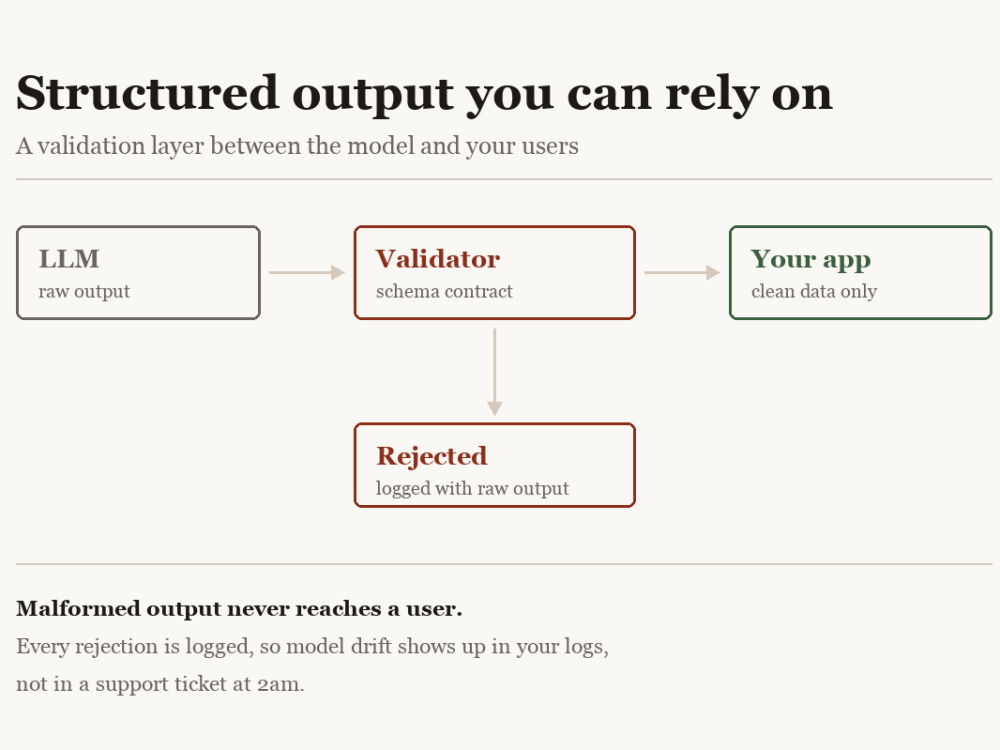
I fix that at the boundary rather than by rewriting prompts forever. A programmatic validator sits between the model and your application. Output that does not match the contract is rejected and never rendered. Rejections are logged with the raw output, so when the model drifts you see it in your logs instead of in a support ticket.
Where the real problem is a capability ceiling rather than a prompt, I will tell you. I have made exactly that call in production: an 8B model was collapsing into repetition loops and truncating JSON on open-ended input. More prompt engineering did not fix it. Splitting the work across two models did, and that was a cost decision as much as a quality one.
You get working code in your repo, not a document describing what you should do.
I am in Hong Kong (UTC+8). Send me one real example of the bad output and I will tell you honestly whether this package covers it before you order.
I fix that at the boundary rather than by rewriting prompts forever. A programmatic validator sits between the model and your application. Output that does not match the contract is rejected and never rendered. Rejections are logged with the raw output, so when the model drifts you see it in your logs instead of in a support ticket.
Where the real problem is a capability ceiling rather than a prompt, I will tell you. I have made exactly that call in production: an 8B model was collapsing into repetition loops and truncating JSON on open-ended input. More prompt engineering did not fix it. Splitting the work across two models did, and that was a cost decision as much as a quality one.
You get working code in your repo, not a document describing what you should do.
I am in Hong Kong (UTC+8). Send me one real example of the bad output and I will tell you honestly whether this package covers it before you order.
Machine Learning Tools
BERT, NLTK, pandas, Python, Python Scikit-LearnWhat's included
| Service Tiers |
Starter
$180
|
Standard
$350
|
Advanced
$600
|
|---|---|---|---|
| Delivery Time | 3 days | 5 days | 8 days |
Number of Revisions | 1 | 2 | 2 |
Model Validation/Testing | - | - | - |
Model Documentation | - | ||
Data Source Connectivity | - | - | - |
Source Code |
Frequently asked questions
About Joey
Chinese-English AI Developer | LLM, RAG & China Market Data
Hong Kong, Hong Kong - 5:39 pm local time
Calling an LLM API is usually the easy part. The difficult part is handling Chinese-language retrieval, bilingual output consistency, access control, structured data, model reliability, and the differences between China, Hong Kong, and international data workflows.
I can help you build:
• Chinese-English LLM applications and internal tools
• Bilingual RAG and semantic search systems
• Chinese-language structured extraction and analysis workflows
• China, Hong Kong, and cross-border market intelligence products
• AI applications using Next.js, Python, FastAPI, Supabase, and PostgreSQL
• Geospatial and public-data pipelines involving China or Hong Kong
My recent work includes:
• A bilingual AI knowledge platform combining instant translation with a custom authority-ranking system
• A financial intelligence platform covering US, Hong Kong, and China A-share markets
• A deployed LLM application with structured-output validation, behavioral guardrails, multilingual retrieval, and PostgreSQL row-level security
• A GIS-to-3D pipeline built from public road data around Hong Kong International Airport
Before specializing in AI applications, I spent four years delivering data products and analytical systems in Beijing. My work included government digitalization, environmental monitoring, early-warning platforms, remote sensing, stakeholder interviews, requirements analysis, and cross-functional project delivery.
I later completed an M.S. in Geographic Information Science at the University at Buffalo, where my research combined spatial statistics, NLP, multilingual sentiment analysis, and behavioral modeling.
What makes me especially useful on cross-border projects is that I can work across three layers:
1. Understand the Chinese-language and local data context
2. Translate an ambiguous business need into a clear product workflow
3. Build and deploy the technical solution
Core stack: Next.js, TypeScript, Python, FastAPI, Supabase, PostgreSQL, pgvector, LLM APIs, GeoPandas, and geospatial data tools.
I work in English, Mandarin, and Cantonese from Hong Kong.
If your project involves Chinese users, bilingual content, China or Hong Kong data, secure RAG, or an AI workflow that needs more than a translated English prompt, send me your target user, sample input, and desired output. I will help you define the smallest useful solution before we build it.
Steps for completing your project
After purchasing the project, send requirements so Joey can start the project.
Delivery time starts when Joey receives requirements from you.
Joey works on your project following the steps below.
Revisions may occur after the delivery date.
Reproduce the failure and define the contract
I reproduce the bad output locally, then write down exactly what valid output looks like. If the failure turns out to be a capability ceiling rather than a prompt problem, I tell you at this stage, before writing code.
Build the validator and wire up rejection logging
The validator goes in as a boundary your code already calls, so integration is a small diff rather than a rewrite. Rejected output is logged in full, so the next drift is visible in your logs.