You will get AI-Based Depth-Guided Haze Simulation Using MiDaS and ZoeDepth
Project details
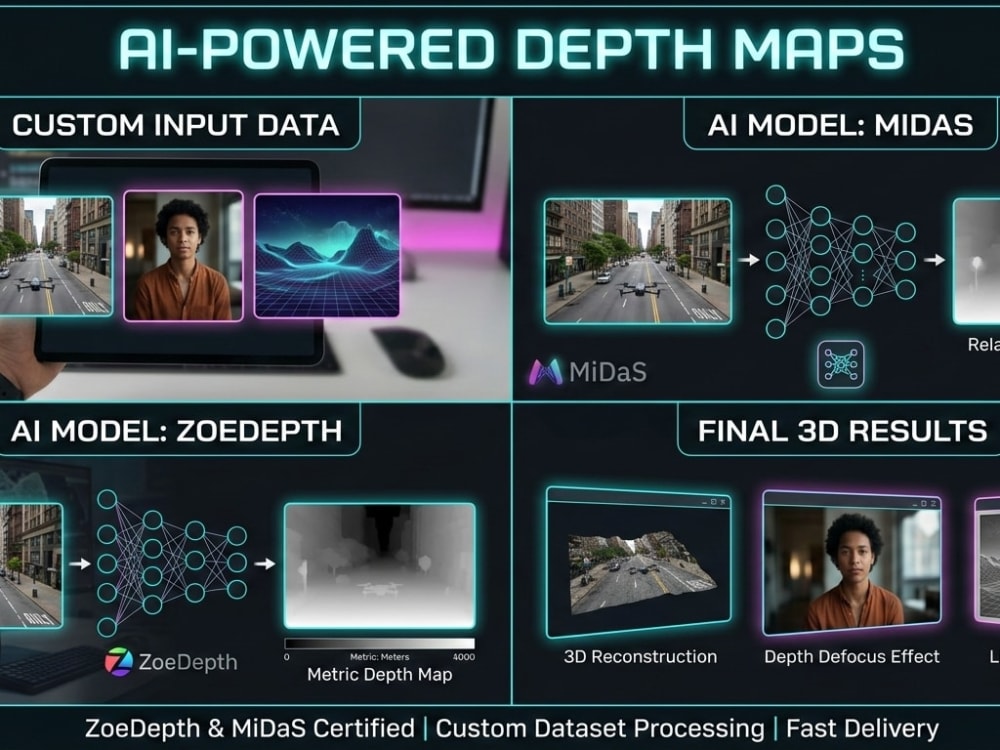
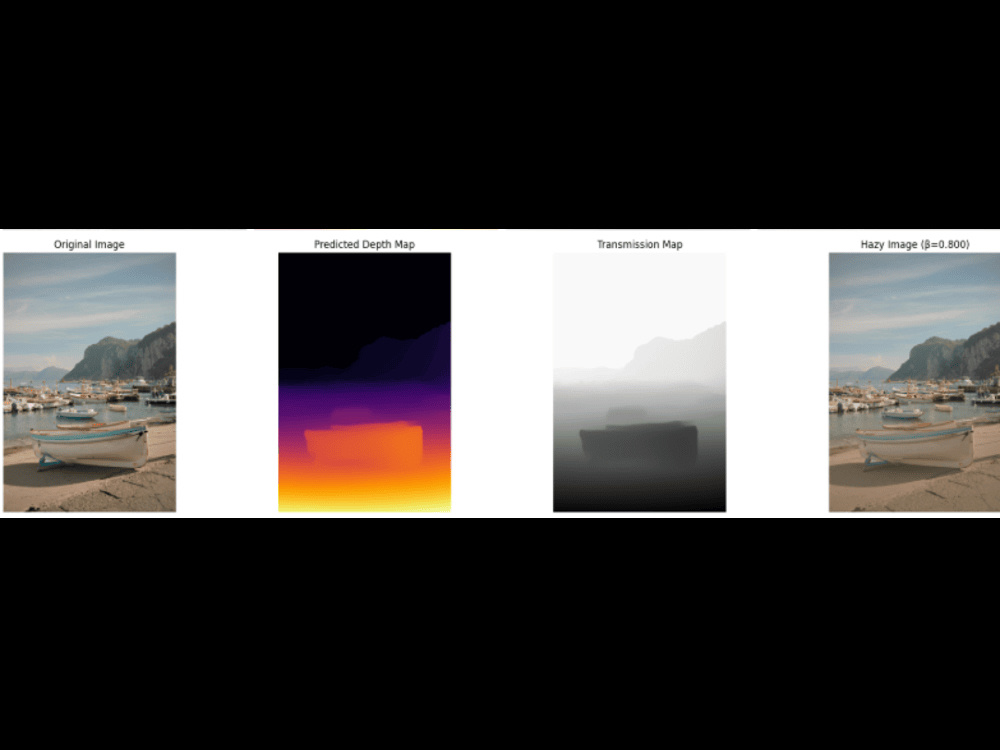
You will get a complete AI-powered depth and haze simulation pipeline that transforms ordinary images into realistic hazy scenes using metric depth estimation. Leveraging state-of-the-art models such as MiDaS and ZoeDepth, this project provides physically grounded depth maps, adaptive haze rendering, and visually appealing results suitable for research, data augmentation, and computer vision training.
With hands-on expertise in deep learning, computer vision, and image synthesis, I ensure accurate atmospheric light estimation, adaptive haze control, and fully reproducible code. The final delivery includes depth maps, transmission maps, and haze-applied images, along with a documented, clean Python implementation ready for further experimentation.
This project stands out for its realism, modular design, and academic-level precision — ideal for anyone building AI datasets or studying visibility degradation in vision models.
With hands-on expertise in deep learning, computer vision, and image synthesis, I ensure accurate atmospheric light estimation, adaptive haze control, and fully reproducible code. The final delivery includes depth maps, transmission maps, and haze-applied images, along with a documented, clean Python implementation ready for further experimentation.
This project stands out for its realism, modular design, and academic-level precision — ideal for anyone building AI datasets or studying visibility degradation in vision models.
AI Development Type
Deep Learning, Model TuningAI Tools
Keras, MATLAB, MLflow, OpenCV, PyTorch, TensorFlowAI Development Language
PythonWhat's included
| Service Tiers |
Starter
$50
|
Standard
$100
|
Advanced
$180
|
|---|---|---|---|
| Delivery Time | 2 days | 5 days | 8 days |
Number of Revisions | 1 | 2 | 4 |
AI Model Integration | - | ||
Detailed Code Comments | |||
Knowledge Graph | - | - | - |
Model Documentation | - | ||
Ontology | - | - | - |
Source Code | |||
Taxonomy | - | - | - |
Optional add-ons
You can add these on the next page.
Custom dataset integration
(+ 2 Days)
+$40
Visualization Report
(+ 1 Day)
+$25
Custom UI Dashboard
(+ 3 Days)
+$70Frequently asked questions
About Vaishnavi
AI Engineer | Computer Vision, GANs (Pix2Pix), Sensor ML
Pune, India - 3:42 am local time
Most ML projects fail at deployment.
I focus on building systems that are accurate, scalable, and actually usable.
🚀 What I can help you with:
✔ Computer Vision (object detection, segmentation, GANs)
✔ Generative AI (Pix2Pix, Stable Diffusion workflows)
✔ Sensor-based ML (IMU, ToF, thermal data fusion)
✔ End-to-end pipelines (data → features → model → deployment)
🔥 Selected Work:
→ Built a gesture recognition system using IMU + ToF + thermal sensors with robust handling of missing sensor data, achieving ~90%+ accuracy across test data
→ Developed Pix2Pix pipelines for image-to-image transformation (segmentation, structured outputs)
→ Engineered feature pipelines using quaternion math + Kalman filtering for noisy real-world signals
→ Designed multimodal ML systems combining vision + sensor inputs
🧠 How I work:
→ I prioritize real-world performance over academic results
→ I write clean, maintainable, production-ready code
→ I communicate clearly and iterate fast
💡 Why clients hire me:
→ I bridge the gap between research-level ML and real-world deployment
→ I don’t just build models — I build usable AI systems
→ I can take your idea from concept → working solution
📩 Have an idea or stuck with an ML problem?
Let’s talk — I’ll help you turn it into a working system.
“Happy to build a small demo/prototype before starting!”
Steps for completing your project
After purchasing the project, send requirements so Vaishnavi can start the project.
Delivery time starts when Vaishnavi receives requirements from you.
Vaishnavi works on your project following the steps below.
Revisions may occur after the delivery date.
Receive images & project details
Client uploads 3–5 sample images (JPEG/PNG), specifies preferred model (MiDaS, ZoeDepth, or both) and selects haze intensity (light / medium / dense). Also indicate desired output format.
Environment & model setup
I set up the Python environment (or Colab), install dependencies, and download/load pretrained MiDaS/ZoeDepth models so inference is reproducible on your hardware.