You will get AI Drift & Stability Analysis for Long-Running Systems
Project details
I provide privacy-preserving analysis of system drift, stability, and recovery behavior over long execution horizons.
This project is designed for teams who want to understand how a software system behaves over time under noise, entropy, and frozen conditions — without retraining, tuning, or accessing production environments.
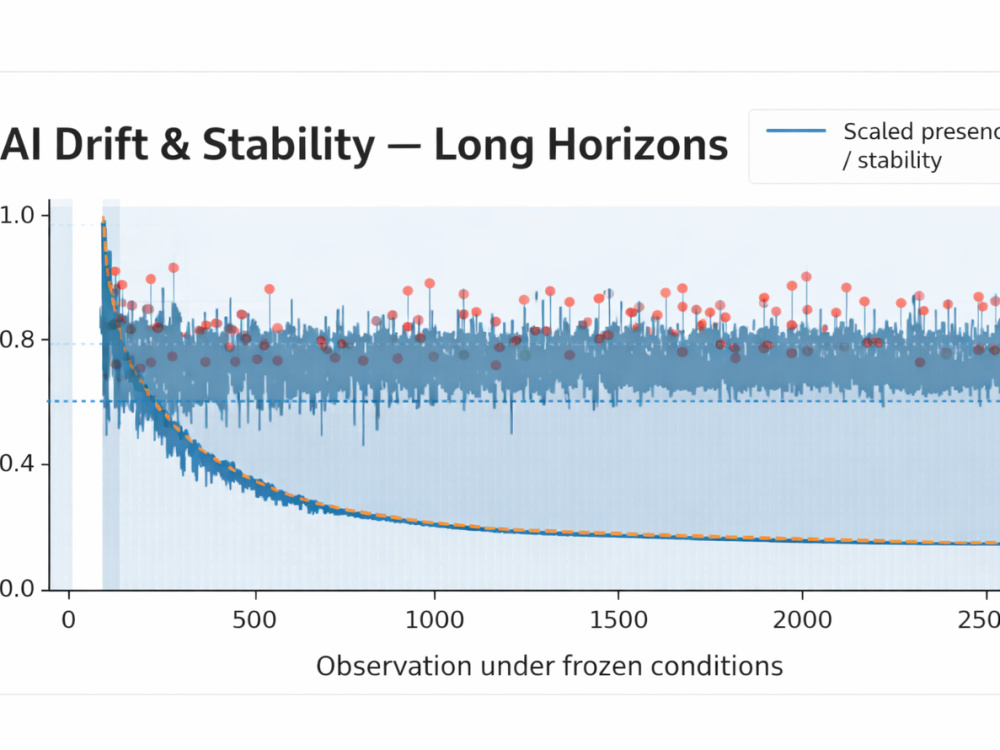
Using a fully local, synthetic, and reproducible framework (CAS 2.0), I evaluate long-horizon behavior such as gradual drift, bounded stability, recovery patterns, and variance accumulation. The goal is not optimization, but durability, interpretability, and safety over time.
All work is observational and offline. No proprietary code, live systems, or sensitive data are required. Results are delivered as clear summaries, charts, and technical notes that help teams reason about long-term reliability rather than short-term performance gains.
This service is well-suited for early-stage models, research systems, simulations, or conceptual architectures where understanding stability and failure modes matters before deployment.
This project is designed for teams who want to understand how a software system behaves over time under noise, entropy, and frozen conditions — without retraining, tuning, or accessing production environments.
Using a fully local, synthetic, and reproducible framework (CAS 2.0), I evaluate long-horizon behavior such as gradual drift, bounded stability, recovery patterns, and variance accumulation. The goal is not optimization, but durability, interpretability, and safety over time.
All work is observational and offline. No proprietary code, live systems, or sensitive data are required. Results are delivered as clear summaries, charts, and technical notes that help teams reason about long-term reliability rather than short-term performance gains.
This service is well-suited for early-stage models, research systems, simulations, or conceptual architectures where understanding stability and failure modes matters before deployment.
Machine Learning Tools
NumPy, pandas, Python, Python Scikit-Learn, SciPy, SQLWhat's included
| Service Tiers |
Starter
$250
|
Standard
$650
|
Advanced
$1,200
|
|---|---|---|---|
| Delivery Time | 3 days | 5 days | 7 days |
Number of Revisions | 1 | 1 | 2 |
Number of Model Variations | 1 | 2 | 3 |
Number of Scenarios | 1 | 3 | 5 |
Number of Graphs/Charts | 1 | 5 | 8 |
Model Validation/Testing | |||
Model Documentation | - | ||
Data Source Connectivity | - | - | - |
Source Code | - | - | - |
Optional add-ons
You can add these on the next page.
Additional Graph/Chart
+$15
Model Documentation
(+ 1 Day)
+$35Frequently asked questions
About Ronald
Privacy-First Systems & App Developer | Drift & Stability Analysis |
Fort Worth, United States - 8:08 am local time
My work centers on:
offline-capable, local-only applications
long-horizon system stability and drift
ethical, non-surveillance AI and automation
clarity, durability, and user sovereignty
I build tools in Flutter and Python that are intentionally simple, inspectable, and resilient — designed to keep working when conditions change, inputs degrade, or usage patterns drift.
Recently, I’ve been developing and publishing CAS 2.0, an open research framework studying:
system drift under entropy
recovery behavior over long execution horizons
stability without tuning, intervention, or cloud dependence
This work is fully synthetic, privacy-preserving, and documented through open research archives. It informs how I design production systems that need to remain reliable months or years after deployment.
What I can help with:
Privacy-first mobile or desktop apps (Flutter)
Local-only or offline-capable tools
Python systems for analysis, simulation, or internal research
Stability & failure-mode reviews of existing systems
Long-horizon risk and drift analysis (pre- or post-incident)
I’m not focused on growth hacks, engagement metrics, or data extraction.
I work best with teams who care about correctness, longevity, and trust.
If you need a developer who thinks beyond short-term optimization and into real-world durability, I’d be glad to talk.
Steps for completing your project
After purchasing the project, send requirements so Ronald can start the project.
Delivery time starts when Ronald receives requirements from you.
Ronald works on your project following the steps below.
Revisions may occur after the delivery date.
Intake & scope
Review client requirements, goals, and constraints. Confirm evaluation scope and outputs.
Configuration
Configure a local, synthetic evaluation aligned to the requested horizon, scenarios, and stability metrics.