You will get an Apache Kafka event streaming pipeline with Spring Boot
Project details
If your system needs to process thousands of events per second without losing data or falling behind under load, a correctly designed Kafka pipeline is the only reliable answer.
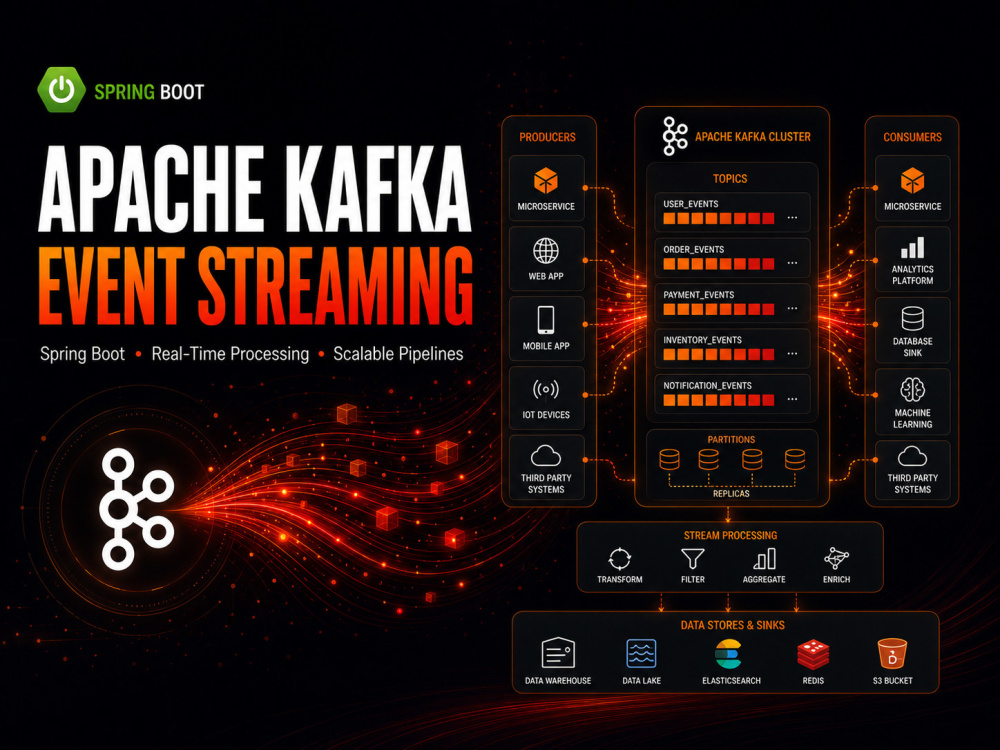
This service delivers a production-ready Apache Kafka event streaming setup integrated with Spring Boot, built for throughput, fault tolerance, and long-term operational reliability.
What you receive:
Kafka producers and consumers integrated with Spring Boot
Topic design with partitioning strategy for parallel processing
Consumer group configuration optimized for throughput
Dead letter queue setup for failed message handling
Schema management using JSON or Avro with Schema Registry
Error handling, retry logic, and alerting configuration
Consumer lag monitoring and pipeline health dashboard
Full documentation covering pipeline design
Who this is for:
Teams building real-time data platforms, IoT backends processing sensor telemetry, fintech transaction streaming systems, and SaaS platforms needing async service communication.
Built on direct production experience running Kafka pipelines processing 6M events per hour from 1.5M IoT smart meters.
Message me with your event volume and use case before ordering.
This service delivers a production-ready Apache Kafka event streaming setup integrated with Spring Boot, built for throughput, fault tolerance, and long-term operational reliability.
What you receive:
Kafka producers and consumers integrated with Spring Boot
Topic design with partitioning strategy for parallel processing
Consumer group configuration optimized for throughput
Dead letter queue setup for failed message handling
Schema management using JSON or Avro with Schema Registry
Error handling, retry logic, and alerting configuration
Consumer lag monitoring and pipeline health dashboard
Full documentation covering pipeline design
Who this is for:
Teams building real-time data platforms, IoT backends processing sensor telemetry, fintech transaction streaming systems, and SaaS platforms needing async service communication.
Built on direct production experience running Kafka pipelines processing 6M events per hour from 1.5M IoT smart meters.
Message me with your event volume and use case before ordering.
Programming Languages
JavaCoding Expertise
Performance Optimization, Security, W3C Markup Validation ServiceWhat's included
| Service Tiers |
Starter
$250
|
Standard
$550
|
Advanced
$1,100
|
|---|---|---|---|
| Delivery Time | 6 days | 12 days | 20 days |
Number of Revisions | 1 | 2 | 3 |
Design Customization | - | - | - |
Content Upload | - | - | - |
Responsive Design | - | - | - |
Source Code | - | - | - |
Frequently asked questions
About Waqas
Python AI Backend Engineer | AI Integration & RAG | Node.js | AWS
Lahore, Pakistan - 12:26 am local time
I am a backend engineer with 13 years of experience building systems where downtime was not an option. My recent focus has shifted heavily toward AI integration, RAG pipelines, LLM-powered workflows, and agentic systems built on top of solid backend foundations, not bolted on as an afterthought.
A few things I have shipped recently:
Delivered 24/7 AI-powered patient consultations, automated ePrescriptions, and intelligent appointment routing on a live telehealth platform, built on Python FastAPI, AWS Lambda, DynamoDB, Step Functions, and pgvector with zero infrastructure management overhead.
Built a full RAG pipeline with Qdrant vector storage, metadata filtering, RBAC retrieval, FastAPI endpoints, and a RAGAS evaluation layer for a local-first enterprise AI platform where sensitive documents never leave the client infrastructure.
Led the AWS cloud migration and re-architecture for a US nonprofit e-learning platform supporting 10,000 plus concurrent users at 99.9% uptime, cutting infrastructure costs by 30% through containerized ECS deployments, automated CI/CD, and full CloudWatch observability.
Deployed a live Python backend on Google Cloud for a published Android game on Amazon, handling unpredictable traffic spikes with auto-scaling infrastructure and zero manual intervention during peak play periods.
Automated 90% of customer interactions and cut manual workload by 40% for a live cab booking platform handling 500 plus daily bookings across 5 plus languages, built on NestJS, PostgreSQL, TypeORM, and AWS.
Built the NestJS and GraphQL backend for Financial Four Square, replacing manual financial reporting with real-time dashboards across 100 plus business portfolios deployed on AWS with CloudFormation and Docker.
What your project gets:
➜ Python backend development with FastAPI, Django, and Flask
➜ AI integration using LangChain, LangGraph, OpenAI API, and Claude
➜ RAG pipelines, vector databases, and LLM-powered workflows
➜ Node.js and NestJS backend development with REST and GraphQL APIs
➜ AWS Serverless architecture including Lambda, Step Functions, and API Gateway
➜ Real-time data pipelines and event-driven architecture at production scale
➜ Docker, CI/CD pipelines, and production observability
➜ Backend performance tuning and scalability improvements
Technologies I work with:
➛ AI and LLM: LangChain, LangGraph, OpenAI API, Claude, RAG pipelines, pgvector, Qdrant, ChromaDB, Pinecone, Prompt Engineering
➛ Languages: Python, TypeScript, JavaScript
➛ Frameworks: FastAPI, Django, Flask, NestJS, Express
➛ Messaging: AWS SQS, AWS SNS, RabbitMQ, MQTT
➛ Databases: PostgreSQL, MongoDB, DynamoDB, Redis, MySQL
➛ Cloud: AWS including Lambda, EC2, RDS, S3, API Gateway, Step Functions, Cognito, CloudWatch, GCP
➛ DevOps: Docker, CI/CD, GitHub Actions, Serverless Framework
➛ API: REST, GraphQL, WebSockets, Swagger
Why clients hire again:
➜ 13 years building backend systems that run in production, not just in demos
➜ AI integration built on top of solid backend fundamentals, not bolted on as an afterthought
➜ Real Python and Node.js experience across healthcare, fintech, energy, and enterprise platforms
➜ Production-scale RAG pipeline and AWS Serverless experience most backend developers do not have
➜ Clean architecture, full documentation, and proper handover every time
➜ No ghost communication, you always know where your project stands
➜ I think in systems, not just features, your codebase stays easier to maintain after I leave than before I arrived
Message me with your biggest backend or AI challenge. I will reply within 12 hours with exactly how I would approach it and a clear plan of action.
Steps for completing your project
After purchasing the project, send requirements so Waqas can start the project.
Delivery time starts when Waqas receives requirements from you.
Waqas works on your project following the steps below.
Revisions may occur after the delivery date.
Step 1
I review your event types, volume expectations, and existing services, then design topic structure, partitioning strategy, consumer group setup, and error handling approach before implementation.
Step 2
I build the full pipeline integrated with your Spring Boot services, configure monitoring and alerting, deliver with complete documentation, and handle revisions within the agreed window.