Oluwasheyi Olayemi isn't taking new orders for this project right now. Here are some similar projects to explore.
You will get An automated LinkedIn AI post generator with Telegram approval workflow
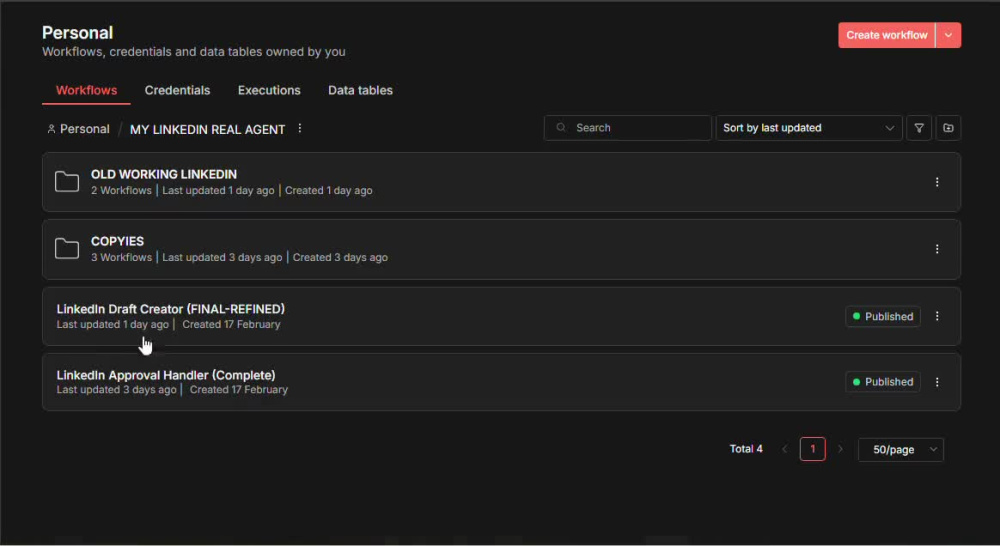
Project details
Consistency is the key to growing on LinkedIn, but writing daily posts and creating images takes hours. I will build a custom, fully automated n8n AI Agent that acts as your personal LinkedIn ghostwriter.
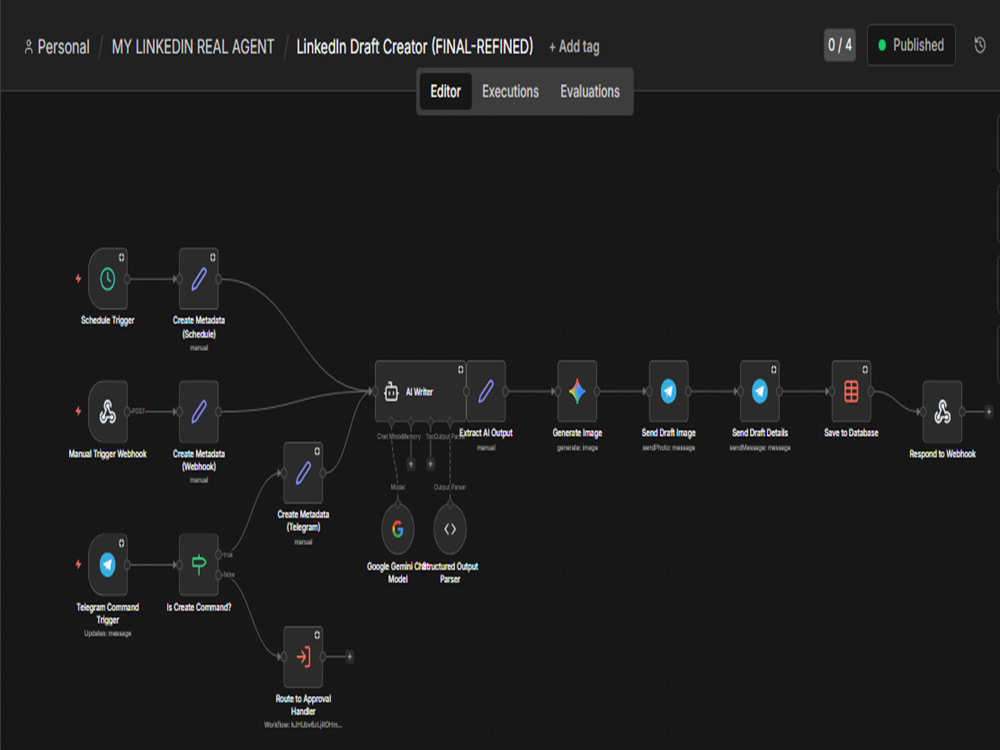
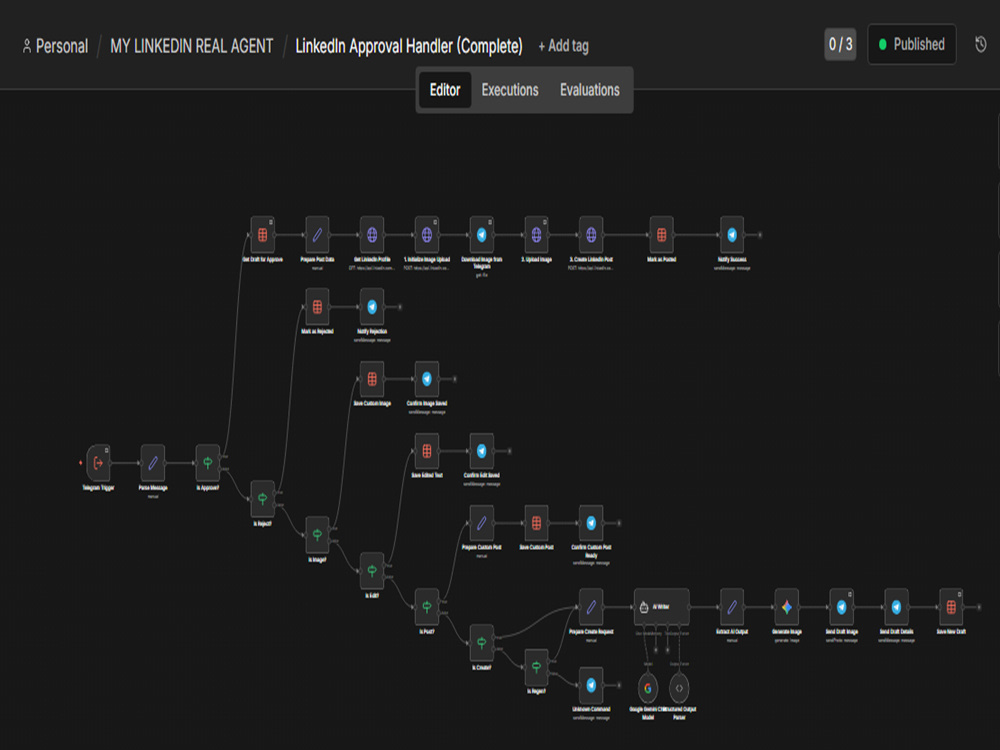
Instead of trusting an AI to post blindly to your professional network, this system uses a secure "Human-in-the-Loop" architecture.
How it works:
The AI (Google Gemini) generates a highly engaging LinkedIn post and image tailored to your brand voice.
It sends the draft directly to your Telegram app.
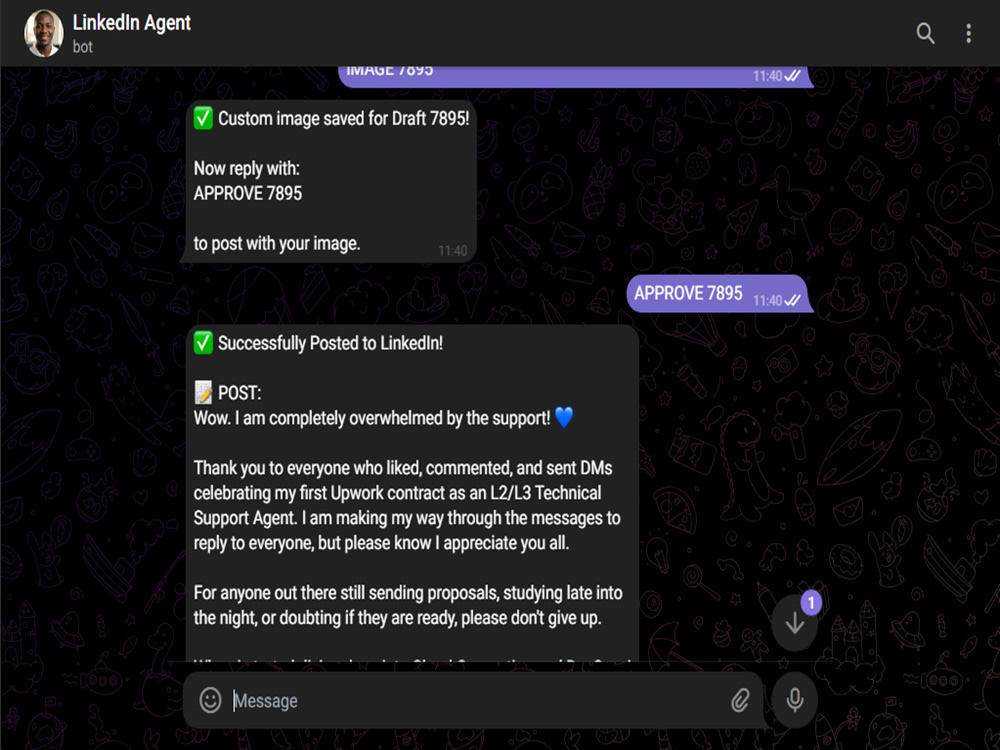
You review it. If you like it, you click "Approve" right inside Telegram.
The n8n workflow instantly publishes the post to your LinkedIn profile.
You retain 100% control of your brand while automating 99% of the work. As a Cloud Systems Engineer and AI Automation Architect, I ensure your setup is secure, reliable, and tailored to your exact needs. Stop writing posts manually and let your digital worker handle it!
Instead of trusting an AI to post blindly to your professional network, this system uses a secure "Human-in-the-Loop" architecture.
How it works:
The AI (Google Gemini) generates a highly engaging LinkedIn post and image tailored to your brand voice.
It sends the draft directly to your Telegram app.
You review it. If you like it, you click "Approve" right inside Telegram.
The n8n workflow instantly publishes the post to your LinkedIn profile.
You retain 100% control of your brand while automating 99% of the work. As a Cloud Systems Engineer and AI Automation Architect, I ensure your setup is secure, reliable, and tailored to your exact needs. Stop writing posts manually and let your digital worker handle it!
AI Algorithms
Large Language Model, Transformer ModelAI Applications
AI Chatbot, AI Content Creation, AI Text-to-Image, Natural Language GenerationAI Development Language
JavaAI Models
ChatGPT, DALL-E, GPT-4What's included
| Service Tiers |
Starter
$150
|
Standard
$300
|
Advanced
$550
|
|---|---|---|---|
| Delivery Time | 3 days | 5 days | 7 days |
Number of Revisions | 1 | 2 | 3 |
AI Model Integration | |||
Batch Normalization | - | - | - |
Database Integration | - | - | |
Detailed Code Comments | - | ||
Image Upscaling | - | ||
MLOps | - | - | - |
Model Deployment | |||
Model Documentation | - | - | |
Model Monitoring | - | - | |
Model Testing & Optimization | - | ||
Model Tuning | - | - | - |
Natural Language Processing | |||
NLP Tokenization | - | - | - |
Pre-Training | - | - | - |
Prompt Engineering | |||
Setup File | |||
Source Code |
Frequently asked questions
1 review
(1)
(0)
(0)
(0)
(0)
This project doesn't have any reviews.
TP
Tiago P.
Mar 27, 2026
L2/L3 Customer Support Agent Needed
Excellent quality of service :)
About Oluwasheyi Olayemi
AWS DevOps Engineer | Cloud Infrastructure & SRE
Isheri Olofin, Nigeria - 9:36 pm local time
Most of my day to day work lives in AWS. I design environments around EC2, VPC, IAM, S3, RDS, Secrets Manager, and Route 53, with security built in from day one instead of bolted on after something goes wrong. IAM roles get scoped to exactly what a service needs and nothing more. Security groups stay readable enough that I can explain them to someone six months later. Secrets live in Secrets Manager, not in an env file someone forgot to gitignore. All of it sits in Terraform, version controlled and reviewable, because I have inherited enough undocumented "it works, don't touch it" environments to know I never want to hand one over myself.
On the server side I handle Ubuntu and Debian hardening, UFW firewall rules, automatic SSL through Caddy and Let's Encrypt, scheduled backups, log rotation, and Tailscale for secure remote access into private infrastructure. I self host my own tooling, so when something breaks in a client's environment, there's a decent chance I already broke the same thing on my own setup first and know the fix.
I run production workloads on Docker and Kubernetes, specifically EKS, deployed through Terraform and shipped through GitHub Actions into ArgoCD for the actual rollout. I have the scar tissue to prove it holds up under pressure. On one project, a Terraform managed EKS cluster kept failing to provision its load balancer. The nginx ingress config was mixing annotations meant for AWS's built in cloud provider with annotations meant for the AWS Load Balancer Controller, two systems fighting over the same NLB and neither winning. Stripped it back to one consistent set of annotations, paired with cert-manager for automated TLS, and the cluster came up clean. That's the kind of debugging I enjoy, not because it's glamorous, but because finding the actual root cause means it doesn't come back next sprint.
I also manage Azure DevOps pipelines and ARM templates for teams in the Microsoft ecosystem, and I'm comfortable being the person on call when something breaks. I would rather take a 2am page and fix the actual cause than watch something quietly degrade for a week and call it stable.
Documentation is not an afterthought, it's part of the deliverable. Every environment I hand off comes with a runbook covering what was built, why it was built that way, and exactly what to do when it breaks, written so an engineer who has never touched the system can pick it up cold.
A few recent builds. SharpPay, a fintech platform with a React frontend, a Spring Boot API, and a Postgres database on NeonDB, deployed through a pipeline that builds Docker images, pushes them to ECR, and updates the live server with no manual SSH involved. Chill Clips, a Netflix style streaming app running on a Contabo VPS behind a Dockerized Caddy reverse proxy, where a push to main turns into a live deploy in under two minutes. The build I'm proudest of is AeroBank, a cloud native financial application where I led a 22 person engineering team as Tech Lead. My job was to make manual server management disappear entirely, so every piece of infrastructure, from the AWS networking layer to the deployment pipeline itself, lives in code instead of in someone's head. We provisioned highly available infrastructure with Terraform, then orchestrated a React frontend and Java backend through multi-stage Docker builds, pushing through ECR into EKS. The whole release process runs on GitOps, with custom GitHub Runners, GitHub Actions, and ArgoCD handling deployments end to end so we hit zero downtime on every release. Coordinating 22 engineers around that pipeline meant building in Slack ChatOps and Jira automations too, because a deployment system only works if the team actually trusts it enough to use it without asking me first.
I'm available for more than 30 hours a week. If something is urgent, say so up front and I will treat it that way. If you need infrastructure that stays up, scales without drama, and comes with documentation your next hire can actually use, send me a message.
Steps for completing your project
After purchasing the project, send requirements so Oluwasheyi Olayemi can start the project.
Delivery time starts when Oluwasheyi Olayemi receives requirements from you.
Oluwasheyi Olayemi works on your project following the steps below.
Revisions may occur after the delivery date.
n8n Workflow Architecture Setup
I will design the core n8n workflow canvas, configuring the custom triggers, schedules, and data routing to automate your content pipeline.
Google Gemini Prompt Engineering
I will configure the Google Gemini nodes to perfectly match your brand voice, ensuring both the text and image generations are highly relevant.