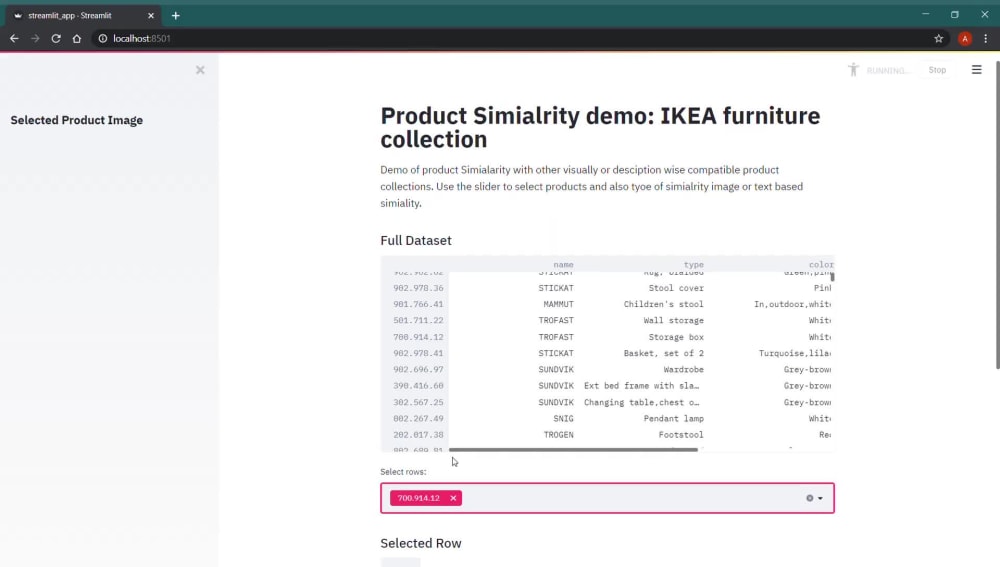
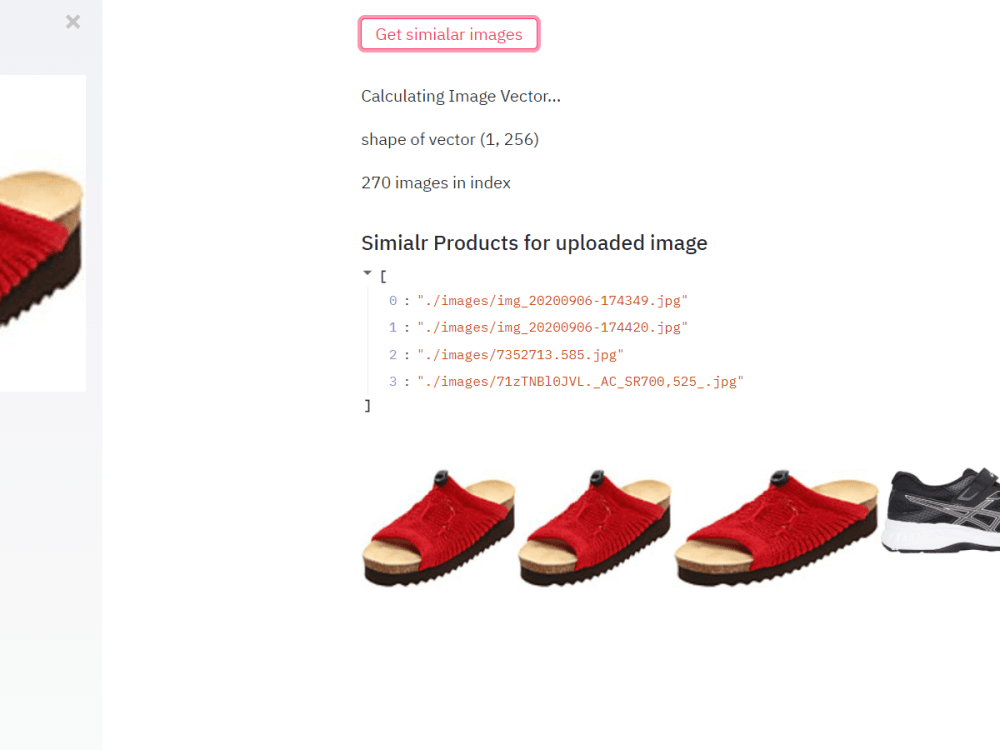
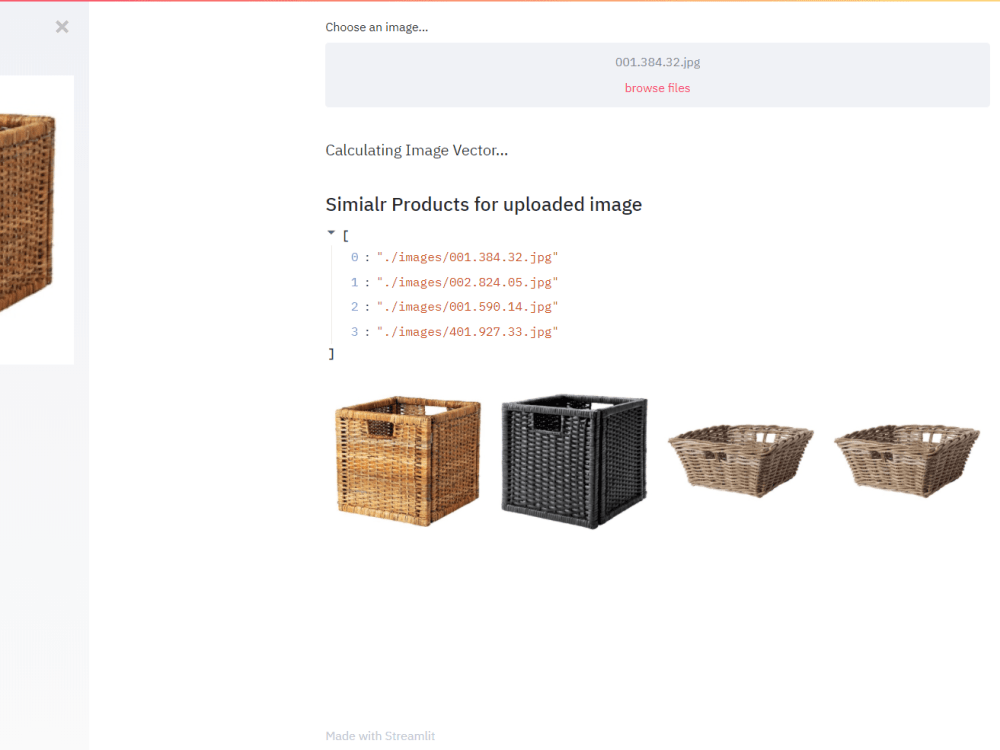
You will get an image retrieval tool with web UI using python and pinecone vector DB.
Top Rated
Top Rated
Project details
Our state-of-the-art Image Retrieval Tool offers an intuitive web UI designed to cater to a multitude of scenarios. Leveraging the prowess of the CLIP Model , this tool requires no prior training and assures optimal baseline performance right out of the box. Additionally, the system's flexibility allows for model finetuning tailored to specific domains for enhanced precision. For those seeking domain adaptation, we also support advanced neural network architectures such as Autoencoders and Siamese networks.
Main Features:
High-Quality Vectorization: Uses the CLIP models for superior image to vector conversion.
Extensive Database Support: The system is compatible with several leading vector databases including Pinecone, Milvus, Faiss, Annoy, and Elasticsearch.
Multi-domain Application: Suitable for diverse subdomains such as fashion, jewelry, real estate, art, and more.
Fast and Accurate Retrieval: Utilizes cosine similarity for prompt and precise image retrieval.
Flexible File Support: Accepts JPG and PNG images for both indexing and querying.
Seamless Integration: Built with a REST API framework for easy integration into web or mobile platforms.
Main Features:
High-Quality Vectorization: Uses the CLIP models for superior image to vector conversion.
Extensive Database Support: The system is compatible with several leading vector databases including Pinecone, Milvus, Faiss, Annoy, and Elasticsearch.
Multi-domain Application: Suitable for diverse subdomains such as fashion, jewelry, real estate, art, and more.
Fast and Accurate Retrieval: Utilizes cosine similarity for prompt and precise image retrieval.
Flexible File Support: Accepts JPG and PNG images for both indexing and querying.
Seamless Integration: Built with a REST API framework for easy integration into web or mobile platforms.
Machine Learning Tools
Keras, NumPy, OpenCV, Python, Python Scikit-Learn, PyTorch, scikit-learn, SciPy, TensorFlowWhat's included $500
These options are included with the project scope.
$500
- Delivery Time 5 days
- Number of Revisions 1
- Number of Model Variations 1
- Number of Scenarios 1
- Number of Graphs/Charts 1
Optional add-ons
You can add these on the next page.
Custom training
(+ 5 Days)
+$300
Extended Vector Database Integration
(+ 4 Days)
+$200Frequently asked questions
37 reviews
(34)
(3)
(0)
(0)
(0)
This project doesn't have any reviews.
YI
Yeonjun I.
Feb 4, 2026
ADO057 | AI Agent Failure Annotation (Full Project) (Abhilash)
MT
Md Mehrab T.
Oct 14, 2025
ADO057 | AI Agent Failure Annotation (Test Project)
LS
Lois S.
Sep 9, 2025
ADO057 | AI Agent Failure Annotation (Test Project)
TN
Tom N.
Aug 15, 2024
AI podcast web application
Would hire again. Great work.
ML
Martin L.
Aug 5, 2024
Job categories process and fixes to query endpoint
Abhilash was a capable and rock solid performer who was always available and happy to come back with amendments and suggestions. Highly recommended.
About Abhilash
Senior Agentic AI Engineer | Enterprise RAG & Production LLM Systems
100%
Job Success
Trivandrum, India - 4:27 am local time
✅ 9+ years in AI and machine learning engineering
✅ Upwork Top Rated with 100% Job Success
✅ Completed and delivered projects for global clients
✅ Ranked in the Top 10% of Kaggle competitors
✅ Worked with teams across the North America, Europe and East Asia
✅ Reduced manual review time by 50% and improved retrieval relevance by 35% in production.
My work includes enterprise architecture-review agents, regulated document-verification platforms, multimodal intake systems and source-grounded assistants that analyse complex files and return structured findings with citations.
CORE CAPABILITIES
• Multi-agent architecture and stateful orchestration
• Enterprise RAG, document intelligence and multimodal analysis
• Evaluation datasets, guardrails and regression testing
• FastAPI, PostgreSQL, pgvector and asynchronous processing
• Private LLM deployment with vLLM and Kubernetes
• Model routing, inference optimization and observability
Most AI systems do not fail because the model is incapable. They fail because nobody defines what a correct result looks like. I establish the evaluation dataset and acceptance criteria early, test releases against them, guard inputs, outputs and tool calls, and require human approval before consequential actions.
🧠 PRODUCTION MULTI-AGENT SYSTEMS
With LangGraph, I implement state machines, parallel specialist agents, conditional routing, retries, escalation, human checkpoints and PostgreSQL-backed persistence. A long-running job can resume from its last checkpoint instead of restarting after a failure.
I use the OpenAI Agents SDK for specialist handoffs, agents as tools, session memory, guardrails and tracing. I use Google ADK with Gemini and Vertex AI when the system must operate inside a client’s Google Cloud environment.
A system may include a coordinator, parallel specialists, a reducer that resolves conflicting findings, a citation verifier and a human-review gate for low-confidence decisions.
📚 ENTERPRISE RAG & DOCUMENT INTELLIGENCE
I build source-grounded systems over policies, presentations, contracts, technical submissions and scanned files.
Retrieval pipelines can include layout-aware OCR, structure-aware chunking, dense embeddings, BM25, Reciprocal Rank Fusion, cross-encoder reranking, page-level citations and abstention when evidence is weak.
Hybrid retrieval finds both semantic meaning and exact identifiers such as clause numbers, batch numbers, product codes and case IDs that pure vector search can miss.
🚀 PRIVATE LLM DEPLOYMENT & OPTIMIZATION
I deploy LLMs through managed providers, private cloud and self-hosted GPU infrastructure. This includes vLLM on Kubernetes, OpenAI-compatible endpoints, model routing, streaming, batching, asynchronous processing, retries, circuit breakers, caching and token, latency and cost monitoring.
I select models based on measured quality, privacy, latency and cost instead of using the largest model for every task.
🛡️ EVALUATION, GUARDRAILS & RELIABILITY
I make AI applications measurable and reliable through:
• Failure taxonomies built from production traces
• Golden datasets with expected answers and source spans
• Retrieval, groundedness and citation evaluation
• CI regression tests and structured-output validation
• Hallucination, contradiction and prompt-injection testing
• Repair, retry, fallback, escalation and safe-refusal paths
• Token, cost and latency dashboards
📌 SELECTED EXPERIENCE
REGULATED DOCUMENT VERIFICATION
Built a hybrid retrieval system combining OCR, layout parsing, dense search, BM25, Reciprocal Rank Fusion and reranking. LangGraph agents reviewed technical submissions in parallel and returned evidence-backed findings. A private 32B model ran on Kubernetes through vLLM because documents could not leave the network.
ENTERPRISE GOVERNANCE INTAKE
Developed a FastAPI and LangGraph platform that checks submissions against internal standards and returns structured findings with evidence. It includes persistent state, parallel review, retries, escalation, human checkpoints, multimodal analysis and pluggable guardrails.
🔌 WORKFLOW & SYSTEM INTEGRATION
When an AI system needs Gmail, Google Calendar, Drive, Slack, CRM or internal-system connectivity, I use APIs, webhooks, n8n or custom Python services. n8n is an optional integration layer. Critical reasoning and validation remain in testable, version-controlled Python.
STACK
Python, FastAPI, LangGraph, OpenAI Agents SDK, Google ADK, Gemini, Claude, Azure OpenAI, n8n, PostgreSQL, pgvector, Redis, Docker, Kubernetes, vLLM, Langfuse, OpenTelemetry, AWS, Azure, GCP and Vertex AI.
Send me what is slow, unreliable or difficult to scale. I will respond with a practical architecture, an honest estimate and a clear recommendation.
Steps for completing your project
After purchasing the project, send requirements so Abhilash can start the project.
Delivery time starts when Abhilash receives requirements from you.
Abhilash works on your project following the steps below.
Revisions may occur after the delivery date.
Specify the domain and requirements with sample data
We can discuss the requirement and explore the sample data to see which is the best course of action. We can decide whether we can use our pre-trained models or train new models s-0pecifically for the domain.
Give the image data or image samples to test the retrieval model
Fo testing the model and adjusting the parameters sample data is required