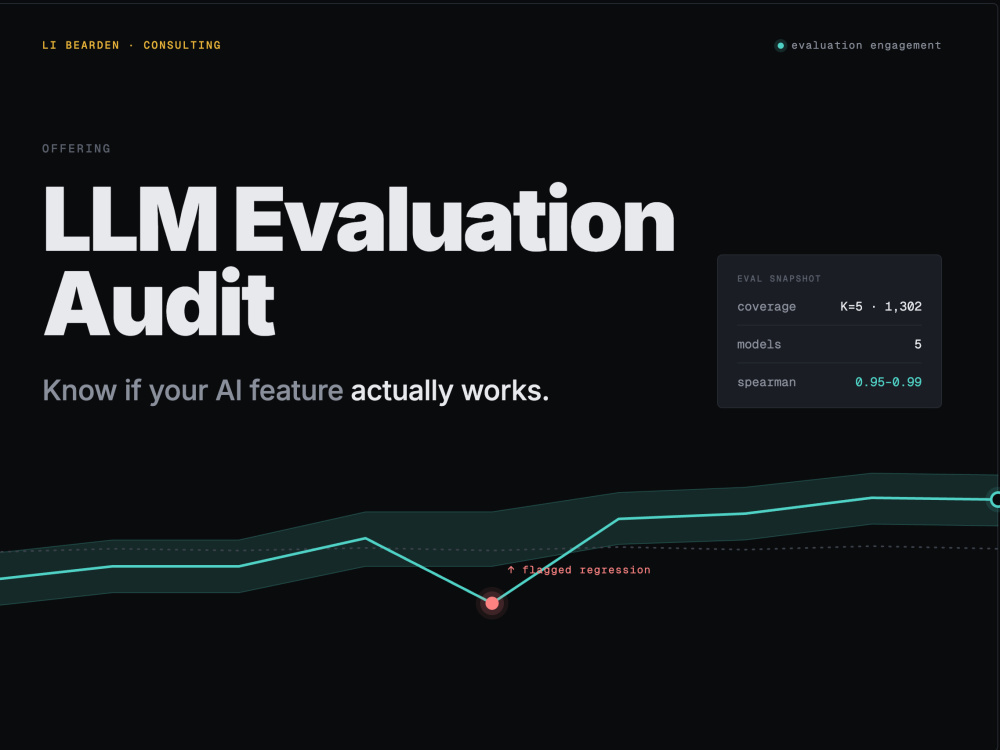
You will get an LLM Evaluation Audit: know if your AI feature actually works
Rising Talent
Project details
You've shipped an LLM feature — but can you tell if it's getting better or worse? Most teams can't. Prompt tweaks and model swaps go out on vibes, and quality regressions surface as customer complaints.
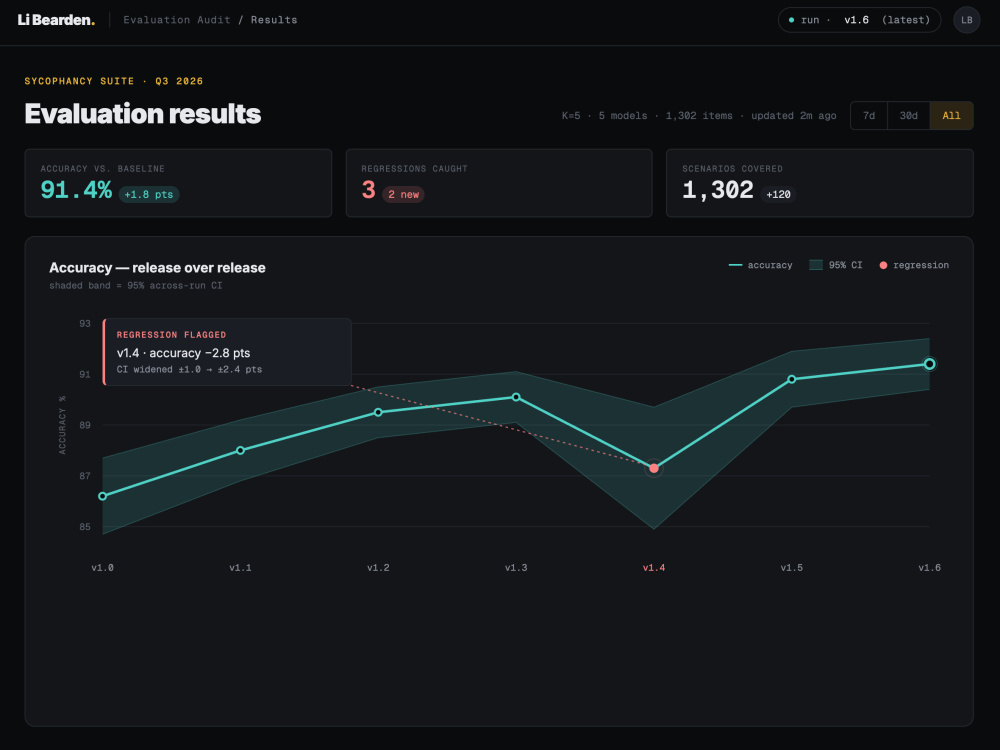
I'll build you an evaluation framework that fixes that: a benchmark suite matched to your actual use case, regression tests that catch quality drops before deploys, and metrics your whole team can read. Every configuration is measured across K=5 independent runs with real confidence intervals — so genuine changes separate from run-to-run noise, and you never ship noise as signal.
Why me: five years of production AI engineering at Deepgram (150+ enterprise deployments, including air-gapped on-prem systems), and my current research audits the reliability of published LLM benchmarks — arXiv preprint, August 2026. I know exactly where eval numbers lie and how to build ones that don't.
Works for chatbots, RAG systems, agents, voice AI, and classification pipelines. Python-based, framework-agnostic, and you keep everything: code, docs, metrics, tests. No vendor lock-in, no black box.
I'll build you an evaluation framework that fixes that: a benchmark suite matched to your actual use case, regression tests that catch quality drops before deploys, and metrics your whole team can read. Every configuration is measured across K=5 independent runs with real confidence intervals — so genuine changes separate from run-to-run noise, and you never ship noise as signal.
Why me: five years of production AI engineering at Deepgram (150+ enterprise deployments, including air-gapped on-prem systems), and my current research audits the reliability of published LLM benchmarks — arXiv preprint, August 2026. I know exactly where eval numbers lie and how to build ones that don't.
Works for chatbots, RAG systems, agents, voice AI, and classification pipelines. Python-based, framework-agnostic, and you keep everything: code, docs, metrics, tests. No vendor lock-in, no black box.
What's included
| Service Tiers |
Starter
$1,500
|
Standard
$4,500
|
Advanced
$9,000
|
|---|---|---|---|
| Delivery Time | 5 days | 14 days | 28 days |
Number of Revisions | 1 | 2 | 2 |
Number of Model Variations | 1 | 2 | 4 |
Number of Scenarios | 1 | 3 | 6 |
Number of Graphs/Charts | 2 | 4 | 8 |
Model Validation/Testing | - | ||
Model Documentation | |||
Data Source Connectivity | |||
Source Code | - |
Optional add-ons
You can add these on the next page.
Fast Delivery
+$500 - $2,500
Team walkthrough session (60 min)
+$300Frequently asked questions
About Li
Voice AI & LLM Evaluation | Ex-Deepgram, 5 Yrs Production ML
Portland, United States - 7:28 pm local time
Five years as an Applied AI Engineer at Deepgram, where I supported 150+ enterprise voice deployments from integration through production. Now independent, I focus on two things:
Voice AI & ASR: production speech pipelines, API integration, latency and accuracy tuning, custom model strategy. If it involves getting speech in or out of a system reliably at scale, I've probably debugged it.
LLM evaluation: most teams ship LLM features with no way to know if they're getting better or worse. I design evaluation frameworks that fix that; benchmark design, regression testing, reliability audits, hallucination and failure-mode detection. My current research (arXiv preprint, August 2026) audits the run-to-run reproducibility of published LLM benchmarks, so I know exactly where eval numbers lie to you and how to build ones that don't.
I work best with teams who have something running but need it to be more reliable, more measurable, or easier for the rest of the organization to use: short, well-scoped engagements over open-ended retainers.
Typical engagements: eval framework design and implementation · voice AI integration and rescue · production readiness audits · team training and workshops (materials included).
Steps for completing your project
After purchasing the project, send requirements so Li can start the project.
Delivery time starts when Li receives requirements from you.
Li works on your project following the steps below.
Revisions may occur after the delivery date.
Step 1 — Scope & intake
Review your feature, examples, and pipeline access; confirm scenario families and what the gate should measure.
Step 2 — Scenario suite
Turn your examples into a versioned test suite with explicit expected behaviors, tracked in git.