You will get An LLM running inside your own infrastructure, with no data leaving
Project details
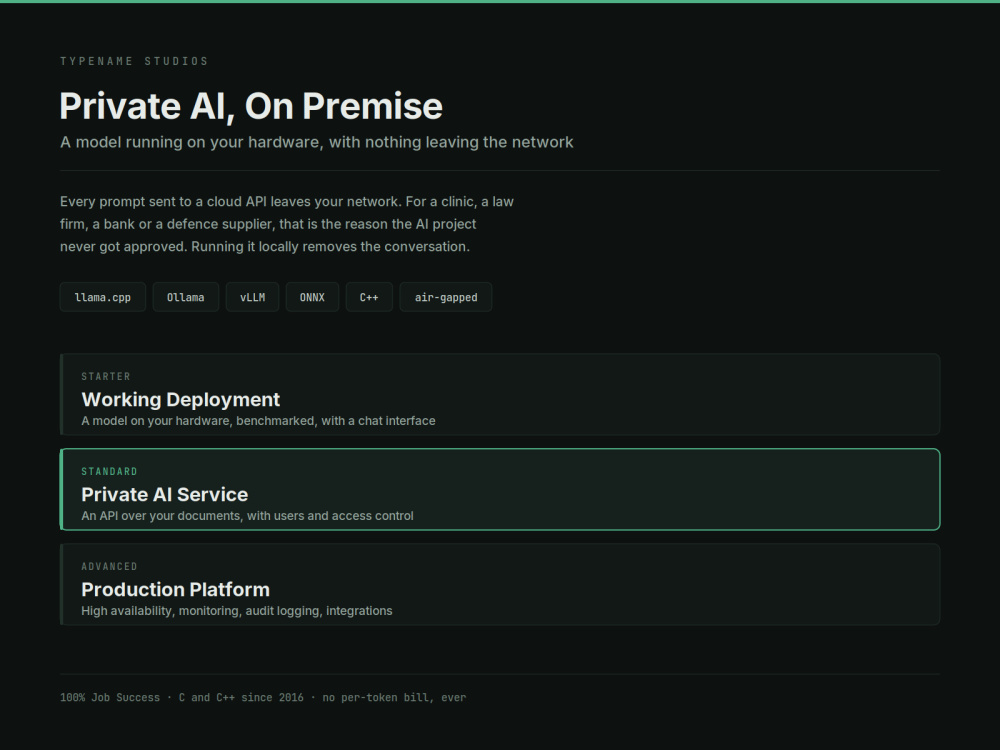
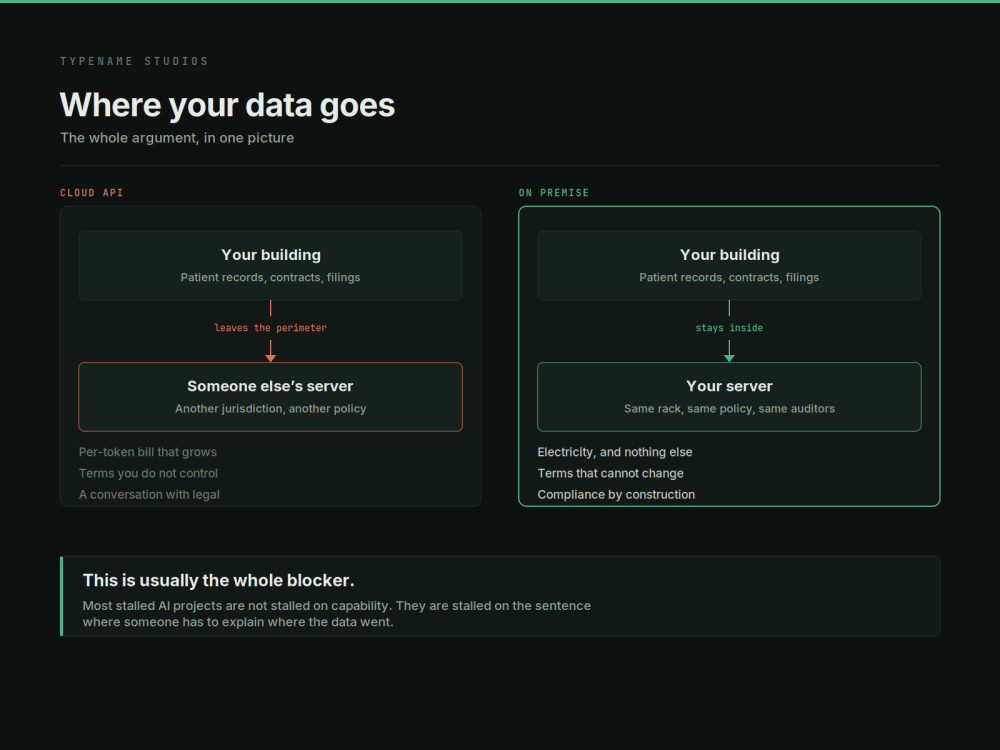
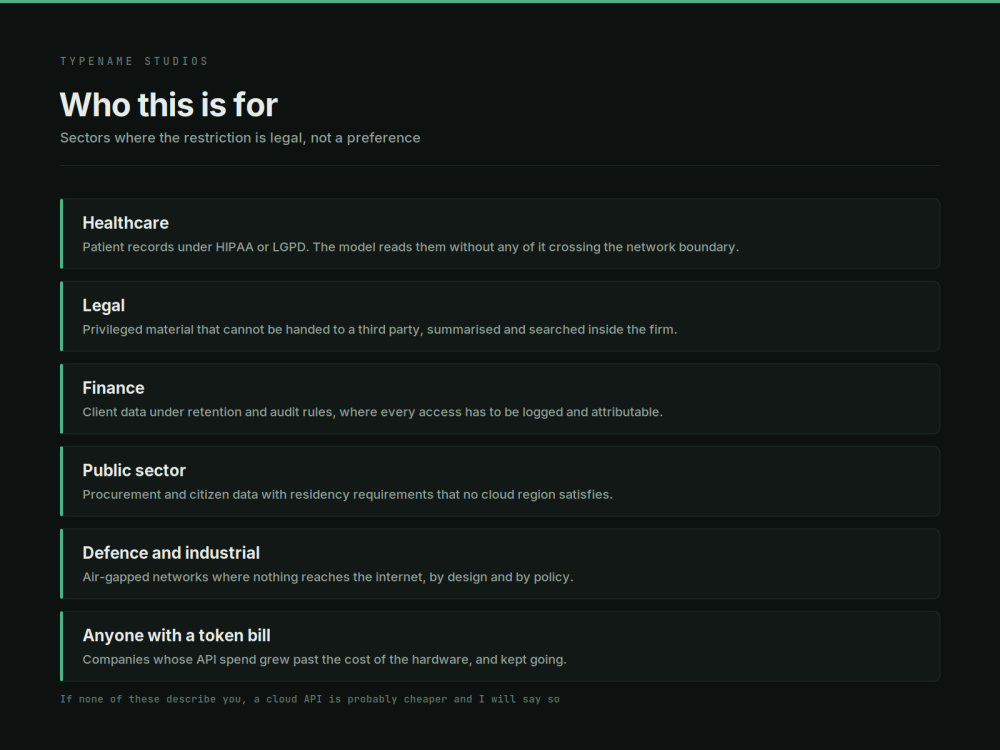
Every prompt sent to a cloud API leaves your network. For most companies that is a shrug. For a clinic, a law firm, a bank or a defence supplier, it is the reason the AI project never got approved.
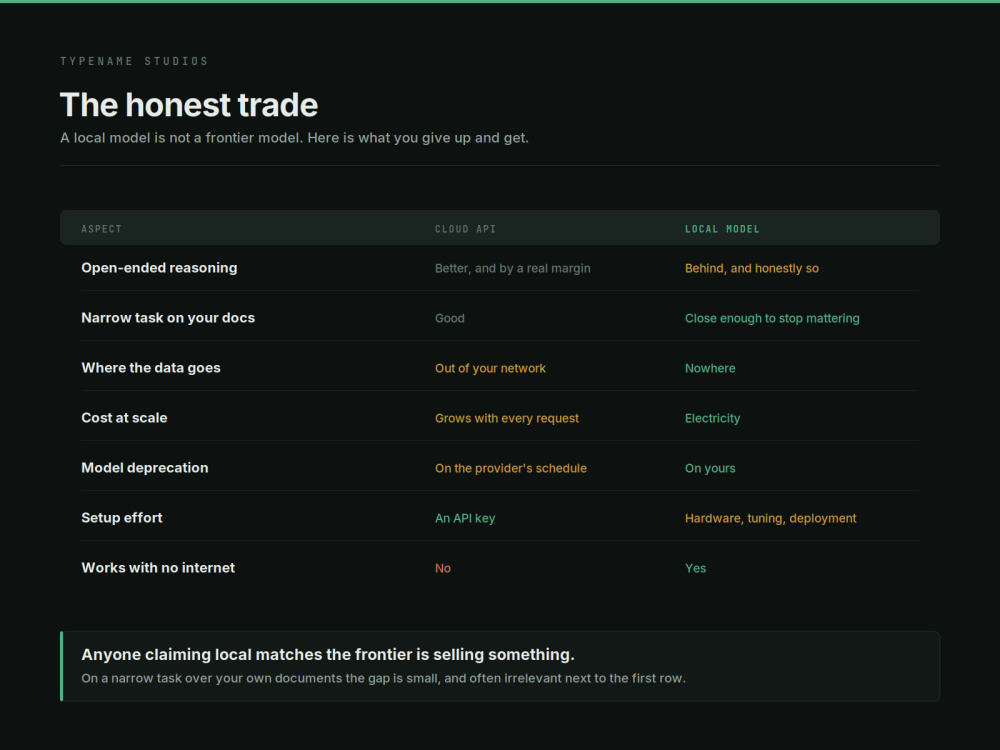
This puts the model inside your own perimeter instead. Model selection matched to the hardware you have, quantized and served at a speed people will tolerate, behind a chat interface or an API your team can reach. On the larger packages it answers over your own documents, citing the source of each answer, with logins, access control and an audit trail. The data never leaves, the per-token bill disappears, and no provider can deprecate a model you built on.
Most people offering this call an API. Local inference lives a layer below that, in C and C++, where I have worked since 2016. That is why the numbers you get are measured on your machine rather than copied from a model card, and why the deployment ends up fast enough to be used instead of technically working and quietly abandoned.
You get the deployment, the configuration and written operating documentation. It runs on your hardware, your team can maintain it, and it keeps running if you never speak to me again.
This puts the model inside your own perimeter instead. Model selection matched to the hardware you have, quantized and served at a speed people will tolerate, behind a chat interface or an API your team can reach. On the larger packages it answers over your own documents, citing the source of each answer, with logins, access control and an audit trail. The data never leaves, the per-token bill disappears, and no provider can deprecate a model you built on.
Most people offering this call an API. Local inference lives a layer below that, in C and C++, where I have worked since 2016. That is why the numbers you get are measured on your machine rather than copied from a model card, and why the deployment ends up fast enough to be used instead of technically working and quietly abandoned.
You get the deployment, the configuration and written operating documentation. It runs on your hardware, your team can maintain it, and it keeps running if you never speak to me again.
AI Development Type
Deep Learning, Knowledge Representation, Model Tuning, Software MaintenanceAI Tools
MLflow, NVIDIA AI Platform, Open Neural Network Exchange, PyTorchAI Development Language
C++What's included
| Service Tiers |
Starter
$1,100
|
Standard
$2,800
|
Advanced
$5,500
|
|---|---|---|---|
| Delivery Time | 10 days | 20 days | 30 days |
Number of Revisions | 1 | 2 | 3 |
AI Model Integration | |||
Detailed Code Comments | - | ||
Knowledge Graph | - | - | - |
Model Documentation | |||
Ontology | - | - | - |
Source Code | |||
Taxonomy | - | - | - |
Optional add-ons
You can add these on the next page.
Fast Delivery
+$480 - $2,400
Additional Revision
+$250
Fine-tuning on your data
(+ 10 Days)
+$1,800
Speech to text, offline
(+ 7 Days)
+$900
Compliance documentation
(+ 5 Days)
+$600Frequently asked questions
7 reviews
(7)
(0)
(0)
(0)
(0)
This project doesn't have any reviews.
HW
Huitong W.
Jun 16, 2025
C++ Game Development
Very good Developer!
HW
Huitong W.
Oct 20, 2024
Next Game Development
Very Good
HW
Huitong W.
Jul 1, 2024
Implement NavPower in GameEngine.
HW
Huitong W.
May 14, 2024
C++ game Development
Very good developer.
We are about to start more contracts.
We are about to start more contracts.
CG
Chris G.
Mar 8, 2024
Desktop .EXE Application Development for Data Simulator
Was a pleasure working with Francisco! A+++ work and was able to help develop our application very quickly and effectively. Would highly recommended!
About Francisco
Security & Systems Engineer | C/C++, Anti-Cheat, Infrastructure
100%
Job Success
Novo Hamburgo, Brazil - 9:59 am local time
What I do for clients falls into four areas. Game integrity: anti-cheat detection built on behaviour rather than signatures, client-side and server-side, with the evidence behind every flag. Native engineering: C++17 and C++20 systems, stable C ABI layers and language bindings, legacy modernization, and the profiling to prove a change actually helped. Security: application and infrastructure audits ranked by what an attacker can reach rather than by a generic score. Infrastructure: VMware assessment, migration planning to Proxmox or Hyper-V, and backup designs that get tested instead of assumed.
Different domains, same question underneath. What breaks, under what conditions, and who pays for it when it does. That is the question I am useful for, whether the answer lives in a memory allocator, a permission model or a renewal quote.
I also build products under TypeName Studios, which is where that standard comes from. Praetor is a game integrity platform with a C++ SDK that links into the game server and runs statistical detectors without a kernel driver or a client agent. Ethereal is the C++ middleware underneath everything I ship, thirty one modules exposed through a C ABI so it embeds into non-C++ codebases. Living with those architectural decisions for years changes how you make them.
I ask the hard questions before writing a line of code, because the wrong architecture costs far more than the wrong syntax. You get direct communication, realistic timelines, and code your team can still read a year from now. Tell me what you are trying to build and I will tell you straight whether I am the right person for it.
Steps for completing your project
After purchasing the project, send requirements so Francisco can start the project.
Delivery time starts when Francisco receives requirements from you.
Francisco works on your project following the steps below.
Revisions may occur after the delivery date.
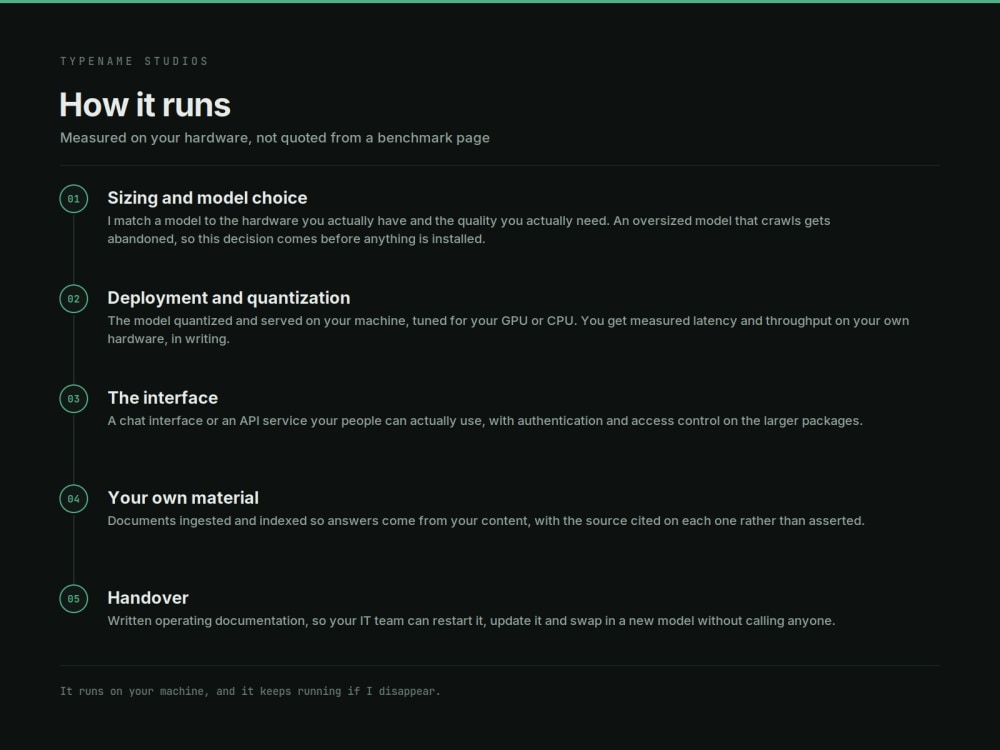
Sizing and model choice
I match a model to the hardware you actually have and the quality you actually need. Oversized models that crawl get abandoned, so this decision comes before anything is installed.
Deployment and quantization
The model quantized and served on your machine, tuned for your GPU or CPU. You get measured latency and throughput on your own hardware, not numbers from a benchmark page.